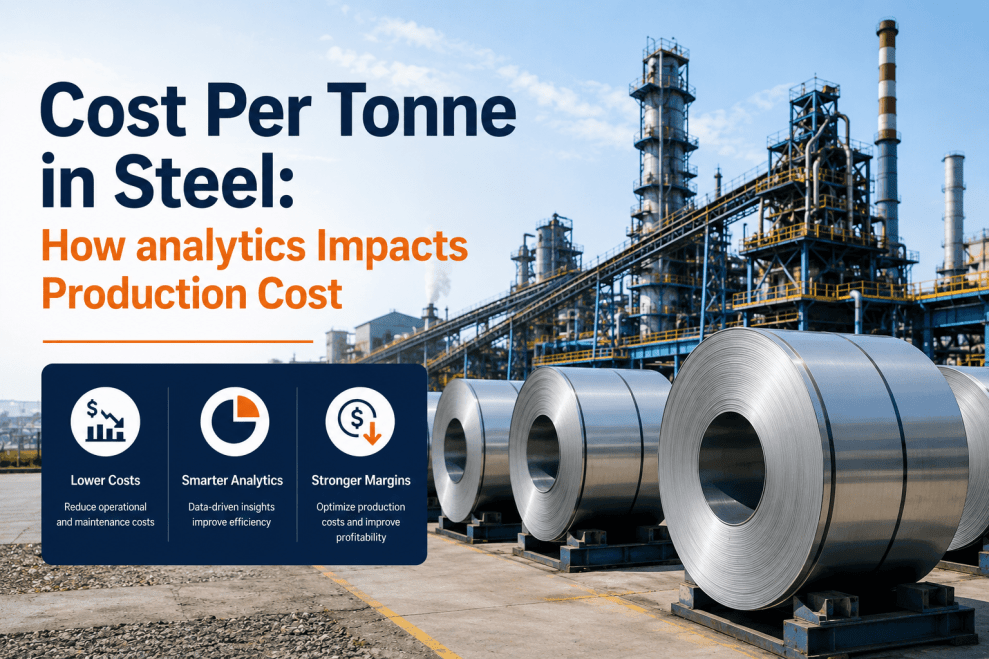
In fast-growing steel markets, moving product from plant to project site is as critical as producing it. Yet most steel plants invest heavily in production equipment maintenance while treating logistics assets — rail cars, torpedo ladles, forklifts, weighbridges, and packaging lines — as afterthoughts. The result is predictable: a $300-million production line runs at 95% availability while a $50,000 forklift or a $200,000 weighbridge creates a dispatch bottleneck that idles the entire output chain. Steel plants that track logistics equipment failures find that 18–22% of all dispatch delays originate not from production issues but from transport and loading equipment breakdowns. iFactory's Analytics Dashboard and Downtime Tracking connects production availability to dispatch performance — revealing the hidden maintenance gaps that cost steel plants $2–8 million annually in delayed deliveries and contractual penalties.
How Poor Analytics Creates Logistics Bottlenecks in Steel Plants
Learn how maintenance failures in logistics equipment create costly delivery bottlenecks — and how iFactory connects production to dispatch.
How a Single Equipment Failure Cascades into a Delivery Crisis
Logistics failures are invisible in production KPIs until they hit the customer. The cascade from a single forklift breakdown to a missed delivery follows a predictable 5-step chain — and each step multiplies the cost. See how iFactory breaks this chain.
Equipment Fails
Forklift, weighbridge, or rail car breaks down.
Loading Stops
Steel stuck — queue builds in yard.
Window Missed
Trucks idle. Demurrage charges start.
Deadline Breached
Contractual penalty triggers.
Revenue Lost
$25K+ penalty. Customer trust eroded.
The Hidden Cost of Ignoring Logistics Maintenance
Contractual Penalties
Late delivery charges on construction steel, auto-grade coil, and pipe orders.
Demurrage & Idle Vehicles
Trucks and rail wagons waiting at the plant because loading equipment is down.
Emergency Repair Premiums
Expedited parts, overtime labour, weekend callouts for logistics equipment.
Inventory Holding Cost
Finished steel sitting in plant yard because dispatch chain is broken.
Reactive vs Predictive — The Logistics Maintenance Gap
iFactory Technology That Closes the Logistics Gap
AI Camera Vision
Thermal imaging on torpedo ladles and visual inspection on packaging lines — detecting refractory hotspots and strapping failures in real time.
AI Digital Twin
Per-asset models predict remaining life on refractory linings, wheel bearings, hydraulic seals, and drive motors — auto-scheduling replacements.
PLC & OBD Integration
Rail car PLC data and forklift OBD diagnostics feed into iFactory — continuous health monitoring without manual inspection rounds.
SAP PM + Dispatch Link
Maintenance alerts link directly to dispatch scheduling — so the operations team sees equipment-driven delivery risks before they become customer-facing delays.
What a Logistics Planning Manager Said
For years we blamed production for late deliveries. iFactory's downtime tracking showed that 19% of our dispatch delays came from logistics equipment failures we never tracked. Once we saw the data, the fix was straightforward — and our on-time delivery rate went from 81% to 96% in 8 months.
On-Time Delivery Improvement — 3-Phase Roadmap
Visibility
Prevention
Optimisation
Frequently Asked Questions
How much do logistics equipment failures really cost a steel plant?
$2–8 million annually in penalties, demurrage, emergency repairs, and inventory holding. Most plants undercount because they don't track logistics downtime separately.
Can iFactory link maintenance data to dispatch performance?
Yes — the analytics dashboard correlates equipment downtime events with dispatch delay records, revealing the exact maintenance-to-delivery failure chain. See the dashboard.
What is the fastest way to reduce logistics bottlenecks?
Start by tracking downtime on the 5 highest-impact logistics assets. iFactory identifies these within the first 30 days of deployment.
Does iFactory work for both integrated and mini-mill operations?
Yes — fleet management and dispatch analytics scale from 20-asset mini-mills to 500+ asset integrated plants with identical platform configuration.
Connect Maintenance to Dispatch with iFactory
First bottleneck identified in 30 days.