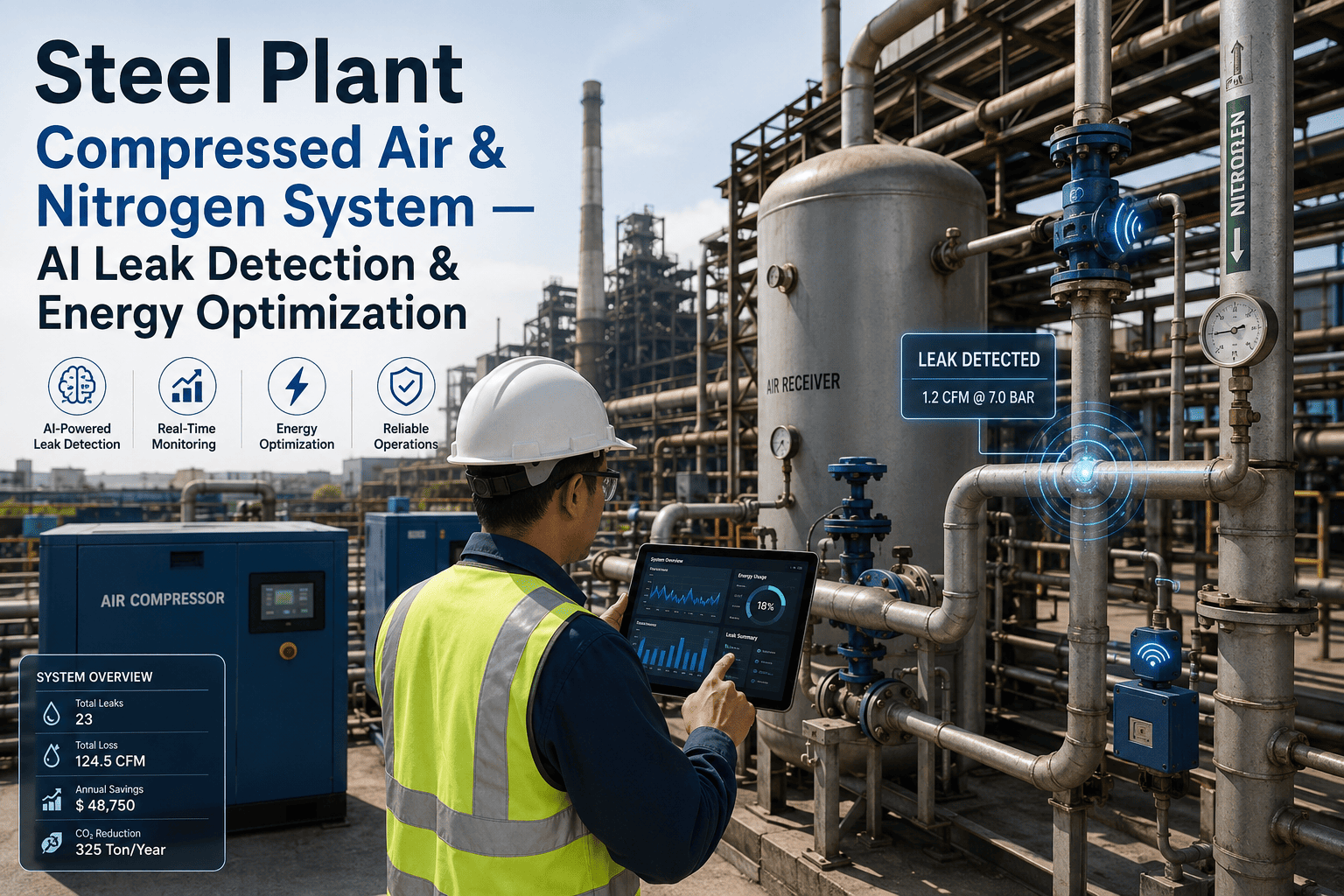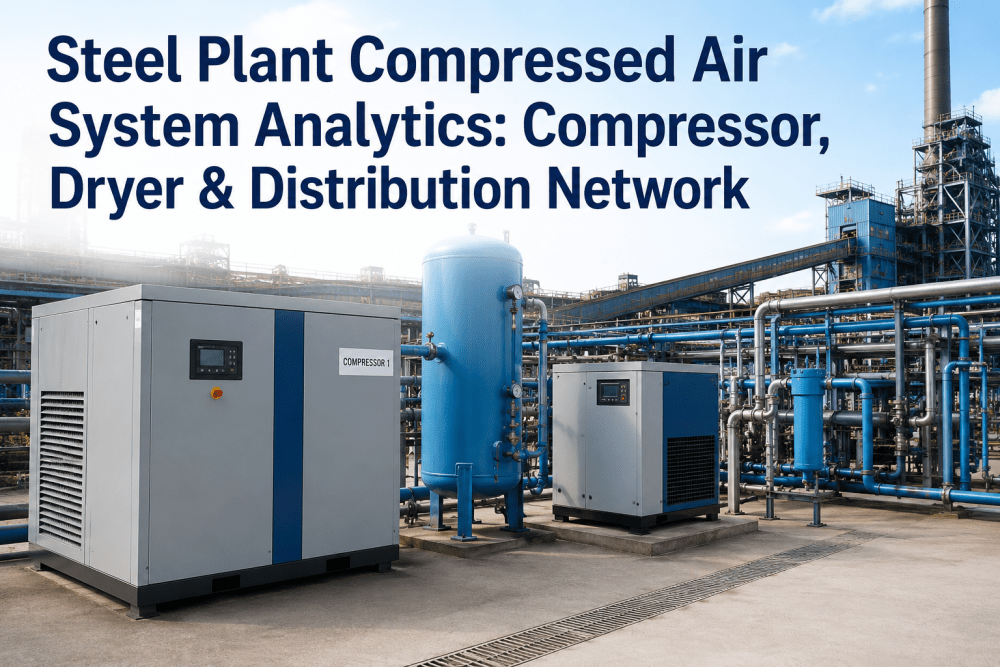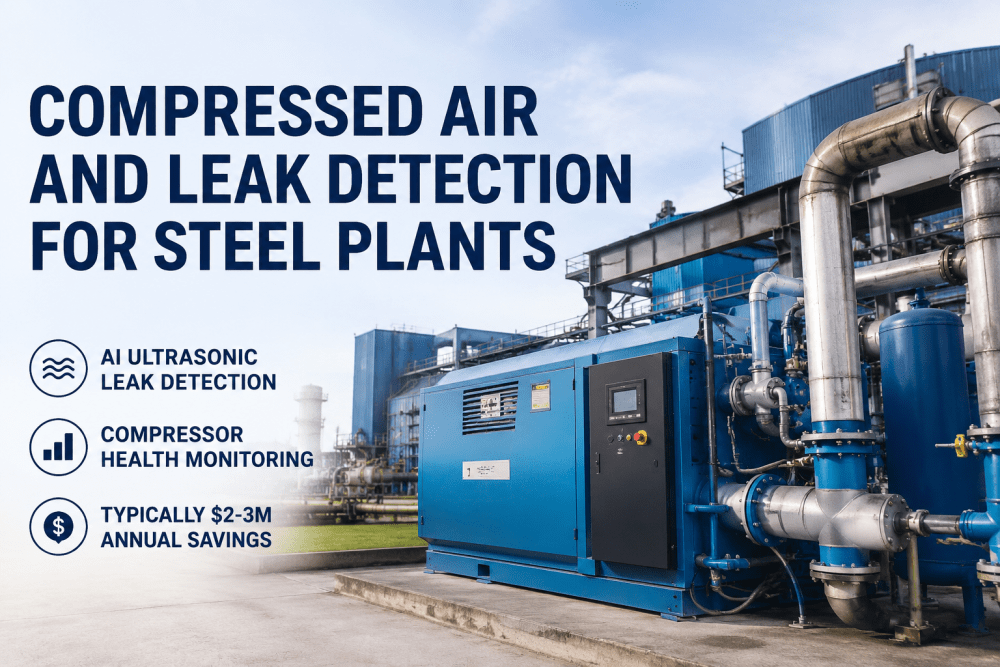
Compressed air systems in integrated steel mills represent one of the largest single electricity consumption categories — typically 10 to 15 percent of total plant electrical load — yet they receive substantially less analytical attention than rolling mill drives, furnace power systems, or material handling electrification. The reason is structural: compressed air is distributed across dozens of production buildings through networks that span miles of piping, serving applications ranging from instrument air and pneumatic controls to soot blowing, baghouse cleaning, and process cooling. A single unaddressed leak at 100 psi through a 1/4-inch orifice wastes approximately $8,000 to $12,000 per year in electricity cost alone — and most integrated mills carry hundreds of unaddressed leaks at any given time. AI ultrasonic leak detection combined with continuous compressor health monitoring represents the first analytical approach that addresses both sides of the compressed air cost equation simultaneously: the demand-side waste from uncontrolled leaks and the supply-side efficiency of the compressor plant itself. This guide covers the complete compressed air analytics methodology for steel plant operations and how iFactory AI's platform delivers continuous, automated performance monitoring that utility managers and plant engineers have not had access to with traditional manual survey approaches.
The Real Cost of Compressed Air Inefficiency in Integrated Steel Mills
The true cost of compressed air in a steel mill is not the electricity bill from the compressor plant alone. It is the combination of generation cost, distribution loss from leaks, pressure degradation at end-use points, and the maintenance cost of keeping undersized or poorly sequenced compressors online to compensate for system losses. Most integrated mills operate with a specific energy consumption (SEC) of 0.12 to 0.18 kWh per standard cubic meter of compressed air delivered. Mills that have systematically addressed leaks and optimized compressor sequencing operate at 0.07 to 0.09 kWh per standard cubic meter — a 35 to 50 percent efficiency improvement that is achievable without replacing a single compressor in most plants. The gap between the mill's actual SEC and its achievable SEC is the direct measure of compressed air waste, tracked continuously by iFactory's platform and converted into a dollar figure per shift that makes the efficiency opportunity visible to operations and finance teams alike. Book a Demo to Start Measuring
- Leak surveys conducted annually or semi-annually — leaks that develop between surveys go undetected for months
- Compressor sequencing managed by fixed pressure bands with no demand prediction capability
- SEC tracked at plant level on a monthly basis — efficiency losses invisible at shift resolution
- Compressor maintenance scheduled on calendar intervals or run-hour targets regardless of actual condition
- Pressure setpoints configured for worst-case demand scenarios, keeping all units loaded unnecessarily
- Oil analysis and vibration data collected but analyzed in isolation with no cross-correlation between data sources
- Continuous ultrasonic leak detection with real-time leak location mapping — new leaks flagged within hours of formation
- AI compressor sequencing based on demand prediction models that anticipate load changes before they occur
- SEC tracked per compressor per shift with automated anomaly detection and efficiency benchmarking
- Condition-based maintenance triggered by vibration trend shifts, temperature signatures, and oil condition analytics
- Dynamic pressure band management that adjusts setpoints in real time based on actual demand profile
- Unified health model integrating pump data, oil analysis, vibration, and thermal data into a single equipment score
AI Ultrasonic Leak Detection — Continuous Monitoring vs. Manual Surveys
Manual ultrasonic leak detection surveys — conducted annually or semi-annually by a technician walking the distribution network with a handheld detector — identify a fraction of total leaks and provide no visibility into leak progression between surveys. A leak that develops the day after the survey completes goes undetected for up to 12 months, wasting energy every hour of every shift until the next survey identifies it. AI ultrasonic leak detection replaces the periodic survey model with continuous monitoring: fixed ultrasonic sensors deployed at strategic intervals along the distribution network, feeding acoustic data to iFactory's AI engine that classifies each event as a leak, a false positive, or normal operating noise, and maps the leak location within the piping network for targeted repair. Schedule a Leak Detection Audit
Compressor Health Analytics — AI Monitoring for Screw and Centrifugal Units
Compressor reliability is the foundation of any compressed air efficiency program — a failing compressor that consumes 15 percent more energy than its healthy baseline offsets every leak repair dollar saved on the distribution side. iFactory's compressor health analytics module applies separate monitoring models for screw and centrifugal compressor types, each calibrated to the failure modes and performance degradation patterns specific to that technology class. The platform ingests data from the compressor control panel, vibration sensors, oil analysis reports, and thermal imaging to build a unified health score for each unit — updated in real time and trended across the full equipment lifecycle. Book a Compressor Health Assessment
Rotary screw compressors — the most common compressor type in steel mill applications below 3,000 CFM — degrade through rotor wear, oil system degradation, and bearing fatigue. iFactory's screw compressor monitoring model tracks five primary degradation indicators continuously: discharge temperature trend relative to baseline, air-end temperature differential, oil pressure and temperature profiles, vibration velocity at rotor pass frequency, and drive motor current signature. The AI model correlates these indicators to predict remaining useful life of the air-end, recommend oil change timing based on actual condition rather than calendar intervals, and detect incipient bearing failure 3 to 6 weeks before vibration levels reach alarm thresholds. The most significant savings from screw compressor AI monitoring typically come from eliminating oil changes performed on fixed schedules that replace oil with 40 to 60 percent of its useful life remaining — a pattern iFactory has documented in 80 percent of steel mill screw compressor installations during initial deployment.
Centrifugal compressors — the preferred technology for steel mill baseload applications above 5,000 CFM — fail through different mechanisms: surge events, impeller fouling, thrust bearing wear, interstage seal degradation, and gearbox component fatigue. iFactory's centrifugal compressor monitoring model tracks surge margin in real time, analyzing the approach to the surge line under varying inlet conditions and discharge pressures. Impeller fouling rate is estimated from stage pressure ratio trends — a declining pressure ratio at constant speed indicates fouling buildup that, if unaddressed, reduces stage efficiency by 3 to 6 percent before visible performance loss triggers operator attention. Thrust bearing condition is assessed through axial position monitoring combined with vibration at the bearing housing. For gearbox-driven centrifugal units, gear mesh frequency vibration and oil analysis solids content are correlated to predict gear wear progression and enable planned gearbox overhauls rather than emergency replacements triggered by tooth fracture events.
| Equipment Asset | iFactory Monitoring Parameters | Failure Mode Detected | Warning Lead Time | Estimated Avoided Cost / Event |
|---|---|---|---|---|
| Screw Compressor Air-End | Discharge temperature trend, air-end delta-T, vibration at rotor pass frequency, motor current draw | Rotor wear, bearing spalling, oil carryover, screw contact | 4–8 weeks | $85,000–$180,000 |
| Centrifugal Compressor Thrust Bearing | Axial shaft position, bearing metal temperature, thrust-side vibration envelope, oil drain temperature | Babbitt wear, thrust collar damage, lubrication starvation | 6–12 weeks | $120,000–$260,000 |
| Centrifugal Compressor Surge Protection | Inlet pressure and temperature, discharge pressure, stage flow rate, anti-surge valve position | Surge cycle onset, impeller stall, diffuser fouling | 2–6 weeks | $75,000–$160,000 |
| Screw Compressor Oil System | Oil pressure delta across filter, oil temperature profile, oil analysis particle count and viscosity | Filter bypass, oil degradation, cooler fouling, seal leakage | 2–4 weeks | $35,000–$90,000 |
| Compressor Drive Motor (Screw and Centrifugal) | Motor current signature, winding temperature, vibration at motor bearing frequencies, power factor | Winding insulation degradation, bearing failure, rotor bar cracking, misalignment | 4–10 weeks | $55,000–$130,000 |
| Dryer and Filter Bank System | Pressure drop across dryer, dew point temperature, condensate drain cycle count, filter delta-P trend | Desiccant degradation, pre-filter saturation, drain valve failure, heat exchanger fouling | 2–5 weeks | $20,000–$50,000 |
Expert Perspective: What AI Changes in Compressed Air Management
We had been running our compressed air plant the same way for fourteen years — three centrifugal units and four screw compressors sequenced by a pressure-based controller that cycled units on and off based on header pressure alone. We had annual leak surveys from an external contractor, and we changed oil and filters on every compressor based on the manufacturer's recommended intervals. The initial iFactory deployment showed us three things in the first 30 days that changed how we operate the entire system. First, we had 187 active leaks in the distribution network that the last contractor survey had identified 43 of. The 144 undetected leaks were costing us approximately $340,000 per year in wasted electricity. Second, our sequencing strategy was keeping two compressors loaded against each other in a pressure band overlap on every shift, wasting 8 percent of total compressor power. Third, we were changing oil in all seven compressors on the manufacturer's 2,000-hour schedule when oil analysis showed that four of the seven could safely run to 4,000 hours and one was degrading at 1,200 hours and needed a shorter interval. That single finding — one compressor with accelerated oil degradation that we had been running to 2,000 hours — had been causing accelerated air-end wear that would have resulted in a $140,000 rebuild within the next year. The AI caught it at 1,100 hours. The annual savings from all three findings exceeded the platform cost by a factor of four in the first year.
Integrated Air System Optimization with iFactory Compressed Air AI
The full value of compressed air analytics is realized when leak detection, compressor health monitoring, and system-level optimization operate as a single integrated intelligence layer rather than separate point solutions. iFactory's Compressed Air AI platform combines these three capabilities into a unified system that manages the entire compressed air network — from compressor inlet to end-use point — as a single controllable asset. The platform's system-level optimization engine continuously balances supply-side output against demand-side consumption, adjusting compressor sequencing, pressure setpoints, and leak repair prioritization in response to actual plant conditions rather than fixed parameters set during a single annual optimization study. Book a Full System Audit
Frequently Asked Questions: Compressed Air AI for Steel Plants
iFactory requires access to the compressor control system data stream — which in most modern compressor plants is available through the unit's PLC or integrated controller via Modbus TCP, OPC-UA, or BACnet. Ultrasonic sensor gateways connect to the plant network over standard Ethernet or wireless mesh. No new historian infrastructure is needed. A data readiness assessment is available at no cost to determine connectivity requirements for your specific compressor plant configuration before any commitment.
The AI model is trained on acoustic signatures from steel mill compressed air environments, learning to distinguish the ultrasonic frequency profile of an orifice leak from pneumatic cylinder exhaust, air knife operation, material handling impacts, and other background noise. The model uses frequency band analysis, time-domain pattern recognition, and sensor correlation — a genuine leak is detected by multiple sensors with a consistent time-of-flight differential, while localized noise events are picked up by a single sensor without the propagation pattern characteristic of a continuous leak.
Yes. iFactory's compressor monitoring module is manufacturer-agnostic and supports any compressor equipped with a PLC or controller that exposes key operating parameters — discharge temperature, pressure, flow, vibration, and oil condition data. The platform maintains separate health models for screw and centrifugal compressor types, applied at the individual unit level regardless of make or model. Mills with mixed fleets from Atlas Copco, Ingersoll Rand, Sullair, Kaeser, Cameron, and Siemens have been integrated into a single iFactory instance with no compatibility issues.
iFactory integrates with plant SCADA, DCS, and energy management platforms through standard industrial communication protocols including OPC-UA, Modbus TCP, MQTT, and REST API interfaces. The platform publishes compressed air performance data — SEC, leak status, compressor health scores, and savings metrics — to existing dashboards and historians so the compressed air analytics layer enhances rather than replaces the plant's current monitoring infrastructure. Integration timelines are typically 2 to 4 weeks for most steel mill environments.
iFactory compressed air AI deployments in integrated steel mills typically achieve full cost recovery within 4 to 6 months, with the fastest payback cases occurring when the initial deployment identifies high-cost leaks and compressor sequencing inefficiencies in the first 30 days. The combined approach — leak detection plus compressor health monitoring — delivers 3.2 times the ROI of either approach deployed alone, because eliminating distribution waste while improving supply-side efficiency compounds the savings. An ROI model using your plant's specific compressor plant configuration and energy rates is available at no cost.
Conclusion: The Analytics Layer Your Compressed Air System Is Missing
Compressed air is the most expensive utility in a steel mill when measured by energy cost per unit of delivered work — and it is the utility where the largest efficiency improvement opportunity remains unrealized in most plants. The gap between a mill's current compressed air specific energy consumption and the achievable SEC for its compressor plant configuration and distribution network is a measurement problem before it is an equipment problem. Leaks that could be repaired are going undetected. Compressors that could be sequenced more efficiently are running loaded against each other. Oil changes that could be extended are being performed on fixed schedules that waste both lubricant and useful component life. These are solvable problems — and they are solvable with the data that most steel mill compressed air plants are already generating, once that data is collected, analyzed, and acted on at the resolution that AI-powered analytics makes possible.
iFactory's Compressed Air AI platform brings continuous ultrasonic leak detection, compressor health monitoring, and system-level optimization to steel mill compressed air operations that have been managing these systems with manual surveys and fixed-interval maintenance. The result is a compressed air plant that delivers the same flow at lower pressure, runs fewer compressors to meet the same demand, and spends less on maintenance while extending equipment life — with no capital investment in new compressors or distribution infrastructure required to begin. The data is already in your compressor controllers and distribution network. The analytics just needs to be applied to it.