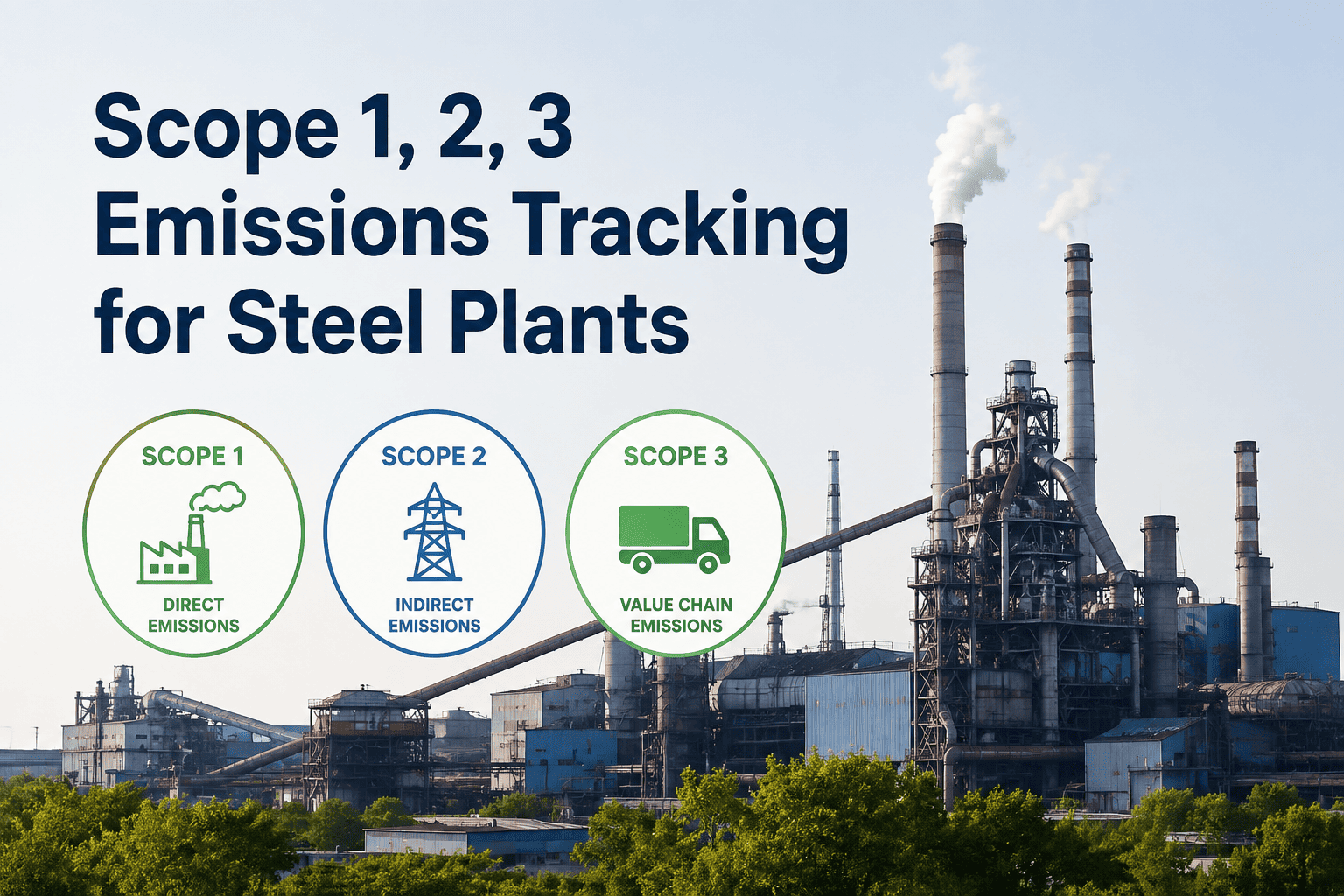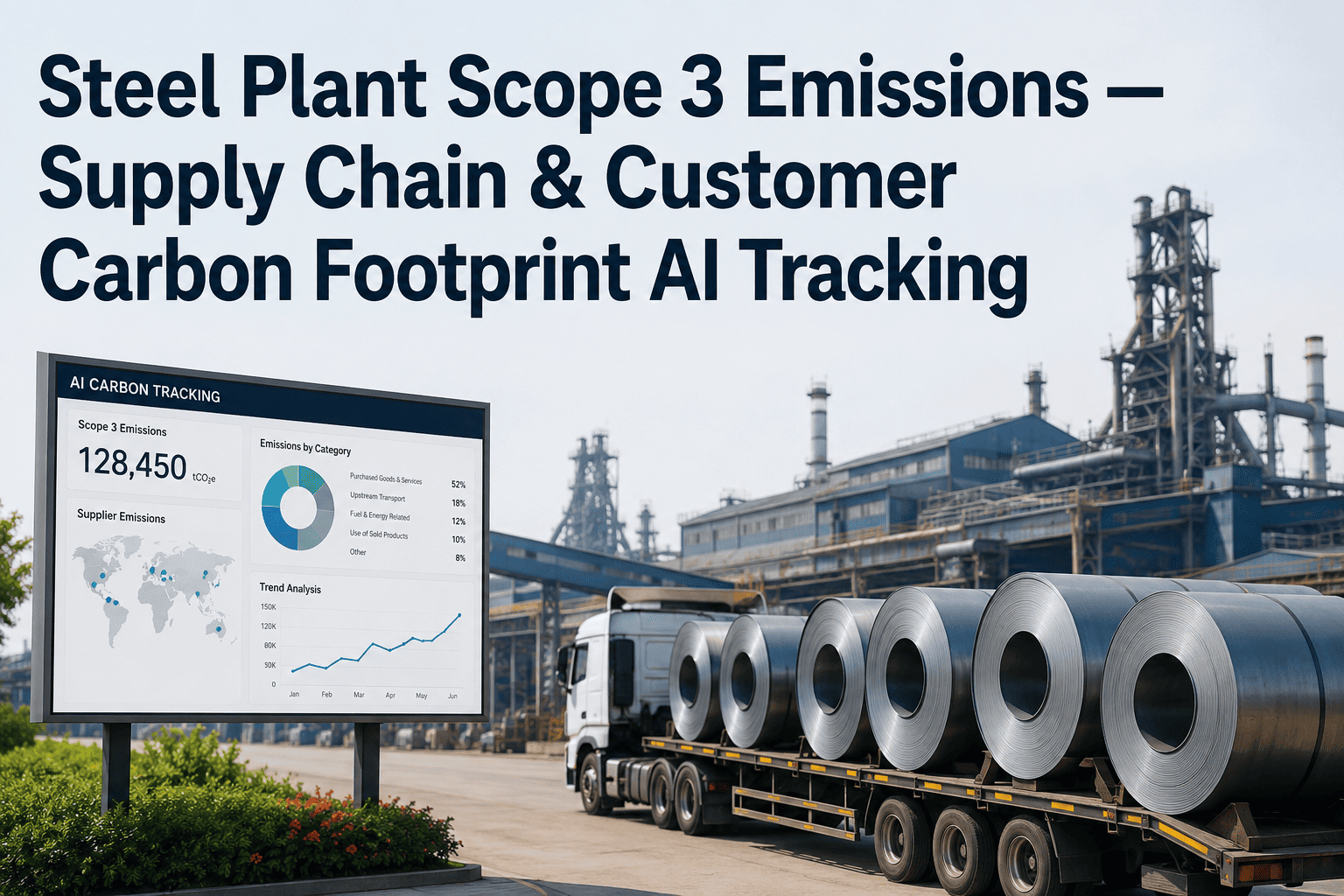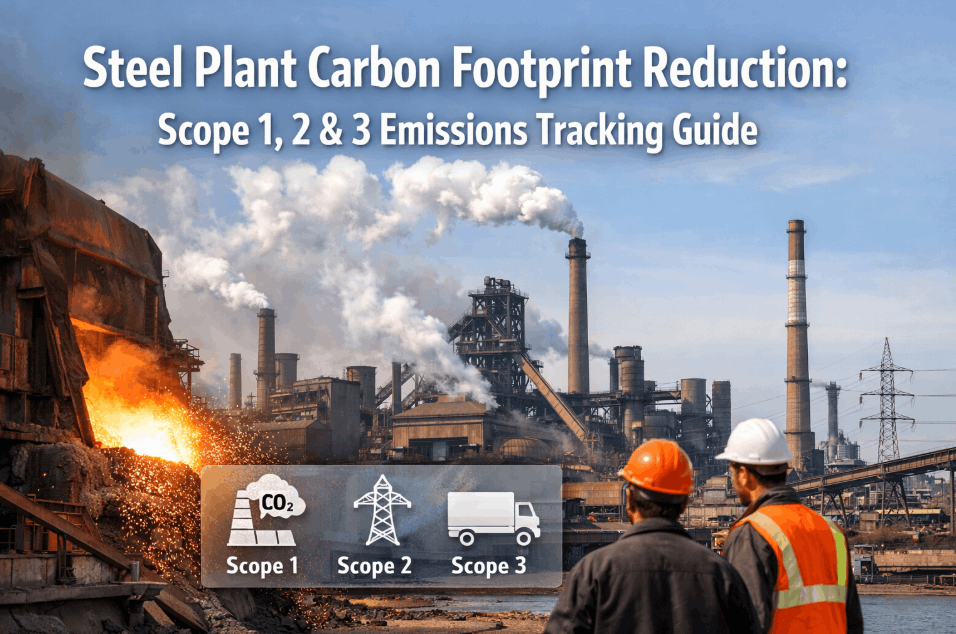
Scope 1 sounds like the simplest of the three emission scopes since it only covers what happens inside the plant's own boundary, yet integrated steel plants routinely undercount it by missing one of three distinct source categories. Process emissions from the blast furnace and BOF, combustion emissions from reheating and power generation, and fugitive emissions from leaks and venting each need their own measurement approach and emission factor, and treating them as one blended number produces a figure that will not hold up under GHG Protocol-aligned scrutiny. Getting Scope 1 right matters beyond its own reporting line, since it anchors the carbon intensity figure that CBAM, investor disclosure and internal benchmarking all build on. Plants reviewing their current methodology can see Scope 1 calculated source by source on live plant data before the next reporting cycle.
Scope 1 Emissions Calculation for Integrated Steel Plants
Process, combustion and fugitive emission source mapping with GHG Protocol-aligned methodology.
Why Scope 1 Is Often Undercounted
A blended Scope 1 total usually means one of three source categories was folded into another, or missed entirely.
Process emissions from chemical reactions in the furnace are harder to meter than fuel combustion.
Multiple fuel sources across reheating and power generation get combined without separate factors.
Leaks and venting are often left out entirely since they are harder to measure directly.
Each gap understates the final Scope 1 figure, which then understates the carbon intensity number every downstream report relies on.
Mapping Sources to Methodology
Each source category needs its own calculation approach aligned to GHG Protocol guidance.
| Source Category | Calculation Approach | Data Needed |
|---|---|---|
| Process emissions | Mass balance against carbon input and output | Raw material composition and production volumes |
| Combustion emissions | Fuel-specific emission factors applied to consumption | Fuel type and volume by source |
| Fugitive emissions | Equipment-level leak factors or direct monitoring | Equipment inventory and leak detection data |
Check Your Own Scope 1 Methodology for Gaps
Book a 30-minute session and bring your current calculation approach. iFactory AI will check it against each source category.
Building an Accurate Boundary
Getting the Scope 1 boundary right takes four steps, in order.
What iFactory AI Supports
Each source category is calculated with its own method, then rolled up into one defensible Scope 1 total.
Source-Specific Calculation
Process, combustion and fugitive emissions each use the method appropriate to that source.
GHG Protocol Alignment
Methodology follows GHG Protocol guidance for integrated steel plant boundaries.
Live Data Connection
Activity data feeds from existing plant metering rather than manual entry.
Cross-Validation
Calculated totals are checked against fuel purchase records to catch gaps.
iFactory AI maps and calculates Scope 1 emissions across all three source categories using existing plant data.
Expert Review
Process emissions are consistently the hardest category to get right, since they come from a chemical reaction rather than something a meter directly measures. A mass balance approach against raw material composition is more reliable than trying to infer process emissions from fuel data alone.
Fugitive emissions are the category plants most often skip entirely, usually because they assume the volume is too small to matter. On an integrated plant with significant process gas handling, that assumption is often wrong enough to affect the total meaningfully.
Frequently Asked Questions
Why can't process emissions be calculated the same way as combustion emissions?
Combustion emissions come from burning a known quantity of fuel with a known emission factor, while process emissions come from chemical reactions in the furnace that depend on raw material composition rather than fuel consumption. A single combustion-style factor applied to process emissions produces an inaccurate result. See the distinction explained in a live session.
How are fugitive emissions actually measured without direct metering?
Equipment-level leak factors, based on equipment type and age, are commonly used where direct monitoring is not practical, with the inventory of equipment built first to apply those factors consistently. Direct monitoring can replace factor-based estimates where it is available. Ask support about fugitive emission estimation for your equipment inventory.
What does cross-validation against fuel purchase records actually catch?
Comparing the calculated combustion emissions total against actual fuel purchase volumes catches metering gaps or double-counting that would otherwise go unnoticed until an external review flags the discrepancy. This is a quick check that significantly improves confidence in the final number. Request a sample cross-validation report.
Does this methodology support both blast furnace and EAF routes?
Yes, the source categories and calculation methods adjust to the route, since an EAF plant's process emission profile differs significantly from a blast furnace plant's. Contact support to confirm the methodology for your specific route.
How does an accurate Scope 1 figure affect our CBAM exposure?
Scope 1 emissions feed directly into the carbon intensity figure used for CBAM declarations, so an undercounted Scope 1 total understates exposure now but risks correction and penalty later when a verifier catches the gap. Getting it right the first time avoids that cycle. Book a session connecting Scope 1 to your CBAM calculation.
Count All Three Source Categories, Not Just the Easy One
iFactory AI calculates process, combustion and fugitive emissions with the methodology each one needs. Book a walkthrough on your own data.