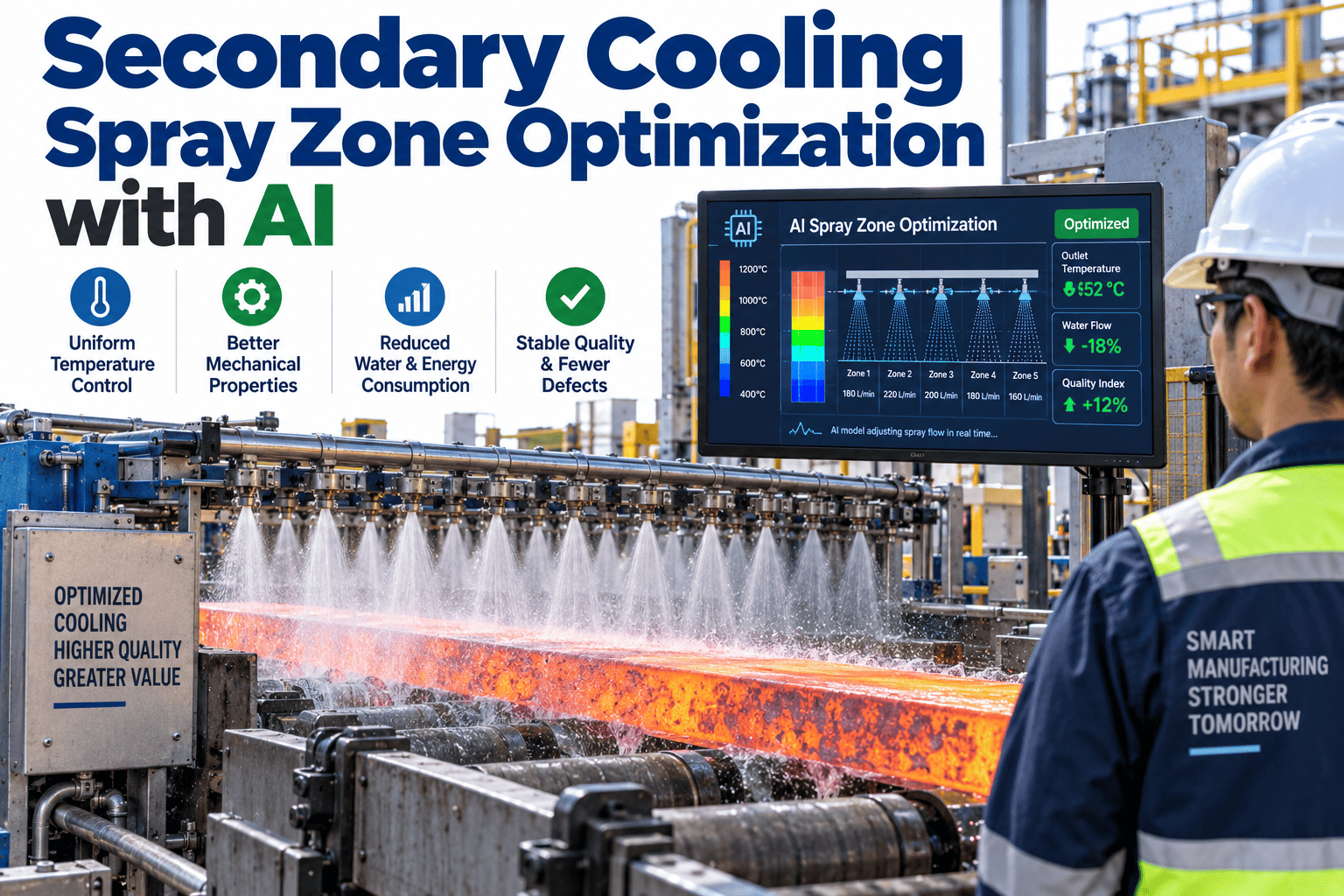
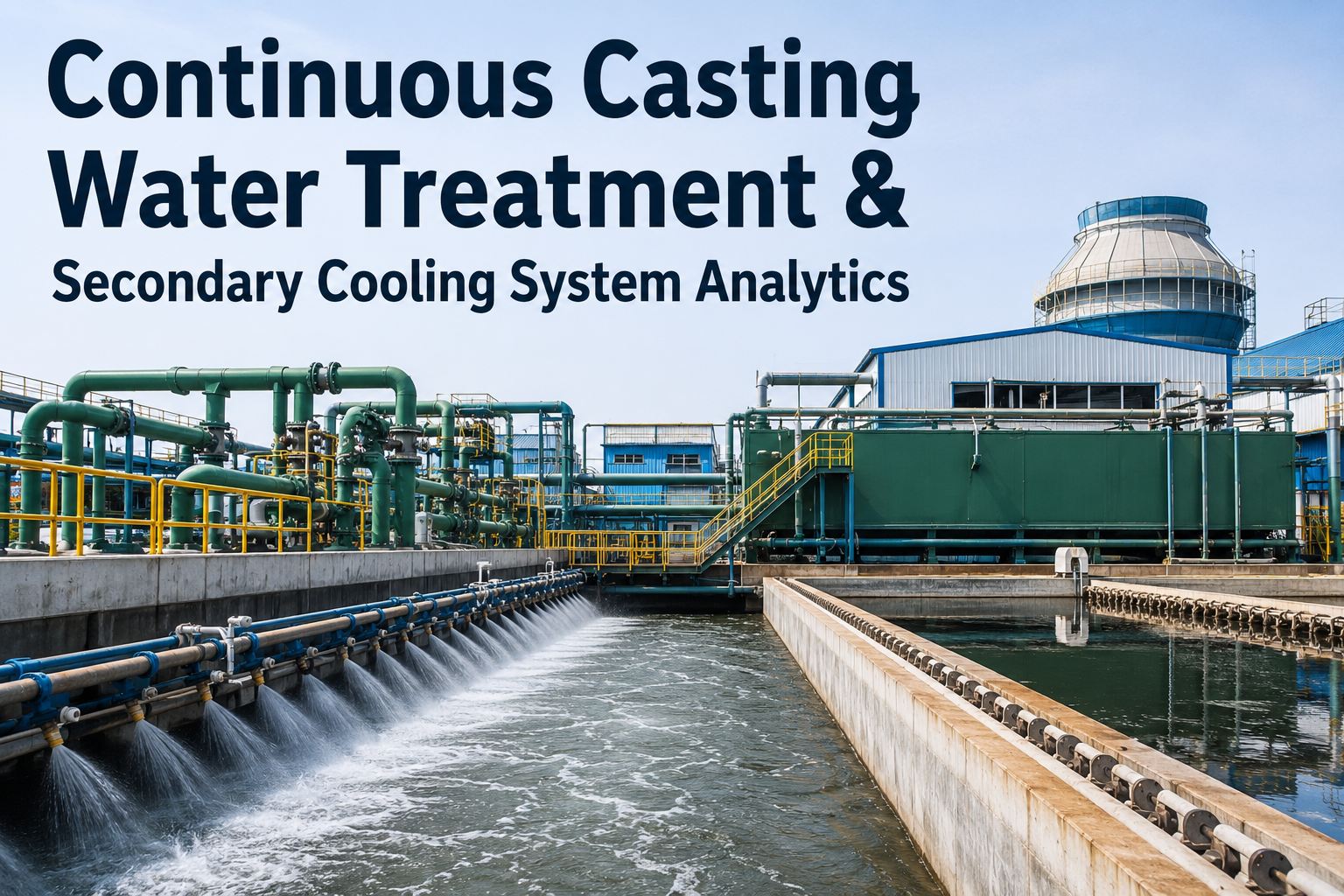
Secondary cooling removes roughly 80% of the heat from a solidifying strand, yet most casters still set spray water flow using fixed zone-level tables designed once at commissioning and rarely revisited against actual grade mix or casting speed. That gap matters because secondary cooling does not just finish the job the mold started — it determines where the solidification front actually ends up, and that endpoint position is what soft reduction, centerline segregation control, and internal crack prevention are all built around. A thermal model that tracks the strand's surface and core temperature zone by zone, and adjusts spray water flow to match, is not an incremental refinement of a working system. It is the difference between a caster that hits its metallurgical targets by design and one that hits them by coincidence. If you want to see how an AI thermal model would map onto your own caster's zone configuration, book a demo with iFactory's team.
CASTING QUALITY · SECONDARY COOLING · AI THERMAL MODELING
Fixed Flow Tables Cool the Strand. A Thermal Model Cools It Correctly.
iFactory builds a zone-by-zone thermal model of your strand from mold exit to straightener, adjusting spray flow in real time to hold the solidification endpoint where soft reduction and segregation control actually need it.
80%
Share of total strand heat removed in the secondary cooling zones
±5°C
Surface temperature tolerance targeted in high-quality slab production
3x
Higher internal crack rate from undetected cooling asymmetry between zones
0.74
Inner-to-outer arc water ratio shown to mitigate transverse thermal gradients in trials
THE THERMAL PROFILE
Why a "Strong-to-Weak" Cooling Curve Beats a Flat One
A fixed flow table typically applies similar cooling intensity across every zone, which sounds even-handed but produces exactly the kind of temperature swings a strand cannot tolerate. Research on ship plate slab casting found that a strong-to-weak cooling pattern along the casting direction — aggressive heat extraction near the mold exit, tapering progressively toward the straightener — prevents the abrupt temperature fluctuations that a flat or reversed profile creates. The zone-by-zone view below shows the shape a well-optimized thermal profile actually takes, and why each stage needs a different cooling intensity rather than a shared setpoint.
Foot Roll / Mold Exit
Shell is thinnest here — maximum controlled cooling locks in surface integrity before bulging risk begins.
Upper Arc
Cooling tapers as shell thickens, avoiding the sharp reheat that triggers transverse cracking at oscillation marks.
Lower Arc
Selectively shutting off nozzles in this stage at medium-low speeds can raise corner temperature roughly 50°C, keeping it out of the brittle range at straightening.
Horizontal / Soft Reduction
The solidification endpoint needs to land exactly here for soft reduction to engage the still-mushy core rather than a fully solid or fully liquid section.
See Your Own Zone Profile Against the Strong-to-Weak Target
iFactory models your actual zone-by-zone temperature curve and flags where flow deviates from the profile your grade mix and casting speed require.
WHY THE ENDPOINT MATTERS
Solidification Endpoint Position Is the Metallurgical Target, Not Just a Byproduct
Soft reduction technology presses down on the still-unsolidified core of the strand to counteract the natural shrinkage that drives centerline segregation, but it only works if the solidification front is actually located inside the soft reduction zone when the pressing rolls engage. Get the cooling profile wrong — through non-uniform spray distribution or the wrong overall water ratio for the current casting speed — and the solidification end becomes irregular and longer than designed, missing the soft reduction window and producing exactly the centerline macro segregation the system exists to prevent. This is why secondary cooling optimization is not primarily about the strand surface; the surface temperature control matters largely because it is the observable proxy for something happening deeper in the strand that cannot be measured directly in real time.
1
Cooling Intensity Sets Shell Growth Rate
Every zone's water flow directly controls how fast the shell thickens at that point in the caster, which in turn determines exactly when the core finishes solidifying.
2
Shell Growth Rate Determines Endpoint Position
A thermal model translates the zone-by-zone cooling profile into a predicted position for the solidification front — the calculation soft reduction timing depends on.
3
Endpoint Position Must Align With Soft Reduction
If the endpoint lands before or after the soft reduction zone, the pressing mechanism either compresses already-solid metal uselessly or misses the still-mushy core it needs to reach.
4
Misalignment Shows Up as Centerline Segregation
When soft reduction misses its window, the segregation and hot-tearing risk it was designed to prevent shows up downstream, often not caught until rolling or final inspection.
WHAT AN AI THERMAL MODEL ACTUALLY DOES
From Static Flow Tables to a Model That Adjusts With the Cast
Continuous Endpoint Prediction
Real-Time
The model recalculates predicted solidification endpoint continuously as casting speed, grade, and superheat shift during the cast, instead of relying on a static table built for average conditions.
Transverse Uniformity Correction
Width-Direction
Modeling non-uniform spray distribution across the slab width — not just along the casting direction — catches the transverse thermal gradients that drive off-center segregation independent of the overall cooling curve.
Speed-Linked Flow Adjustment
Casting-Speed Aware
Water ratio and casting speed are matched dynamically so the solidification endpoint stays inside the soft reduction window even as speed changes mid-cast rather than only at the setpoint used for the flow table.
GRADE SENSITIVITY
Not Every Steel Grade Wants the Same Cooling Curve
Middle-carbon steels in the 0.10 to 0.18 percent carbon range are particularly sensitive to transverse surface cracking if the cooling profile allows the surface to pass back through a brittle temperature range after initial cooling — precisely the reheat effect a strong-to-weak profile is designed to prevent. A thermal model that treats every grade with the same generic curve will systematically underperform on exactly the chemistries most prone to cracking, while overcooling grades that would tolerate a faster, less conservative profile. Matching the cooling curve to grade chemistry, not just to slab dimensions and casting speed, is what separates a thermal model that genuinely optimizes from one that simply digitizes the existing flow table.
SIGNS THE PROFILE IS OFF
Four Signals Your Cooling Profile Needs Remodeling, Not Just Adjustment
Transverse Cracks at Regular Pitch
Cracks appearing at intervals matching nozzle spacing point to a spray coverage or reheat problem localized to a specific zone rather than a random defect pattern.
Centerline Segregation Despite Active Soft Reduction
If soft reduction is engaged but segregation persists, the most likely cause is a solidification endpoint that has drifted outside the reduction zone, not a mechanical soft reduction fault.
Off-Corner Cracks in Slabs
Asymmetric transverse cooling — one arc side running hotter than the other — produces off-corner cracking that a symmetric flow table cannot diagnose or correct.
Defect Rate Changes With Grade Mix, Not Just Speed
If defect rates shift noticeably when the grade schedule changes at constant casting speed, the flow table is very likely tuned to one grade's requirements and mismatched to others.
FREQUENTLY ASKED QUESTIONS
Questions Casting Engineers Ask About AI Thermal Modeling for Secondary Cooling
Is this the same as monitoring individual spray nozzle condition and water chemistry?
No — nozzle clogging detection and water chemistry control are about keeping the delivery system performing as designed. Thermal modeling is about whether the design itself, the flow rate assigned to each zone, is actually correct for the current grade and casting speed. Both matter, but they solve different problems.
Contact support to discuss how the two capabilities work together.
How does a thermal model know where the solidification endpoint actually is if it can't be measured directly?
The model calculates predicted endpoint position from heat transfer physics — spray water flow, casting speed, steel grade, and superheat — validated against surface temperature measurements taken at multiple points along the caster. Surface readings confirm the model's predictions are tracking reality even though the internal solidification front itself isn't directly observable in production.
Do we need to change our physical spray system to benefit from a thermal model?
Not necessarily. Most of the value comes from recalculating the correct flow setpoints for your existing zone configuration and adjusting control valve targets accordingly — the model works with the nozzle and zone hardware you already have, rather than requiring a spray system redesign.
Book a demo to see how this maps onto your caster configuration.
How quickly does a change in casting speed need to be reflected in the cooling profile?
Ideally in near real time — casting speed and water ratio are directly linked, since a speed change without a corresponding flow adjustment shifts the solidification endpoint away from the soft reduction zone almost immediately. Static flow tables built around a single reference speed cannot track this, which is one of the clearest gaps a dynamic thermal model closes.
Does grade-specific cooling actually require a different curve for every steel chemistry we run?
Not every grade needs a unique curve, but grades that undergo different transformation behavior — particularly middle-carbon steels prone to a brittle temperature window — do need distinct treatment from grades without that sensitivity. Grouping grades by transformation behavior rather than treating every heat identically is usually enough to capture most of the improvement.
Book a demo to see how grade grouping would apply to your production mix.
Stop Cooling to a Table. Start Cooling to a Model.
iFactory builds a zone-by-zone thermal model of your caster and keeps the solidification endpoint aligned with soft reduction as speed and grade shift, in real time.