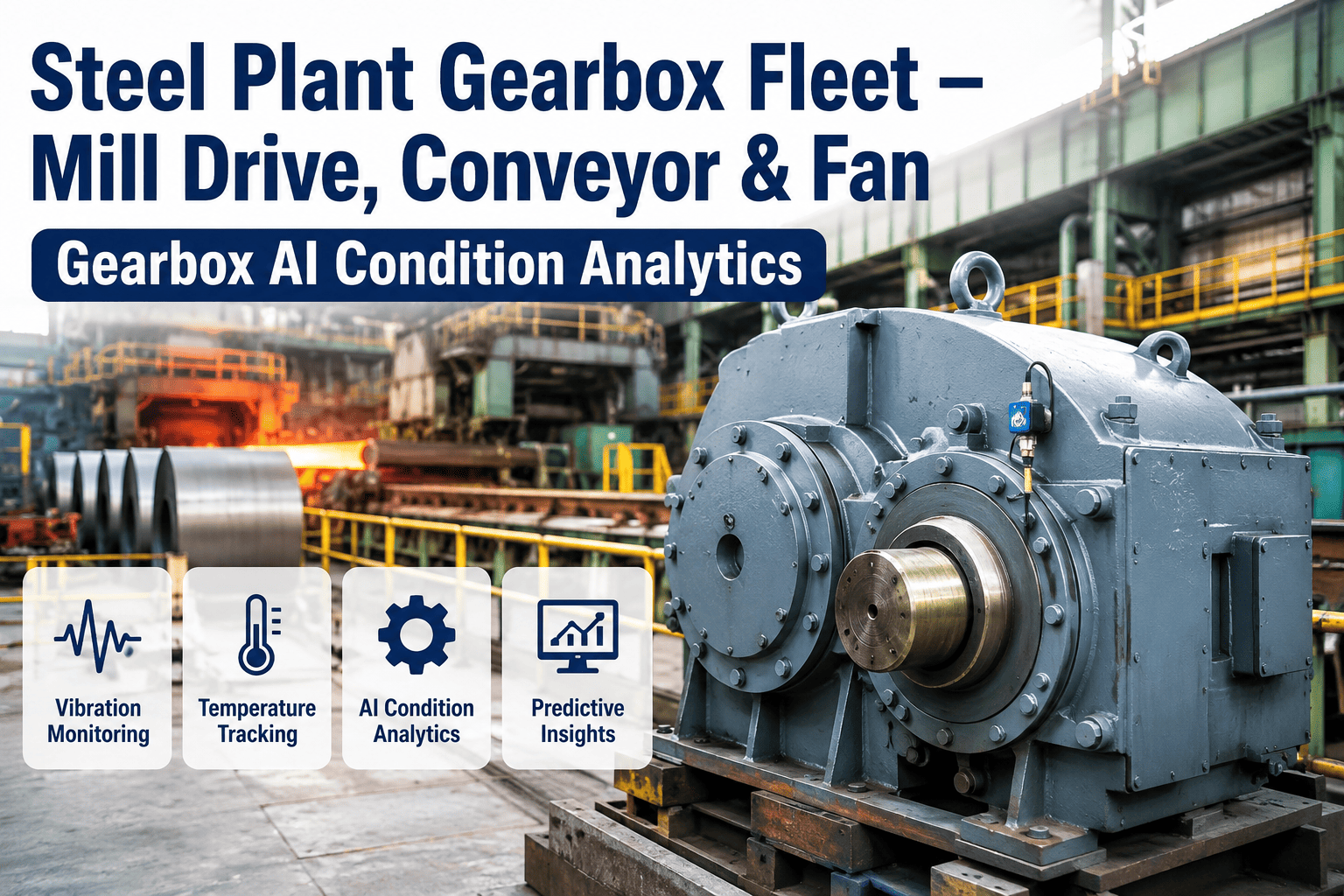
Two hundred gearboxes spread across mill drives, conveyors, and fans sounds like a maintenance database problem, but the harder issue is that those two hundred gearboxes aren't the same two hundred gearboxes — a planetary reducer on a mill drive fails differently, and gives different warning signs, than a helical unit on a conveyor or a bevel gearbox on an induced-draft fan. Most enterprise reliability programs end up managing this fleet with one of two flawed approaches: a single generic vibration threshold applied to everything, which misses type-specific failure modes, or a patchwork of different monitoring standards by area, which makes fleet-wide comparison meaningless. This piece looks at what standardized, type-aware gearbox monitoring actually requires at fleet scale, and how a demo can show your current gearbox population mapped against failure mode coverage gaps.
Why a Single Threshold Doesn't Work Across a Mixed Fleet
A vibration alarm threshold that's appropriately conservative for a mill drive gearbox — a unit running high torque, low speed, with a planetary gear arrangement — is often either too sensitive or too permissive when applied unchanged to a high-speed fan gearbox running a completely different load and speed profile. Gear mesh frequencies, bearing frequencies, and normal operating vibration levels differ by gearbox type, mounting, and duty cycle, which means a single fleet-wide threshold either generates so many false alarms on sensitive units that operators start ignoring them, or misses genuine early-stage faults on units where the generic threshold was set too loose to catch that type's specific failure signature.
At the scale of two hundred or more gearboxes across an enterprise, that inconsistency compounds into a reliability program that can't actually be trusted to prioritize maintenance resources correctly, because the alarm data itself isn't comparable across the fleet in any meaningful way.
What Standardization Actually Means at Fleet Scale
Standardizing condition monitoring across a mixed gearbox fleet doesn't mean forcing every unit onto identical thresholds — it means establishing a consistent methodology for setting type-appropriate thresholds so that an alarm severity level means the same thing regardless of where in the plant it fires. A reliability engineer reviewing a fleet-wide dashboard needs to trust that a high-severity alarm on a conveyor gearbox represents comparable urgency to a high-severity alarm on a mill drive unit, even though the underlying vibration signatures that triggered each alarm look completely different.
| Gearbox Type | Typical Application | Dominant Early Fault Signature |
|---|---|---|
| Planetary | Mill drives, high-torque reducers | Planet/sun gear mesh sidebands, carrier bearing wear |
| Helical / Parallel Shaft | Conveyor drives, general material handling | Gear mesh harmonics, input/output bearing wear |
| Bevel / Right-Angle | Fan drives, auxiliary equipment | Misalignment signature, bearing wear compounded by fan imbalance |
| Worm | Low-speed auxiliary drives | Thermal signature and thrust bearing wear more than classic gear mesh |
Prioritizing Two Hundred Gearboxes Without Guessing
Not every gearbox in an enterprise fleet carries equal operational risk, and treating them equally in a monitoring rollout wastes resources on low-criticality units while potentially under-resourcing the mill drive or primary conveyor gearboxes whose failure would stop production entirely. A criticality-weighted approach — factoring in production impact of failure, spare part lead time, and historical failure frequency for that specific gearbox type and application — gives a defensible basis for sequencing which units get full monitoring first versus which can run on a lighter-touch schedule.
Building the Rollout Without Disrupting Existing Maintenance Practice
What Changes for a Maintenance Manager Running the Program
With standardized, type-aware thresholds in place, a maintenance manager reviewing a fleet-wide alarm list can actually trust the ranking presented — the gearboxes at the top of the list genuinely represent the highest current risk, rather than simply being the units whose generic threshold happened to be set too tight. That trust is what makes it possible to allocate a limited maintenance crew's time efficiently across an enterprise-scale fleet instead of chasing whichever alarm fired most recently regardless of its actual severity relative to the gearbox type it came from.
It also improves spare parts planning meaningfully. Because failure mode is identified specifically by gearbox type rather than as a generic "vibration alarm," a manager can confirm the right spare — bearing, gear set, or full reducer — is on order well before a planned repair window, rather than discovering a lead-time gap once a unit is already pulled apart.