Unplanned equipment failure in a steel plant is far more than a maintenance headache — it is a high-stakes operational crisis that directly impacts the bottom line and personnel safety. When a ladle turret jams or a critical BOF blower fails, the loss isn't just measured in idle man-hours; it is measured in solidified "skulls" of cold metal, potential explosive breakouts, and hundreds of tons of lost prime output. In a typical 5 MTPA integrated steel plant, critical equipment failures account for 12–18% of total production cost variations, equating to ₹80–250 crore in avoidable losses annually. Yet, historical data confirms that 65% of these catastrophic breakdowns are preceded by detectable "early-warning" signatures — vibration shifts in motor bearings, thermal spikes in hydraulic systems, or abnormal current draw in heavy-duty cranes. iFactory's AI Analytics and Asset Management platform uses these signatures to predict failures 4–12 weeks in advance. By converting emergency "break-fix" chaos into surgical planned maintenance, steel producers across India and the Middle East have reduced unplanned breakdown frequency by 48%, ensuring molten metal flows without interruption.
Top 10 Steel Plant Equipment Failures & How AI Prevents Them
From conveyor snaps to ladle jams — discover how AI-driven predictive monitoring detects the top 10 steel mill failures weeks before they strike, saving ₹250Cr+ annually.
The Anatomy of a Breakdown — Five Hidden Cost Layers
Most steel mills only track the direct repair cost and immediate tonnage loss — but a major asset failure has five distinct cost layers that ripple through the entire production chain. iFactory's AI engine quantifies these automatically to show the true ROI of prevention. Baseline your production risk — free in 5 days.
of total event cost
of total event cost
of total event cost
of total event cost
of total event cost
The Top 10 High-Risk Assets — Preventable vs Wear
iFactory's failure library benchmarks the most common steel plant breakdowns. The preventable share (dark) represents the opportunity to avoid sudden stoppage through AI early-detection, while the light portion represents scheduled end-of-life replacement.
How to Prevent the "Top 10" Failures with Digital AI
Effective failure prevention in steel plants is a systematic journey from dark data to predictive intelligence. iFactory structures this journey through a 5-step engineering programme that layers AI onto your existing infrastructure.
iFactory scans your Asset Register to identify which equipment "Top 10" failures cause the highest production risk. We map every motor, conveyor, and turret to its total potential downtime cost.
Connect iFactory to existing PLC/SCADA data and deploy ruggedized vibration/thermal sensors on critical unmonitored assets. We create a 24/7 digital "pulse" for every target machine.
iFactory's steel-specific AI models ingest historical failure data. The system learns to recognize the "pre-snap" frequency of conveyor belts or the "pre-jam" current draw of ladle turrets.
Every AI alert automatically spawns a Work Order in your system — specifying the required spare part, the technician skill-set, and the optimal repair window before failure occurs.
Monthly reporting on failure patterns and maintenance performance. iFactory helps you refine your PM schedules, moving from "calendar-based" to "health-based" maintenance cycles.
Why iFactory for Steel — Specialized Failure Intelligence
What a COO Said
Our Hot Strip Mill was experiencing ₹4 crore in annual losses just due to unplanned hydraulic failures. iFactory's predictive analytics detected a pump seal deterioration 3 weeks before it would have caused a catastrophic mill-stop. We fixed it during a planned Friday shift for ₹18,000. Under the old reactive model, that failure would have cost us ₹65 lakh in production loss alone. The system didn't just pay for itself; it secured our entire rolling schedule.
Frequently Asked Questions
Can AI really predict a conveyor belt snap in a dusty mill environment?
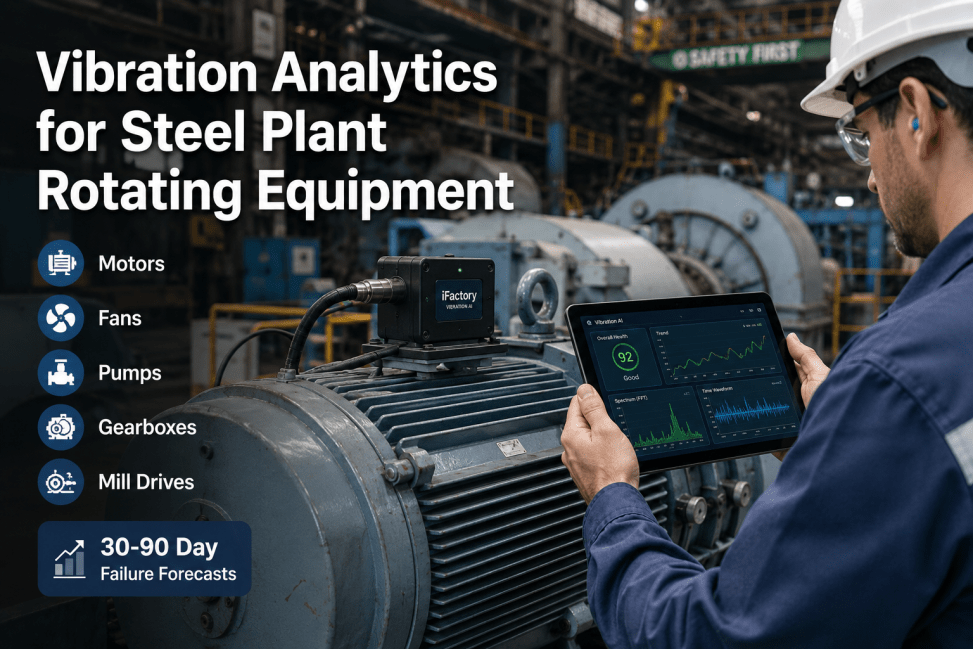
Yes. By monitoring high-frequency acoustic emissions and motor torque patterns, iFactory identifies the specific vibration signatures of frayed steel cords and splice deterioration — detecting potential snaps weeks before they occur, even in high-dust environments.
How does iFactory handle the high temperatures and EMF of a Melt Shop?
iFactory uses ruggedized, industrial-grade sensors designed for steel plant conditions. Our platform also bridges data from existing heat-shielded PLC logic, ensuring AI monitoring remains stable even in the proximity of Electric Arc Furnaces (EAF).
What the typical ROI for a rolling mill equipment monitoring programme?
Average ROI for rolling mills is 6.2× within 18 months. By eliminating just two major unplanned "mill-stops" per year, a plant typically recovers the entire 3-year subscription cost of the iFactory platform.
Do we need to install new sensors on every piece of equipment?
No. iFactory follows a "Criticality First" approach. We leverage your existing PLC data first, adding digital sensors only to the 10-15 critical assets that cause 70% of your downtime risk.
Prevent Your Next Critical Equipment Failure
Free failure-risk audit from your existing maintenance logs — delivered in 5 days.