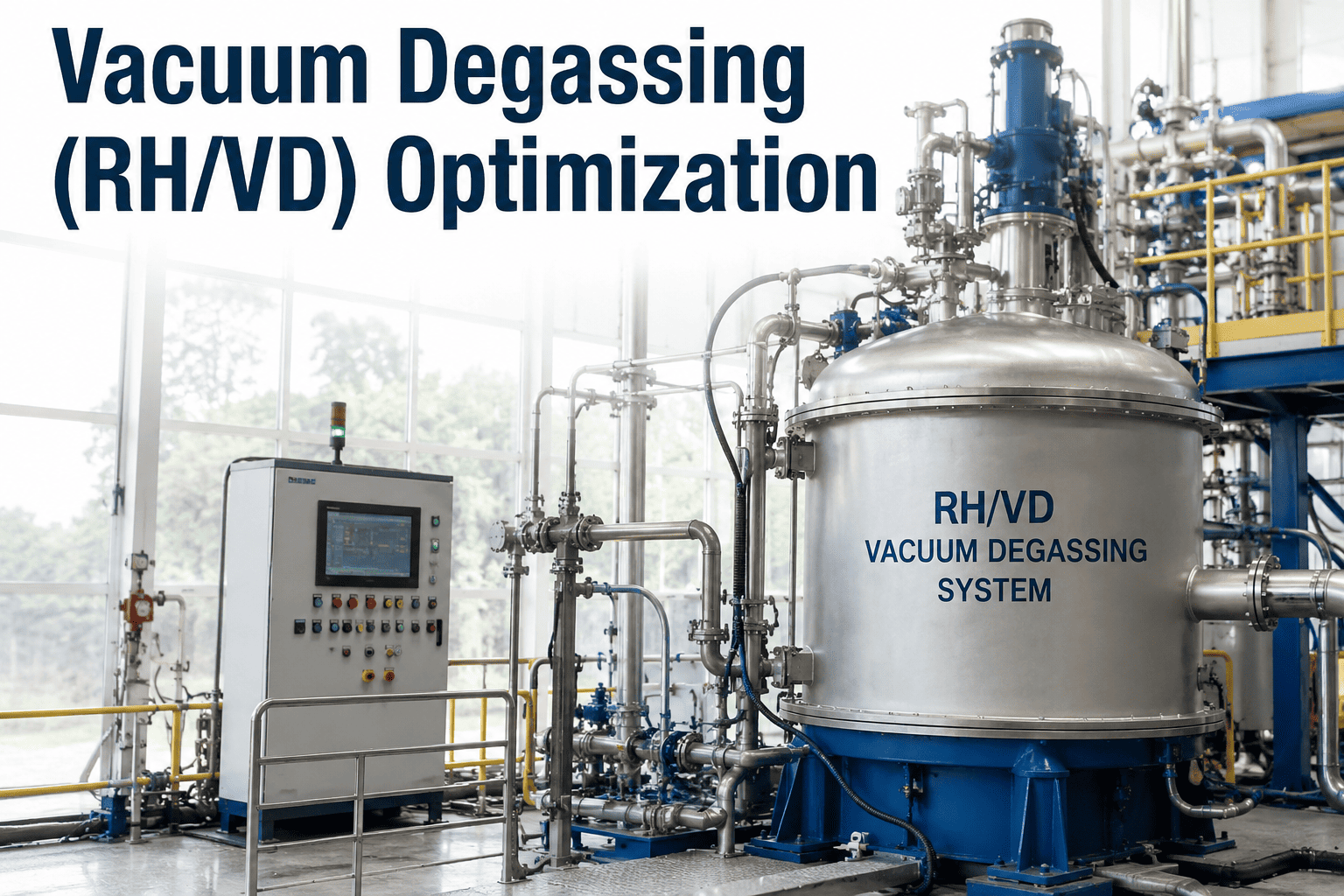
A heat is sitting in the RH degasser at 1620°C and the melt shop superintendent is watching the hydrogen number refuse to move. Cycle time is already past 22 minutes, the caster is waiting, and the metallurgist knows that pushing the heat out early risks a hydrogen flake claim from the customer six weeks from now. Pulling more vacuum time protects quality but burns argon, refractory life, and throughput on a unit that is already the bottleneck of the shop. Every RH and VD operator makes this trade-off dozens of times a week, mostly on instinct and a lagging chemistry sample, because the vacuum vessel gives almost no real-time signal about what is actually happening inside the melt. iFactory's process intelligence layer was built to close exactly this gap for secondary metallurgy teams.
Know when the vacuum cycle is actually done, not when the clock says it is
iFactory reads mold and vessel process signals in real time to tell RH and VD operators when hydrogen, nitrogen, and inclusion targets are truly met, cutting cycle time without risking clean-steel grade failures.
The vessel hides the one thing you need to know
Vacuum degassing is where clean-steel grades are won or lost, yet the process itself is nearly a black box. Operators infer melt state from off-gas trends, decarburization rate, and circulation flow, then decide when to stop pulling vacuum. Get it wrong in either direction and the cost shows up somewhere else in the shop.
Circulation rate drifts unnoticed
Snorkel wear and lift-gas variation change recirculation flow heat to heat. Operators run the same fixed cycle time regardless, so some heats are under-treated for hydrogen and nitrogen removal.
Chemistry samples lag reality
A LECO hydrogen sample takes minutes to return, by which point the vessel has already moved past the true end point. Teams either over-treat to be safe or release heats on outdated data.
Inclusion cleanliness is invisible in real time
Argon stirring intensity for inclusion flotation is set by recipe, not by what is actually floating out of the melt, so cleanliness varies even among heats treated to identical vacuum programs.
Every extra minute costs the whole shop
RH and VD units are frequently the throughput bottleneck between BOF or EAF and the caster. Excess cycle time on one vessel ripples into caster idle time and missed heat schedules downstream.
Shops running fixed-time vacuum cycles typically over-treat 30–40% of heats just to cover the uncertain ones. Book a 30-minute session to see what your own vessel data says about cycle-time waste.
Real-time signal where you used to have a stopwatch
iFactory ingests off-gas analysis, lift-gas flow, vacuum pressure, and temperature trends directly from the RH or VD unit's existing instrumentation, then models decarburization rate, hydrogen removal kinetics, and inclusion flotation behavior heat by heat instead of applying one fixed recipe to every heat.
| Decision point | Fixed-recipe operation | iFactory-guided operation |
|---|---|---|
| Cycle end point | Set by standard clock time regardless of melt state | Called by modeled hydrogen and nitrogen trend against grade target |
| Argon stir rate | Fixed by grade recipe | Adjusted live based on modeled inclusion flotation progress |
| Circulation monitoring | Operator judgment from lift-gas gauge | Continuous recirculation-rate estimate with drift alerts |
| Hydrogen risk | Confirmed only after LECO sample returns | Predicted continuously, with confidence band shown live |
| Refractory and argon use | Consumed at the same rate on every heat | Reduced on heats reaching target early |
Clean-steel demand is rising faster than vessel capacity
Automotive, pipeline, and heavy-plate customers are tightening hydrogen and nitrogen specifications year over year, particularly as high-strength steel grades become more common and more sensitive to hydrogen-induced cracking. At the same time, most melt shops aren't adding new vacuum vessels; they're expected to push more clean-steel tonnage through the same RH and VD units they've run for a decade. That combination puts real pressure on cycle time, because the traditional lever for meeting tighter specs has always been longer treatment time, and longer treatment time is exactly what a bottleneck vessel can't afford.
This is why the shift toward condition-based cycle-end decisions matters beyond any single shop's cost savings. Plants that can hit tighter hydrogen and cleanliness targets without extending cycle time gain a real capacity advantage over competitors still running fixed-time recipes, especially as clean-steel order books grow. It also changes the conversation with customers: instead of quoting longer lead times to guarantee tighter specs, shops with real-time treatment visibility can commit to both speed and quality at once.
There's a second, quieter benefit that shows up in refractory and consumables budgets. Vacuum vessel refractory life is directly tied to total vessel dwell time and thermal cycling, so shops that reduce average cycle time by even a few minutes per heat see a measurable extension in refractory campaign length. Combined with lower argon consumption from matched stirring intensity, the total cost picture often extends well beyond the direct cycle-time savings that show up first.
Capabilities built for the pulpit, not the lab
iFactory's vacuum treatment module runs on a screen already in front of the RH or VD operator, showing live model output alongside the instrumentation they already trust.
Hydrogen end-point prediction
A continuously updated hydrogen estimate with confidence interval, replacing the wait for a lab sample and letting operators call the cycle end point with evidence instead of a fixed timer.
Nitrogen pickup alerts
Flags air ingress or reoxidation risk from circulation instability before nitrogen pickup shows up in the final chemistry, so operators can correct lift gas mid-cycle.
Inclusion flotation tracking
Models argon stir intensity against modeled inclusion rise time, helping operators hold cleanliness targets on high-spec grades without blanket over-stirring.
Circulation rate diagnostics
Tracks snorkel and lift-gas performance across campaigns, flagging gradual circulation decline before it silently extends every cycle on the unit.
Grade-specific treatment profiles
Learns treatment behavior per grade and adjusts recommended cycle length automatically as your product mix shifts, instead of relying on one static recipe table.
Heat-by-heat treatment log
Every cycle is logged with modeled versus actual chemistry outcome, building the dataset your metallurgy team needs to keep refining treatment practice.
What melt shops see within one quarter
Results vary with vessel type, campaign length, and current instrumentation, but the pattern across deployments is consistent: shorter cycles, tighter chemistry, and fewer surprise reject heats.
What a vacuum treatment pilot includes
Connects to existing instrumentation
Off-gas analyzers, lift-gas flow meters, and vacuum sensors already on your RH or VD unit feed the model directly, with no new sensors required for a pilot.
On-premise deployment
Runs on plant-network hardware with no cloud dependency, so process data never leaves the melt shop network.
8–10 week pilot
Model calibration against your grade mix and historical heat data, followed by live shadow-mode validation before operators rely on it directly.
Metallurgy-team validation
Every recommendation is reviewable against lab chemistry, giving your metallurgists a way to audit and refine the model over time.
Works across vessel types
Deployed on RH, RH-OB, and VD/VOD units across carbon, stainless, and clean-steel product lines.
24x7 managed monitoring
iFactory's operations team maintains model performance and flags drift so your process engineers aren't managing the system on top of the shop floor.
Vacuum treatment AI, explained plainly
Stop treating every heat like the worst-case heat
See how iFactory reads your RH or VD vessel in real time and shortens cycle time without gambling on hydrogen risk. We'll walk through it on your own process data.