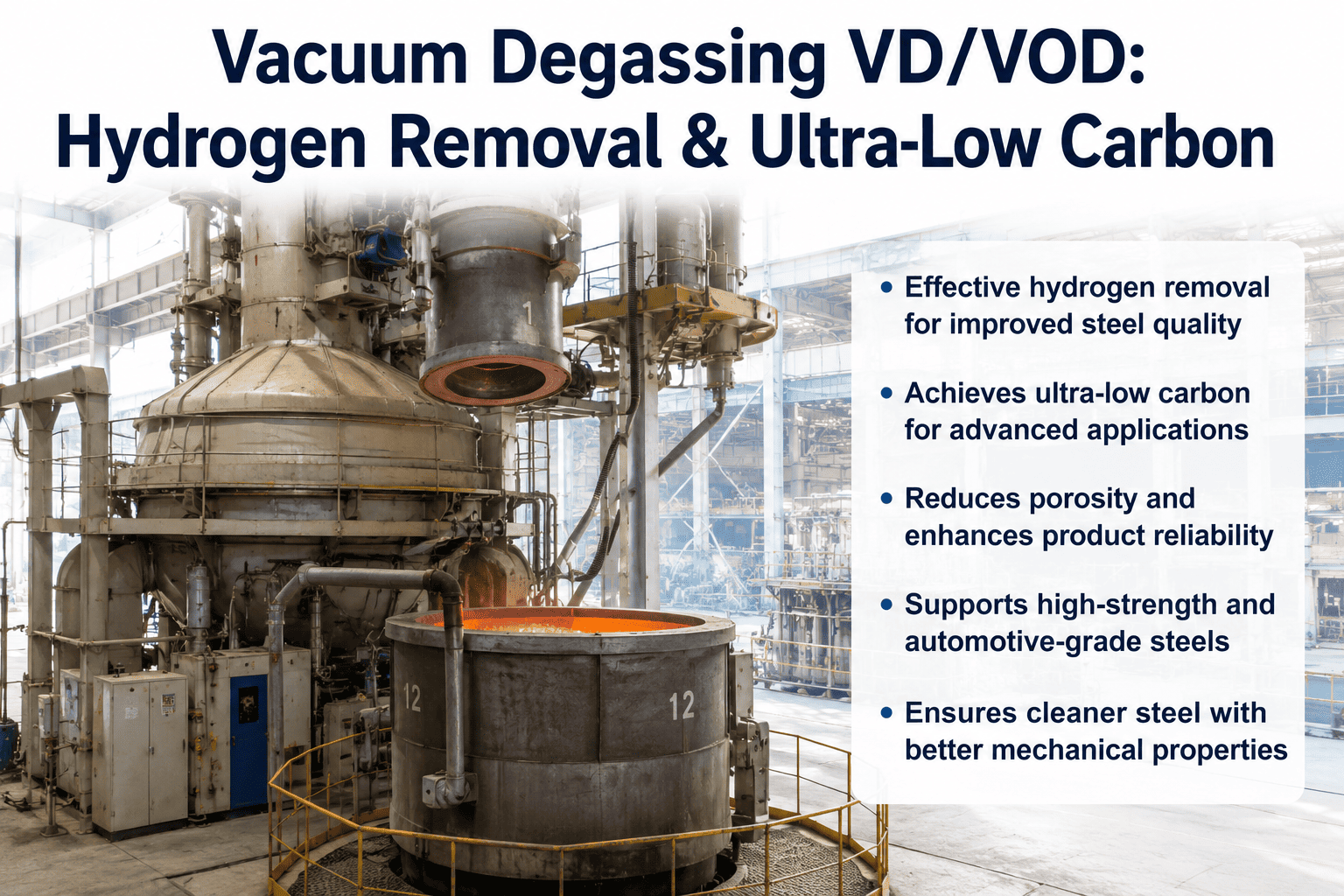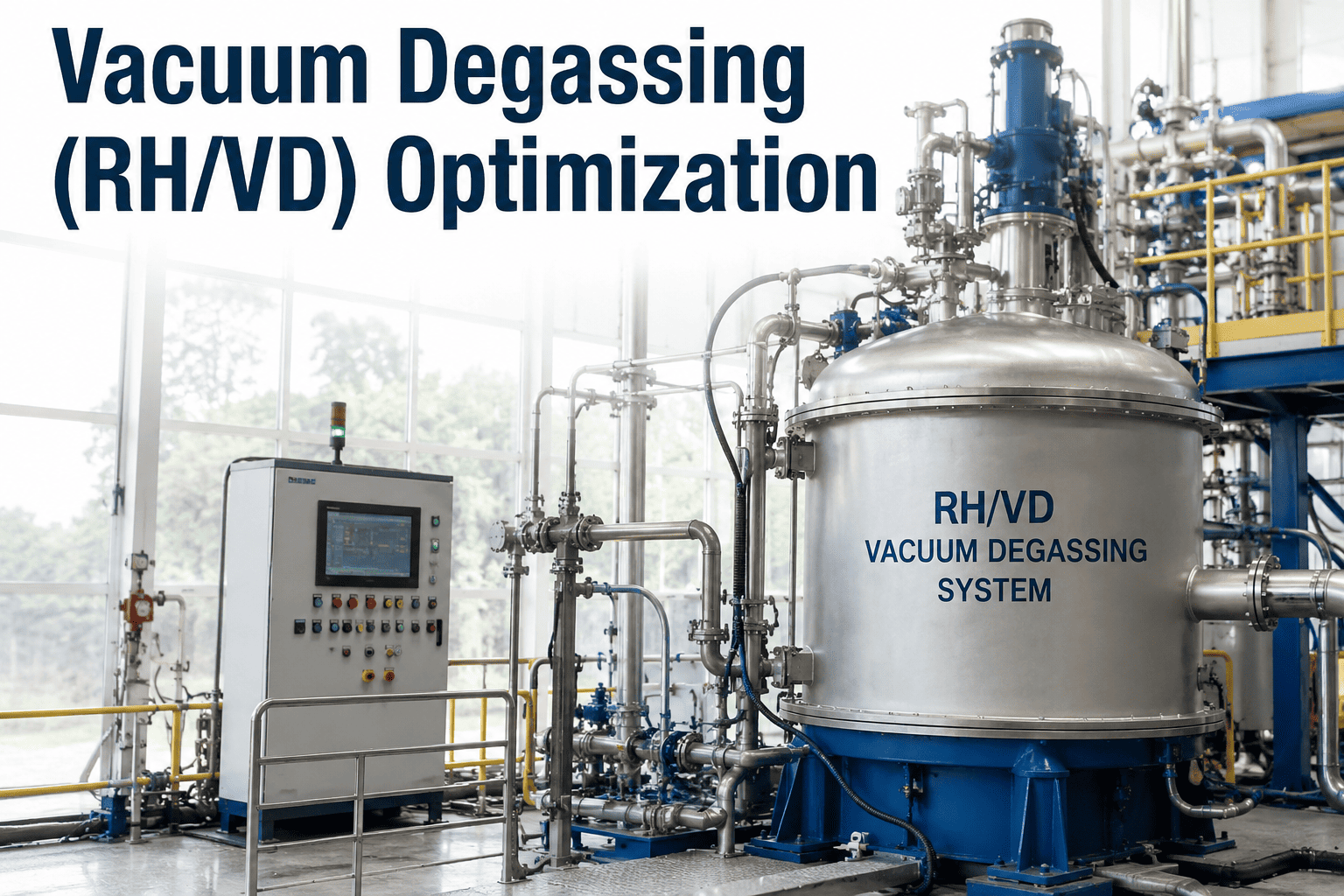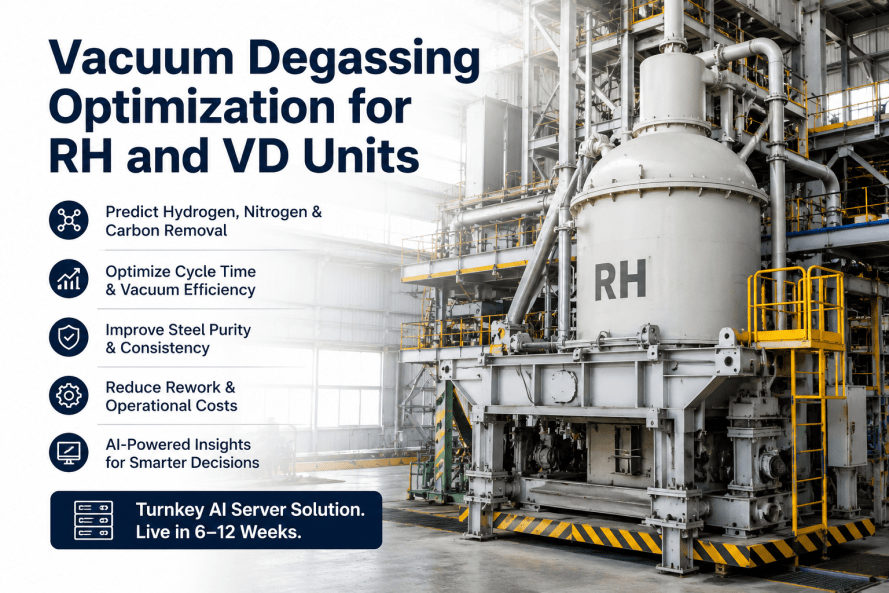
Vacuum degassing — performed through the Ruhrstahl-Heraeus (RH) process, the tank degassing (VD) process, or the combined RH-OB (oxygen blowing) and RH-KTB (Kawasaki top blowing) variations — is the final quality control gate in secondary steelmaking, the process step where hydrogen, nitrogen and carbon are removed from liquid steel to meet the demanding specifications required for premium grade applications including line pipe for sour gas service, offshore structural steel for arctic temperature service, automotive exposed panels requiring ultra-low carbon content for deep drawability, and rail steel requiring hydrogen content below 2 ppm to prevent flaking and shatter crack formation during cooling. A typical RH degasser processes 20 to 40 heats per day circulating 30 to 60 tons of steel per minute through the vacuum vessel at operating pressures of 0.5 to 5 millibar, achieving hydrogen removal of 60 to 80% in a single 15-to-25-minute treatment cycle through the thermodynamic driving force of the hydrogen partial pressure differential between the liquid steel in the vacuum vessel and the gas phase maintained by the vacuum pump system at flow rates of 300 to 800 kg/h of water vapor equivalent. The metallurgical complexity of vacuum degassing arises from the simultaneous requirement to remove hydrogen (which is reversible and re-enters the steel if ladle slag is wet or alloys are moist), remove nitrogen (which is slow and requires clean steel with low dissolved oxygen and sulfur content), achieve ultra-low carbon content below 20 ppm through the carbon-oxygen reaction in the RH-OB process where oxygen is injected through submerged lances to drive decarburization at rates of 0.5 to 2.0 ppm per minute at carbon contents below 50 ppm, and control steel temperature within the tight window required by the continuous caster while compensating for the heat losses of 5 to 15°C through the vacuum vessel refractory and the temperature drop of 20 to 40°. Book a Demo to discuss vacuum degassing optimization for your RH, RH-OB, or VD vessel configuration, steel grade portfolio, and quality specification requirements.
Is Your Vacuum Degasser Hydrogen Removal Efficiency and Cycle Time Costing $2–$5 Million Per Year in Downgrades and Lost Capacity?
iFactory's Vacuum Degassing Process Optimizer predicts hydrogen removal kinetics, carbon-oxygen reaction progress, nitrogen pickup risk, and optimal treatment endpoint in real time from vacuum vessel pressure, offgas composition, circulation gas flow rate, and bath temperature measurements — processed on an on-premise NVIDIA edge server with zero cloud dependency, read-only PLC connectivity, and no modifications to your existing vacuum degasser control system.
Why Vacuum Degassing Optimization Is the Final Quality Gate for Premium Steel Grades
Vacuum degassing operates at the intersection of three constraints that determine whether a heat qualifies for premium-grade applications or must be downgraded to less demanding specifications: hydrogen content that must be reduced below 2 ppm for sour gas line pipe and below 3 ppm for heavy plate and forging grades to prevent hydrogen-induced cracking during service, carbon content that must be reduced below 20 ppm for ultra-low-carbon interstitial-free steels used in automotive exposed body panels to achieve the required deep drawability and surface finish quality, and nitrogen content that must be controlled within the grade specification tolerance to prevent strain aging and maintain formability in low-carbon sheet steels. Each of these removal reactions depends on different thermodynamic and kinetic conditions: hydrogen removal is controlled by the mass transfer coefficient at the steel-vacuum interface and the circulation rate through the vacuum vessel, carbon removal depends on the carbon-oxygen reaction kinetics which accelerate at low carbon concentrations due to the increased diffusivity of carbon in liquid steel, and nitrogen removal is limited by the slow diffusion rate of nitrogen in liquid steel which is strongly affected by the dissolved oxygen and sulfur content at the steel surface. The operator must manage these competing removal reactions within a single 15-to-35-minute treatment cycle using only process parameter measurements — vessel pressure, offgas composition, circulation argon flow rate, oxygen lance flow and position in RH-OB operations, and bath temperature before and after treatment — without any real-time measurement of the hydrogen, carbon, or nitrogen content inside the vacuum vessel during active degassing. AI-enabled vacuum degassing optimization closes this measurement gap by using the available process parameter data to build a real-time kinetics model that predicts the instantaneous concentration of each element in the steel as a function of treatment time, vessel pressure, circulation rate, and slag condition, enabling the operator to know when the heat has reached its quality target without waiting for post-treatment sample analysis.
Four Critical Challenges in Vacuum Degassing Operation That AI Addresses
Each vacuum degassing process step presents a specific optimization challenge that the operator must solve without real-time chemistry data inside the vacuum vessel. The following four challenges represent the highest-leverage application areas for AI optimization in vacuum degassing operations, ranked by their impact on quality hit rate, cycle time, and treatment cost.
Hydrogen Removal Kinetics and Endpoint Prediction
The hydrogen removal rate in the RH degasser is determined by the mass transfer coefficient of hydrogen across the steel-vacuum interface, which depends on the steel circulation rate through the vacuum vessel, the specific surface area of the steel exposed to the vacuum, and the hydrogen partial pressure gradient driven by the vacuum pump system. The operator adjusts the circulation gas rate and treatment duration based on the initial hydrogen content of the steel from the BOF or EAF, but cannot measure the hydrogen content during treatment and must rely on empirical rules to determine the treatment endpoint. AI models trained on hydrogen measurement data from post-treatment samples, circulation gas flow rates, vessel pressure profiles, and steel grade characteristics predict the hydrogen removal rate as a function of time and recommend the optimal treatment duration to achieve the target hydrogen content without over-treatment that wastes cycle time or under-treatment that misses the quality specification.
Nitrogen Control and Pickup Prevention
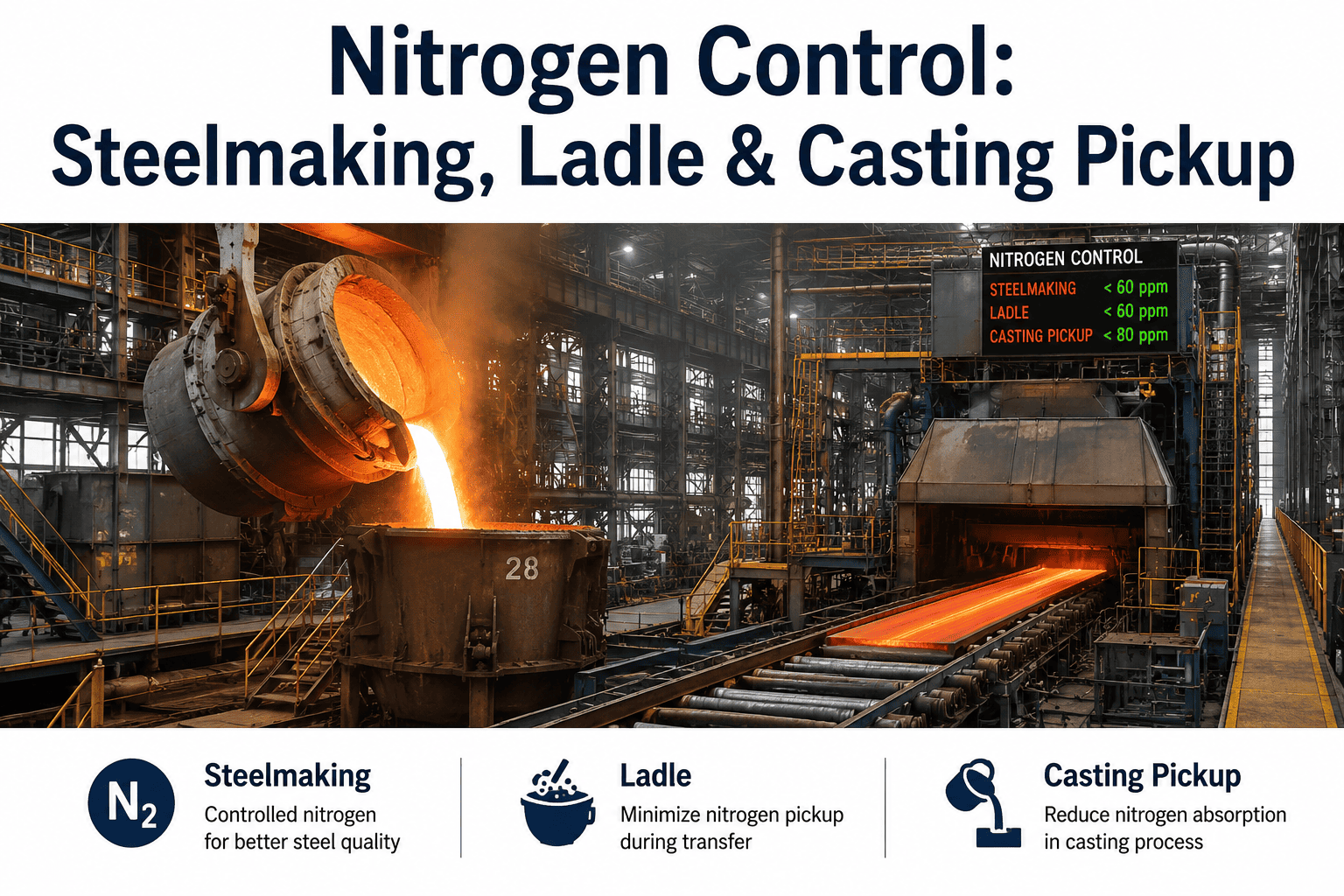
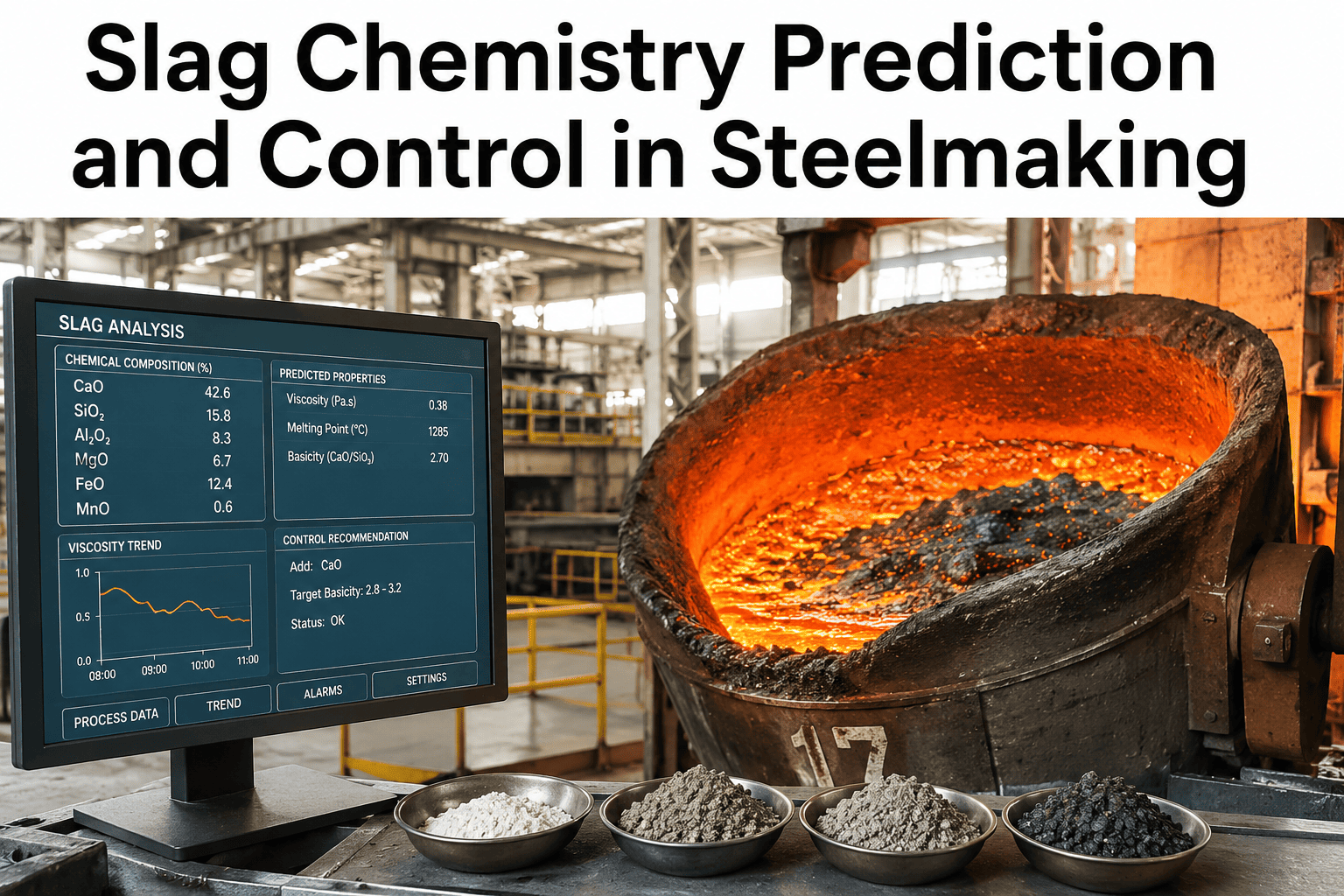
Nitrogen removal during vacuum degassing is slow and inefficient because the diffusion coefficient of nitrogen in liquid steel is approximately ten times lower than that of hydrogen, and the nitrogen removal rate is strongly inhibited by the presence of dissolved oxygen and sulfur at the steel surface which block the nitrogen recombination and desorption reaction sites. If the ladle slag is not properly conditioned before vacuum treatment — if the FeO content in the slag is above 2% or the slag basicity is below 2.5 — the arc from the RH-OB oxygen lances or the stirring action of the circulation gas can entrain slag into the steel and cause nitrogen pickup that increases the nitrogen content by 5 to 15 ppm during treatment. AI nitrogen models trained on steel and slag chemistry data, vacuum process parameters, and treatment time predict the nitrogen removal rate and the risk of nitrogen pickup during each treatment phase, enabling the operator to adjust the slag condition, oxygen lance position, and circulation gas flow rate to prevent nitrogen contamination that would downgrade the heat from its target grade specification.
Ultra-Low Carbon Decarburization Control in RH-OB Operations
The RH-OB process achieves carbon contents below 20 ppm by injecting oxygen through submerged lances into the steel circulating through the vacuum vessel, driving the carbon-oxygen reaction that removes carbon as CO gas while simultaneously providing the thermal energy from the exothermic reaction to compensate for vacuum vessel heat losses. The decarburization rate changes dramatically as the carbon content approaches ultra-low levels — at carbon contents above 100 ppm the rate is controlled by oxygen availability, while below 50 ppm the rate becomes controlled by carbon diffusion to the reaction sites, reducing the rate from 5 to 8 ppm per minute at the start to 0.5 to 1.5 ppm per minute in the final decarburization phase. AI models trained on offgas CO/CO2 composition data, oxygen lance flow rates and positions, vessel pressure, and steel temperature predict the instantaneous carbon content throughout the decarburization cycle and recommend the oxygen flow profile, lance position, and endpoint timing required to achieve the target carbon content in the minimum cycle time without over-blowing that wastes oxygen and extends treatment time.
Vacuum Pump Health and Energy Optimization
The vacuum pump system — typically a multi-stage steam ejector system with 4 to 6 stages operating at steam pressures of 8 to 16 bar or a mechanical pump system with dry screw or roots blower configurations — consumes 18 to 35% of the total secondary steelmaking energy per heat through steam generation or electrical power demand. The pump system must maintain the required vessel pressure of 0.5 to 5 millibar throughout the treatment cycle while responding to the gas load from the decarburization reaction, the circulation argon flow, and any air leakage through vessel seals and lance ports. AI models trained on pump performance data, vessel pressure response curves, and steam consumption or power draw patterns predict the optimal pump stage sequencing and steam pressure setpoints for each treatment phase, reducing energy consumption by 18 to 30% while ensuring that the vacuum system always has sufficient pumping capacity to maintain the required vessel pressure for effective degassing.
Five AI Capabilities That Transform Vacuum Degassing Process Control
iFactory's Vacuum Degassing Process Optimizer platform delivers five integrated capabilities purpose-built for the operating dynamics of RH, RH-OB, RH-KTB, and VD process configurations — covering the full treatment from hydrogen removal kinetics through ultra-low carbon decarburization to vacuum pump health optimization. Each capability operates on sensor data from existing vacuum degasser instrumentation and delivers actionable recommendations to the operator through a dedicated console without modifying existing vacuum degasser control system logic.
Machine learning models trained on 12 to 18 months of vacuum degasser heat data — including initial hydrogen content from primary steelmaking, vessel pressure profiles, circulation gas flow rates, steel temperature, and slag condition data — predict the hydrogen content in the steel at 1-minute intervals with a treatment cycle prediction horizon. The model accounts for the decreasing hydrogen removal rate as the hydrogen content approaches the equilibrium value determined by the vessel pressure and the mass transfer coefficient, recommending the circulation gas rate and treatment duration to achieve the target hydrogen content in the minimum cycle time. When the removal rate falls below an economically effective threshold — typically 0.05 ppm per minute — the model recommends terminating the degassing cycle to avoid wasting treatment time beyond the point of diminishing returns.
AI decarburization models trained on offgas CO/CO2 composition data, oxygen lance flow and position, vessel pressure, and steel temperature predict the instantaneous carbon content throughout the RH-OB treatment cycle, distinguishing between the oxygen-limited and carbon-limited decarburization regimes that govern the removal rate at different carbon concentration ranges. The model recommends the oxygen flow profile — typically 800 to 2,000 Nm³/h per lance depending on vessel size and steel temperature — and the oxygen lance vertical position in the up-leg snorkel to optimize the oxygen utilization efficiency and prevent excessive temperature increase from the exothermic reaction. Operators report achieving carbon contents below 15 ppm consistently with 95%+ first-attempt hit rate, compared to 75 to 85% with conventional operator-controlled decarburization practice.
AI nitrogen models continuously assess the nitrogen removal rate and the risk of nitrogen pickup based on the current slag condition, dissolved oxygen content, sulfur content, circulation gas rate, and vacuum vessel pressure. When the model detects conditions that increase nitrogen pickup risk — slag FeO above 3%, slag basicity below 2.3, dissolved oxygen above 50 ppm at the steel surface, or excessive slag entrainment indicated by pressure fluctuations and offgas composition changes — the system alerts the operator and recommends corrective actions including slag conditioner addition, oxygen lance position adjustment, or circulation gas flow reduction. The model predicts the final nitrogen content within 2 to 4 ppm accuracy, enabling the operator to confirm that the heat will meet the nitrogen specification without waiting for post-treatment sample analysis.
The vacuum degasser operator must predict the steel temperature at the end of treatment based on the starting temperature from the ladle furnace, the heat losses through the vacuum vessel refractory (5 to 15°C per cycle), the temperature drop from the oxygen lancing reaction in RH-OB operations (20 to 40°C), and the cooling effect of the circulation argon gas. AI thermal models trained on temperature measurement data, vessel refractory condition tracking, circulation gas flow rates, and oxygen blowing parameters predict the temperature trajectory through the treatment cycle within ±3°C, enabling the operator to determine whether the starting temperature is adequate to complete the degassing cycle and deliver the steel to the caster at the target tundish temperature. When the model predicts an insufficient final temperature, it recommends adjustments to the LRF heating target before the steel arrives at the vacuum degasser, preventing the cycle disruption caused by having to return the heat to the LRF for additional heating.
The vacuum pump system performance is continuously monitored through pump stage temperature, differential pressure, steam flow rate or motor current draw, and the time required to evacuate the vessel from atmospheric pressure to the target operating pressure at the start of each treatment cycle. AI models trained on pump performance data across the full operating range predict the optimal pump stage sequencing and operating setpoints for each treatment phase — initial evacuation, active degassing, deep degassing for ultra-low hydrogen and carbon targets, and vacuum break — to maintain the required vessel pressure at each phase while minimizing steam consumption or electrical power demand. The model detects pump performance degradation from fouling, wear, or steam quality issues and alerts maintenance personnel before the pump efficiency decline affects treatment cycle time or quality outcomes. Typical energy reduction: 18 to 30% compared to fixed-stage pump operation practice.
Conventional Vacuum Degasser Control vs AI-Enabled Vacuum Degassing Optimization
The performance gap between conventional vacuum degasser control and AI-enabled optimization is visible across every operating dimension that determines secondary steelmaking quality and profitability for premium-grade production. The comparison table below maps twelve critical vacuum degasser operating parameters against conventional and AI-enabled approaches, showing the performance improvement that an integrated process optimization platform delivers. Book a Demo to discuss which AI capabilities deliver the highest ROI for your RH, RH-OB, or VD vessel configuration, steel grade portfolio, and quality specification requirements.
| Operating Parameter | Conventional Vacuum Degasser Control | AI-Enabled Vacuum Degassing Optimization | Improvement |
|---|---|---|---|
| Hydrogen removal endpoint accuracy | Operator estimates treatment duration based on empirical rules and starting hydrogen content; post-treatment sample determines success with no in-cycle chemistry visibility | AI predicts hydrogen content at 1-minute intervals from vessel pressure, circulation rate, and starting conditions; recommends treatment endpoint when target hydrogen content is reached | 10–20% improvement in hydrogen removal efficiency; eliminates 15–25% of under-treated heats requiring re-treatment |
| Ultra-low carbon hit rate (<20 ppm) | 75–85% of heats achieve target carbon below 20 ppm; 15–25% require extended treatment or are downgraded due to carbon content above specification | 92–97% first-attempt hit rate for carbon below 20 ppm; AI predicts carbon content from offgas composition and recommends oxygen flow profile and endpoint | +15 to 20 percentage points; reduces downgrades by 50–70% for ultra-low-carbon grades |
| Treatment cycle time | 20–35 minutes per heat; operator extends treatment beyond target to ensure specification is reached due to lack of in-cycle quality visibility | 15–28 minutes per heat; AI recommends minimum treatment duration based on real-time kinetics model and quality target | 12–22% reduction in average treatment cycle time; enables 3–6 additional heats per day |
| Nitrogen control | 5–15 ppm nitrogen pickup is common during RH-OB treatment; operator has limited visibility into nitrogen pickup risk factors during active degassing | <3 ppm nitrogen pickup typical; AI monitors slag condition, oxygen content, and circulation parameters to alert operator to nitrogen pickup risk | 60–80% reduction in nitrogen pickup; enables consistent nitrogen specification compliance |
| Temperature prediction accuracy | ±8–15°C prediction error; operator compensates with conservative starting temperature target from LRF, adding 10–20°C safety margin | ±2–4°C prediction error; AI thermal model accounts for vessel condition, oxygen blowing parameters, and circulation gas cooling | 60–75% reduction in temperature prediction error; eliminates unnecessary heating margin |
| Vacuum pump energy consumption | Fixed-stage pump sequencing for all treatment cycles; no adjustment for varying gas loads from decarburization or air leakage conditions | AI optimizes pump stage sequencing and setpoints per treatment phase based on gas load prediction; reduces steam/power demand | 18–30% reduction in vacuum pump energy consumption; saves $0.15–$0.40 per ton |
| Decarburization oxygen efficiency | Fixed oxygen flow rate and lance position per grade group; operator adjusts based on experience and offgas temperature trends | AI recommends variable oxygen flow profile and lance position based on real-time decarburization rate and carbon content prediction | 10–18% reduction in oxygen consumption per ton; improved temperature control from optimized reaction heat input |
| Circulation argon consumption | Fixed circulation gas flow rate of 30–60 Nm³/h per leg throughout treatment; no adjustment for changing mass transfer requirements | AI recommends variable circulation flow profile optimized for hydrogen removal phase, decarburization phase, and temperature control phase | 12–20% reduction in argon consumption; optimized mass transfer conditions per treatment phase |
| Vessel refractory life | 120–200 heats per campaign; refractory wear accelerated by thermal cycling, slag attack, and oxygen lance flame impingement | 140–240 heats per campaign; AI thermal management reduces peak temperature exposure and optimizes oxygen lance position to minimize refractory wear | 15–25% extension in vessel refractory campaign life; saves $0.08–$0.20 per ton |
| Heat-to-heat quality consistency | CV of 20–35% for hydrogen removal across heats; operator experience level and shift culture drive treatment outcome variability | CV of 8–15% for hydrogen removal; standardized AI recommendations reduce heat-to-heat variability across shifts | 50–60% reduction in quality outcome variability; consistent premium-grade qualification rates |
| Operator decision support | Operator relies on experience, pre- and post-treatment sample analysis, written practice guides, and visible process parameters with no integrated process model | AI console shows real-time hydrogen, carbon, and nitrogen content predictions; vessel pressure trajectory; temperature forecast; and recommended treatment endpoint | Standardizes decision quality across shifts; reduces operator training time by 40–60% for new degasser operators |
| Data integration and traceability | Manual logging of treatment parameters, sample results, and process observations in spreadsheets or production databases with limited search and analysis capability | Automatic capture of all vacuum degasser process parameters at 1-second granularity; AI predictions, operator responses, and heat quality outcomes stored in searchable database per heat | Complete per-heat digital record for quality traceability, grade development, vacuum pump maintenance planning, and process engineering analysis |
The Five Phases of AI-Optimized Vacuum Degassing Treatment
Deploying AI process optimization in a vacuum degasser requires a treatment phase-specific approach that accounts for the changing process conditions and quality objectives at each stage of the degassing cycle, from initial vessel evacuation through the deep degassing period to the vacuum break and temperature adjustment phase before casting.
What a Vacuum Degassing Operations Manager Learned Deploying AI Optimization on an RH-OB Station
Based on iFactory's deployments across vacuum degasser operations at U.S. integrated and mini-mill steel producers operating RH, RH-OB, and RH-KTB vessel configurations from 120 to 300 ton capacity with steam-ejector and mechanical vacuum pump systems, the following operational outcomes consistently emerge when AI process optimization is deployed with proper sensor infrastructure, operator adoption discipline, and phased deployment planning.
"I have managed vacuum degassing operations for eighteen years across two integrated steel mills operating RH-OB vessels from 180 to 250 tons serving slab casters producing automotive exposed, line pipe, and high-strength low-alloy grades requiring hydrogen below 2 ppm and carbon below 25 ppm for the most demanding quality specifications. For the first fifteen of those years, the vacuum degasser control philosophy was essentially unchanged from the original commissioning: the operator adjusted the circulation gas rate to the standard practice for the steel grade, set the vacuum pump stage configuration based on the treatment type, activated the oxygen lances at a fixed flow rate for the fixed duration specified in the practice guide, and waited for the post-treatment sample to confirm that the hydrogen and carbon targets were achieved. The operator had no visibility into the process inside the vacuum vessel during the treatment cycle and made every process decision based on experience, heuristic rules, and hope that the sample result would be within specification. The AI system changed that by providing a real-time prediction of the hydrogen and carbon content inside the vessel, a recommended treatment endpoint based on the actual removal kinetics of the current heat, and an oxygen lance control recommendation that adjusted the blowing profile in real time based on the offgas composition feedback. We reduced our average RH-OB treatment cycle time from 31 minutes to 24 minutes in the first 60 days of advisory deployment on our highest-volume automotive-grade family, and the operators on every shift now use the AI kinetics display as their primary process reference to determine when the heat has reached its quality target. The hydrogen removal endpoint prediction alone eliminated the need for 20% of post-treatment hydrogen samples because the operators trusted the AI prediction to certify that the hydrogen content was below the target specification — and every sample eliminated is 8 to 12 minutes of treatment cycle time that goes directly to increasing degasser productivity and caster throughput."