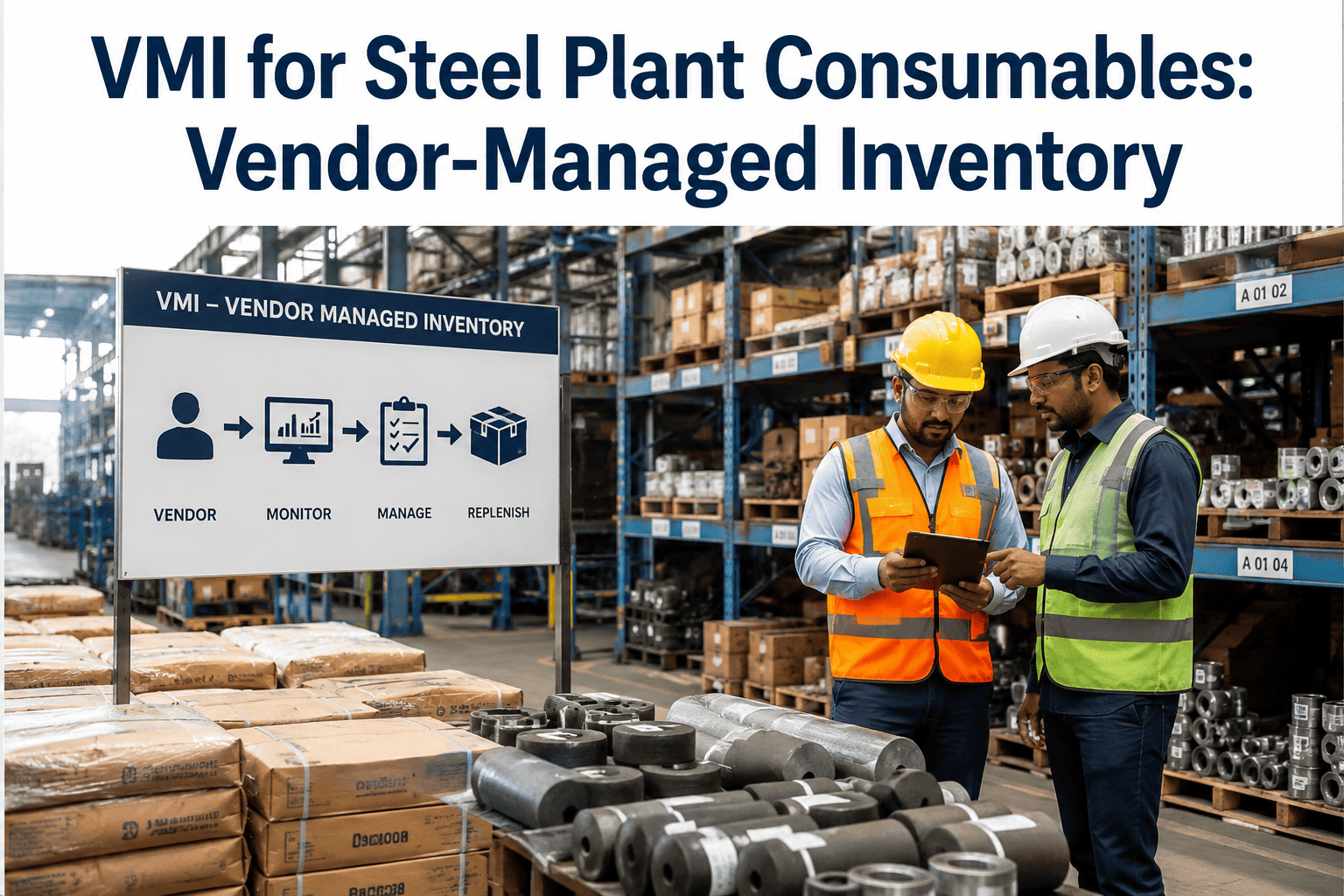
Refractory materials, welding consumables, and lubricants are among the highest-turnover items in a steel plant storeroom, and they are also some of the least suited to being managed with the same manual reorder process applied to a slow-moving custom gearbox. Vendor-managed inventory shifts the replenishment burden for these high-volume consumables to the supplier who already knows their own production and delivery capacity best. Book a demo to see VMI applied to your highest-turnover consumable categories.
Let the Supplier Who Makes the Part Manage the Shelf It Sits On
High-turnover consumables like refractory materials, welding rods, and lubricants consume a disproportionate share of purchasing and receiving effort relative to their strategic complexity. Vendor-managed inventory shifts replenishment ownership to the supplier under an agreed consumption and stocking framework, freeing your team's attention for the parts that actually need it.
Which Consumable Categories Suit a Vendor-Managed Model
The Core Elements of a VMI Program Structure
A functioning VMI agreement rests on a few clearly defined elements: agreed minimum and maximum stock levels for each item, a consumption reporting mechanism that gives the supplier visibility into actual usage, whether through periodic counts or connected sensors, and a defined ownership and billing structure that specifies when material transfers from supplier-owned consignment stock to plant-owned inventory, typically at the point of consumption.
Without clear consumption visibility, VMI degrades into the supplier guessing at replenishment timing, which defeats the purpose of the arrangement. This is why the most successful VMI programs pair the commercial agreement with a real data feed, whether that is periodic cycle counts shared with the supplier or a connected system that reports consumption automatically.
Give Your Consumables Suppliers the Data They Need to Manage Stock Well
iFactory connects consumption data directly to your VMI suppliers, replacing guesswork replenishment with a shared, accurate view of actual usage.
Comparing Manual Reordering to a Vendor-Managed Model
| Factor | Manual Reordering | Vendor-Managed Inventory |
|---|---|---|
| Who monitors stock levels | Plant purchasing or storeroom staff | Supplier, against agreed min/max levels |
| Purchasing transaction volume | High, frequent purchase orders for routine items | Low, consolidated billing on consumption |
| Stockout risk on routine items | Depends on manual diligence | Lower, supplier is contractually accountable |
| Plant staff time required | Significant for high-turnover items | Minimal, focused on exception handling |
The shift is not simply convenience, it also changes the accountability structure, since a VMI supplier that consistently fails to maintain agreed stock levels is directly measurable against the contract terms, giving the plant a clearer basis for a supplier performance conversation than an informal manual reordering relationship typically provides.
Five Steps to Setting Up a VMI Program
Common Questions About Vendor-Managed Inventory
Does the plant still own consignment stock sitting in a VMI arrangement, or does the supplier own it until consumed?
Most VMI agreements for consumables use a consignment structure where the supplier retains ownership of the material physically sitting on the plant's shelf until it is actually consumed, at which point ownership transfers and billing is triggered, meaning the plant does not carry that stock as owned inventory or tie up working capital in it while it sits unused. The specific ownership and billing terms are defined in the individual supplier agreement rather than being universal across every VMI program. Book a demo to review typical consignment structures for VMI agreements.
How does the plant maintain accountability if a VMI supplier repeatedly fails to keep agreed stock levels?
A well-structured VMI agreement includes measurable service level terms, such as a maximum acceptable stockout frequency or a required response time to a low-stock alert, giving the plant a contractual basis for a performance conversation or, if necessary, moving the category back to manually managed reordering or a different supplier. Consumption data visibility is what makes this accountability enforceable, since without an accurate usage record it is difficult to distinguish a supplier performance failure from a demand spike outside the agreed parameters. Contact support to discuss service level structuring for your VMI agreements.
What categories of spare parts are generally not well suited to a vendor-managed inventory model?
Vital, low-turnover, single-source parts with long lead times are generally poorly suited to VMI, since the model works best for high-volume, predictable consumables where a supplier can confidently manage stock without frequent plant intervention, while a rarely consumed critical spare needs a dedicated stocking decision that reflects downtime risk rather than routine replenishment logic. VMI is best applied selectively to the consumable categories where it fits rather than extended broadly across the entire parts catalog. Book a demo to identify which categories in your catalog fit a VMI model.
How is consumption data shared with the supplier in a typical VMI arrangement?
Consumption reporting ranges from simple periodic manual counts shared on a set schedule to barcode or RFID scanning at the point of use, up to connected sensor data for bulk items like tank-stored lubricants that report level continuously. The right mechanism depends on the item's value, consumption volatility, and how much manual effort the plant is willing to dedicate to reporting, with higher-value or higher-volatility items generally justifying more automated tracking. Contact support to set up consumption data sharing for your VMI categories.
Can a VMI program coexist with the plant's existing inventory classification and criticality system?
VMI works best as a replenishment mechanism applied to items already classified as lower-criticality, high-turnover consumables under your broader inventory strategy, rather than as a separate or competing system, so criticality classification should generally be finalized first and then used to identify which items are strong VMI candidates. This keeps the overall inventory strategy coherent rather than having two disconnected systems managing overlapping parts. Book a demo to see VMI integrated with your existing criticality classification.
Free Your Team From Managing Reorders on Routine Consumables
iFactory helps you structure and monitor VMI programs for refractory materials, welding consumables, and lubricants, giving suppliers the consumption data they need to keep shelves stocked reliably.