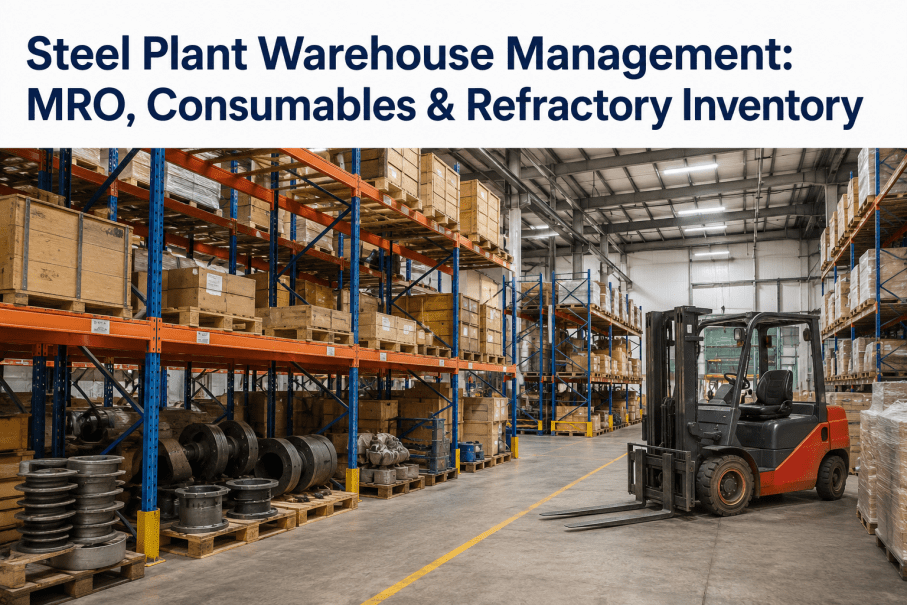
When a bearing fails on a rolling mill drive at two in the morning, the difference between a fifteen-minute repair and a two-hour production loss frequently comes down to whether the maintenance technician can walk directly to the right bin or has to search three aisles of unlabeled shelving while the line sits idle. Warehouse organization is not a housekeeping exercise, it is a direct input to mean time to repair. Book a demo to see how location and labeling data connects to your maintenance response time.
The Part Being on the Shelf Does Not Help If Nobody Can Find It Fast
A poorly organized MRO warehouse turns a stocked part into a wasted asset every time a technician has to search for it during a breakdown. 5S principles applied specifically to spare parts storage, combined with disciplined bin location and labeling, turns retrieval into a predictable, fast step instead of a scavenger hunt.
Applying 5S Specifically to an MRO Storeroom
What a Well-Designed Bin Location System Looks Like
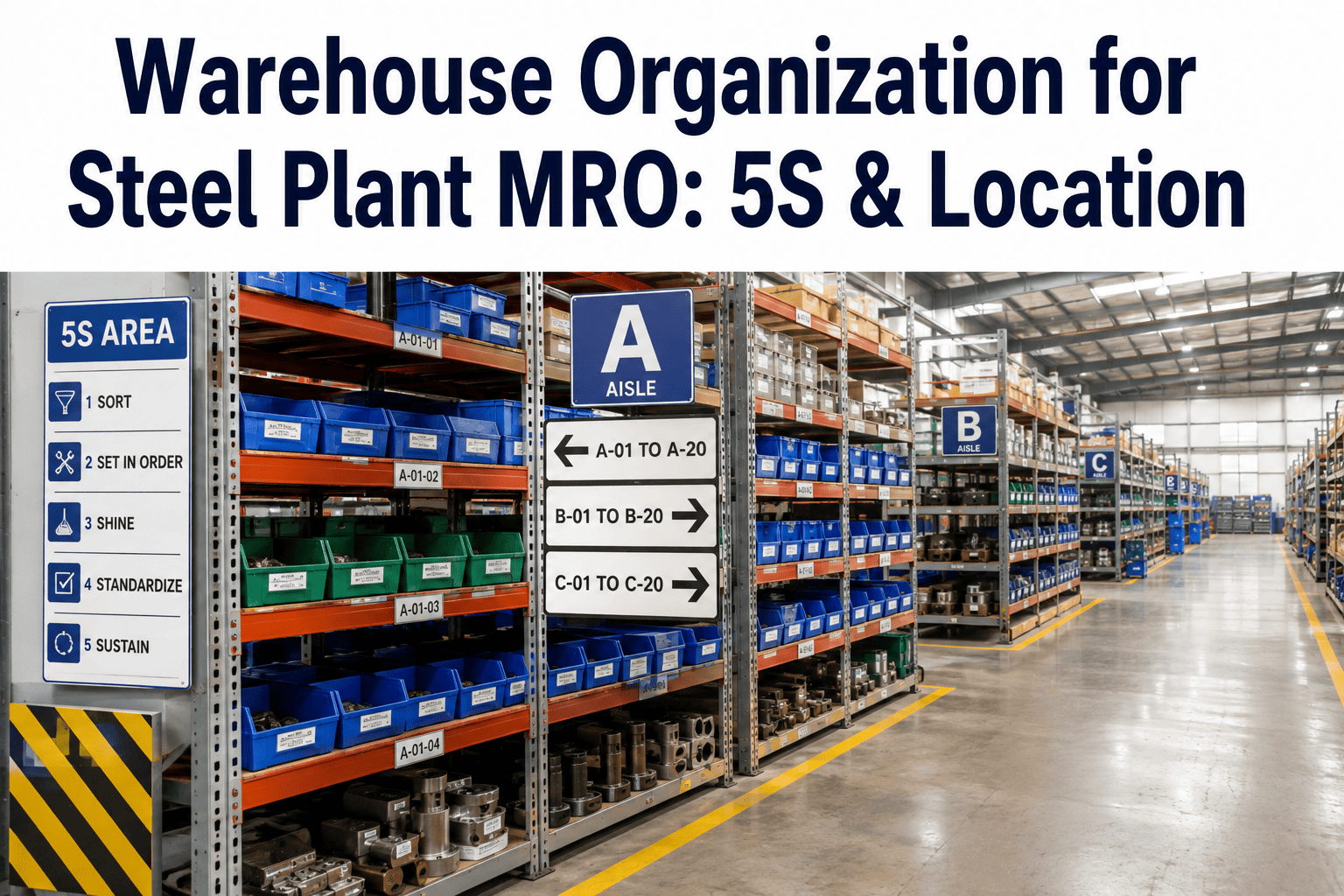
A functioning location system uses a consistent aisle-bay-shelf-bin code that any trained employee, not just the one who has worked there for a decade, can interpret and navigate to directly. The label itself should show the part number, description, and the associated equipment or asset it serves, since a technician arriving under pressure needs to confirm they have the right part quickly rather than cross-referencing a separate catalog.
Fast-moving and critical parts deserve placement closest to the storeroom entrance or issue counter, following the same logic warehouses use for high-velocity retail picking, since the parts retrieved most often or under the most time pressure should require the least travel distance. Slow-moving, low-criticality parts can occupy less accessible locations without meaningfully affecting response time.
Cut the Time Between Breakdown and Bin
iFactory helps design and audit bin location, labeling, and visual management standards that turn part retrieval into a fast, predictable step during a breakdown response.
What Organized Storage Changes About Breakdown Response
| Factor | Unorganized Storeroom | 5S-Organized Storeroom |
|---|---|---|
| Time to locate a known-stocked part | Minutes to tens of minutes, dependent on staff familiarity | Under a minute with a location lookup |
| Confidence a part is actually where the system says | Low, frequent location mismatches | High, with regular location audits |
| New or temporary staff productivity | Very low, dependent on tribal knowledge | High, system is self-explanatory |
| Risk of ordering a part already in stock | Elevated, hard-to-find stock gets duplicated | Low, visibility prevents duplicate ordering |
The productivity gap for new or temporary staff deserves particular attention, since a storeroom that only works because one experienced employee has the layout memorized is a significant operational risk the moment that person is unavailable, whether due to vacation, shift change, or turnover.
Simple Visual Cues That Speed Up Storeroom Navigation
Common Questions About MRO Warehouse Organization
How much of an impact does warehouse organization actually have on breakdown response time?
Part retrieval time is a direct, measurable component of total repair time during a breakdown, and while the exact impact varies by plant layout and storeroom size, facilities that move from an informal, tribal-knowledge storeroom to a labeled bin location system consistently report meaningful reductions in the time between a technician arriving at the storeroom and leaving with the correct part. For vital, long-lead-time parts, that saved time can be the difference between a short stoppage and an extended one. Book a demo to discuss expected impact for your storeroom layout.
Does implementing a bin location system require a full physical reorganization of the storeroom?
A full physical reorganization delivers the strongest result, but a phased approach starting with fast-moving and critical parts can deliver meaningful improvement without requiring the entire storeroom to be reorganized at once, allowing the highest-impact locations to be addressed first while a longer-term plan addresses the rest. The sort and set-in-order steps are typically the most disruptive and are worth planning around a period of lower storeroom activity. Contact support to plan a phased reorganization approach for your storeroom.
How is location accuracy maintained once the initial 5S organization is complete?
Location accuracy typically degrades over time without a recurring audit discipline, since parts get returned to the wrong bin, temporary staff put items away incorrectly, or new parts get added without a properly assigned location, which is why a scheduled cycle count and location audit process, checking a rotating sample of bins regularly rather than the entire storeroom at once, is essential to sustaining the initial organization effort. Book a demo to see recommended audit cadences for maintaining location accuracy.
Can warehouse organization standards integrate with a barcode or handheld scanning system?
A well-structured bin location and labeling system is the foundation a barcode or RFID scanning system builds on, since the physical labels need a consistent, machine-readable format for scanning to work reliably, and adding barcode capability to a poorly organized storeroom generally just automates the confusion rather than fixing it. Facilities considering handheld scanning are generally better served completing the physical organization and labeling standardization first. Contact support to plan barcode integration alongside your organization project.
Should fast-moving and slow-moving parts be stored differently within the same storeroom?
Placing fast-moving, high-consumption, and high-criticality parts in the most accessible locations closest to the issue counter, while relegating slow-moving, low-criticality parts to less convenient locations, reduces average travel distance across all retrievals and is a standard warehouse velocity-based slotting principle applied to an MRO context. This slotting decision should be revisited periodically as consumption patterns shift, since a part that was fast-moving two years ago may no longer justify prime shelf space today. Book a demo to see velocity-based slotting recommendations for your parts catalog.
Turn Part Retrieval Into a Predictable Step, Not a Search
iFactory helps design bin location, labeling, and visual management standards that make every part in your storeroom easy to find, even under breakdown pressure.