A fabric spec sheet that lists "50,000 rubs" without saying which test produced that number is not a durability claim — it is an unanswered question. Martindale, Wyzenbeek, and Taber measure abrasion resistance using entirely different motions, different abradants, and different units, and a rub count from one method cannot be substituted for another without risking a fabric that fails in the field despite passing on paper. Sourcing, QC, and product teams specifying fabric for upholstery, apparel, or technical textiles can Book a Demo to see how iFactory tracks abrasion test results against the correct method and market for every fabric specification.The confusion around these three methods rarely comes from bad intent — it comes from the fact that all three produce a number that looks superficially similar: a five-digit figure representing how many times a mechanical arm rubbed a piece of fabric before something gave way. That surface similarity is exactly what makes the underlying differences dangerous to overlook. A buyer comparing two supplier certificates side by side, one reporting Martindale cycles and one reporting Wyzenbeek double rubs, can easily assume the higher number represents the more durable fabric when in fact the two figures are not measuring durability on the same scale at all.
Three Tests, Three Motions, Three Sets of Units
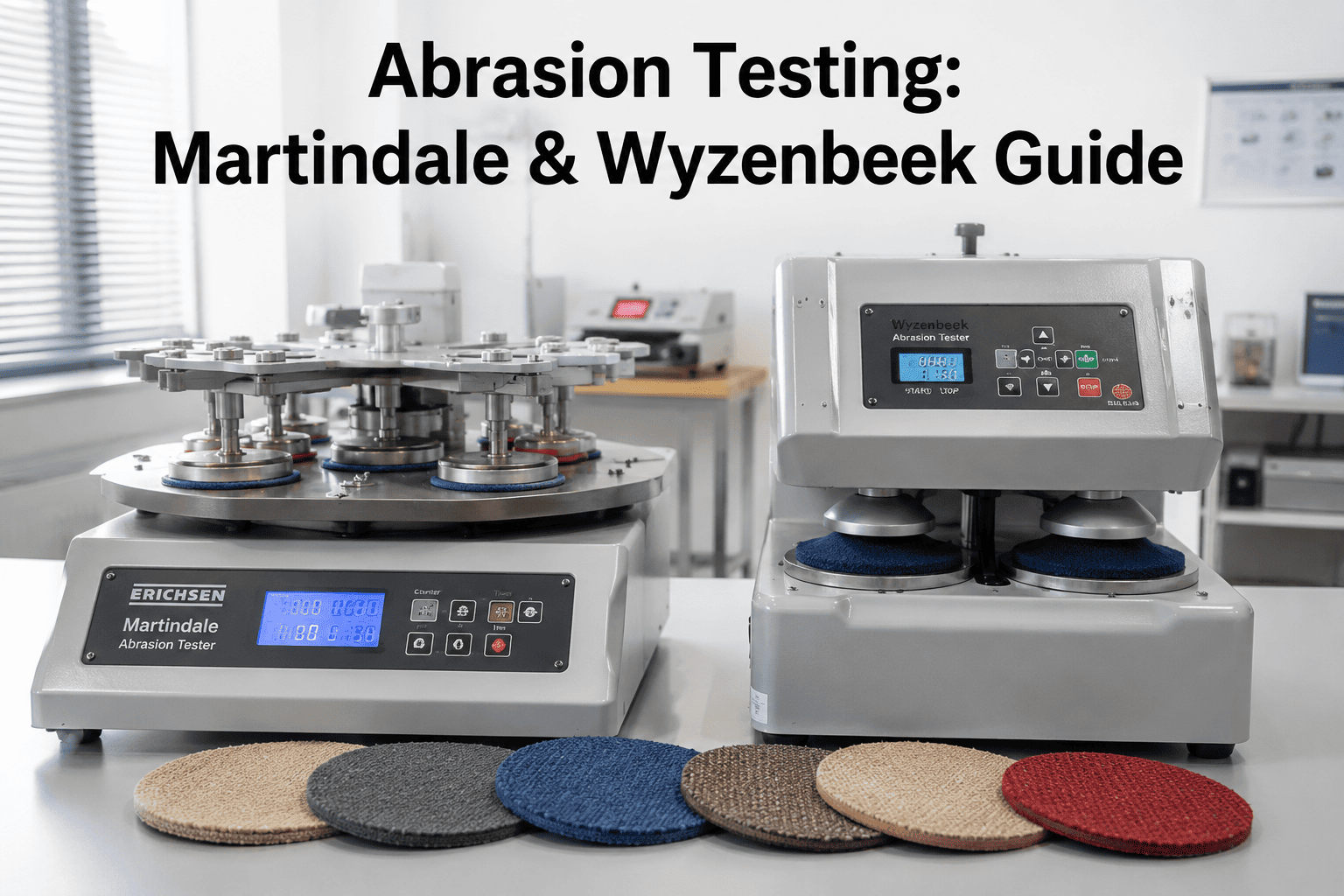
Abrasion resistance measures how much rubbing wear a fabric can withstand before it fails visually or structurally. That single concept splits into three dominant test methods worldwide, each built around a different physical motion and a different abradant material, which is exactly why their results are not interchangeable. Choosing the wrong test for a market or product category is one of the most common — and most expensive — specification errors in textile sourcing, since a fabric approved under one method's number can still fail a buyer expecting a different method entirely.
Each method also emerged from a different origin and a different original problem to solve, which partly explains why they never converged into a single global standard. Martindale traces back to wartime textile research in the United Kingdom, developed originally to evaluate gas-protection fabric durability before becoming the dominant civilian upholstery and apparel standard across Europe and Asia. Wyzenbeek grew out of the American textile testing tradition and became the entrenched convention for the US furniture and automotive industries specifically. Taber's rotating-wheel design was built around a fundamentally different problem — evaluating coatings, finishes, and hard flooring surfaces rather than woven textile structure — which is why it remains the preferred method for leather, vinyl, and carpet testing rather than woven upholstery fabric.
Why the Numbers Don't Convert Between Methods
The single most costly assumption in fabric specification is treating rub counts from different methods as directly comparable. They are not, and no reliable universal conversion factor exists — the physical mechanics of wear are simply too different between a figure-eight motion against soft wool, a linear motion against coarse cotton duck, and a spinning abrasive wheel against a flat sample.
Regional convention drives which test dominates a given market, and that convention matters more than any technical preference. Martindale, standardized under ISO 12947, is the default across Europe and much of Asia. Wyzenbeek, standardized under ASTM D4157, is the default across North America, particularly for upholstery. Presenting a Wyzenbeek double-rub count to a European specifier expecting Martindale cycles — or the reverse — creates confusion at best and a rejected shipment at worst, since building control officers, insurers, and contract buyers in each region are calibrated to their own convention's thresholds.
The safest practice for any supplier or brand selling into multiple regions is to test to both conventions independently for products crossing markets, rather than attempting to translate one result into the other. This doubles the testing line item, but it produces two genuinely defensible certificates instead of one certificate plus a disputed estimate. For fabrics staying within a single region's market, testing to that region's dominant convention only is the more cost-effective choice, provided the sourcing team is confident the product will not later be resold or redirected into a market expecting the other standard.
Durability Thresholds: Reading the Rub Count Against Real-World Use
Raw rub counts mean little without a reference scale connecting them to actual use categories. Both major methods have established, if imperfectly standardized, tiers that buyers and specifiers use to judge whether a fabric fits its intended application — from delicate decorative use through heavy commercial and contract environments.
These tiers are guidance, not law — individual specifiers, retailers, and contract standards each publish their own minimum thresholds, and a fabric destined for hospitality or healthcare contract use typically faces higher minimums than the same fabric sold for light residential use. Reading a rub count in isolation without checking it against the specific buyer's minimum threshold for that product category is a common and avoidable sourcing mistake.
It is also worth remembering that abrasion resistance is only one dimension of a fabric's overall durability profile, not a complete picture on its own. A fabric can post an excellent rub count and still underperform in the field due to poor colorfastness, weak seam strength, or inadequate pilling resistance — attributes abrasion testing does not directly measure. Buyers and product teams building a full durability specification typically pair abrasion test requirements with separate colorfastness, tensile strength, and pilling resistance criteria, rather than treating a strong rub count as a stand-in for overall fabric quality.
Endpoint Determination: What Actually Stops the Test
A rub count is only meaningful if everyone agrees on what condition ends the test. Each method defines its endpoint slightly differently, and knowing which criterion was used to stop a given test is as important as the number itself when comparing two supposedly similar fabrics.
Beyond the pass/fail breakdown endpoint, both Martindale and Wyzenbeek support supplementary assessments that go further than a simple cycle count. Appearance change assessment — covered separately under ISO 12947-4 for Martindale — rates surface changes like pilling, fuzzing, and color change against reference photographic standards even when the fabric has not technically broken down, since a fabric that survives the cycle count but looks visibly worn may still fail a buyer's practical durability expectations. Mass loss determination, covered under ISO 12947-3, measures the actual weight of fiber worn away during testing, providing a quantitative wear-rate figure that complements the pass/fail breakdown result.
The inspection interval matters more than it might first appear, particularly for Martindale testing. Checking a specimen too infrequently risks missing the exact cycle count at which breakdown occurred, understating the fabric's actual limitations or overstating them depending on which side of the true failure point the next inspection interval falls. This is why ISO 12947-2 specifies fixed inspection points — typically an initial check at 16 cycles followed by inspections every subsequent 8 cycles — rather than leaving inspection frequency to the tester's discretion. A laboratory that inspects at wider intervals than the standard specifies is producing a less precise endpoint determination, even if the final reported number happens to fall within a reasonable range.
Specification Reference: Standards, Abradants, and Load
Specifying a test correctly means citing more than just "Martindale" or "Wyzenbeek" — the specific standard part, abradant material, and applied load or pressure all affect the result, and omitting them leaves room for a testing lab to make assumptions that may not match what the buyer intended.
| Method | Governing Standard | Abradant | Reporting Unit |
|---|---|---|---|
| Martindale | ISO 12947-1 through -4 | Standard worsted wool cloth | Cycles, reported in multiples of 5,000 |
| Martindale (US equivalent) | ASTM D4966 | Standard worsted wool cloth | Cycles |
| Wyzenbeek | ASTM D4157 | Cotton duck canvas or wire screen | Double rubs, reported in sets of 5,000 |
| Taber (fabric / coated) | ASTM D3884 | CS-10 or H-18 abrasive wheels | Cycles |
| Taber (coated fabric alt.) | ASTM D3389 | CS-10 or H-18 abrasive wheels | Cycles |
Sample conditioning matters as much as the test itself and is frequently overlooked in informal supplier certificates. Specimens should be conditioned at standard atmospheric conditions — typically 20°C plus or minus 2 degrees and 65 percent relative humidity plus or minus 2 percent, per ISO 139 — before testing begins, since moisture content measurably affects fiber flexibility and therefore abrasion behavior. A certificate that doesn't confirm conditioning was performed under these controlled conditions carries meaningfully less confidence than one that does.
A useful practice when reviewing an incoming supplier certificate is to request the full test report rather than accepting a single summary number in isolation. A complete report identifies the specific standard part applied, the abradant type and grade, the applied load or pressure, whether backing was used, the conditioning method, and the exact endpoint criterion that stopped the test. Any certificate missing several of these details should prompt a follow-up request rather than an assumption that standard defaults were used — labs vary in rigor, and a shortened summary certificate is not the same evidentiary weight as a full test report referencing the governing standard explicitly.
Choosing the Right Test for Your Product
The correct test is determined by three factors working together: the product category, the target market, and the fabric construction — not personal preference or whichever machine happens to be available in a given lab.
Getting this decision wrong rarely surfaces immediately. A fabric tested to the wrong method can still ship, still pass an internal quality check, and still sit in a warehouse or a finished product for months before the mismatch becomes visible — usually when a retailer's compliance team rejects a shipment, an insurer questions a contract-grade certification, or a customer experiences premature wear the certificate suggested shouldn't have happened. Building the correct method into the sourcing specification from the start, rather than discovering the gap after a shipment is already in transit, is the difference between a routine testing line item and an expensive rework.