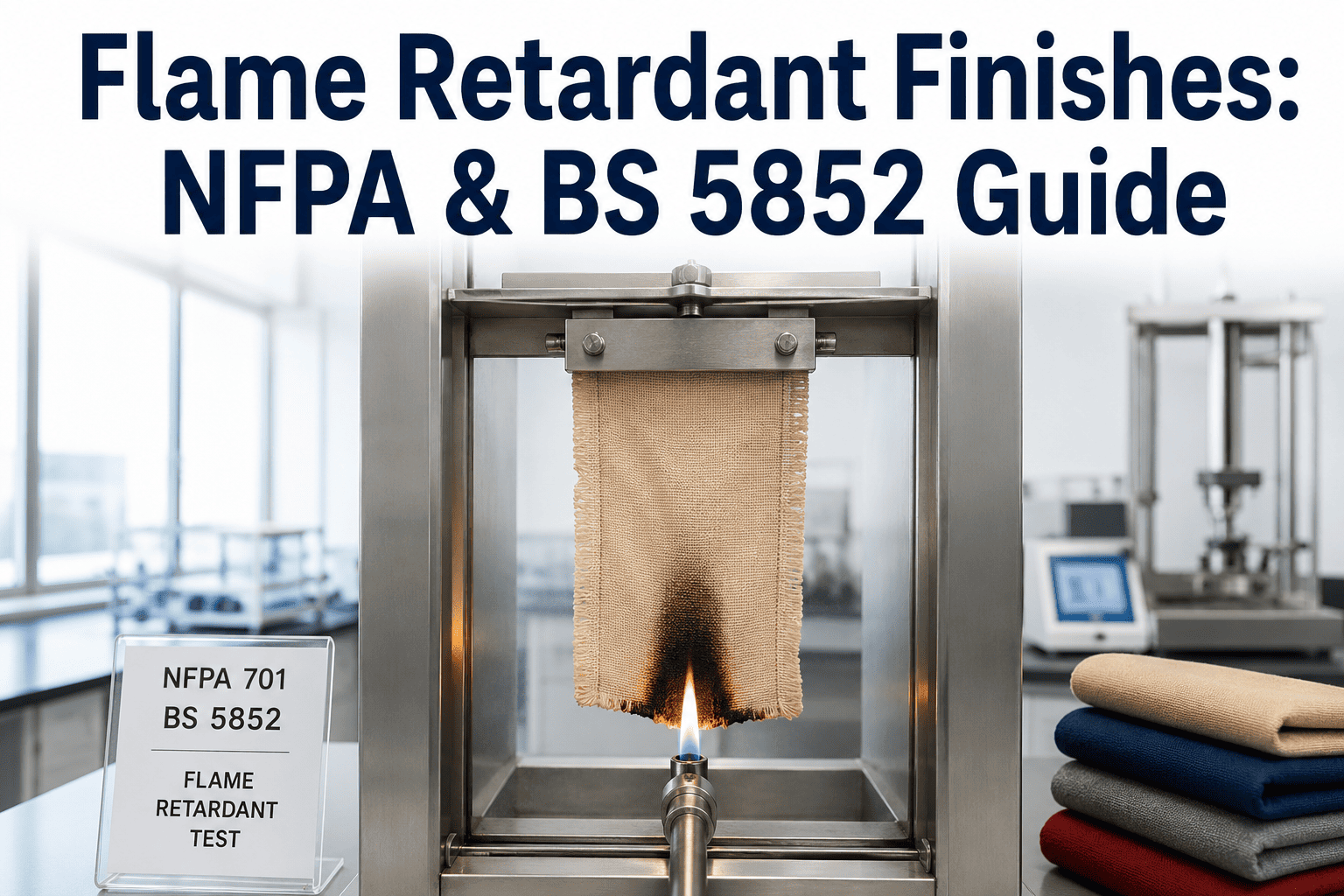
A children's pajama top and an adult cotton shirt can be cut from fabric that looks and feels identical off the same roll, yet one of them is legally required to self-extinguish against an open flame and the other is not. That difference is not a manufacturing detail, it is federal law, enforced under the Flammable Fabrics Act through three separate CPSC standards that apply depending on what the garment is and who wears it. Getting the wrong standard applied to the wrong product category is one of the most common and most expensive compliance mistakes in apparel manufacturing, and it usually surfaces at the worst possible moment, during a retailer audit or after a shipment has already left the port. Our compliance and quality engineering team works with manufacturers to build flammability verification directly into production rather than treating it as a final gate before shipment.
Three Standards, One Fire, Zero Room for the Wrong Test
16 CFR Part 1610 governs general apparel. Parts 1615 and 1616 govern children's sleepwear. Confusing the two is how compliant-looking garments end up recalled, and how compliant fabric ends up rejected by a buyer who tested it against the wrong standard.
How Part 1610 Classifies General Apparel Fabric
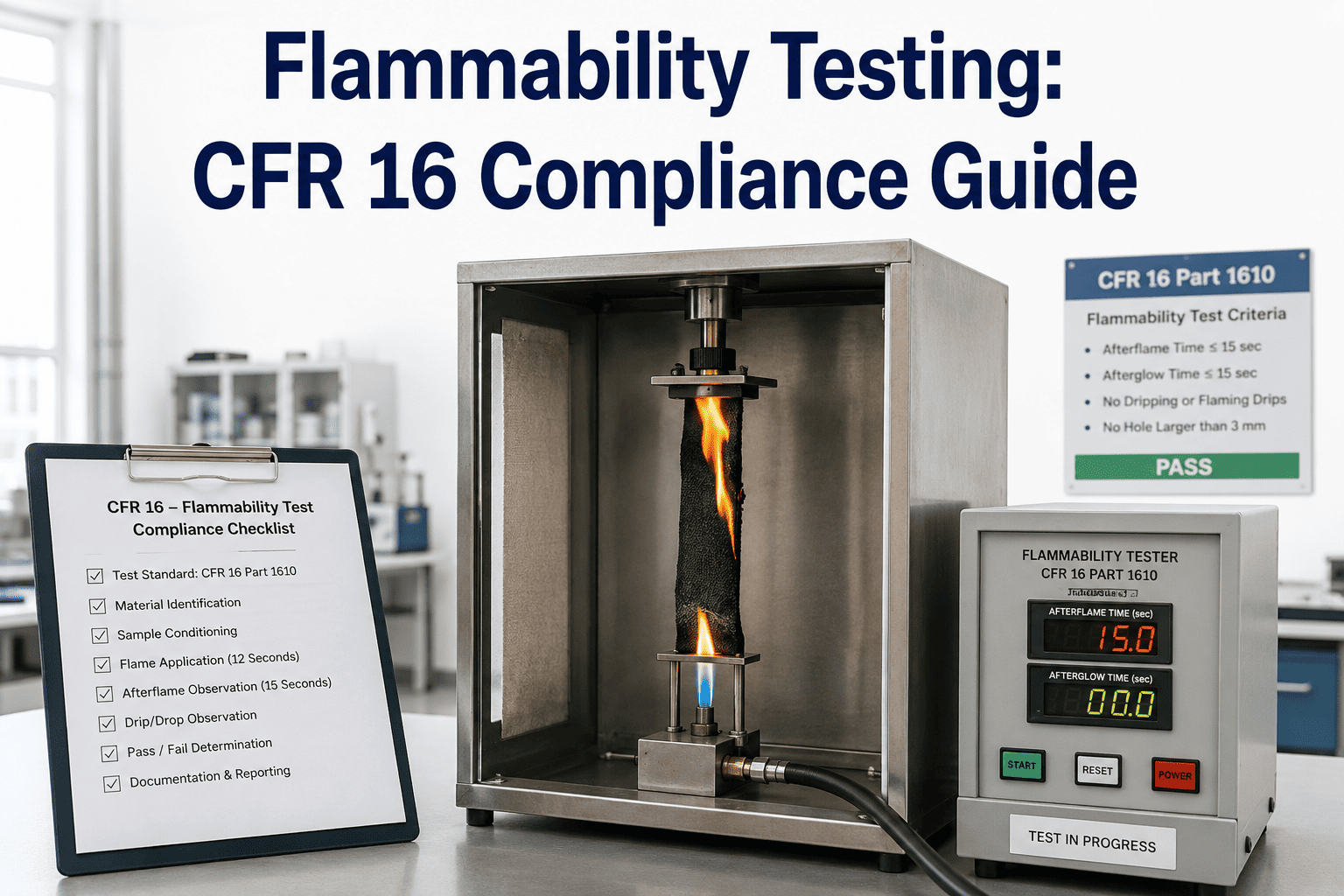
Part 1610 is the baseline standard that applies to essentially every clothing textile sold in the United States unless a more specific standard, like children's sleepwear, overrides it. Rather than a simple pass or fail, the standard sorts fabric into three flammability classes based on how fast a flame spreads across the surface and how it burns, and only one of those three classes is actually prohibited from commerce.
The test itself involves suspending a conditioned fabric specimen vertically in a specified cabinet and exposing its surface to a controlled flame for one second, then measuring how quickly the flame spreads across the specimen and timing the burn from start to finish. Five specimens are tested for each sample, and the classification is determined by the combination of average burn time and the specific burning behavior observed, whether the flame travels along the surface or burns through the base of the fabric, since raised-surface and plain-surface fabrics are evaluated slightly differently under the standard's burn code system.
Certain fabrics are exempt from Part 1610 testing entirely because years of testing data have shown they reliably pass, including plain surface fabrics weighing 2.6 ounces per square yard or more regardless of fiber content, and plain or raised surface fabrics made from acrylic, modacrylic, nylon, olefin, polyester, or wool. Relying on an exemption without documenting why it applies is a common gap auditors flag, since the exemption has to be demonstrably correct for the specific fabric construction and weight, not just assumed based on fiber type. Our team can help verify which exemptions genuinely apply to a given fabric line before it's built into a sourcing decision.
Where 1615 and 1616 Diverge from General Apparel Entirely
Children's sleepwear does not get the three-class system at all. Under Parts 1615 and 1616, covering sizes 0 through 6X and 7 through 14 respectively, there is effectively one pass and fail line measured by char length, the distance a flame burns up a vertically suspended fabric specimen before self-extinguishing. The average char length across five specimens cannot exceed seven inches, and no individual specimen can exceed ten inches. There is no intermediate classification and no acceptable middle ground.
This stricter standard exists because the risk profile for children's sleepwear is fundamentally different from general apparel. Children spend a large portion of their time in sleepwear near potential ignition sources, candles, stoves, space heaters, and unlike adults they often cannot react quickly enough to remove a burning garment or reach help. The char length test is designed to simulate exactly that scenario, a small flame contacting the lower edge of a nightgown or pajama, and to verify the fabric will stop burning on its own well before it could engulf the wearer. The two standards share nearly identical criteria, the primary difference between 1615 and 1616 being the size range and a handful of dimensional specifics tied to the age group each one covers.
The only way to avoid this test entirely is the tight-fitting garment exemption, which the CPSC allows because snug garments are statistically less likely to contact an open flame and less likely to sustain one if they do. Qualifying for that exemption requires meeting precise, size-specific dimensional limits at every measurement point, chest width, sleeve width, seat width, and several others, taken directly from official CPSC dimension tables rather than estimated by a pattern maker. A garment that misses a tight-fitting measurement at even one size point in the range loses the exemption for that size and has to pass the full char length test instead, or carry the required "Fits Snugly, Not Flame Resistant" label and matching hangtag.
The Three-Stage Testing Chain Sleepwear Actually Requires
Passing a single lab test on greige fabric is not sufficient for children's sleepwear compliance. The standards require verification at three separate stages, because flame resistance can be lost between raw fabric and a finished, washed garment in ways a single early test would never catch, particularly if a finish or trim is added downstream that wasn't present in the original fabric sample.
Trims are a frequent point of failure in this chain that gets underestimated. Lace, embroidery, ribbons, and other decorative elements over two inches in their longest dimension, or covering more than twenty square inches in aggregate, count as part of the tested garment and have to meet the same flame resistance standard as the base fabric. A sleepwear line that passes on the base fabric but adds an untested lace trim at the finished garment stage can fail the prototype test for a reason that has nothing to do with the fabric supplier's original compliance data.
Each of these three stages also generates its own record, tied to a specific Fabric Production Unit or Garment Production Unit rather than a blanket approval for the product line as a whole. This matters because a production run spanning multiple fabric batches, dye lots, or trim suppliers is not automatically covered by whatever test passed at the prototype stage. Manufacturers who treat the prototype result as a one-time approval for the entire season's production are taking on risk that a single changed input, a different lace supplier, a different dye lot, invalidates without anyone noticing until a retailer's independent test finds it first.
Why Compliant Fabric Still Fails After It Leaves the Mill
A fabric that tests within spec at the mill can still fail downstream for reasons that have nothing to do with the original weaving or knitting process. Flame retardant finishes, especially non-durable topical treatments, can degrade with laundering, which is why the standards require testing after a specified number of wash and dry cycles rather than only on unwashed fabric. A finish that passes fresh off the finishing line but hasn't been validated through the required wash cycles is a liability the manufacturer usually doesn't discover until a retailer's own lab testing catches it.
| Failure Point | Why It Happens | How It's Usually Caught |
|---|---|---|
| Finish degradation after washing | Non-durable topical flame retardant washes out over cycles | Post-wash char length retesting per the standard |
| Untested trim or lace addition | Decorative element added after base fabric was tested | Prototype-stage full garment testing |
| Dye lot variation | Different dye lots can shift char length results | Production unit testing per batch, not just once |
| Wrong standard applied | General apparel standard used instead of sleepwear standard | Product classification review before testing begins |
Dye lot variation is another underappreciated factor, since different dye lots of the same fabric construction can produce measurably different char length results even when the base fiber and weight are unchanged. This is part of why the standards allow multiple colors or print patterns to share a single Fabric Production Unit only when prior testing has shown their char lengths are not significantly different from each other, a requirement that gets skipped more often than it should when a mill assumes color has no bearing on flame performance.
Documentation That Has to Survive an Audit, Not Just a Shipment
CPSC compliance is not just about passing the test once, it is about being able to produce the records proving that test was done correctly, on the right units, using the right standard, for as long as the retention requirement demands. Test records under the children's sleepwear standards generally need to be maintained and available on request for a multi-year window, which means a manufacturer's internal recordkeeping system has to survive staff turnover, factory changes, and season-over-season product line updates without losing the paper trail.
This retention requirement is frequently underestimated because the failure mode is delayed rather than immediate. A manufacturer can ship several seasons of fully compliant, correctly tested product and still fail an audit years later if the underlying test reports, sampling records, or production unit documentation were archived inconsistently or lost during a system migration. The standards were written with this exact scenario in mind, since a fire incident investigation can occur long after the garment was sold, and the manufacturer needs to be able to demonstrate compliance for that specific production run regardless of how much time has passed.
- Test reports filed by season, hard to cross-reference by fabric batch
- Retailer audit requests answered by searching archived folders
- Wrong-standard mistakes caught only when a shipment is challenged
- Test records linked directly to fabric and garment production units
- Audit documentation generated on demand from production data
- Product classification checked against the correct standard automatically
What This Means for Sourcing and Buyer Relationships
Amazon and major retail buyers increasingly require a Children's Product Certificate that explicitly references test reports from a CPSC-accepted third-party laboratory, and the certificate has to cite the correct standard for the actual product category rather than a general apparel test substituted for a sleepwear requirement. Reviewers checking these certificates commonly flag the same handful of errors: citing 1610 for a product that is legally sleepwear, missing the Fabric or Garment Production Unit identifiers in the report, or submitting results that don't cover the required post-wash testing.
None of these errors are difficult to avoid once the product classification is settled correctly at the design stage, before fabric sourcing and testing even begins. The harder problem in practice is that classification isn't always obvious, a loose-fitting robe intended for lounging can still legally qualify as sleepwear depending on how it's marketed and sold, which pulls it into 1615 or 1616 regardless of what the manufacturer intended the garment to be used for. Getting that classification question answered early is what prevents a compliance problem from surfacing after fabric has already been committed, dyed, and cut.
The cost asymmetry here is significant and worth planning around deliberately. Verifying classification and building the correct testing chain into a production schedule from the start adds a modest amount of lead time and lab cost. Discovering a classification or documentation gap after a shipment has already reached a retailer's distribution center, or worse, after product is already on shelves, means a recall process, a Children's Product Certificate that has to be redone with correct citations, and a buyer relationship that now treats every future shipment from that manufacturer with additional scrutiny. The manufacturers who treat flammability compliance as a design-stage decision rather than a final pre-shipment check are the ones who avoid that asymmetry entirely.
Frequently Asked Questions
Build Flammability Compliance Into Production, Not Just Into the Final Report
Share your current product mix across general apparel and sleepwear categories. We'll show you where classification, testing stage, or documentation gaps are creating audit risk before a buyer or the CPSC finds them first.