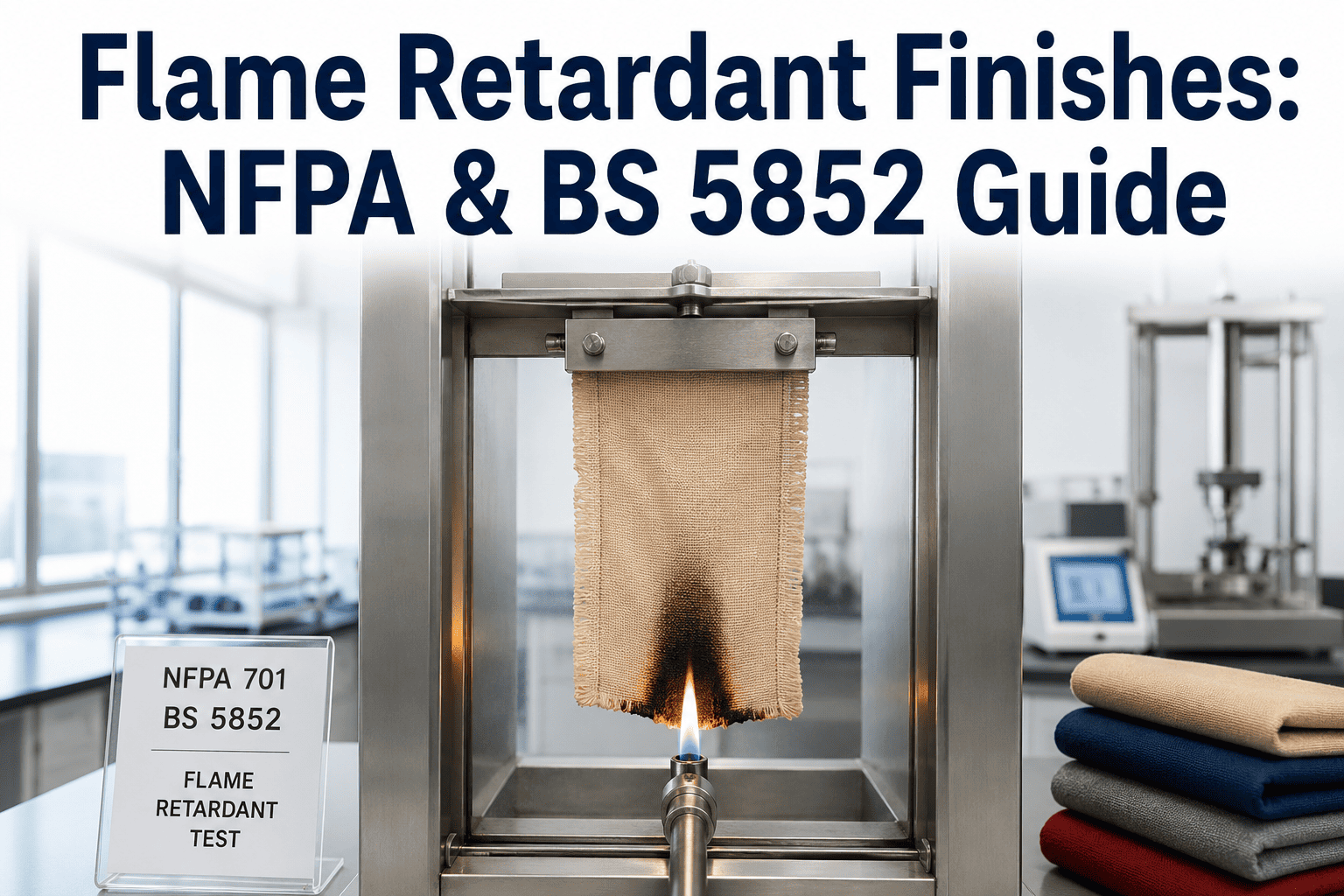
A furnishing fabric that meets flame retardant requirements in one market can fail the equivalent test in another entirely, because NFPA 701 and BS 5852 evaluate fire behavior through different ignition sources, exposure durations, and pass criteria despite both being widely referenced flame safety standards. For textile manufacturers supplying furnishing, workwear, and children's clothing markets across multiple regions, treating flame retardant compliance as a single global checkbox is one of the most common and costly sourcing mistakes, since a fabric validated for one market's test method carries no guarantee of passing another's, a distinction covered further in iFactory's support documentation.
01 / Why NFPA 701 and BS 5852 Are Not Interchangeable
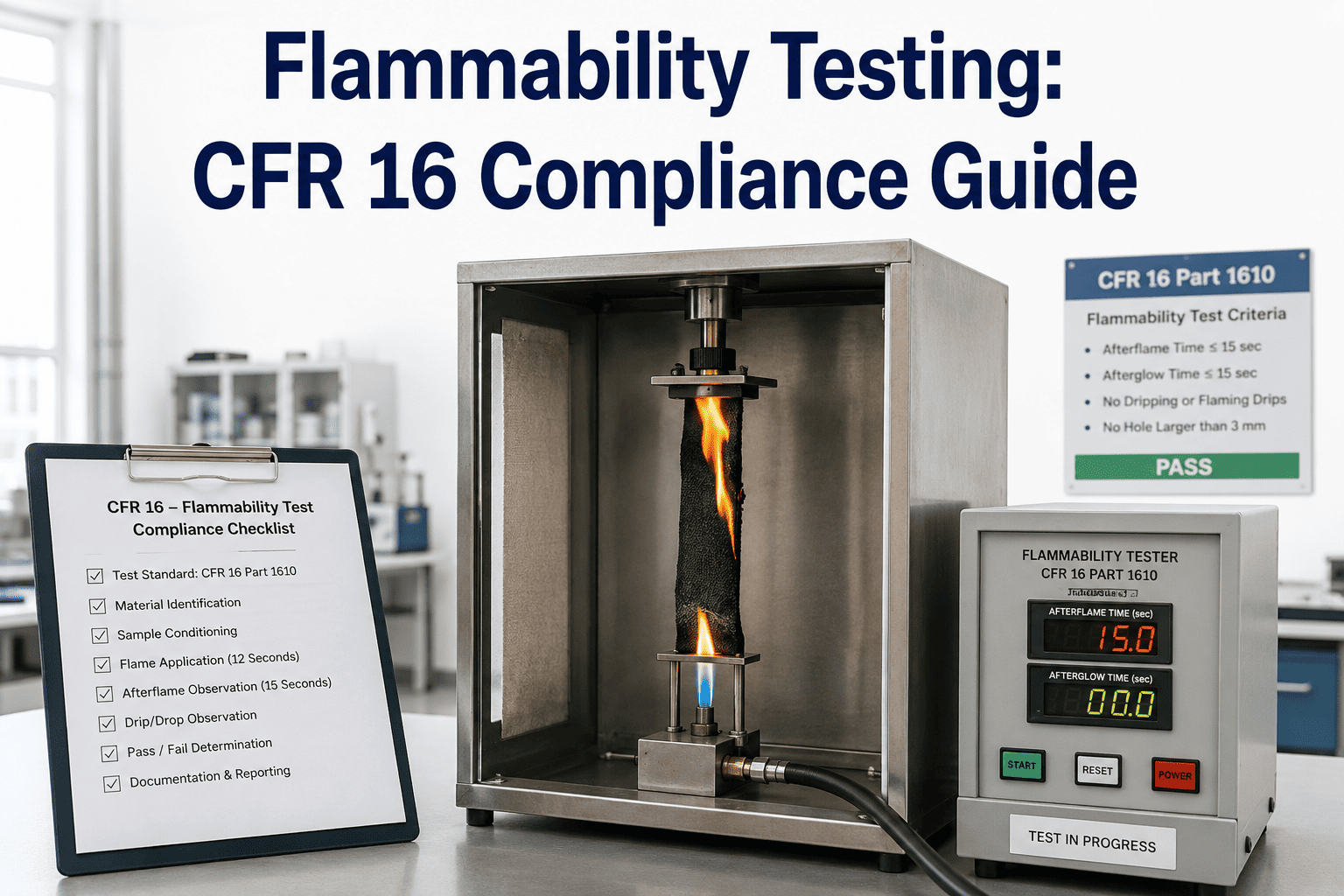
NFPA 701, the standard most commonly referenced in the United States for furnishing and drapery fabric, exposes a vertically hung fabric sample to a controlled flame for a fixed exposure time and measures char length, afterflame time, and whether flaming or glowing material drops from the sample. BS 5852, widely used across the UK and much of Europe, instead uses a small ignition source — typically a simulated cigarette or match-flame equivalent — applied to fabric mounted over a specific foam substrate configuration meant to approximate actual furniture construction, and measures whether ignition progresses beyond a defined point. The practical consequence is that a fabric engineered and tested to pass NFPA 701's vertical flame exposure has no established equivalence to BS 5852's furniture mock-up ignition resistance, and vice versa — each requires its own validated finish formulation and its own test run against the specific standard a target market requires.
02 / FR Chemical Selection by End-Use Category
Flame retardant chemistry selection is driven as much by end-use handling and regulatory context as by the target flame test itself, and children's clothing in particular carries additional chemical restriction requirements that furnishing fabric does not face.
| End-Use Category | Typical FR Approach | Key Consideration |
|---|---|---|
| Furnishing & Drapery | Topical FR finish or inherently FR fiber blends | Durability to dry cleaning and UV exposure over furniture lifespan |
| Industrial Workwear | Inherently FR fiber or durable topical treatment | Durability through repeated industrial laundering cycles |
| Children's Sleepwear | Tight-fitting design exemption or approved FR chemistry | Chemical restriction lists specific to children's product regulation |
| Contract & Hospitality Textiles | Topical FR finish matched to target market standard | Multi-market compliance if fabric supplies both US and European buyers |
03 / Durability to Washing — Where FR Finishes Are Most Commonly Lost
A flame retardant finish validated at the point of manufacture provides no ongoing protection if it washes out or degrades before the product reaches the end of its intended service life, which is why durability testing across realistic laundering cycles is as important to a defensible FR claim as the initial flame test itself.
04 / Compliance Testing Sequence for Multi-Market Products
Manufacturers supplying furnishing or workwear fabric to buyers across multiple regions typically need to plan a testing sequence that validates against each relevant standard rather than assuming a single test result transfers.
05 / Documentation That Holds Up Under Buyer Audit
Flame retardant compliance documentation increasingly faces the same independent verification scrutiny as antimicrobial and other functional textile claims, and building a defensible record depends on traceability from finish batch through test result.
Conclusion — Match the Standard to the Market, Then Prove Durability
Flame retardant compliance across furnishing, workwear, and children's clothing markets depends on matching the correct test standard to each target market and validating that protection survives the product's realistic service life, rather than treating a single flame test result as universally transferable. Book a demo to review your current FR finish and testing documentation against your target markets.
Frequently Asked Questions — Flame Retardant Textile Finishes
No — passing NFPA 701 provides no guarantee of passing BS 5852, since the two standards use fundamentally different ignition sources, test configurations, and pass criteria. NFPA 701 evaluates a vertically hung fabric sample's response to a defined flame exposure, while BS 5852 tests fabric mounted over a foam substrate against a small ignition source meant to simulate a cigarette or match dropped onto upholstered furniture. A fabric formulated and finished specifically to meet NFPA 701's char length and afterflame requirements may or may not have the ignition resistance BS 5852 measures, and the only reliable way to confirm compliance with both is to test against both standards independently rather than assuming cross-standard equivalence, as detailed further in iFactory's support documentation.
Inherent FR fiber has flame resistance built into the polymer structure of the fiber itself, meaning the flame retardant property does not wash out or degrade over the fabric's service life, which makes it the preferred choice for applications requiring durable protection through extensive laundering, such as industrial workwear. Topical FR finish, by contrast, is a chemical treatment applied to fabric after it is woven or knit, and while modern durable topical finishes can maintain performance through many wash cycles, they generally show more gradual activity decline over time than inherent fiber-based protection. The tradeoff is typically cost and handfeel — inherent FR fiber tends to carry a higher raw material cost and can affect fabric drape and comfort differently than a topical finish applied to a standard fiber base.
Yes — children's clothing, and children's sleepwear in particular, faces additional chemical restriction requirements in most major markets beyond standard flame performance testing, since certain flame retardant chemistries have raised health and safety concerns specific to prolonged skin contact and ingestion risk in young children. Regulatory frameworks in the United States, European Union, and other major markets maintain specific lists of restricted or banned flame retardant chemicals for children's textile applications, and these restrictions are updated periodically as new safety research emerges. Many children's sleepwear products instead rely on tight-fitting garment design exemptions that reduce flame test requirements rather than chemical FR treatment, which avoids the chemical restriction question entirely but requires the garment to meet specific fit and sizing criteria to qualify for the exemption.
Durability testing for industrial workwear typically involves laundering fabric samples through a specified number of industrial wash cycles — commonly fifty or more — using detergent and wash conditions representative of actual industrial laundry service, then repeating the flame retardant test to confirm performance still meets the required standard. This differs from home laundering test protocols in both the detergent chemistry and mechanical action involved, since industrial laundering is typically more aggressive and uses different chemical formulations than consumer detergents. Fabric validated only against home laundering conditions may not accurately represent performance under actual industrial laundry service, which is why workwear-specific durability protocols matched to the real laundering environment are important for defensible FR claims in this category.
Dry cleaning solvents interact with flame retardant finishes differently than water-based laundering, and furnishing and drapery fabrics — which are more commonly dry cleaned than washed — need durability validation specific to dry cleaning cycles rather than assuming laundering durability data applies. Some topical FR finishes that hold up well through repeated water-based washing can show different degradation patterns under dry cleaning solvent exposure, and the reverse is also true for finishes optimized for dry cleaning environments. Furnishing fabric manufacturers should confirm which cleaning method their product will realistically undergo in service and validate FR durability against that specific method rather than a generic durability claim. Book a demo to review durability testing appropriate to your product's expected care method.