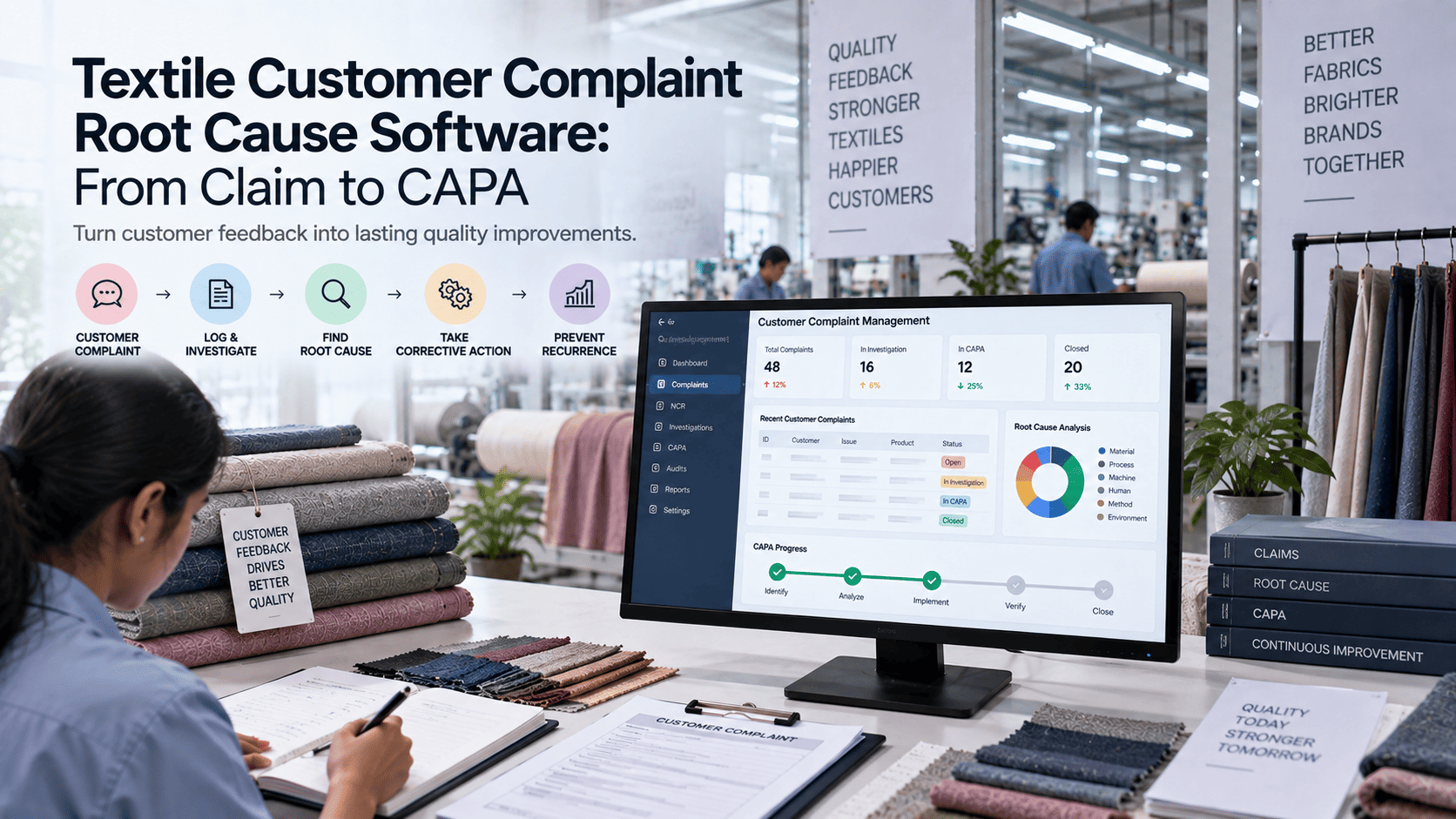
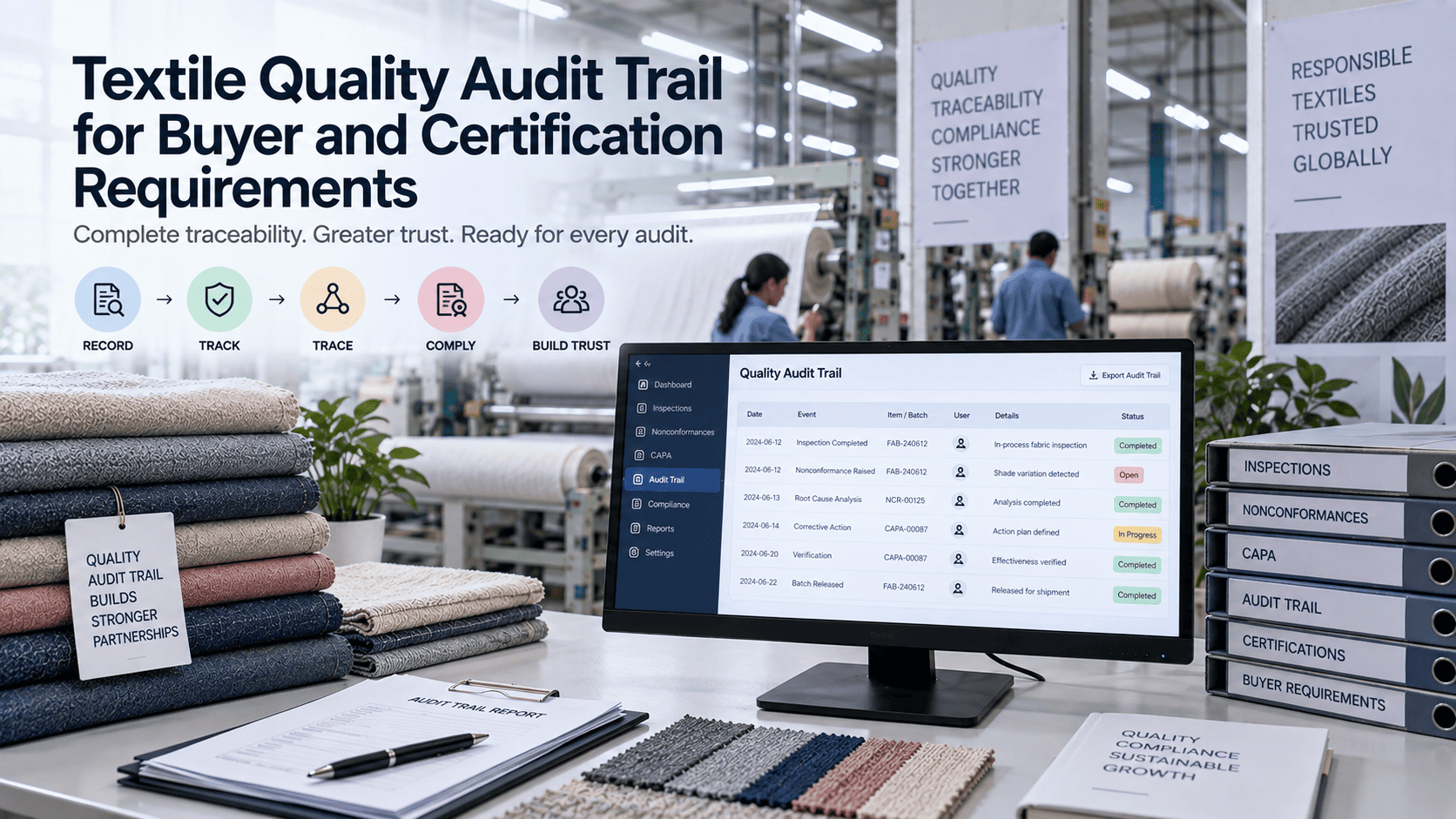
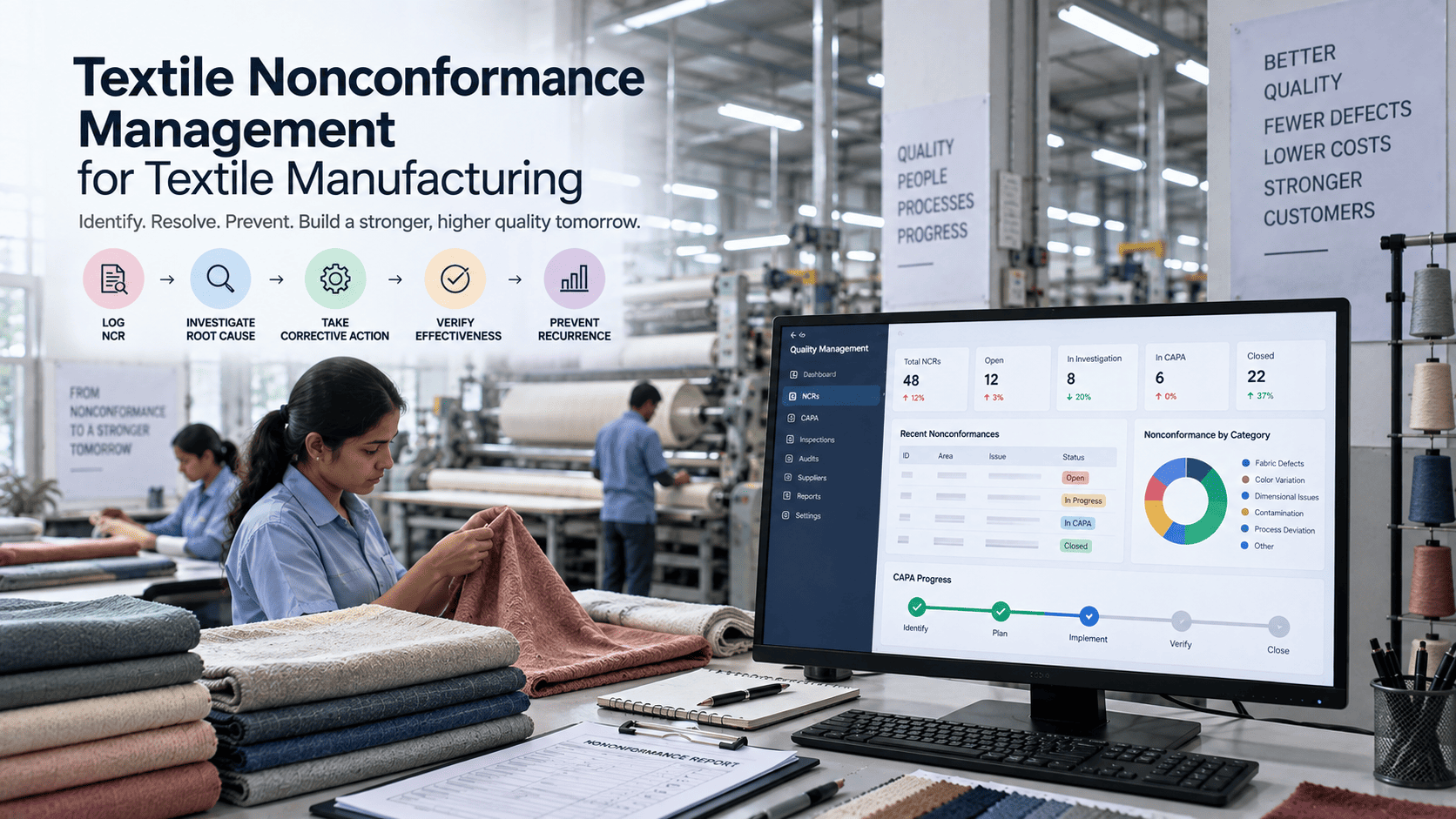
A textile customer complaint typically arrives with a photograph, a shipment number, and a demand — a defect on a finished garment or a fabric roll, tied to a shipment that left the mill weeks or months ago. The buyer expects an answer, evidence, and a corrective action commitment inside a defined window. What the mill has is a stack of inspection sheets, lab reports, and loom logs that were never joined together at the time. Every day the response takes is a day the buyer’s trust erodes and the claim negotiation weakens. Root cause analysis on a complaint is the speed of the trace back to the specific roll, loom, and shift.
iFactory / Textile customer complaint root cause
From Buyer Claim to Defensible Root Cause in Days, Not Weeks
A complaint-to-CAPA workflow that ties every buyer claim to the specific rolls, looms, shifts, lab results, and inspection records that made the affected shipment — with structured root cause and traceable CAPA closure.
D+0
Claim received
Photo + shipment ID
D+1
Traced to lot
Roll · loom · shift
D+3
Root cause
Structured 5-why
D+7
Buyer response
Defensible + dated
D+7
working target for response
Trace back
to roll · loom · shift
Structured
5-why, not narrative
The Problem on the Floor
A buyer complaint on textile fabric or apparel typically references a shipment that left the mill weeks earlier. To respond credibly, the mill has to reconstruct which rolls were in that shipment, which lots those rolls came from, which looms wove them, which shifts, which yarn lots fed the looms, and what the 4-point inspection and lab test records looked like. In most mills, that reconstruction takes three to six weeks of QA time chasing sources across paper logs, Excel sheets, and email threads. By the time the mill responds, the buyer has escalated, the claim negotiation is weaker, and the corrective-action commitment has to be broader than the evidence supports.
Where the Record Actually Breaks
Complaint handling breaks in every mill for the same reasons. Every one of these gaps is a claim-negotiation weakness.
Shipment-to-roll gap
Shipment records are in the ERP, roll records are in the mill’s system. Nobody has a single query that joins them, so the trace-back starts with a manual PDF walk.
Loom log inaccessible
The loom that wove the affected roll can be identified — but the loom log for that shift is on paper in the weaving shed and takes a day to find and photograph.
Lab test disconnected
The lab test for the yarn lot that fed the loom exists as a PDF in a shared drive. It’s not linked to the roll, so nobody thinks to look for it during the trace.
CAPA broader than evidence
Because the trace is incomplete, the CAPA commits to a broader corrective action than the actual root cause needed. The mill absorbs cost the evidence would have narrowed.
What Good Looks Like on the Line
A working complaint-root-cause system holds four disciplines — the fast trace-back, the structured root cause, the CAPA linked to specific evidence, and the buyer response defensible in days.
Claim Intake
Every complaint captured with buyer, shipment ID, product, defect photo, and buyer’s stated impact — in one intake form that starts the trace timer.
Timer starts at intake
Trace to Roll
Shipment ID resolves to specific rolls, rolls resolve to looms and shifts, looms resolve to yarn lots, all inside one query. Trace takes hours, not days.
Query, not project
Structured RCA
Root cause analysis enforced through 5-why or fishbone against defined categories (machine, material, method, man, environment) with evidence attachments per branch.
Evidence per branch
Buyer Response Pack
Response package generated automatically with the trace, the root cause, the CAPA commitment, and the evidence — the artefact the buyer’s QA reads and decides on.
Package, not email
How iFactory AI Fits
iFactory AI overlays the systems you already have — ERP for shipments, QMS for complaints, MES for looms, LIMS for lab — and reconciles them into the single trace that responds to a buyer claim credibly.
Complaint Register
QMS Layer
Every buyer complaint with intake date, response target date, current status, and days-open — the register that tells you which claims are aging.
Trace Chain
Overlay Layer
Shipment → roll → loom → shift → yarn lot → lab result trace assembled on demand. The reconstruction that used to take weeks lands in a working session.
Root Cause Register
QMS Layer
Every structured RCA with 5-why branches, evidence per branch, and the identified root cause category — searchable across complaints for repeat-cause patterns.
Buyer Response Log
QMS + CRM
Every buyer response with the response package sent, buyer decision, and financial outcome — the log that quantifies claim-defense effectiveness.
Pick your three most recent buyer complaints. Time how long it took from complaint intake to a defensible written response. If any took more than a week, the trace speed is the negotiation weakness. Book a complaint response review — we’ll walk one live.
12-Week Rollout on One Line
One buyer, one product family, twelve weeks. The pilot is scoped to prove the trace-back time drops from weeks to days and the buyer response becomes evidence-defensible rather than commitment-heavy.
Weeks 1–2
Complaint History
Pull last two quarters of complaints from the pilot buyer. Baseline: average days-to-response, average trace time, share of complaints with full root cause evidence.
Weeks 3–4
Trace Configuration
Configure the shipment-to-roll trace chain. Ingest historical roll, loom, shift, and lab records for the pilot product family. QA team walks through with a real historical complaint.
Weeks 5–8
Live Response
New complaints from the pilot buyer run through the intake register with response-timer active. Trace, RCA, and response package assembled in the QMS.
Weeks 9–12
Days-to-Response Match
Twelve-week window closes. Compare days-to-response and evidence completeness against the baseline. Buyer feedback on the new response format captured for the review.
Who Owns the KPI
Complaint response crosses QA, production, lab, merchandising, and commercial. Every function owns a specific number or the response reverts to whoever has time.
QA Head
Days from complaint to response
Owns the response clock — the single number that decides whether the buyer sees the mill as responsive or slow. Under 7 days is the working target.
Production Head
Root causes traced to specific loom/shift
Owns the trace depth — the share of complaints traced to a specific loom and shift rather than closed with a generic “process variation” root cause.
Merchandiser
Claim value defended with evidence
Owns the commercial outcome — the share of claim value defended or negotiated down because the evidence pack was strong, not settled for lack of trace.
Site GM
Repeat complaints by buyer
Owns the pattern — repeat complaints from the same buyer signal the CAPAs from earlier complaints didn’t hold. The number that drives structural corrective action.
FAQ
What if the complaint arrives months after shipment — is the data still there?
This is the common case. Textile complaints often surface at retail, weeks or months after the mill shipped. As long as the source records (loom logs, inspection sheets, lab tests) were captured into the unified system when production ran, the trace works regardless of how much later the complaint arrives. This is the argument for the overlay approach — you don’t wait for a complaint to start capturing; you capture continuously so the record is there when the complaint eventually lands. Historic complaints on production that predates the overlay are traceable to whatever records exist; the gap is what the future avoids.
How does the structured root cause differ from what we write today?
Most complaint responses today have a root cause line that reads “operator error,” “process variation,” or “fabric quality issue.” None of these is actionable and none of these defends a claim negotiation. Structured RCA forces the 5-why to reach a specific mechanism — the reed condition on Loom 14 was past its wear limit, the yarn lot delivered was 2 counts finer than spec, the sizing solution viscosity drifted at 3 AM. Each branch of the 5-why requires evidence attached. The buyer reads a root cause that names a mechanism and a corrective action that addresses it — that combination is what defends the negotiation.
Book a demo to see structured RCA on your own complaint history.
What about complaints where the defect can’t be found in our records?
This happens — a buyer sends a photo of a defect that doesn’t match any inspection or lab record for the affected shipment. The response is honest: the mill traces what it can (shipment to rolls, rolls to looms and shifts) and reports what the records show alongside what they don’t show. Often the trace reveals the defect signature was present but scored below threshold, or was present on adjacent rolls not sampled. Either finding is more defensible than “we couldn’t find it.” The system captures the trace-limitation itself as a data-gap CAPA — the next complaint from that buyer has a better record because of it.
Stop responding to buyer claims after the negotiation has already weakened.
Walk One Real Buyer Claim Through the Trace — Live
Bring one recent buyer complaint with its shipment ID, defect photo, and buyer response deadline. We’ll assemble the trace back to rolls, looms, and shifts live and show what the response pack would have looked like.