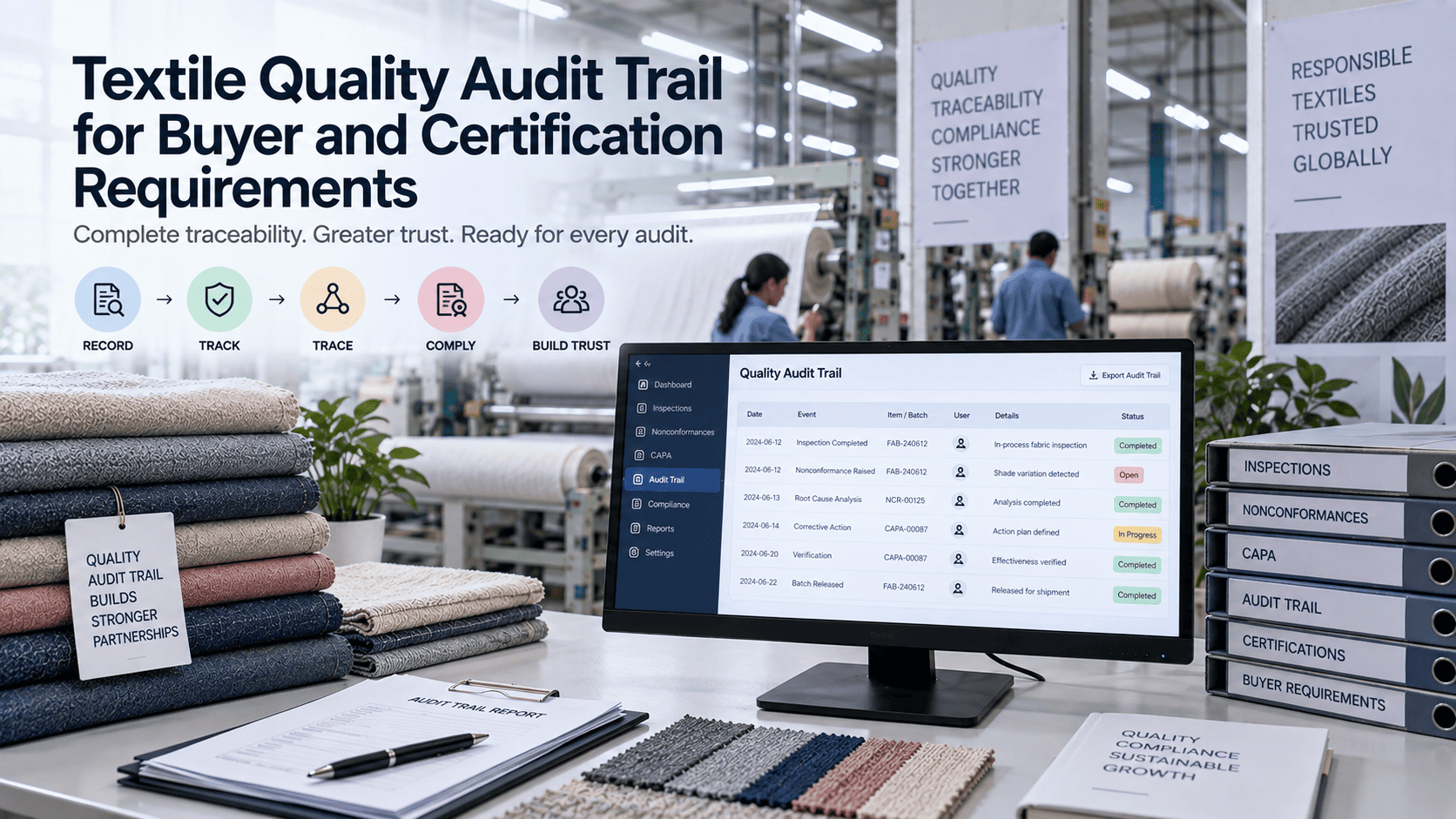
A textile nonconformance is easy to detect and easy to record — an inspector marks a roll as failed, a lab test comes back below spec, a buyer files a claim. What is hard is what happens next. In most mills the nonconformance report is written, affected material is held, and the CAPA is drafted — and then the process stops. Effectiveness verification, the step that proves the corrective action actually prevented recurrence, almost never lands. The same failure mode returns three months later on a different loom, and nobody connects them because NCRs live as isolated documents. A working system is not the paperwork — it is the discipline that closes the loop.
iFactory / Textile nonconformance management
Every NCR Closed With Verified Effectiveness — Not Just Documented
A textile NCR + CAPA system that carries every nonconformance through detection, containment, root cause, corrective action, and effectiveness verification — with the same failure pattern recognised across looms, shifts, and quarters.
1
Detect
Inspector, buyer, or lab
→
→
3
Root cause
5-why · fishbone
→
→
5
Verify
Effectiveness proof
Step 5
where most systems collapse
Pattern
recognition across quarters
The Problem on the Floor
A textile NCR is not one event — it is a sequence. Detection can come from an in-line 4-point inspection, a lab test result, or a buyer complaint received weeks after shipment. Containment means quarantining every roll from the affected lot before more of it ships. Root cause analysis has to walk from the fabric defect back to the loom, the yarn lot, the weaver, the shift, and often the raw fibre or the sizing. The CAPA has to be owned by a named person with a date. And effectiveness verification has to be scheduled, executed, and evidenced. Skip any step and the same failure recurs — and the buyer notices the pattern before the mill does.
Where the Record Actually Breaks
Nonconformance data breaks predictably. Almost every mill has each of these gaps somewhere in their NCR process.
Isolated NCR docs
Each NCR filed as its own document (Word, PDF, or paper). No search across NCRs. The same defect pattern on Loom 14 in April and again in July stays hidden.
Root cause too shallow
Root cause listed as “operator error” or “fabric quality issue.” Neither is actionable. The 5-why doesn’t reach the sizing, the drafting rollers, or the yarn lot.
CAPA without verification
Corrective action written, sometimes implemented, almost never verified. The NCR is closed on the CAPA date, not on the effectiveness date.
Buyer complaint disconnected
Customer complaint arrives with a defect photo. Nobody traces it back to a specific NCR from six weeks ago that named the same defect. Repeat failure feels like a new one.
What Good Looks Like on the Line
A working nonconformance system holds all five steps and enforces them in sequence — with pattern recognition across NCRs to catch repeat failures before the buyer catches them for you.
Detection Capture
Every source (inspection, lab, buyer) writes into the same NCR register with the specific defect class, affected lot, quantity, and evidence attached.
One register, all sources
Containment Hold
Automatic quarantine flag on the affected lot at the moment the NCR opens — no roll from the lot ships until QA releases the hold with a signed decision.
Auto-hold at detection
Root Cause Discipline
Structured 5-why or fishbone with defined categories (machine, material, method, man, environment) and required evidence — root cause depth enforced, not skipped.
Structured, not narrative
Effectiveness Gate
CAPA effectiveness verification scheduled at the CAPA close date + N days — the NCR does not close until the verification event fires and the evidence is captured.
Close = verified, not written
How iFactory AI Fits
iFactory AI overlays the QMS you already run — Ideagen, MasterControl, ETQ, or a bespoke system — and adds the NCR discipline and pattern recognition that most implementations skip.
NCR Register
QMS Layer
Every NCR with source, defect class, lot, quantity, evidence, and status — queryable across looms, shifts, quarters, and buyers.
Pattern Detection
QMS + Analytics
Repeat-failure detection across the NCR register — same defect class recurring on the same loom, shift, or yarn supplier surfaces as an alert, not a discovery.
CAPA Register
QMS + Compliance
Every CAPA with owner, action, target date, effectiveness date, and evidence — the register that answers repeat-failure questions in one query.
Verification Log
QMS Layer
Effectiveness verification events with pass/fail evidence — the artefact that lets the QA head close an NCR defensibly at buyer audit.
Take the last six months of NCRs at your mill. Ask which ones had a verified effectiveness date and which were closed on the CAPA write date. If the second number is higher, the loop isn’t closing. Book a CAPA audit — we’ll walk your last quarter live.
12-Week Rollout on One Line
One weaving hall, one buyer’s product line, twelve weeks. The pilot is scoped to prove that end-to-end NCR discipline (detection through verified effectiveness) holds up under real production pressure — and surfaces repeat failures the current system hides.
Weeks 1–2
NCR Baseline
Pull last six months of NCRs. Baseline: average time detect-to-close, effectiveness-verification rate, repeat-failure detection rate. Identify the top three defect classes.
Weeks 3–4
Register Migration
Migrate active NCRs into the unified register. Configure structured root cause categories and effectiveness verification triggers. QA team walks through together.
Weeks 5–8
Live Enforcement
New NCRs run through the enforced 5-step flow. Every CAPA gets a verification date. Pattern-detection alerts active for the top three defect classes.
Weeks 9–12
Repeat-Failure Audit
Twelve-week window closes. Compare effectiveness-verification rate, repeat-failure detection, and average close time against the baseline. Rollout scope confirmed.
Who Owns the KPI
NCR discipline crosses inspection, QA, production, and compliance. Every function needs a specific number they own or the flow reverts to write-and-forget.
Inspection Head
NCRs opened per 1000 rolls inspected
Owns detection sensitivity — a rising open rate signals inspector calibration or a real quality drift; a falling rate can signal missed defects.
QA Head
Effectiveness verification rate %
Owns the loop-close — what share of CAPAs have a verified effectiveness date, not just a written date. This is the number that tells the truth.
Production Head
Repeat-failure rate by defect class
Owns the pattern — same defect class recurring after CAPA closure means the root cause was wrong or the corrective action didn’t hold. Both need production’s attention.
Compliance / Audit
NCR audit readiness score
Owns the buyer-audit defense — the completeness of the NCR record set for any given shipment. The number that decides claim outcomes.
FAQ
Isn’t “corrective action” the same as fixing the immediate problem?
No — that’s containment, which is step 2. Corrective action is the specific change that prevents recurrence, and it lives at step 4. The two get conflated in most mills, which is why the same defect returns three months later: the immediate rework got done, but no lasting change was made to the process, the machine setting, or the training that caused it. A working NCR system enforces the distinction, and effectiveness verification at step 5 is the check that the corrective action actually held.
How does pattern recognition across NCRs actually work?
Every NCR carries a defect class, a source (loom, shift, yarn lot, weaver), and a timestamp. The system tracks recurrence at each of those levels. When the same defect class opens on the same loom for the third time in six months, or on three different looms from the same yarn supplier, an alert fires — not another NCR, but a systemic-issue flag that routes to the QA head. This is the difference between managing NCRs one at a time and seeing the pattern that the buyer will otherwise find first.
Book a demo to see pattern detection on your own NCR history.
What if effectiveness can’t be verified within a reasonable window?
Some corrective actions can be verified in days (a machine setting change, a re-training completion). Others take a full production cycle to prove out (a fabric-blend change, a supplier switch). The verification date is set at CAPA close based on when meaningful evidence will be available — not on a fixed calendar. If the target date arrives and evidence is not yet available, the NCR stays open with a defined extension reason, not silently closed. That discipline is exactly what buyer auditors look for.
Stop closing NCRs on the CAPA write date.
Audit One Quarter of Your NCRs for Verified Closure
Bring last quarter’s NCR register and one buyer’s product line. We’ll walk the effectiveness-verification rate live, surface the repeat-failure patterns your current system hides, and quantify the audit-readiness gap.