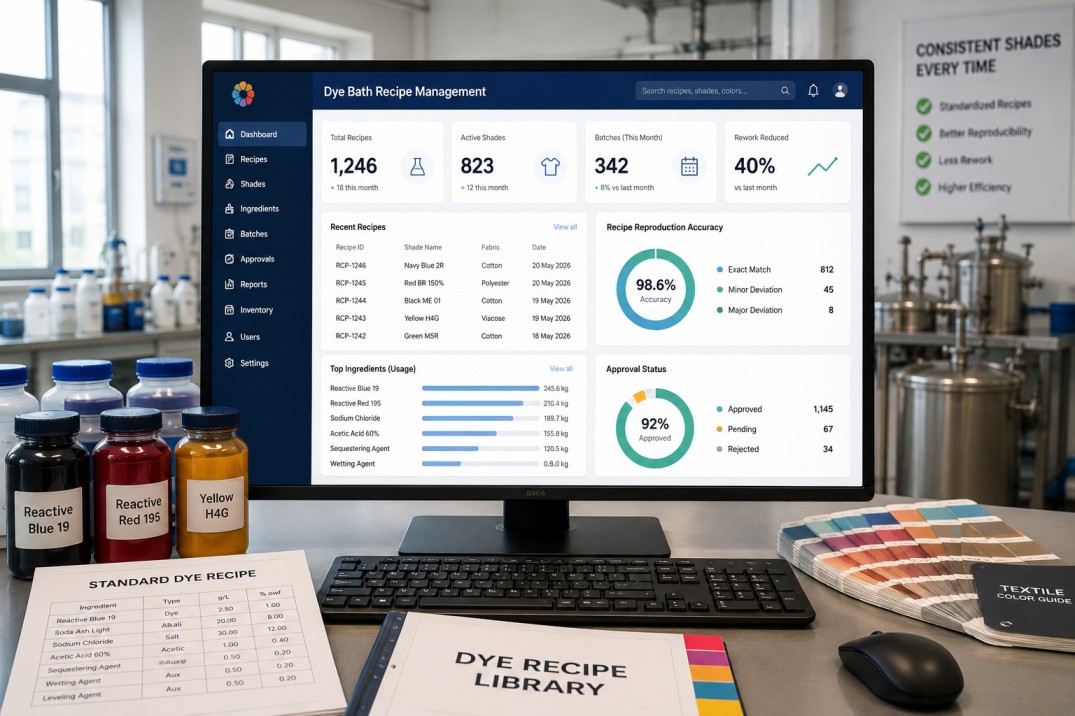
Dye Recipe Management System: Version Control & Audit
By James Smith on August 5, 2026
A dyer notices a shade running slightly warm partway through a run and adds a touch more of the yellow component to correct it — a reasonable, well-intentioned adjustment made under production pressure. Nobody writes it down. Three months later, a different shift runs the same recipe number for a repeat order, follows the original documented formula exactly, and produces a batch that doesn't match the customer's approved standard — because the "original" formula in the system was never actually the recipe that made the approved standard in the first place. This is not a rare edge case. It is the single most common root cause behind shade repeat failures traced back through a proper investigation, and it happens because most dye houses manage recipes the way they managed them thirty years ago: as documents, not as governed, versioned records. The fix isn't a stricter policy nobody follows under production pressure — it's a system that makes the undisciplined path structurally impossible in the first place. See how iFactory brings version control and full audit trail to dye recipe management so every batch can be traced back to the exact recipe version that produced it.
01
Version History
Every recipe change logged, timestamped, attributed
02
Audit Trail
Reconstruct which version produced which batch, on demand
03
Change Control
No undocumented edits reach production without approval
04
Multi-Site Sync
The same shade, the same governed recipe, every location
Dye Recipe Management System: Version Control and Audit
Digital recipe governance built for the dye house — standardization, documented change tracking, and a complete audit trail that turns "we're not sure which recipe version made that lot" into a question with a definite answer.
How an Undocumented Edit Becomes a Customer Complaint Three Months Later
The scenario in the opening paragraph is not hypothetical — it's the pattern that shows up repeatedly once a dye house actually investigates a shade repeat failure back to its root cause. The failure isn't usually a chemistry problem. It's a documentation and governance problem wearing a chemistry problem's clothes.
A recipe stored as a spreadsheet or a paper card has no concept of a version. There's only "the current version," and if that current version gets edited — by anyone, for any reason, in the moment — the previous version simply stops existing. Nobody signed off on the change. Nobody recorded why it was made. The next person to open that file has no way to know the recipe in front of them isn't the one that actually produced the approved lab dip standard sitting on the shelf.
The scenario compounds when the same recipe file is shared across shifts, or worse, across multiple dye houses producing nominally identical shade codes for the same customer. Every additional person with edit access to an unversioned document is another opportunity for a well-intentioned, undocumented adjustment to quietly become "the recipe" — and the failure only surfaces weeks or months later, when a repeat order doesn't match, and the investigation has no trail to follow back to the moment things diverged.
Borrowing From Software Engineering
Version Control Is a Solved Problem — Just Not in Most Dye Houses Yet
Software engineering solved this exact problem decades ago with version control systems: every change to a codebase is recorded as a discrete, attributed, timestamped commit, nothing overwrites history, and any prior state can be reconstructed on demand. The same discipline maps directly onto dye recipes, component for component — the concepts are not a metaphor borrowed loosely, they translate almost one-to-one.
Every Change Is a New Version, Not an Overwrite
When a recipe is adjusted, the system creates a new version with its own identifier rather than silently replacing the prior one — the original recipe that made the approved standard remains permanently retrievable, exactly as it was when it was approved.
Every Version Is Attributed and Timestamped
Each recipe version records who made the change, when, and — critically — why, captured as a mandatory note at the point of edit rather than reconstructed later from memory during an investigation.
Production Always Pulls From an Approved Version
A dye machine or job card references a specific, approved recipe version — not "whatever is currently in the file" — so an in-progress edit by someone else cannot silently affect a batch already running against the prior version.
Rollback Is a Feature, Not a Recovery Project
If a new recipe version underperforms, reverting to the last known-good version is a controlled, logged action — not a scramble to remember what the formula looked like before someone changed it.
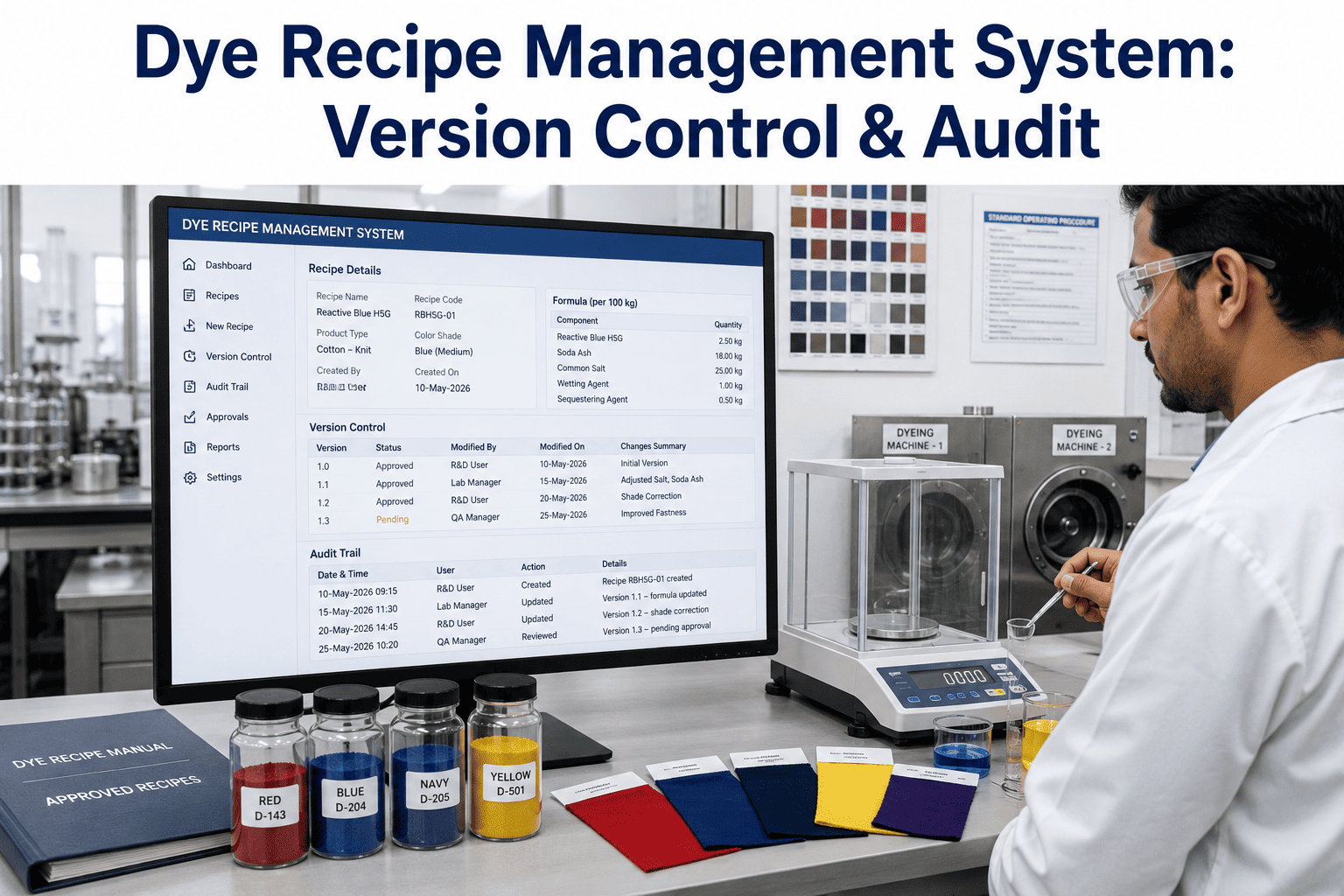
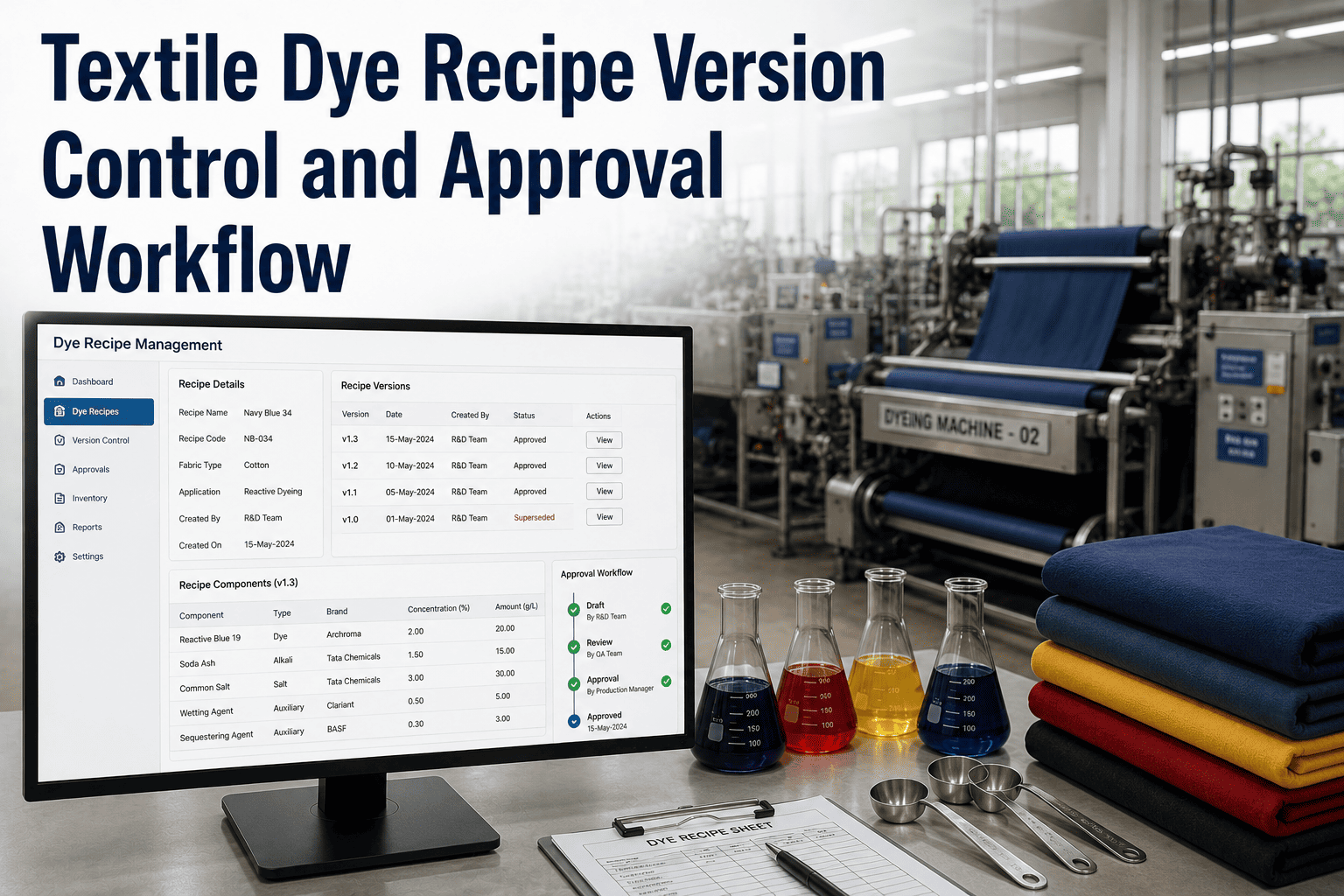
Notice what the v1.2 entry in this timeline actually represents — not a hypothetical failure mode, but the exact scenario described in the opening of this article, made visible and attributable instead of invisible. Under a document-based recipe system, that edit would have simply become the new "current version" with no trace of what changed or why. Under a version-controlled system, it exists as a distinct, flagged entry the moment it happens, and the rollback to v1.1 that follows it is a deliberate, logged, approved correction rather than someone quietly restoring an old file from a backup and hoping nobody asks what happened.
Every Batch, Traced to Its Exact Recipe Version
"We Think It Was This Recipe" Is Not an Answer a Customer Complaint Investigation Can Work With
iFactory logs every recipe version, every change, and every batch's link back to the exact version that produced it — so a color complaint investigation starts with certainty, not a guess.
The Specific Records an Investigation or a Certification Audit Will Ask For
A vague claim of "we track our recipes" rarely satisfies an actual investigation or a formal quality audit. The four items below are the specific, concrete records a credible audit trail needs to be able to produce on request, not just in principle.
1
The Exact Recipe Version Used for a Specific Batch
Not "the current recipe for this shade code" — the specific version, with its exact component quantities, that was active and approved at the moment that particular batch was dyed.
2
Who Approved That Version, and When
A named approver and an approval timestamp — not an assumption that "someone in the lab must have signed off on it" reconstructed after the fact from memory.
3
The Full Change History Leading to That Version
Every prior version, in order, with the reason each change was made — the complete lineage from the original lab-approved formula to whatever version was actually in production.
4
Confirmation That No Unapproved Edit Reached the Floor
Evidence that the version used in production matched an approved version exactly — with no undocumented, in-the-moment adjustment made after approval and before the batch was run.
Why This Is Increasingly a Compliance Question
Recipe Governance Is Moving From Best Practice to Baseline Expectation
Recipe version control used to be treated as an internal process improvement — worth doing, but not something a customer or auditor would specifically ask to see. That's changing. As supply chain transparency and ESG-related reporting requirements expand across the textile industry, documented change control and formulation traceability are increasingly showing up as explicit expectations in customer quality agreements and certification frameworks, not just implicit good practice.
A dye house that cannot produce a documented recipe version history on request is exposed to a specific and growing risk category — not because its actual color consistency is necessarily worse than a competitor's, but because it cannot prove the consistency it has achieved. Documentation gaps of this kind increasingly show up in customer audits as findings independent of any actual quality incident, which makes recipe governance a preventable compliance exposure rather than only a quality-improvement opportunity.
Getting Started
Moving From Documents to a Governed Recipe System
These four steps reflect the sequence that actually changes recipe governance in practice, rather than adding a compliance-sounding process nobody follows once production pressure returns.
01
Consolidate Every Recipe Into One System of Record
Before version control can mean anything, every recipe needs to live in a single governed system — not spread across individual spreadsheets, paper cards, and a dyer's personal notes, each with its own silent, unversioned copy of "the truth."
02
Require a Reason for Every Recipe Edit, No Exceptions
Make the "why" field mandatory at the point of change, not optional — a change logged without a reason is only marginally more useful than no log at all when an investigation needs to understand what actually happened and why.
03
Lock Production Job Cards to a Specific Approved Version
Ensure the dye machine or job card references an immutable, specific version identifier rather than a live link to "the current recipe" — this single design choice is what actually prevents an in-progress edit from silently affecting a running batch.
04
Synchronize the Version System Across Every Site Producing the Same Shade
For multi-site operations, confirm every location references the same governed recipe version for a given shade code — a local, undocumented site-level adjustment is exactly the kind of drift that produces inter-site color inconsistency on nominally identical orders.
Field Perspective
“
Every color complaint investigation I've run eventually asks the same question: what recipe actually made this batch? And far too often, the honest answer is "we're not entirely sure — probably this one, but someone might have tweaked it." That answer is unacceptable to a customer, and it should be unacceptable internally too, because it means the dye house genuinely cannot reproduce its own approved shade with confidence. Version control doesn't make dyers slower or add bureaucracy for its own sake. It makes the recipe that made the approved standard permanently retrievable, which is the one thing every subsequent repeat order actually depends on — and once a dye house has lived through even one investigation where the answer was simply "here's the exact version, here's who approved it, here's when," it's very hard to go back to not having that.
Adaeze Okonkwo-Lindqvist
Dye House Quality Manager · 15 years in dyeing operations and color quality management across cotton and synthetic fiber dye houses
Common Questions
Frequently Asked Questions
What's the actual difference between a spreadsheet-based recipe system and a version-controlled one?
A spreadsheet or paper card recipe has only one state — "the current version" — and any edit permanently overwrites whatever was there before, with no record that a change even happened unless someone manually documents it separately. A version-controlled system treats every edit as a new, distinct, permanently retrievable version, attributed to a specific person, timestamped, and linked to a documented reason — the original approved formula remains accessible indefinitely, regardless of how many subsequent adjustments have been made since. This distinction is what makes it possible to answer, with certainty, exactly which recipe produced any specific batch, months or years after the fact. Book a recipe governance review to assess how your current recipe system compares.
How common is an undocumented recipe edit as the root cause of a shade repeat failure?
Once a dye house implements a proper investigation process for shade repeat failures, an undocumented or uncommunicated recipe change is consistently one of the most frequently identified root causes — more often than a genuine equipment or chemistry variance. This is precisely because the failure mode is invisible under a document-based recipe system: the edit happens, nobody records it, and the next person working from "the recipe" has no way to know it differs from what actually produced the approved standard. A version-controlled system doesn't prevent every shade variation, but it eliminates this specific and common failure mode by making every change visible and attributable.
Does requiring approval for every recipe change slow down production or limit a dyer's ability to make in-process corrections?
Properly implemented version control distinguishes between documented in-process corrections during an active batch — which remain fast and don't require a formal approval workflow mid-run — and permanent changes to the recipe of record for future batches, which do require documented review before becoming the new standard. The goal isn't to prevent dyers from responding to real-time conditions; it's to ensure that whatever adjustment they make is captured as data rather than lost, and that it doesn't silently become "the recipe" for the next repeat order without anyone deciding that it should.
How does recipe version control help with multi-site color consistency specifically?
Multi-site dye houses producing the same nominal shade at different locations are especially vulnerable to a specific failure mode: one site makes a local, undocumented adjustment to solve a local issue, and that adjustment never propagates to or gets reconciled against the other sites, so the "same" shade code quietly diverges across locations over time. A synchronized, version-controlled recipe system makes this drift visible immediately — every site references the same governed version identifier for a given shade, and any site-specific deviation shows up as a distinct, attributable version rather than disappearing into an unmonitored local copy. Talk to solutions engineering about synchronizing recipe governance across multiple dye house locations.
What does an auditor or customer quality team actually expect to see during a recipe compliance review?
A credible recipe audit trail needs to show the exact recipe version used for a specific batch, who approved that version and when, the complete change history leading to it from the original approved formula, and confirmation that no undocumented edit reached production between approval and the batch actually running. Increasingly, customer quality teams and certain certification frameworks expect this level of traceability as a baseline expectation rather than an advanced capability, particularly as ESG and supply chain transparency requirements expand — a dye house unable to produce this documentation on request is exposed to a compliance gap regardless of how good its actual color consistency has historically been.
Know Exactly Which Recipe Made Every Batch
From "We Think It Was This Version" to a Documented, Defensible Answer
iFactory brings version control, mandatory change documentation, and a complete audit trail to dye recipe management — so every batch traces back to the exact approved recipe version that produced it, across every site.