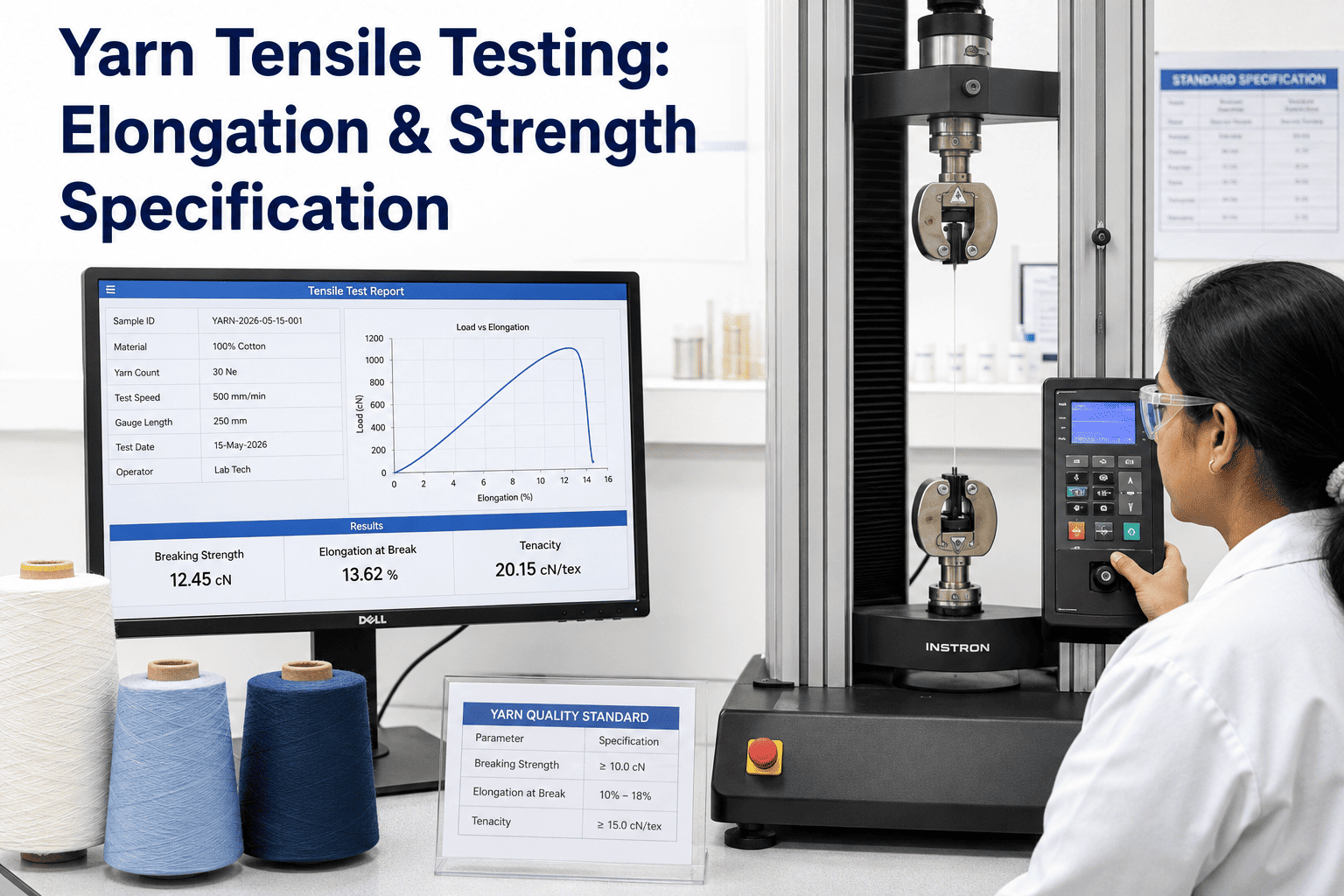
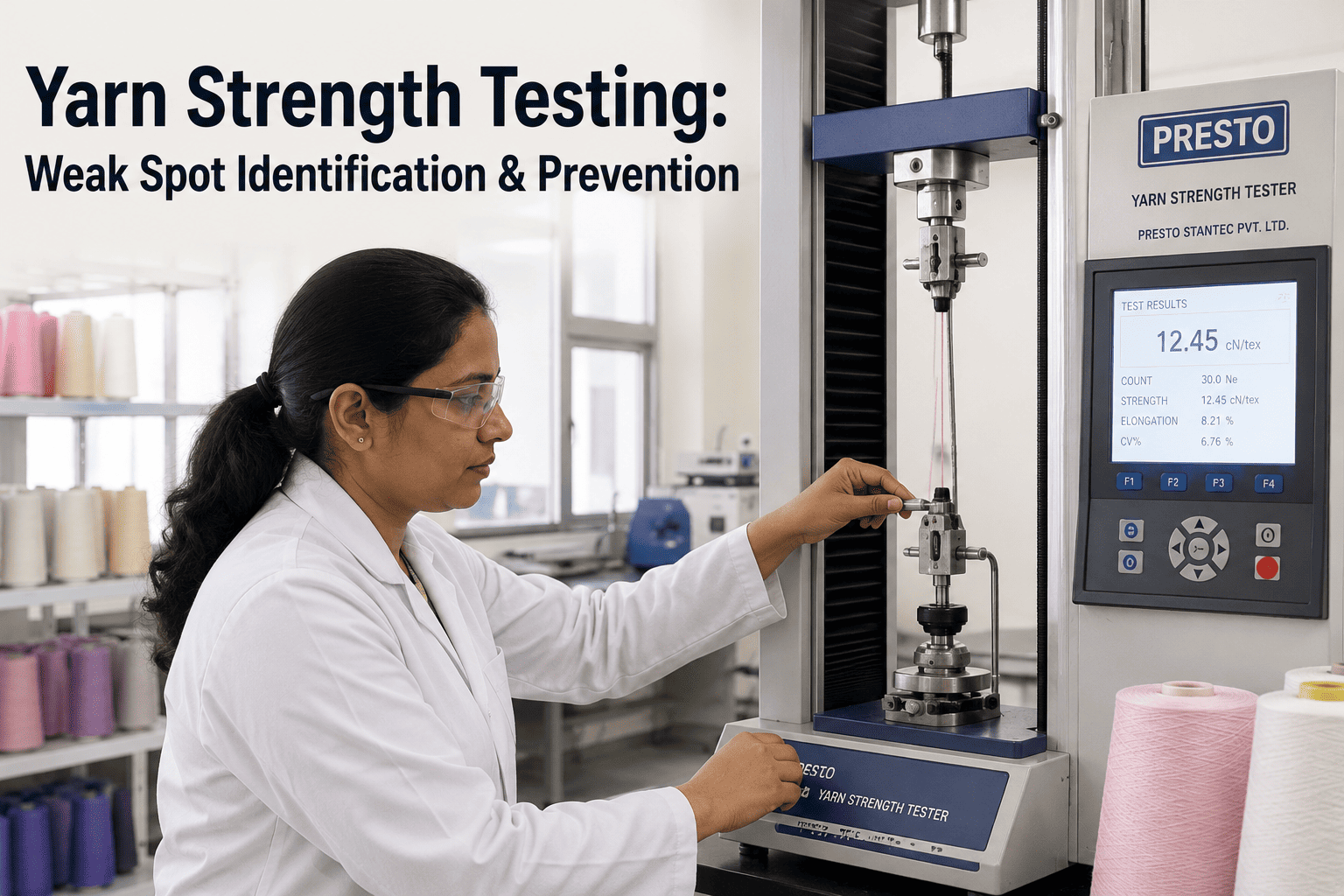
Two spinning lots can carry the identical count, the identical nominal strength spec, and the identical supplier certificate — and still behave completely differently on a high-speed loom. The difference rarely shows up in the average; it shows up in the spread. A lot with a strength coefficient of variation of 4% behaves nothing like a lot averaging the same strength at 9% CV, because the weakest tail of that distribution is what actually breaks under tension, not the mean. Testing and specifying yarn tensile properties correctly — strength, elongation, and lot-to-lot consistency together — is what separates a spec sheet that looks complete from one that actually predicts downstream performance, and the gap between those two kinds of spec sheets is where most weaving-mill complaints originate. See how iFactory tracks tensile test results and inter-lot variation automatically against the specification your downstream customers actually need.
Yarn Quality · Tensile Testing & Specification
Yarn Tensile Testing: Elongation and Strength Specification
Single yarn strength, CSP (Count Strength Product), elongation at break, and the inter-lot variation control that determines whether a passing average actually predicts consistent downstream performance.
Single-Strand vs. Skein Testing — Two Related but Different Measurements
A spec sheet referencing "yarn strength" without naming the test method is ambiguous by default — single-strand and skein testing measure related properties through fundamentally different mechanics, and comparing results across methods without conversion produces meaningless comparisons. The table below lays out the practical differences a testing engineer or QA manager needs to confirm before accepting or issuing a spec.
Property
Single-Strand Method (ASTM D2256)
Skein / Lea Method (CSP)
What's Tested
One individual yarn strand, clamped and pulled to break
A 120-yard lea (skein) of multiple wraps, pulled as a bundle
Primary Output
Breaking force, elongation %, tenacity, modulus
Lea strength (lbs), combined with count into CSP
Reflects
Individual filament/strand behavior under tension
Bundle behavior — closer to how yarn performs under real processing tension
Most Common Use
Technical/industrial yarns, modern QC labs, elongation-sensitive specs
Traditional cotton spinning mills, legacy spec sheets, CSP-referenced contracts
Test Speed Reference
Variable, per D2256 gauge length and extension rate settings
Historically 12 in/min traverse; modern testers also use ~300 mm/min
Neither method is universally "correct" — the right choice depends on what the downstream customer's contract actually references. A weaving customer citing a CSP threshold expects lea-method results; a technical yarn buyer citing tenacity in cN/tex expects single-strand ASTM D2256 data. Testing the wrong method and converting after the fact introduces error that a same-method test avoids entirely, and it's a surprisingly common source of dispute between mills and customers who each assumed the other meant the same test.
Understanding CSP
Count Strength Product — Still Referenced, Still Worth Getting Right
CSP, also called Break Factor, remains a standard reference point in cotton spinning despite predating modern single-strand instrumentation by decades. The calculation is simple; the interpretation is where mills most often go wrong, particularly when the industry reference bands get treated as a universal pass/fail line rather than the general guidance they actually are.
CSP Formula
CSP = Average Lea Strength (lbs) × Yarn Count (Ne)
Worked Example
Yarn count30 Ne
Average lea strength (20 leas tested)79.3 lbs
CSP calculation79.3 × 30 = 2,379
ClassificationStrong — above the commonly cited 2,200 threshold
Widely cited quality bands classify CSP below roughly 1,800 as weak, 1,800–2,200 as average, and above 2,200 as strong — but these bands are reference points from cotton spinning literature, not universal contractual thresholds. The threshold that actually matters is whatever the specific downstream customer's specification states, and that number should be confirmed in writing rather than assumed from a general industry rule of thumb. A mill that ships against the generic 2,200 threshold when a specific customer's contract actually requires 2,400 has technically shipped "strong" yarn by industry convention while still failing the contract that actually governs the shipment.
This is the single most common gap between a lot that passes a mean-only spec review and a lot that generates a customer complaint within its first shift on a high-speed loom. The average strength figure on both lots' certificates would look identical. Only the CV% figure — a number many mills calculate but few actually report on the shipping documentation — reveals which lot carries meaningfully more risk. A testing program that reports average strength without CV% is handing a downstream customer half the information they need to plan around the yarn's actual behavior.
Elongation at Break
The Property That Gets Less Attention Than Strength — and Shouldn't
A yarn spec focused entirely on breaking strength while ignoring elongation is only half-specified. Elongation at break — how much a yarn stretches before it fails — directly affects how the yarn behaves under the dynamic tension of high-speed weaving and knitting, independent of its raw breaking force, and a strength-only spec sheet is systematically blind to this entire dimension of downstream risk.
Too Little Elongation
A yarn with insufficient stretch under tension breaks more readily during the sudden tension spikes inherent to high-speed loom operation, even if its raw breaking strength number looks acceptable in isolation — strength and elongation need to be read together, not separately.
Too Much Elongation
Excessive stretch can cause dimensional inconsistency in the finished fabric and tension control problems on the loom or knitting machine, since the yarn behaves less predictably as tension varies across a production run.
Measured Alongside Strength, Not Instead of It
ASTM D2256 captures elongation as a standard output of the same single-strand test that measures breaking force — there's no reason to test strength and elongation separately, and a complete spec should report both figures together for every lot, not strength alone.
Test Conditions Matter
Why Conditioning and Test Speed Belong on the Report, Not Just the Result
Tensile results are not purely a property of the yarn itself — they're a property of the yarn under specific, standardized test conditions, and reporting a strength or elongation figure without the conditions it was measured under makes the number harder to compare or reproduce.
Conditioning Environment
Standard practice conditions samples at a controlled temperature and humidity — commonly cited references use approximately 27°C and 65% relative humidity — before testing, since yarn moisture content measurably affects both strength and elongation results.
Test Speed and Traverse Rate
Historical lea testers commonly ran at 12 inches per minute; modern instrumented testers often specify roughly 300 mm per minute or a rate defined against a target time-to-break — the specific rate used should always accompany the reported result, since strength figures are rate-dependent.
Sample Size
A meaningful average and CV% require an adequate sample count — commonly at least ten to twenty individual tests per lot for single-strand testing, or a comparable number of leas for skein testing — since a handful of tests produces an unstable estimate of both the mean and the variation.
These three factors — conditioning, test speed, and sample size — are frequently omitted from a customer-facing certificate even when the testing lab followed them correctly internally. Including them explicitly on the report does more than satisfy a documentation formality: it gives a downstream customer's own quality team the information needed to reproduce the result independently, which is often the fastest way to resolve a dispute over a shipment that a customer believes doesn't match its certificate.
The Average Passes. The Tail Doesn't.
A Lot Can Meet Every Spec on Average and Still Cause Breaks Downstream
iFactory tracks strength, elongation, and CV% together across every lot — flagging variation that a mean-only spec sheet would miss entirely.
Building a Tensile Specification Program That Predicts Downstream Performance
These four steps address the specific gaps that most commonly separate a technically-passing spec sheet from one that actually predicts how a lot will behave once it reaches a customer's production floor.
01
Confirm the Test Method Every Spec Actually References
Audit current customer contracts and internal spec sheets to confirm whether each one specifies single-strand ASTM D2256 data, skein/CSP data, or an ambiguous "yarn strength" figure that needs clarification before the next shipment.
02
Report CV% Alongside Every Average, Not as an Optional Addendum
Make coefficient of variation a mandatory field on every lot test report, not a figure that only gets calculated when someone specifically asks for it — this is the single change most likely to catch a problem an average-only report would miss.
03
Test Elongation as Standard Practice, Not an Exception
Since ASTM D2256 captures elongation from the same test run that measures breaking force, there's minimal additional cost to reporting it on every lot — build it into the standard report template rather than treating it as a special request.
04
Correlate CV% Trends Against Actual Downstream Break Data Where Possible
Where a customer relationship allows it, tracking a specific customer's reported loom break rate against the CV% of the lots that supplied that run builds an empirical, customer-specific variation threshold rather than relying on generic industry guidance.
Field Perspective
“
I've reviewed more spec sheets than I can count that report a single average strength number and nothing else, and every single time I ask for the CV%, the answer is either "we don't track that" or a number nobody had looked at closely. The average is the easy number to report and the least useful one for predicting what happens on a customer's high-speed loom. A weaving mill running a lot with a wide strength spread will call about breaks within the first shift, and when we go back and check, the average was always fine. It was never the average that broke. It was the tail — and once a mill starts reporting CV% as a matter of course instead of an afterthought, those calls become dramatically rarer.
Priyanka Deshmukh-Verhoeven
Textile Testing Engineer · 17 years in yarn quality control and specification across cotton spinning and technical yarn production
Common Questions
Frequently Asked Questions
What's the actual difference between single-strand testing and CSP/skein testing?
Single-strand testing, governed by ASTM D2256, clamps and pulls one individual yarn strand to failure, producing breaking force, elongation, tenacity, and modulus data for that single strand. CSP, or Count Strength Product, comes from skein testing — a 120-yard lea of multiple yarn wraps tested as a bundle, with the resulting lea strength multiplied by yarn count to produce the CSP figure. The two methods measure related but genuinely different things: single-strand reflects individual filament behavior, while skein testing reflects bundle behavior closer to how yarn experiences tension during real processing. Specifying which method a contract references, rather than assuming "yarn strength" means one specific test, avoids comparing incompatible numbers and prevents disputes when a mill's certificate and a customer's spec were never actually testing the same thing. Book a tensile testing review to confirm which method your current downstream specifications actually require.
Why does coefficient of variation matter more than average strength for downstream weaving performance?
A high-speed loom doesn't experience the average strength of a yarn lot — it experiences whatever specific section of yarn is under tension at that moment, and it's the weakest sections in the distribution's lower tail that actually break. Two lots can report identical average strength while one has a tight, low coefficient of variation and the other has a wide spread — the wide-spread lot will produce more breaks on the loom even though its average looks identical to the tighter lot on a spec sheet that only reports the mean. This is why a complete tensile specification should always include CV% alongside the average, not the average alone.
What CSP value counts as acceptable for cotton yarn?
Commonly cited reference bands in cotton spinning literature classify CSP below roughly 1,800 as weak, 1,800 to 2,200 as average, and above 2,200 as strong, but these are general industry reference points rather than universal contractual standards. The threshold that actually governs a specific shipment is whatever value the downstream customer's own specification states, and mills should confirm that figure in writing rather than relying on the general reference bands, since acceptable CSP can vary by end-use application, yarn count, and customer-specific quality requirements.
Why is elongation at break important if a yarn already meets its strength specification?
Breaking strength and elongation measure different aspects of how a yarn responds to tension, and a yarn can meet a strength threshold while still performing poorly downstream due to inadequate or excessive stretch characteristics. Insufficient elongation makes a yarn more prone to breaking under the sudden tension spikes common in high-speed weaving, even when its raw breaking force looks acceptable, while excessive elongation can cause dimensional inconsistency and tension control problems on the loom. ASTM D2256 captures both properties from the same test, so there's no reason a complete specification should report strength without elongation alongside it. Talk to solutions engineering about tracking strength and elongation together across your lot testing program.
How much inter-lot variation is normal, and when does it become a problem worth escalating?
Some lot-to-lot variation is inherent to any spinning process and cannot be entirely eliminated, but the specific threshold that separates normal variation from a genuine downstream risk depends on the customer's process sensitivity — a high-speed technical weaving operation has a much lower tolerance for CV% spread than a hand-loom operation running at a fraction of the speed. Rather than relying on a single universal CV% threshold, tracking CV% trends over time by lot and correlating them against actual downstream break-rate data for a specific customer's process is the more reliable way to establish what "acceptable variation" means for that specific relationship, and it produces a threshold grounded in real outcomes rather than a generic industry rule that may not fit every customer's equipment and speed.
Specify What Actually Predicts Performance
Strength, Elongation, and Consistency — Tracked Together, Not in Isolation
iFactory tracks single-strand and skein tensile results, elongation, and inter-lot CV% together across every production lot — so a spec sheet reflects what a downstream customer will actually experience, not just a flattering average.