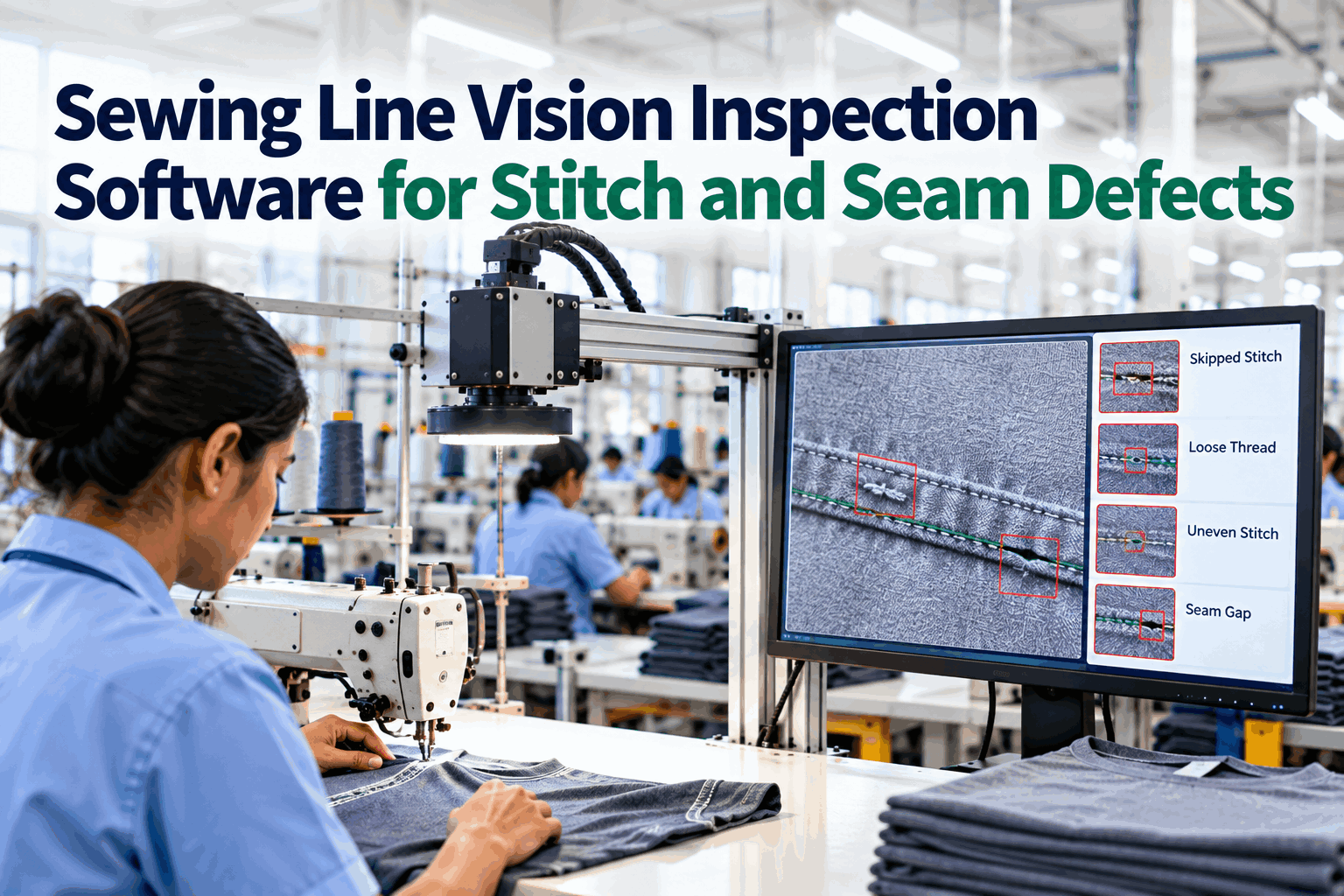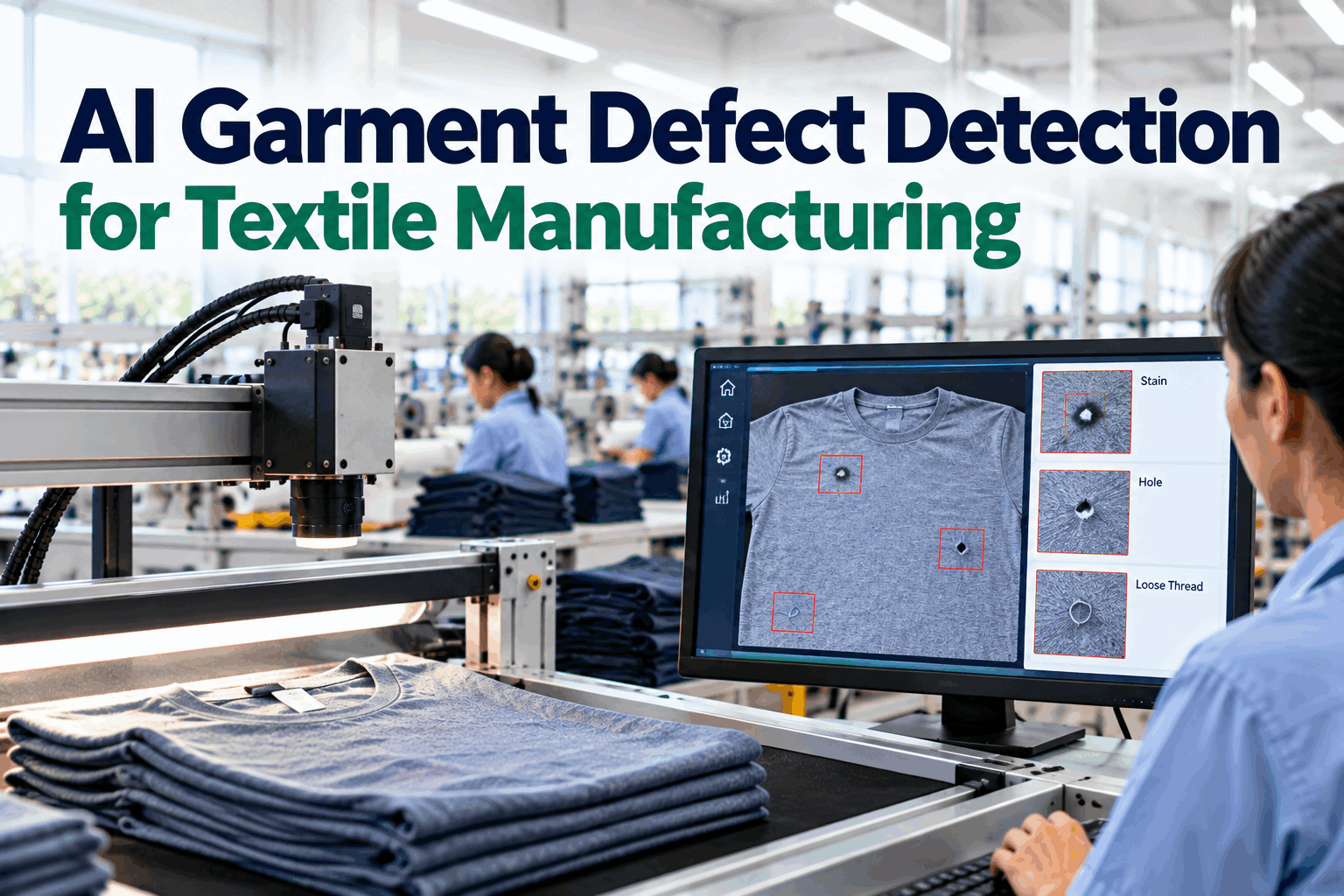
Garment defects are made one operation at a time and usually found all at once, at end-of-line checking or final audit. By then a skipped stitch on a side seam has been repeated across a whole bundle, and the fix is rework, not prevention. AI garment defect detection moves inspection closer to where defects are made: cameras at key sewing and assembly stations flag problems within seconds, so the operator or mechanic can act before the next bundle. This article covers where garment defects come from, how they are classified, how AI vision finds them and how to measure the result with DHU and first pass yield. To see detection on your own styles, book a short walkthrough.
AI Garment Defect Detection: Find Sewing and Assembly Defects Where They Are Made
Cameras at key sewing, assembly and finishing stations flag defects within seconds, tied to the operation, machine and bundle that produced them.
Why End-of-Line Checking Finds Defects Too Late
A garment passes through many operations: cutting, sewing sub-assemblies, joining, attaching trims, finishing and packing. Each operation can add defects, and on a progressive bundle line each defect is repeated on every piece until someone notices. Traditional quality control checks at the end of the line and at final audit, which is exactly where defects have already multiplied.
The cost is not only rework. End-of-line checkers are working against the clock and see each garment for seconds. Some defects slip through, and those reach final inspection under AQL sampling, where a lot can fail on a handful of major defects. Online, the stakes rise further: a 2025 survey of UK shoppers reported by Just Style found that around 30% of fashion bought online is returned, with poor fit named as the main reason, and quality problems add to that.
AI vision does not replace the checker. It adds eyes at the operations where defects start and gives operators feedback while it still matters. We can map those operations for your styles on a call.
How Garment Defects Are Classified
Garment inspection groups defects by severity, and the severity sets how much tolerance the buyer allows. AQL sampling under ISO 2859-1 or ANSI/ASQ Z1.4 uses these classes to decide whether a lot passes.
| Class | Examples | Typical AQL | What happens |
|---|---|---|---|
| Critical | Broken needle fragment, sharp point, unsafe small parts, missing mandatory safety labels | 0 | Any finding fails the lot and triggers investigation |
| Major | Open seam, skipped stitches on a stressed seam, wrong size label, stain on a visible panel | 2.5 is most common | Counted against the accept number |
| Minor | Loose thread ends, slight puckering, small misalignment that does not affect use | 4.0 | Counted against a higher accept number |
As QIMA notes in its AQL guidance, a lot of 4,000 units inspected at general level II gives a sample of 200 pieces, and at AQL 2.5 the lot is accepted with up to 10 major defects and rejected at 11. Those numbers show how few defects it takes to fail an order, and why catching them in line matters.
AI models are trained to report defects in the same classes, so line data and final audit speak the same language. Our specialists align the classes with your buyer manuals.
Where Garment Defects Come From
Most defects trace back to a small number of sources. Knowing them tells you where cameras earn their keep.
Skipped stitches, broken stitches and loose tension come mainly from needles, loopers and thread tension settings.
Fabric defects missed at inspection, shade differences between panels and thread quality all reach the garment.
Puckering, uneven seams and misaligned parts often come from how pieces are fed and guided.
Mis-cut panels lead to uneven seams and measurement defects that no sewing skill can fix.
Labels, buttons, zippers and pockets can be missing, misplaced or poorly attached.
Shine marks, stains, uncut threads and crushed pile appear late in the process.
The mix differs by product. On knitwear, overedge and coverstitch operations tend to dominate, and fabric stretch makes puckering and wavy seams more common. On woven shirts and trousers, lockstitch seams, collars, cuffs and pockets are the usual trouble spots. On denim, heavy seams, bar tacks and rivets add their own risks. Detection should follow the defect history of your own products rather than a generic list, which is why the first step in any rollout is reading the rework and audit records you already have.
Fabric deserves special mention. A textile research survey notes that about 85% of defects found in the garment industry trace back to fabric, which is why garment detection works best alongside good fabric data.
Inline Detection Versus End-of-Line Checking
Inline AI detection and end-of-line checking do different jobs. Most factories need both.
- One checker sees the finished garment
- Defects found after the full bundle is sewn
- Rework needed on every affected piece
- Source operation found by investigation
- Results often recorded on paper
- Feedback to operators hours later
- Cameras watch key operations as they run
- Defects flagged within seconds
- Operator stops the problem at the next piece
- Source operation known automatically
- Every finding stored with an image
- Feedback to operators while it still matters
Inline detection reduces what reaches the end of the line; end-of-line checking remains the final safety net. Together they shift effort from rework to prevention.
Most factories start inline detection at two or three high-risk operations, then expand as the data shows where defects start. That rollout pattern is shown in a demo.
How AI Vision Detects Garment Defects
The detection loop at a sewing or assembly station is short and repeatable.
A camera images the seam or part as the piece leaves the operation.
The model looks for skipped stitches, open seams, puckering or missing parts.
Each finding is classed critical, major or minor.
The operator or line leader sees the image and the call at once.
The finding is stored with operation, machine, bundle and time.
Training uses images of your own styles and fabrics, because a seam on stretch jersey looks very different from a seam on heavy denim. Borderline calls go to a human, and every confirmed call improves the model. Lighting and camera angle matter as much as the model; both are set during installation for each station.
The system learns what good looks like for each style, so a style change needs a short set-up rather than a new project. Ask our engineers how style changes are handled.
Choosing Which Operations Get a Camera
Not every operation needs a camera. The aim is to cover the few operations where defects start most often, cost most to fix later or carry compliance risk. A short checklist helps make that choice with data rather than instinct.
Most lines find that three to five stations cover the bulk of their defects: typically the main joining seams, the hem, the label and trim attach points, and a final look before pressing. Starting small keeps the pilot focused and makes the first results easy to read.
Station choice is revisited as data builds, and cameras can move as styles change. We plan the first set with your industrial engineers during the site survey.
Measuring Quality With DHU and First Pass Yield
Two metrics show whether defect detection is working: defects per hundred units and first pass yield. They measure different things, so track both.
One garment can carry more than one defect, which is why DHU and the defective rate differ. Numbers are illustrative.
DHU counts defects, so it rewards fixing every defect type. First pass yield counts garments, so it shows how much output needs rework. When inline detection works, both improve, and the gap between them narrows as multi-defect garments disappear.
With AI detection, both metrics are calculated per line, operation and hour instead of once a day from paper sheets. See them on a live line view.
How iFactory Delivers AI Garment Defect Detection
Fitted at high-risk sewing, trim and finishing operations.
Trained on your own fabrics, seams and trims.
Critical, major and minor aligned to buyer manuals.
Image and call shown at the station within seconds.
DHU and first pass yield by line, operation and hour.
Every finding linked to bundle, order and style.
It works with your existing production tracking and ERP rather than replacing them. See detection running on styles like yours in a session.
Catch Defects at the Operation That Makes Them
Pick one line and two or three high-risk operations. We fit cameras, train on your styles and show defects, DHU and first pass yield live for the pilot period.
Open seam flagged on 4 of the last 60 shirts at the same point above the hem. Needle and tension check suggested.
A Line Leader and iFactory on the Floor
Here is how a line leader might work with iFactory during a shirt order.
iFactory ships as a pre-configured NVIDIA AI server, racked and ready with the garment defect detection models loaded. Rack it, plug in power and Ethernet, and the AI is live on your network. Our scope covers cameras and lighting on sewing, assembly and finishing stations, PLC/SCADA and ERP integration, cabling and network setup, operator and QC team training, and 24×7 remote monitoring.
Server installed, cameras and lighting mounted, historical inspection and defect records loaded.
Models trained on your own fabrics and styles, then piloted on one line with your QC team reviewing every call.
Rollout to the agreed lines, inspector and supervisor training, ERP hand-off and 24×7 remote monitoring in place.
Cameras, server, software and integration come as one package. For pricing on your lines, contact our sales team.
Frequently Asked Questions
It uses cameras and trained models at sewing, assembly and finishing operations to find defects such as skipped stitches, open seams, puckering and missing parts within seconds, and to link each finding to the operation that caused it.
Visible defects such as skipped or broken stitches, open seams, puckering, stains, misaligned or missing labels and trims, and uncut threads. Some checks, such as needle fragments, also use metal detection alongside vision.
Usually as critical, major or minor. Critical defects typically carry an AQL of 0, major defects most often 2.5 and minor defects 4.0 under ISO 2859-1 or ANSI/ASQ Z1.4 sampling.
No. Inline detection reduces what reaches the end of the line, and checkers remain the final safety net and the reviewers of borderline calls.
With DHU, defects per hundred units, and first pass yield, the share of garments right first time. Both should be tracked by line, operation and hour.
A typical rollout takes 6–12 weeks: cameras and data links first, then training and a pilot on one line, then go-live and training. Plan it with our engineers.
Stop Repeating Defects Across Whole Bundles
iFactory flags sewing and assembly defects at the operation that makes them, so your teams fix problems in seconds instead of reworking bundles at the end of the line.
Line 6 stands out, and each bar opens the defect images behind it.