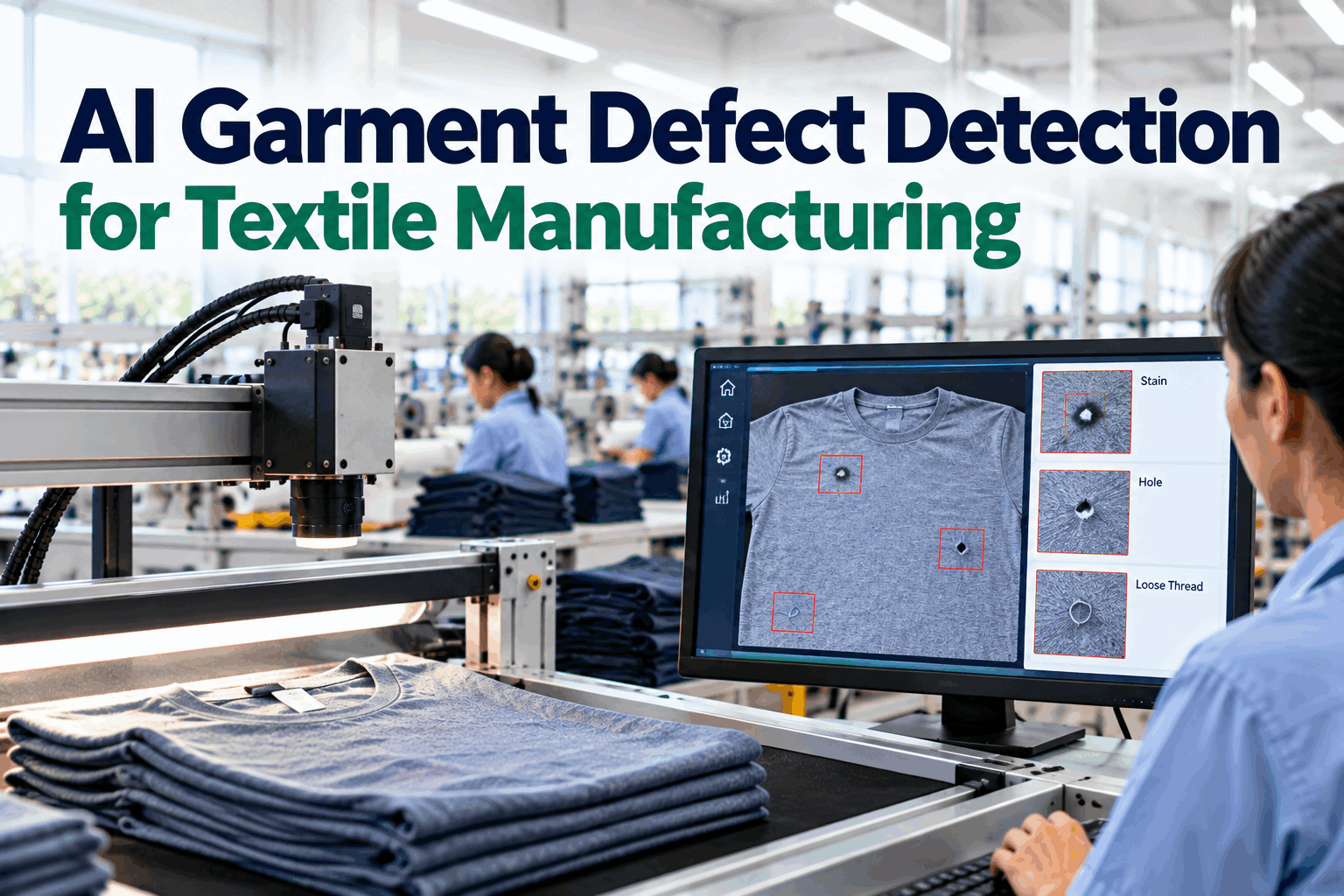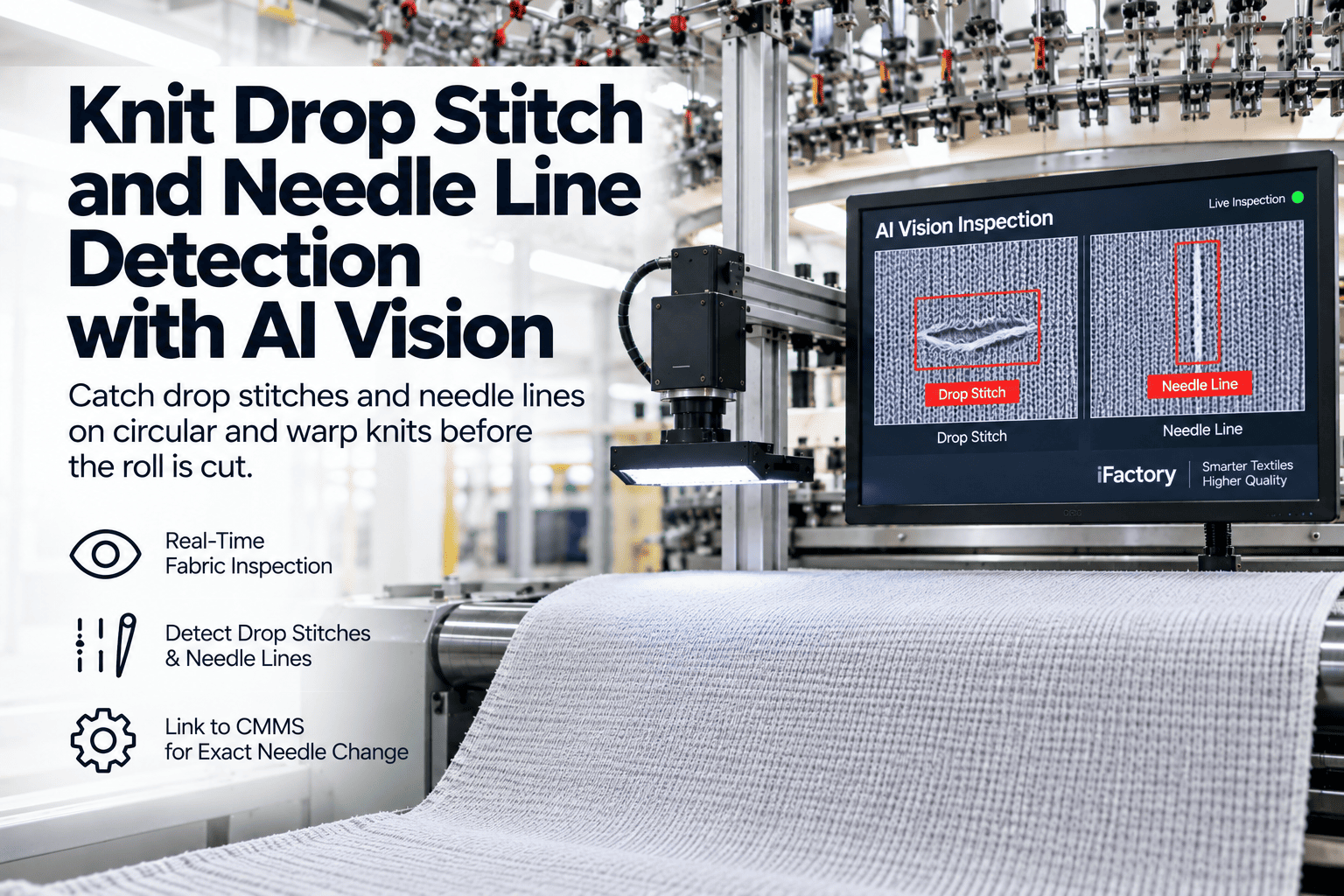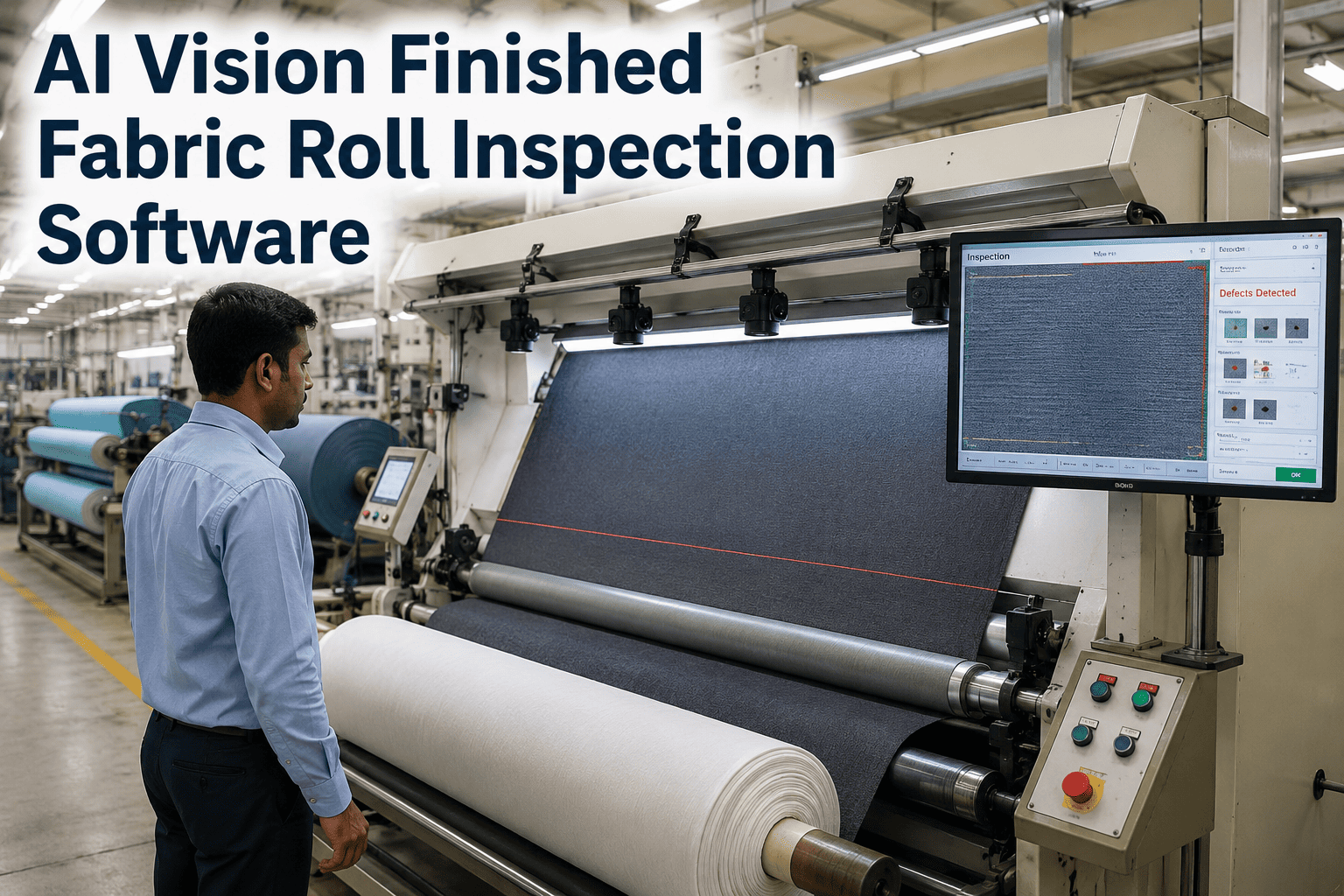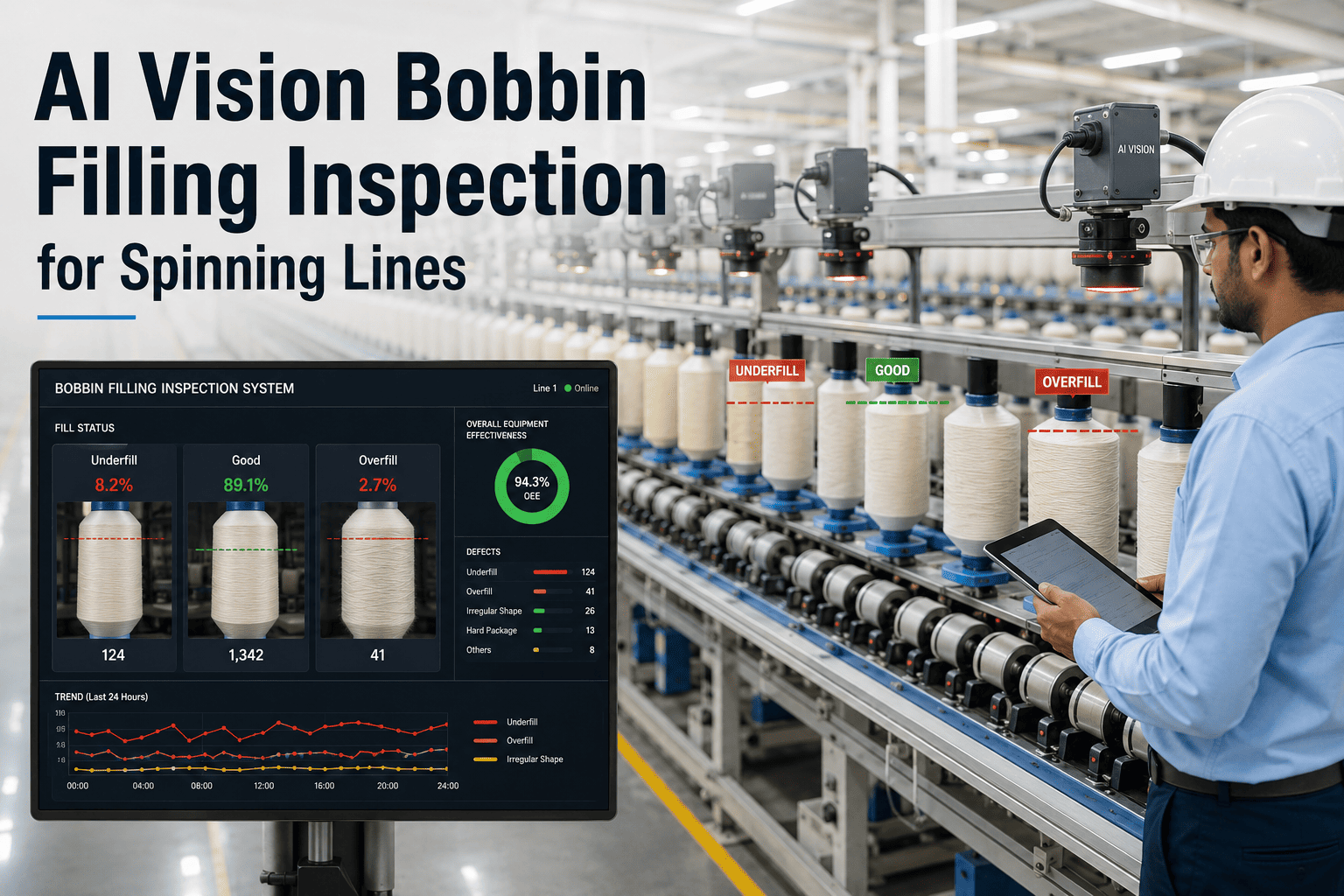
Stitches and seams hold a garment together, and they are where most sewing defects live. A skipped stitch, a loose loop on an overedge seam or a puckered topstitch can look minor on the line and become an open seam after the first wash. Because each operator repeats the same operation hundreds of times a shift, a single machine fault can produce a whole bundle of weak seams before anyone checks. Sewing line vision inspection watches the seam as it is made. This article covers stitch classes and their typical faults, what a camera can and cannot judge, where to mount it and how to use the data to fix machines instead of blaming operators. To see a seam inspected live, book a short walkthrough.
Sewing Line Vision Inspection: Catch Stitch and Seam Defects at the Machine
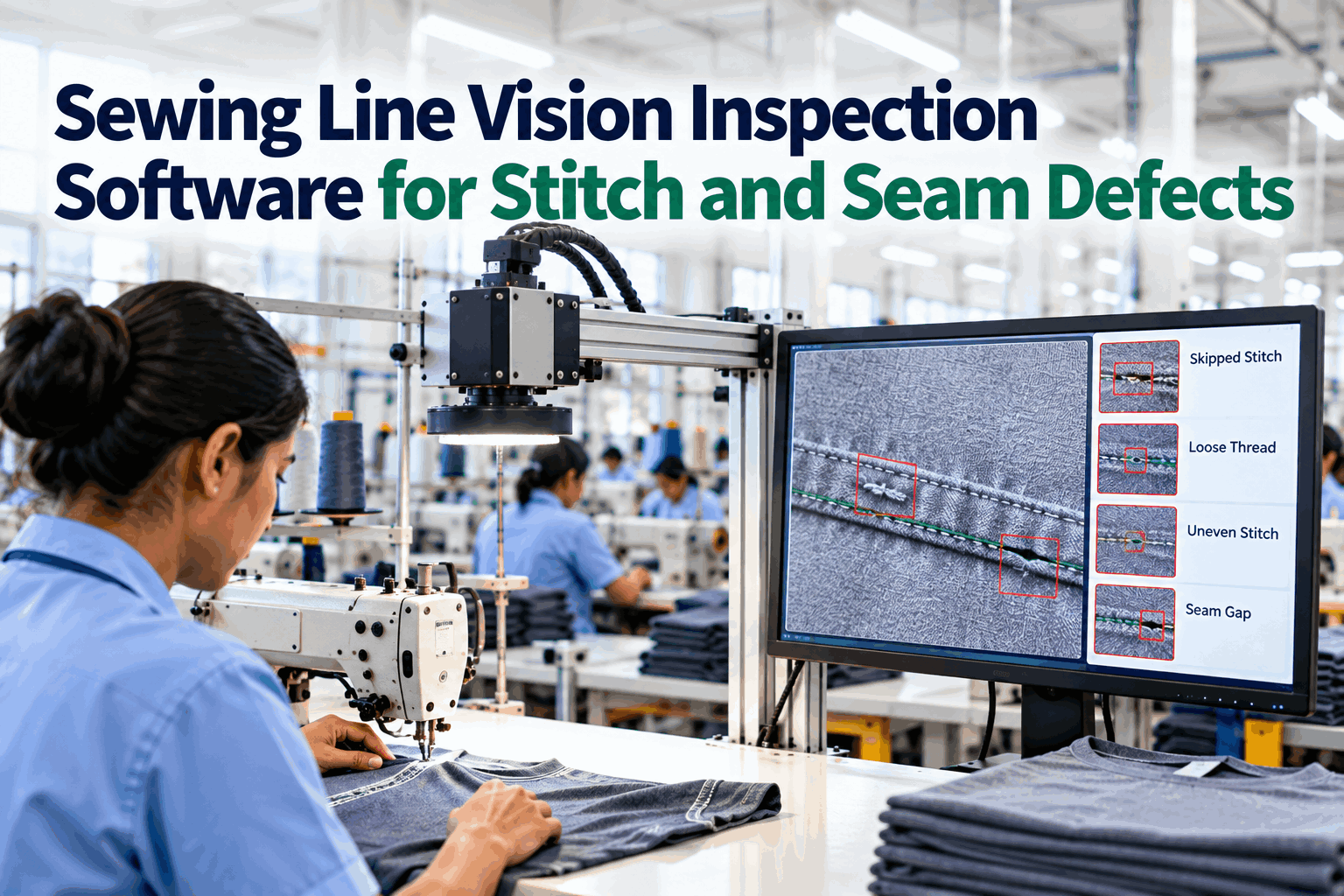
Cameras at the sewing station check every seam as it leaves the needle, spotting skipped stitches, open seams and puckering before the next bundle.
Why Stitch Defects Escape Until It Is Too Late
Stitch defects have three features that make them hard to catch by eye. They are small: a single skipped stitch on a 20-inch seam is easy to miss at checking speed. They are repetitive: a mistimed looper or a worn needle produces the same fault on every piece until it is fixed. And they are latent: a seam can look closed on the line and open under stress in wear or washing.
On a progressive bundle system, the gap between making a defect and finding it can be a whole bundle or more. If checking happens only at the end of the line, dozens of garments may carry the same weak seam, each needing unpicking and resewing. If it happens only at final audit, a few escaped seam defects can be enough to fail a lot under AQL sampling, where AQL 2.5 is the most common level for major defects.
Vision at the machine closes that gap to seconds. The first question is always which seams to watch, which we can work out together on a call.
Stitch and Seam Defects and What Causes Them
ASTM D6193 classifies stitch types and seam types, giving factories a shared language for what a seam should be. The defects below are the ones a sewing line most often needs to catch, with their usual causes.
| Defect | What it looks like | Likely cause | First check |
|---|---|---|---|
| Skipped stitch | Gap in the stitch line, thread lying on the surface | Needle and hook or looper timing, bent or wrong needle | Needle size, point and timing |
| Broken stitch | Thread cut or broken within the seam | Sharp edges, excessive tension, poor thread | Thread path and tension |
| Open seam | Seam not caught, fabric edges separate | Bite too small, feeding off the edge | Guide position and operator feed |
| Seam puckering | Wavy or gathered fabric along the seam | Tension, feed differential, thread and fabric mismatch | Tension and differential feed |
| Uneven stitch density | Stitches per inch vary along the seam | Feed dog wear, pressure foot, pulling | Feed mechanism and handling |
| Loose overedge loops | Loops hanging off the edge | Looper tension, knife setting | Looper tension and knife |
| Crooked seam | Seam line wanders from its path | Handling, missing guide, uneven panels | Guides and cut panel accuracy |
The first-check column matters. Most seam defects are machine or set-up problems that an operator cannot fix alone. Routing each finding to the right person, mechanic or operator, is part of good seam alerts.
What a Camera Can and Cannot Judge
Vision inspection is powerful at the surface and honest about its limits. Knowing both keeps expectations realistic.
- Skipped and broken stitches on visible seams
- Open seams and missed edges
- Stitch density along the seam
- Seam straightness and position
- Puckering and waviness
- Loose loops and untrimmed threads
- Seam strength under load
- Thread tension hidden inside the seam
- Stitches on the far side of the fabric
- Defects covered by later operations
- Fiber content or thread quality
- Fit, which needs measurement
That is why vision sits alongside, not instead of, laboratory seam strength tests and periodic mechanic checks. Where both sides of a seam matter, a second camera or a mirror can view the back. Where a later operation hides the seam, the camera goes before that operation, not after it.
Speed and fabric also set limits. Very fast operations need cameras with short exposure times so stitches do not blur, and dark, textured fabrics such as black fleece need more light and careful angles before thread lines stand out. Clear threads and tone-on-tone stitching are the hardest cases of all. None of these rule vision out, but each is tested on real samples before a station is committed, and the results decide whether a seam is inspected by camera, by a checker or by both.
Our engineers check each target seam for visibility during the site survey and say plainly where vision will and will not help.
Where to Mount Cameras on a Sewing Line
Camera placement decides whether a vision system sees seams or sees hands. This checklist covers the practical points.
Plan for maintenance access as well. Mechanics need to reach the needle bar, looper and feed without removing the camera, so mounts should swing or slide clear.
A well-placed camera is invisible to the operator. A badly placed one is moved within a week. Our installation team works station by station with your mechanics.
Stitch Density and Seam Straightness as Numbers
Beyond yes-or-no defect calls, vision can measure seam quality continuously. These measurements catch slow drift before it becomes a defect.
Trends matter more than single readings. A seam that is still inside spec but drifting toward the limit is a maintenance job for tomorrow, not a defect today. Catching it early avoids both rework and a machine breakdown mid-order.
Spec values come from the tech pack or the buyer’s seam specification, so each style is checked against its own targets. A denim inseam and a jersey shoulder seam have very different stitch density and allowance requirements, and the system switches targets automatically when the style on the bundle ticket changes.
Every measurement is stored by machine, so mechanics can see which machines drift fastest and plan service. That view is part of the mechanic dashboard.
Using Seam Data to Coach, Not Blame
Seam data can be linked to operators as well as machines. How that link is used decides whether the system is trusted on the floor.
Most repeated seam defects come from machines, set-ups and materials, not from operator carelessness. When a defect pattern starts mid-bundle with an operator who was fine an hour earlier, the machine is the first suspect. When one operator shows a steady pattern across machines, it is a training need. Showing the data in that order, machine first and person second, keeps the conversation fair.
Practical rules help. Share images with the operator at the station rather than in a report. Route machine faults to the mechanic automatically. Use operator-level data for coaching sessions, with the supervisor and the images, not for public rankings. Agree these rules with line leaders and worker representatives before go-live.
Our rollout includes a short session with line leaders on how to use the data. Ask our support team for the outline.
How iFactory Delivers Sewing Line Vision Inspection
Mounted at key seams with lighting set for each fabric.
Trained on your stitch classes, fabrics and styles.
Image and call at the station within seconds.
Stitches per inch, allowance, straightness and puckering.
Machine faults sent to mechanics with the evidence.
Defects by operation, machine, style and hour.
It connects to your production tracking and maintenance systems. See seam inspection on styles like yours in a session.
Watch Your Most Troublesome Seams Live
Choose two or three seams with the most rework. We fit cameras, train on your styles and show every stitch defect with its machine and operation for the pilot period.
Skipped loops at the same point on 3 of 25 pieces. Pattern matches a looper timing issue, not handling.
A Seam Fault Caught Before the Next Bundle
This exchange shows how a line supervisor might use iFactory on a knit top order.
iFactory ships as a pre-configured NVIDIA AI server, racked and ready with the stitch and seam defect detection models loaded. Rack it, plug in power and Ethernet, and the AI is live on your network. Our scope covers cameras and lighting on sewing stations, PLC/SCADA and ERP integration, cabling and network setup, operator and QC team training, and 24×7 remote monitoring.
Server installed, cameras and lighting mounted, historical inspection and defect records loaded.
Models trained on your own fabrics and styles, then piloted on one line with your QC team reviewing every call.
Rollout to the agreed lines, inspector and supervisor training, ERP hand-off and 24×7 remote monitoring in place.
Cameras, server, software and integration come as one package. For pricing on your lines, contact our sales team.
Frequently Asked Questions
It uses cameras at sewing stations to check each seam as it is made, detecting skipped stitches, open seams, puckering and other faults within seconds and linking them to the machine and operation.
Visible faults such as skipped and broken stitches, open seams, puckering, uneven stitch density, loose overedge loops, crooked seams and untrimmed threads. Seam strength still needs laboratory testing.
It is a standard practice that classifies stitch types, such as 301 lockstitch, 401 chainstitch and 504 overedge, and seam types. It gives factories and buyers a shared language for seam specifications.
No. Cameras are mounted clear of the operator’s hands and view the seam as it leaves the presser foot. Operators only see an alert when a defect is found.
It does not need to be. Most repeated seam defects come from machines and set-ups, so the data should point to machines first and be used for coaching rather than public rankings.
A typical rollout takes 6–12 weeks: cameras and data links, then training and a pilot on a few seams, then go-live and training. Plan it with our team.
Fix Seam Faults at the Machine, Not at Final Audit
iFactory checks every seam as it leaves the needle and sends each fault to the person who can fix it, before the next bundle repeats it.
Each defect is tied to a station and machine, so fixes go to the right mechanic.