The most expensive AI vision investment a textile mill can make isn't the camera hardware, it's an open-ended pilot with no defined timeline that quietly drags on for six months and never actually reaches production. A structured twelve-week deployment roadmap prevents that drift by breaking the project into concrete phases, each with specific milestones and a hard deadline, from initial site survey through camera installation, model training, and final production validation. Mills that follow a disciplined week-by-week plan consistently reach live production faster than those working from a vague "a few months" estimate, largely because a defined timeline forces decisions and data collection to happen on schedule rather than whenever it's convenient. Mills ready to plan their own twelve-week deployment can start that conversation with iFactory's support team.
The Most Expensive AI Vision Project Is the One That Never Reaches Production
iFactory deploys AI vision inspection on a defined twelve-week roadmap, with concrete milestones from site survey through production validation, so your project reaches go-live instead of drifting indefinitely.
Survey & Design Weeks 4-6
Install & Collect Data Weeks 7-9
Train & Validate Weeks 10-12
Go Live
Why Undefined Pilots Are the Most Common AI Vision Failure Mode
A pilot without a hard deadline tends to expand to fill whatever time is available, since there's no forcing mechanism pushing the project toward an actual go or no-go decision. A defined twelve-week roadmap solves this by making every phase's deadline explicit from the start.
Site Survey Gets Rushed or Skipped Entirely
Skipping a proper assessment of lighting, line speed, and camera placement early on tends to surface as costly rework later in the project.
Training Data Collection Drags On Indefinitely
Without a defined collection window, gathering enough representative defect images can stretch on for months without anyone noticing the delay.
Validation Criteria Are Never Defined Up Front
Without a specific accuracy threshold agreed on before validation begins, the project has no clear finish line to reach a go-live decision against.
Production Go-Live Keeps Getting Pushed Back
A project without milestone accountability tends to accumulate "just one more test" delays that never actually resolve into a live deployment.
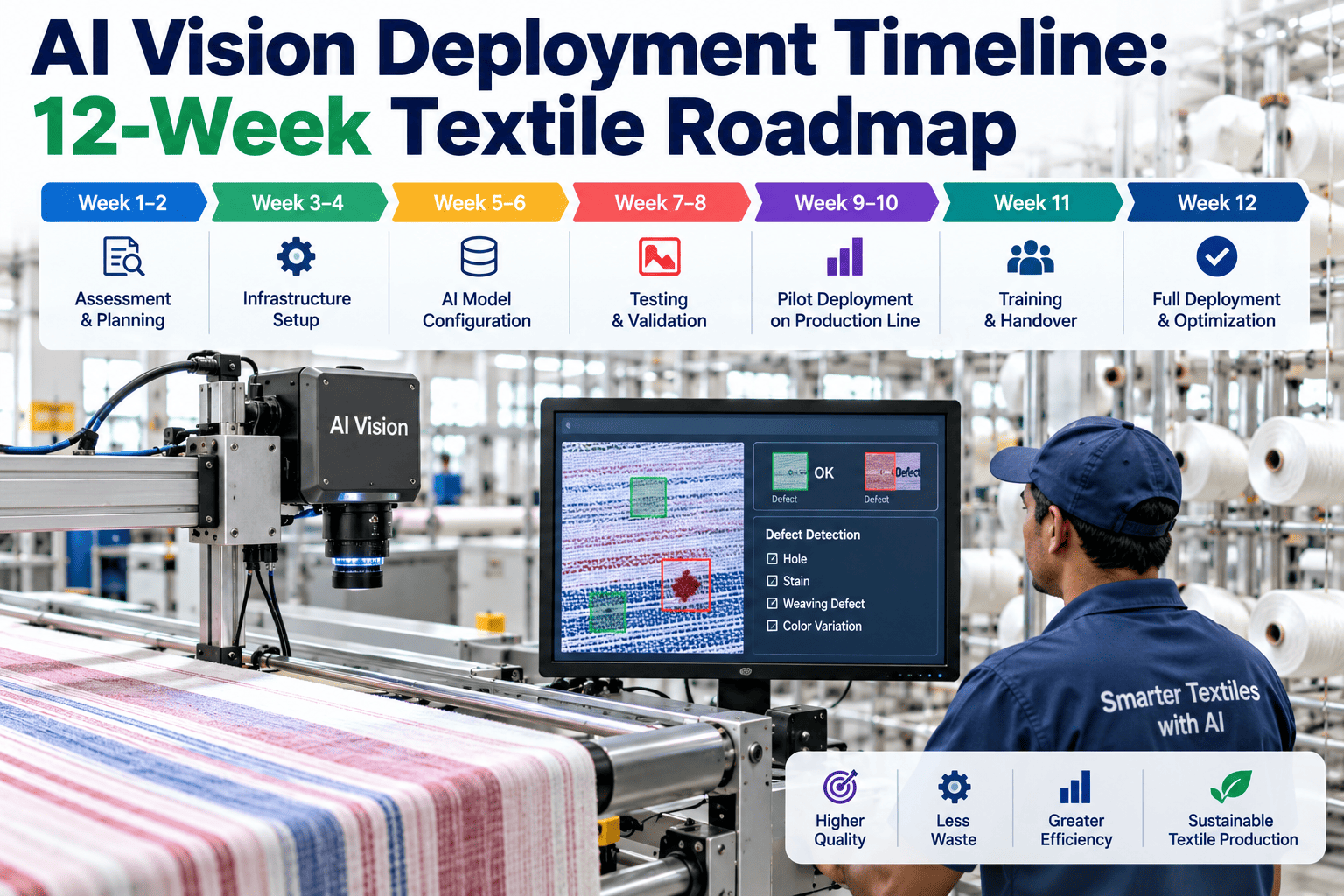
The Twelve-Week Roadmap, Phase by Phase
Each phase has a specific deliverable, and completing that deliverable is what triggers moving into the next phase rather than an arbitrary calendar date alone.
| Weeks | Phase | Key Deliverable |
|---|---|---|
| 1-3 | Site Survey & Design | Confirmed camera placement, lighting plan, and defect priority list |
| 4-6 | Installation & Data Collection | Camera and lighting installed, initial training images gathered |
| 7-9 | Model Training & Validation | Model trained and validated against agreed accuracy threshold |
| 10-12 | Production Go-Live | Live deployment with operator training and monitoring in place |
What Keeps a Twelve-Week Timeline From Slipping
A published roadmap is only useful if specific practices keep the project honest against it week by week.
Define the Accuracy Threshold Before Validation Begins
Agreeing on the specific detection rate that constitutes success avoids an open-ended "keep testing until it feels good enough" phase.
Assign a Single Owner for Each Phase
A clear owner accountable for each phase's deliverable keeps the timeline from drifting due to unclear responsibility.
Hold a Weekly Check-In Against the Roadmap
A brief, regular review of progress against the plan catches slippage early enough to correct it before it compounds.
Treat the Go-Live Date as a Real Deadline
Building organizational commitment to the twelve-week date from the outset prevents the quiet extensions that turn a defined project into an indefinite one.
Reach Production in 12 Weeks, Not an Open-Ended Pilot
iFactory deploys AI vision inspection on a defined roadmap with concrete weekly milestones, so your project reaches go-live on schedule.
A Composite Scenario: The Pilot That Finally Had a Deadline
A composite home textiles manufacturer's first attempt at AI vision inspection had stalled roughly four months in, with training data collection still ongoing and no clear sense of when, or whether, the project would actually reach production. The original plan had never defined specific weekly milestones or an accuracy threshold for success, leaving the pilot to expand indefinitely without a forcing mechanism to reach a decision.
On the second attempt, the team adopted a strict twelve-week roadmap with a named owner for each phase and a specific ninety-seven percent accuracy threshold agreed upon before validation testing began. The site survey and installation phases completed on schedule within the first six weeks, training and validation confirmed the accuracy threshold by week nine, and the system went live in production during week eleven, a full month ahead of the original stalled pilot's already-blown timeline.
Common Mistakes in AI Vision Deployment Timelines
Starting Without a Defined Accuracy Threshold
Without agreeing in advance what counts as success, validation can drag on indefinitely with no clear finish line.
Skipping or Rushing the Site Survey Phase
Inadequate early assessment of lighting and camera placement tends to resurface as costly rework during installation or validation.
Letting Training Data Collection Run Without a Deadline
An open-ended collection window tends to expand well beyond what's actually needed for a representative dataset.
Treating the Go-Live Date as Flexible
A deadline that can be quietly pushed back whenever convenient stops functioning as a real deadline at all.
Is Your Mill Ready to Plan a Structured 12-Week Deployment
You can name a single owner for each project phase
Clear accountability by phase is what keeps a defined timeline from slipping without anyone noticing.
You're willing to define a specific accuracy threshold up front
Agreeing on the success criteria before validation begins prevents an open-ended testing phase.
Leadership is committed to the go-live date as a real deadline
Organizational commitment to the timeline is what actually prevents the quiet extensions that derail most pilots.
You can schedule weekly check-ins against the roadmap
Regular review catches slippage early enough to correct course before it compounds into a much longer delay.
Frequently Asked Questions
Is twelve weeks realistic for every textile AI vision deployment?
Twelve weeks is a realistic target for a well-scoped single-line deployment with a clearly defined defect priority list, though more complex projects involving multiple lines, unusual lighting conditions, or a wider variety of defect types may need a somewhat longer timeline. The key isn't hitting exactly twelve weeks in every case, it's having a defined, phase-by-phase timeline with concrete milestones rather than an open-ended pilot with no forcing mechanism toward a decision. Mills wanting help scoping a realistic timeline for their specific situation can talk to iFactory support.
What happens if the model doesn't hit the accuracy threshold by week nine?
A defined threshold that isn't met by the validation deadline should trigger a specific, pre-agreed response, such as extending training data collection for underperforming defect categories or adjusting the threshold based on a documented technical reason, rather than simply letting the timeline drift indefinitely. Having this contingency planned in advance keeps a shortfall from derailing the entire project's discipline.
How much of the twelve weeks is spent on training data collection specifically?
Data collection typically spans the middle third of the timeline, roughly weeks four through six in a standard roadmap, running in parallel with installation work rather than as a separate sequential phase, which is part of what keeps the overall project on a tight schedule. The exact duration needed depends on how frequently the priority defect types actually occur in normal production.
Can multiple lines be deployed simultaneously on the same roadmap?
Deploying multiple lines at once is possible but generally adds complexity and risk to a first project, which is why most successful rollouts start with a single line on the full twelve-week roadmap before using that validated process as a template for faster subsequent deployments. Book a demo to see how a multi-line rollout gets sequenced after an initial successful deployment.
What's the biggest single factor that causes a deployment timeline to slip?
Undefined validation criteria is one of the most common causes, since without a specific, agreed-upon accuracy threshold, the validation phase has no clear finish line and tends to extend indefinitely as the team keeps testing for a vague sense of "good enough." Defining that threshold explicitly before validation begins is one of the single most effective ways to keep a twelve-week roadmap on schedule.
Reach Production in 12 Weeks With a Roadmap That Holds
iFactory deploys AI vision inspection on a defined, milestone-driven timeline, so your project reaches go-live instead of an open-ended pilot.