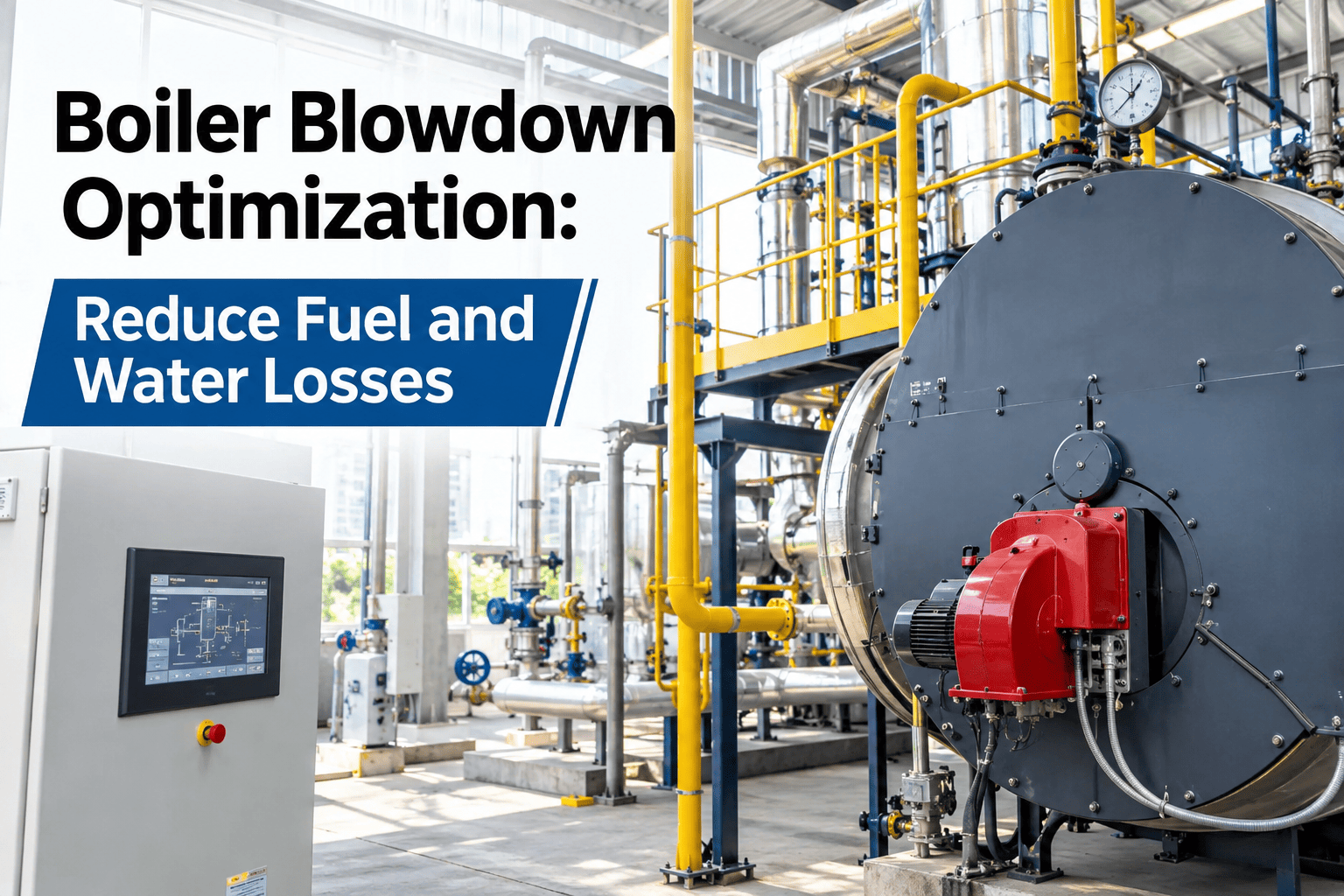
Every textile boiler needs blowdown to stay alive, and every unit of blowdown is paid-for heat leaving through a drain valve. Too little blowdown lets dissolved solids build into scale that insulates the tubes; too much throws away water the boiler already heated to over 300 degrees. Most mills set the valve once and leave it, never tying it back to what the feedwater is actually carrying. A conductivity-based, automatic blowdown control typically cuts a boiler's blowdown rate from around 8 percent of feedwater down to 6, saving tens of thousands of dollars a year on a mid-size unit (U.S. Department of Energy, 2026). Engineers who want that number for their own boiler can run a blowdown savings estimate using their own boiler's feedwater data in a short session.
Every Blowdown Cycle Throws Away Heat. Is Yours Throwing Away Too Much, or Too Little?
iFactory AI watches boiler water conductivity and blowdown frequency together, so the valve opens only as often as the dissolved solids actually require.
What Blowdown Is Actually Doing
Feedwater carries dissolved minerals that concentrate as the boiler evaporates water into steam. Left unchecked, those minerals scale the tubes and foam into the steam line. Blowdown discharges a portion of that concentrated water so the remainder stays within a safe limit.
The Documented Economics of Getting It Right
The U.S. Department of Energy's worked example for a continuously operating, natural-gas-fired, 150 psig, 100,000 lb/hr boiler shows what a two-percentage-point blowdown cut is worth in practice.
| Parameter | Before (8% Blowdown) | After (6% Blowdown) |
|---|---|---|
| Makeup water required | ~108,700 lb/hr | ~106,400 lb/hr |
| Annual fuel savings | — | Tens of thousands of dollars per year |
| Annual water & chemical savings | — | Several thousand dollars per year |
| Typical control system cost | — | $2,500–$6,000, 1–3 year payback |
Turn Your Blowdown Valve Into a Tracked Number
Share your boiler's pressure, output and current blowdown schedule, and see where your own fuel and water savings sit.
Manual Scheduling vs Conductivity-Based Control
Most textile boiler houses still run blowdown on a fixed schedule set by an operator, checked a few times a shift at best. That schedule rarely matches how fast dissolved solids are actually rising, which changes with makeup water quality, steam demand and condensate return rate.
Three Signals Worth Watching Alongside the Valve
Blowdown rate alone tells only part of the story. Three connected signals explain whether a given rate is appropriate for that day's operating conditions.
A rising baseline between blowdown events signals the makeup water quality or condensate return rate has shifted.
A valve opening far more often than usual points to a feedwater or treatment program issue upstream, not a valve fault.
A temperature above the program's baseline can indicate heat transfer surfaces are already fouling, which raises blowdown's urgency.
Five Steps to a Monitored Blowdown Program
Log current blowdown frequency, TDS readings and makeup water quality for two weeks.
Add a conductivity probe feeding a modulating blowdown valve, per ASME guidance.
Agree the TDS band with the water treatment program, not an arbitrary round number.
Let the valve respond continuously instead of on a fixed operator schedule.
Compare fuel and water use against the two-week baseline every month.
A Composite Scenario: The Boiler That Was Blown Down by Habit
A composite, illustrative case drawn from common patterns across published steam audits: a dye house boiler had its blowdown valve set to a fixed interval years earlier, when makeup water quality was worse than it is today after a softener upgrade. Nobody revisited the schedule once the water chemistry changed.
A two-week conductivity log showed the boiler was discharging water well below the treatment program's TDS limit on most cycles, meaning a meaningful share of every blowdown event was wasted heat rather than necessary protection. Moving to conductivity-based control closed most of that gap within the first month, without any change to the water treatment chemicals already in use.
Where iFactory AI Fits
Blowdown optimization needs conductivity, steam demand and condensate return read together, not as separate gauges on separate panels.
Conductivity Trending
Continuous TDS readings replace manual grab-sample checks, with drift flagged before it reaches the treatment limit.
Blowdown Rate Dashboard
Blowdown frequency and volume are tracked against steam output, by boiler and by shift.
Savings Verification
Fuel and water savings are compared against the pre-automation baseline, not an assumed percentage.
Cross-Boiler Benchmarking
Multiple boiler houses on one site are compared side by side, surfacing the unit with the widest optimization gap.
The DOE's 8-to-6-percent example is a standard reference case, not a universal result: your own savings depend on current blowdown rate, fuel price, water cost and boiler size, all of which vary by plant. What is well established is the mechanism: a conductivity-controlled valve removes guesswork from a task operators currently manage by habit, and the published payback window of one to three years holds up across most published industrial case studies. Confirm the current blowdown rate on your own boiler before assuming the DOE figures apply directly.
Frequently Asked Questions
What is a normal blowdown rate for a textile boiler?
Blowdown typically ranges from 4 to 10 percent of boiler feedwater flow, and can run even higher when makeup water carries high dissolved solids. The right figure for your boiler depends on water quality and the treatment program in place. Check your current rate against your feedwater data in a short session.
Does automatic blowdown control replace manual testing entirely?
Most programs keep periodic manual verification as a backup check on the sensor, even after automation is installed. The automation removes the guesswork from day-to-day operation, not the oversight. Ask how verification is scheduled alongside an automated system.
How does condensate return rate affect blowdown?
A low condensate return rate means more fresh makeup water enters the boiler, which usually carries more dissolved solids and forces more frequent blowdown. Improving condensate return is often the cheaper lever to pull before or alongside blowdown automation.
What payback period should we expect on a blowdown control system?
Published industrial examples put the payback at one to three years for the control equipment itself, driven mainly by fuel and water savings. Larger, continuously-run boilers with a currently high blowdown rate tend to see the fastest returns. Estimate payback for your boiler with our team.
Can this work alongside our existing water treatment contract?
Yes, conductivity monitoring and automated blowdown are designed to operate within the limits your water treatment provider sets, and the added data usually helps that provider tune the program further. Loop in your treatment provider during setup through support.
Stop Guessing at the Blowdown Valve
iFactory AI ties blowdown to real conductivity readings, so every discharge is necessary and every saved gallon stays saved. Book a walkthrough with your own boiler data.