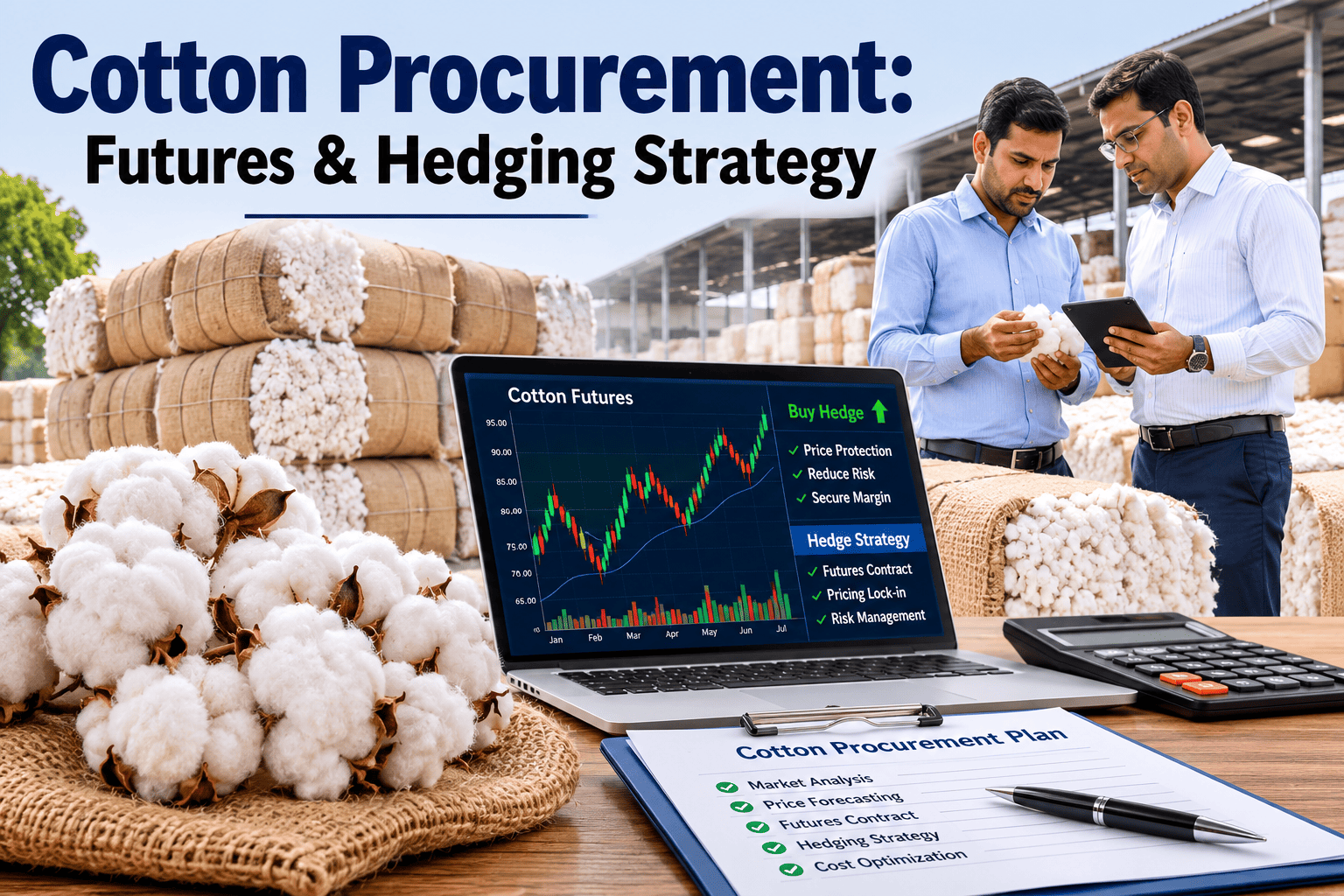
Cotton is one of the few raw materials a textile buyer purchases where the price on the day of the purchase order rarely resembles the price the mill actually pays once fiber arrives, spins, and gets invoiced months later. Between planting decisions in Texas or Gujarat and a finished yarn contract, cotton moves through futures markets, basis adjustments, and quality classing systems that most procurement teams outside the fiber trade never have to think about. Getting cotton procurement right means understanding not just where spot prices sit today, but how futures contracts, hedging instruments, and quality-based buying decisions interact to determine what a mill actually pays — and what quality it actually receives — once the fiber is finally on the floor. This isn't a market procurement teams can navigate with instinct alone; it requires a structured strategy built around futures market mechanics, disciplined hedging, and quality classing fluency.
Why Cotton Procurement Isn't Like Buying Any Other Raw Material
Most textile raw materials — synthetic fibers, dyes, chemicals — trade at relatively stable, negotiated prices tied to production cost and supplier margin. Cotton trades as a globally exchanged commodity, meaning its price is set continuously by futures markets responding to weather, planting decisions, global demand, and speculative positioning thousands of miles from any individual mill. A procurement team buying cotton is, whether they think of it this way or not, participating in a commodity market that behaves more like buying oil or grain than buying polyester chips.
This has real organizational implications for how a textile business structures its procurement function. A team accustomed to negotiating supplier contracts based on production cost and volume commitments often finds itself unprepared for a market where the underlying price can move meaningfully between the morning and afternoon of the same trading day, driven by a USDA report or a weather forecast update that has nothing to do with any individual supplier relationship. Building genuine competency in commodity market dynamics — not just supplier relationship management — is what separates procurement teams that manage cotton cost effectively from those that are simply reacting to whatever price a broker quotes.
Layered on top of this price volatility is a quality classing system that determines whether the fiber a mill receives actually performs the way the price implied it should. Two bales priced identically on a futures basis can spin very differently depending on staple length, micronaire, and strength — which means procurement strategy in cotton has to manage two interlocking variables simultaneously: the financial exposure of price movement, and the quality risk of what actually arrives.
How the Cotton Futures Market Actually Works
Cotton futures contracts, traded primarily on the ICE Futures U.S. exchange, establish a price for cotton delivery at a specified future date. Understanding how these contracts function is the foundation for any procurement strategy that goes beyond simply accepting whatever spot price a supplier quotes on a given day. Even procurement teams that never intend to trade futures contracts directly benefit enormously from understanding how the futures market moves, since nearly every cash price a mill actually pays is quoted as some combination of the futures price plus or minus a basis adjustment — meaning futures market literacy is foundational even for buyers working entirely through cash or basis contracts with suppliers. Book a demo to see how futures exposure translates into your actual mill-level cost data.
The Core Hedging Tools Available to Cotton Buyers
Hedging exists to manage price risk, not to eliminate it entirely or to speculate on favorable price movement. A well-structured hedging program gives a procurement team predictable cost exposure that supports downstream pricing and contract commitments, even when the underlying futures market moves significantly. It's worth stating this plainly because it's a common misconception among procurement teams new to commodity hedging: a hedge that "loses money" when the futures price moves favorably after the hedge was placed is not a failed hedge — it did exactly what it was designed to do, which is remove uncertainty, not maximize price outcomes.
Most mature procurement programs don't rely on a single instrument exclusively — they layer several of these tools together based on the specific risk being managed at a given point in the buying cycle. A mill might use futures contracts to hedge the bulk price exposure for a well-defined production quarter, while using options to protect against extreme downside scenarios during periods of unusual market volatility, and basis contracts to lock in quality-specific sourcing from preferred suppliers regardless of where the futures price ultimately settles.
Cotton Classing — The Quality Variables That Determine Spinning Performance
Price hedging protects a mill from cost volatility, but it does nothing to protect against buying cotton that spins poorly. Cotton classing systems evaluate specific fiber properties that directly determine yarn quality, and procurement decisions that ignore these properties in favor of price alone frequently create downstream production problems that cost far more than any price premium would have. Book a demo to see how classing data connects to your actual spinning performance outcomes.
These classing variables interact with each other in ways that make single-metric purchasing decisions risky. Cotton with excellent staple length but micronaire outside the preferred range for a specific yarn count can still create processing problems, even though the length measurement alone would suggest premium quality. Procurement teams that understand how their specific spinning equipment and product mix respond to different combinations of these variables — not just the individual metrics in isolation — make measurably better purchasing decisions than those buying primarily against a single headline quality number.
Connecting Price Strategy and Quality Strategy Into One Procurement Program
The most common failure in cotton procurement isn't a bad hedge or a bad quality decision in isolation — it's treating price strategy and quality strategy as two separate conversations handled by two different teams with two different priorities. A finance-driven hedging program that locks in favorable pricing on cotton that doesn't meet the mill's actual quality needs creates downstream cost that the original hedge never accounted for.
An integrated procurement strategy connects futures and hedging decisions directly to quality specifications and actual mill consumption patterns, so that a hedge locked in today reflects not just a favorable price, but a price for cotton that will actually perform correctly on the specific equipment and product lines it's destined for. This requires procurement, quality, and production planning functions to share visibility into the same data — something that's historically been difficult when each function operates its own separate tracking system disconnected from the others. A procurement analyst locking in a hedge based purely on futures market movement has no way of knowing whether the underlying quality profile aligns with what the mill's product mix will actually need six months later, unless that connection is built into the process deliberately rather than assumed.
Inventory Strategy as a Risk Management Tool
How much cotton inventory a mill carries, and when it's purchased relative to production need, is itself a form of risk management that interacts directly with hedging strategy. Carrying too little inventory exposes a mill to spot market price spikes and supply disruption; carrying too much ties up working capital and exposes the mill to price declines on unhedged inventory sitting in the warehouse.
The right balance among these risks depends heavily on a mill's specific financial position, product mix stability, and tolerance for cost variability — there is no universally correct inventory strategy that applies across every operation. A mill producing highly standardized commodity yarns with stable, predictable demand can generally tolerate more aggressive forward coverage than one producing frequently changing specialty products, where locking in cotton months ahead against an uncertain future product mix introduces real risk that a more flexible, closer-to-need purchasing approach would avoid.