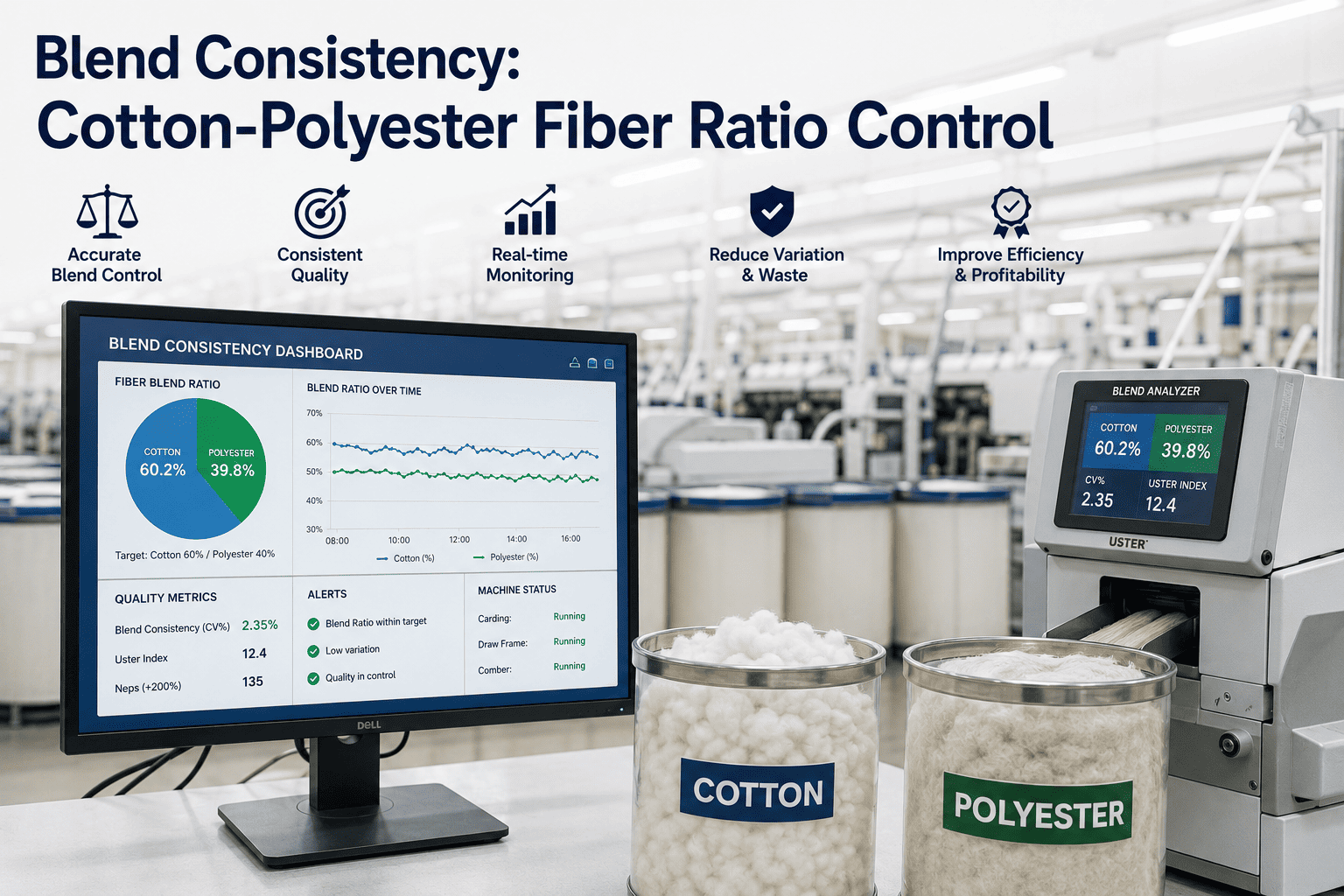
The difference between a 65/35 and a 60/40 polyester-cotton blend sounds like a rounding error until it shows up on the invoice and in the customer complaint file at the same time. Blend ratio is one of the few spinning decisions that simultaneously moves cost, strength, dye uptake, and hand feel — which means getting it wrong does not just produce a quality problem, it produces a margin problem that compounds across every meter shipped. See how blend ratio tracking connects to real production cost with Book a Demo.
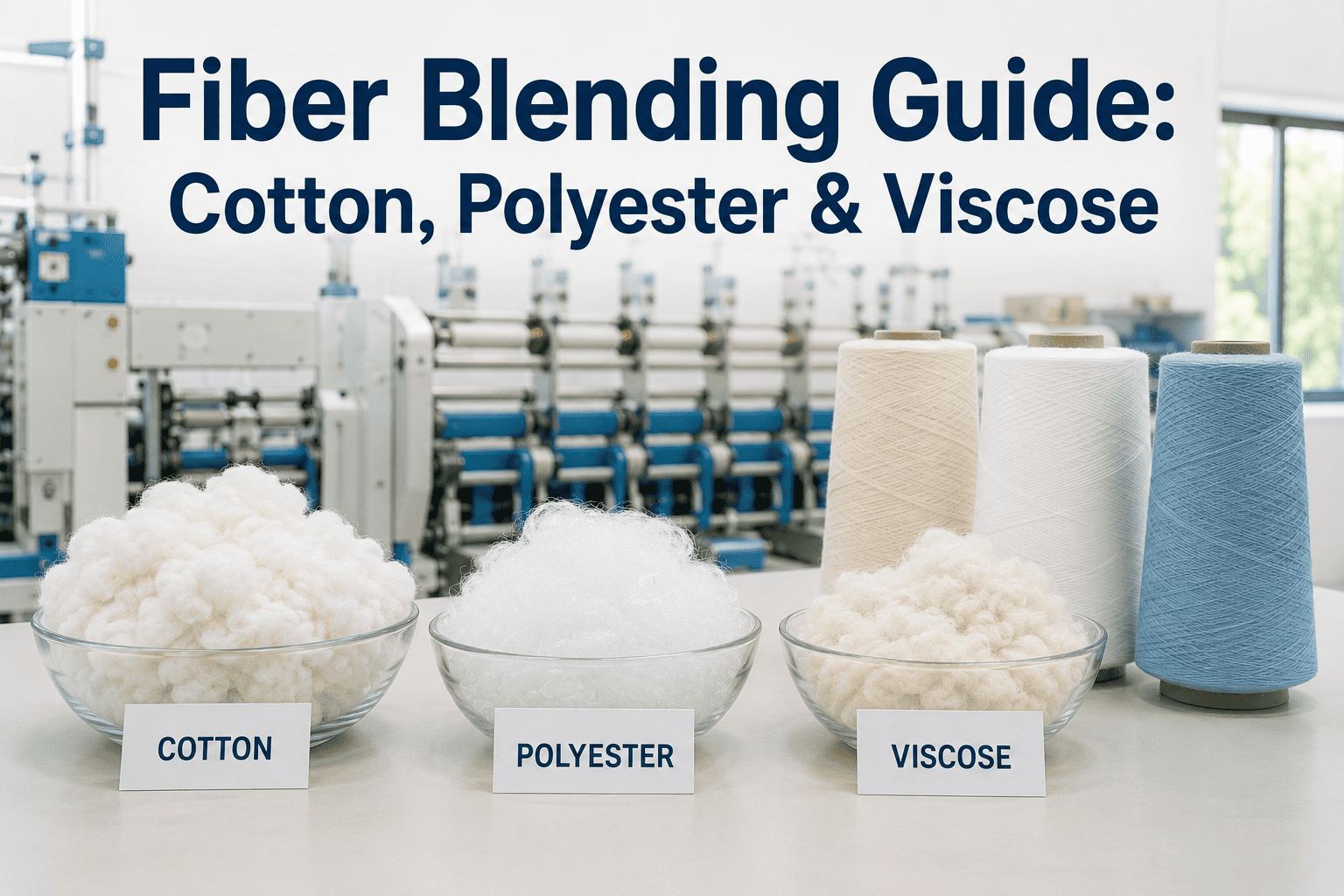
Fiber Blending Guide: Cotton, Polyester & Viscose
A practical framework for setting cotton-polyester, cotton-viscose, and tri-blend ratios that hit target yarn properties without giving away margin to unnecessary fiber cost.
Verify Blend Ratio at the Line, Not After the Invoice
See how automated blend composition tracking flags ratio drift before it reaches finished goods.
Four Properties That Move With Every Percentage Point
Tensile Strength
Increasing polyester content generally raises tenacity, since polyester fiber is inherently stronger than cotton, but pushed too far it compromises moisture absorption and comfort.
Dye Uptake
Cotton and polyester take dye through entirely different mechanisms, meaning blend ratio directly determines whether a fabric needs single-bath or two-stage dyeing.
Pilling Resistance
Higher polyester content increases pilling tendency unless offset by fiber finish treatment, since polyester fiber ends resist breaking off the fabric surface.
Raw Material Cost
Polyester and viscose typically cost less per kilogram than cotton, making blend ratio one of the most direct cost levers available at the spinning stage.
Where Blending Actually Happens in the Process
Blend uniformity depends heavily on where the fibers are combined, not just what ratio is targeted. Blending too late in the process produces streaky, inconsistent yarn regardless of how accurate the target ratio is.
| Blending Stage | Method | Uniformity Level | Best Suited For |
|---|---|---|---|
| Blow Room | Bale-level lay-down mixing | Moderate | Simple two-fiber blends |
| Draw Frame | Sliver doubling and drafting | High | Precision ratio blends, tri-blends |
| Card Sliver | Post-carding combination | Moderate to High | Fiber types needing separate carding |
| Roving Stage | Doubled roving combination | High | Fine-count specialty blends |
Finding the Ratio That Meets Spec at the Lowest Cost
Start from the minimum performance specification the customer actually requires, not the highest-quality blend available in the fiber inventory.
Model tensile and dye-uptake outcomes at several candidate ratios before committing a production run, since small ratio shifts often meet spec at meaningfully lower cost.
Track actual delivered ratio against target continuously, since blend drift during production silently erodes the cost advantage the ratio was chosen for.
Revisit blend ratios whenever fiber market pricing shifts meaningfully, since the optimal ratio changes with relative fiber cost, not just with product specification.
Frequently Asked Questions
Q: How much blend ratio deviation is typically acceptable before it affects fabric quality?
Most specifications tolerate a deviation of around two to three percentage points before dye uptake and strength shift enough to cause a visible or measurable issue downstream. Beyond that range, dye lot matching becomes difficult and tensile properties can drift outside the buyer's tolerance band, particularly for blends targeting a precise ratio like 65/35. Because this tolerance window is narrow relative to how blend ratio typically drifts during long production runs, ongoing verification matters more than a single pre-run check. Ask about continuous blend verification with Book a Demo.
Q: Why does blend ratio drift during a production run even when the recipe is fixed?
Drift typically originates from inconsistent feeding at the blow room, where fiber tuft size and lay-down thickness vary slightly between the different fiber sources being combined. Over the course of a long run, small feeding inconsistencies accumulate into a measurable shift away from the target ratio, particularly when one fiber component has different bulk density than the other. Draw frame doubling helps average out some of this variation, but it does not eliminate a systematic feeding bias if one exists.
Q: Is tri-blend yarn more difficult to produce consistently than a two-fiber blend?
Yes, generally. Tri-blends require controlling two independent ratio relationships simultaneously rather than one, which multiplies the number of ways the blend can drift off target during production. They also typically require more doubling passes at the draw frame to achieve acceptable uniformity across all three fiber types, since the fibers often differ in length, fineness, and surface friction from each other. This makes tri-blend production more sensitive to draw frame maintenance and roving frame calibration than a standard two-fiber blend.
Q: How does fiber blending affect dyeing cost downstream?
Cotton and polyester require fundamentally different dye classes and dyeing conditions, so most polyester-cotton blends need a two-stage dyeing process that adds both time and cost compared to dyeing a single-fiber yarn. Cotton-viscose blends are generally easier to dye in a single bath since both fibers respond to similar dye classes, which is one reason cotton-viscose blends are often chosen when dyeing cost is a significant factor. Reach out through Support Contact to review blend-to-dye cost modeling for your product mix.
Q: What is the most reliable way to verify actual blend ratio in finished yarn?
Laboratory chemical analysis remains the most precise method for confirming exact blend composition, but it is destructive and too slow to catch drift during an active production run. Many mills instead rely on periodic spot checks combined with tight control of feeding parameters at the blend point, accepting a wider margin of uncertainty between formal lab tests. Continuous monitoring of feed rates and material flow at the blending stage offers a practical middle ground, flagging feeding inconsistencies before they accumulate into an out-of-spec ratio.
Hold Every Blend Ratio to Target, Automatically
See live blend composition monitoring running against your own fiber feeding and draw frame data.