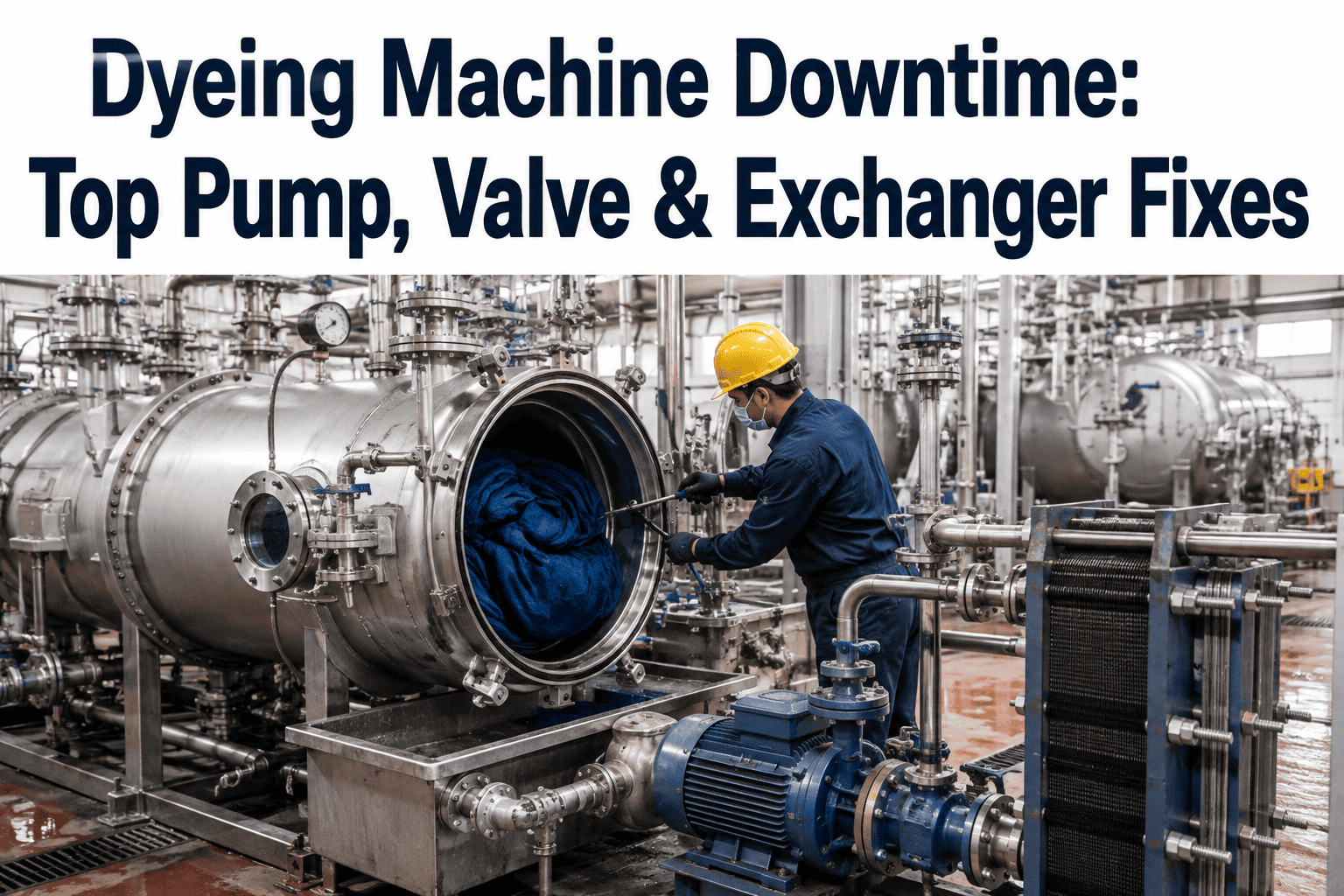
A dyeing machine failure is rarely a surprise to the equipment — it is a surprise to whoever is standing near it when it happens. Pump seal wear, valve degradation, and heat exchanger fouling all follow gradual, measurable failure curves, and by the time a batch actually stops mid-cycle, the underlying condition has usually been drifting for weeks. The difference between reactive dyeing maintenance and preventive maintenance is not better technicians, it is catching that drift before the batch does. Book a demo to see failure-mode tracking running against your own dyeing machines.
Dyeing · Reliability
Three Failure Modes Cause Most Dyeing Machine Downtime. All Three Give Warning Before They Fail.
Preventive maintenance built around the real failure curves of pump seals, valves, and heat exchangers — not a fixed calendar interval that misses early failures and wastes late ones.
The Three Failure Modes Behind Most Unplanned Dyeing Stops
Pumps, valves, and heat exchangers fail differently, on different timelines, and with different warning signs — which is exactly why a single generic maintenance schedule tends to under-serve all three at once.
Pump Seal Failure
Mechanical seal wear increases gradually, producing a slow rise in leakage before a sudden, complete failure mid-cycle.
Warning window: weeks
Valve Degradation
Actuator response time and seat wear degrade slowly, first showing up as inconsistent fill or drain timing before full failure.
Warning window: months
Heat Exchanger Fouling
Scale and residue buildup reduce heat transfer efficiency gradually, extending ramp time long before a full blockage occurs.
Warning window: months
Pump Seal Failure: The Fastest-Moving of the Three
Pump seals give the shortest warning of the three major failure modes, which makes continuous monitoring more valuable here than almost anywhere else on a dyeing machine.
Early Sign
A small, intermittent leak visible only during specific pressure phases of the dyeing cycle.
Mid-Stage Sign
Leakage becomes consistent across the full cycle, often accompanied by a measurable pressure drop.
Late-Stage Sign
Vibration increases sharply as the seal surface degrades further, typically days before complete failure.
Catch a Failing Seal Weeks Before It Stops a Batch.
iFactory tracks pressure, leakage, and vibration trends against each pump's own baseline, flagging drift long before a scheduled inspection would.
Reactive vs. Preventive: What Changes at Each Failure Mode
| Failure Mode | Reactive Approach | Preventive Approach |
| Pump Seal | Replaced only after a batch stops mid-cycle from a full leak | Replaced during a scheduled stop once leakage trend crosses a threshold |
| Valve | Replaced after fill or drain timing causes a batch quality issue | Rebuilt when actuator response time drifts beyond a set tolerance |
| Heat Exchanger | Cleaned only once ramp time becomes visibly unacceptable | Cleaned on a trigger tied to measured heat transfer efficiency loss |
Valve Degradation: The Failure Mode Most Often Missed
Valve issues rarely announce themselves as a valve problem. They usually show up first as an unexplained shade variation or an inconsistent cycle time that gets investigated everywhere except the valve itself.
Fill Timing DriftA valve taking longer to reach full open changes the actual liquor ratio timing without triggering any alarm.
Drain InconsistencyPartial seat wear allows a slow residual drain that extends the effective cycle time on every batch.
Actuator Response LagA growing delay between the control signal and actual valve position is one of the earliest measurable warning signs available.
Heat Exchanger Fouling: The Slowest, Costliest Drift
Because fouling develops over months, it is the failure mode most likely to be normalized rather than fixed — plants gradually adjust cycle times upward instead of recognizing the exchanger itself has degraded.
1
Baseline Ramp Time
Record heating and cooling ramp duration when the exchanger is known to be clean, as the reference point for all future comparisons.
2
Track Ramp Drift Over Time
Monitor how much longer each ramp phase takes relative to baseline across weeks and months of continued operation.
3
Set a Cleaning Trigger
Schedule cleaning once drift crosses a defined threshold, rather than waiting for a fixed calendar date or a visible failure.
We used to replace pump seals on a fixed six-month schedule regardless of actual condition, which meant we were either replacing seals that had plenty of life left or getting caught by a failure that happened five months into the cycle. Once we started tracking leakage and vibration trend against each pump's own baseline, we found some seals were good for nine months and others were failing by month three depending on which product ran through them most. Unplanned dyeing stops from pump failure dropped by more than half in the first two quarters after we switched to trend-based replacement.
— Maintenance Head, Dyeing and Finishing Unit, Surat
Dyeing Machine Downtime — Frequently Asked Questions
Why do pump seals fail with so much less warning than valves or heat exchangers?
A mechanical seal relies on a very thin, precisely maintained fluid film between its faces, and once that film breaks down, wear accelerates quickly rather than progressing at a steady rate. Valves and heat exchangers degrade through a slower, more gradual mechanical or chemical process — seat wear or scale buildup — that extends over months rather than weeks. This is exactly why pump condition benefits most from continuous monitoring rather than periodic manual inspection, since the useful warning window between an early sign and full failure can be measured in days once the seal starts to go.
Contact support if you want help setting a leakage and vibration threshold for your specific pump models.
How can a valve problem be distinguished from a genuine dyeing process issue?
The clearest signal is consistency: a genuine process issue, such as a chemistry or yarn quality problem, typically varies by lot or recipe, while a valve-related issue tends to appear consistently on the same machine regardless of what is being dyed. Tracking fill and drain timing against a recorded baseline for each valve, separate from batch quality data, is the most reliable way to isolate the two, since a valve drifting out of tolerance shows up as a timing trend long before it shows up as a quality complaint.
Is a fixed cleaning schedule ever better than a trigger-based approach for heat exchangers?
A fixed schedule is simpler to plan around, but it almost always results in either cleaning an exchanger that did not yet need it, wasting a production stop, or running an exchanger well past the point where fouling was already costing significant cycle time. A trigger based on measured ramp time drift adapts to the actual water quality, chemistry, and product mix running through that specific machine, which vary enough between plants and even between machines in the same plant that a single calendar interval rarely fits all of them well.
What data is needed to start tracking these three failure modes without new hardware?
Many dyeing machines already have pressure, temperature, and cycle timing data available from the existing machine controller, which is enough to start tracking valve timing drift and heat exchanger ramp time without any additional sensors. Pump condition monitoring benefits from a vibration sensor if one is not already present, since vibration is the most reliable early indicator of seal wear, but leakage and pressure trend data alone can still provide meaningful warning even before a vibration sensor is added.
How quickly can a plant expect to see fewer unplanned dyeing stops after implementing this approach?
Most plants see a measurable reduction in pump-related unplanned stops within the first one to two months, since pump condition changes are the fastest to trend and the easiest to act on quickly. Valve and heat exchanger improvements typically take longer to show results, often a full quarter, because their failure curves are slower and because building a reliable baseline for drift-based triggers takes more historical data than pump monitoring requires.
Your Next Dyeing Machine Failure Already Sent a Warning. Is Anyone Watching For It?
Track pump, valve, and heat exchanger condition against their own real baselines, so preventive maintenance happens on the machine's actual timeline, not a fixed calendar guess.