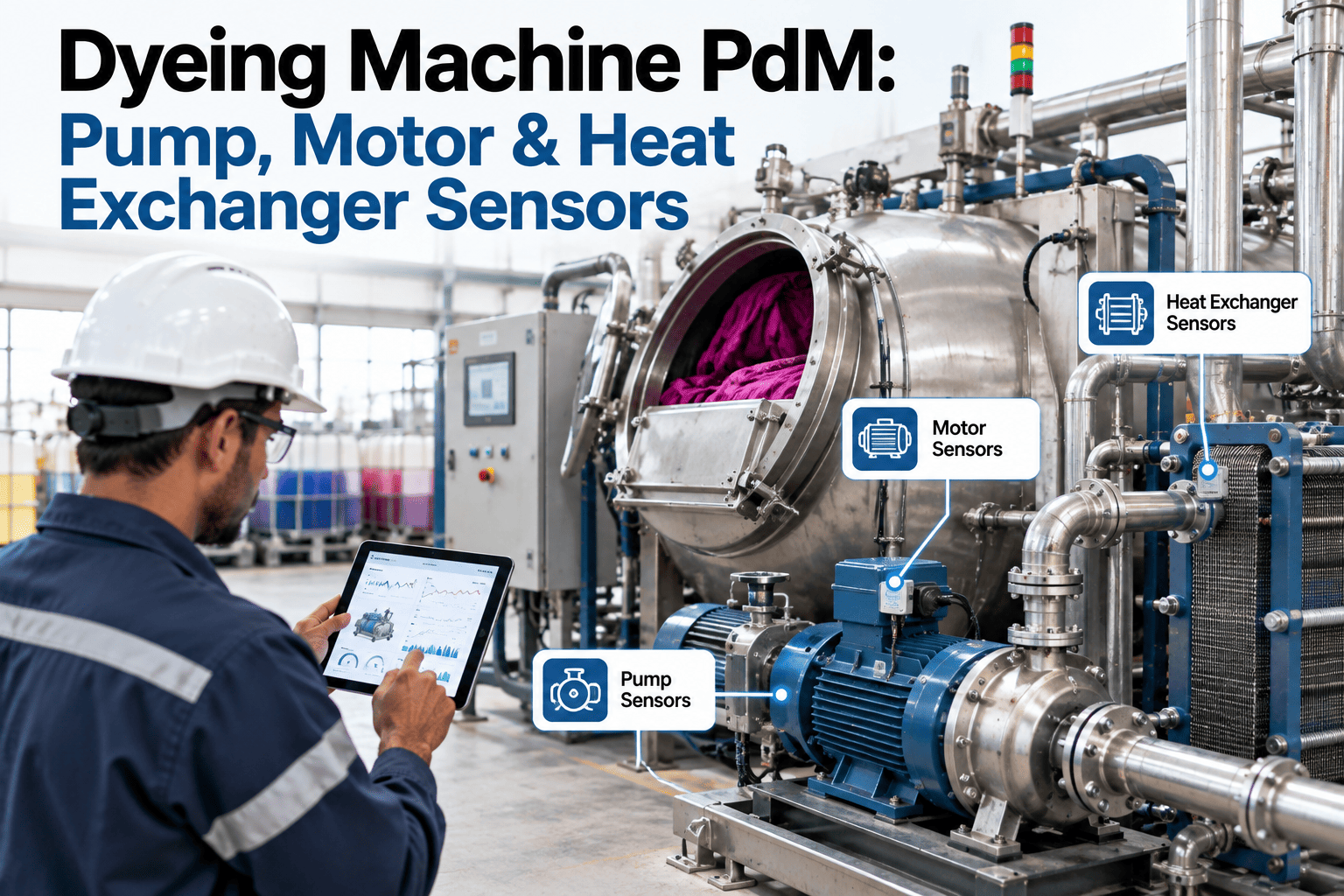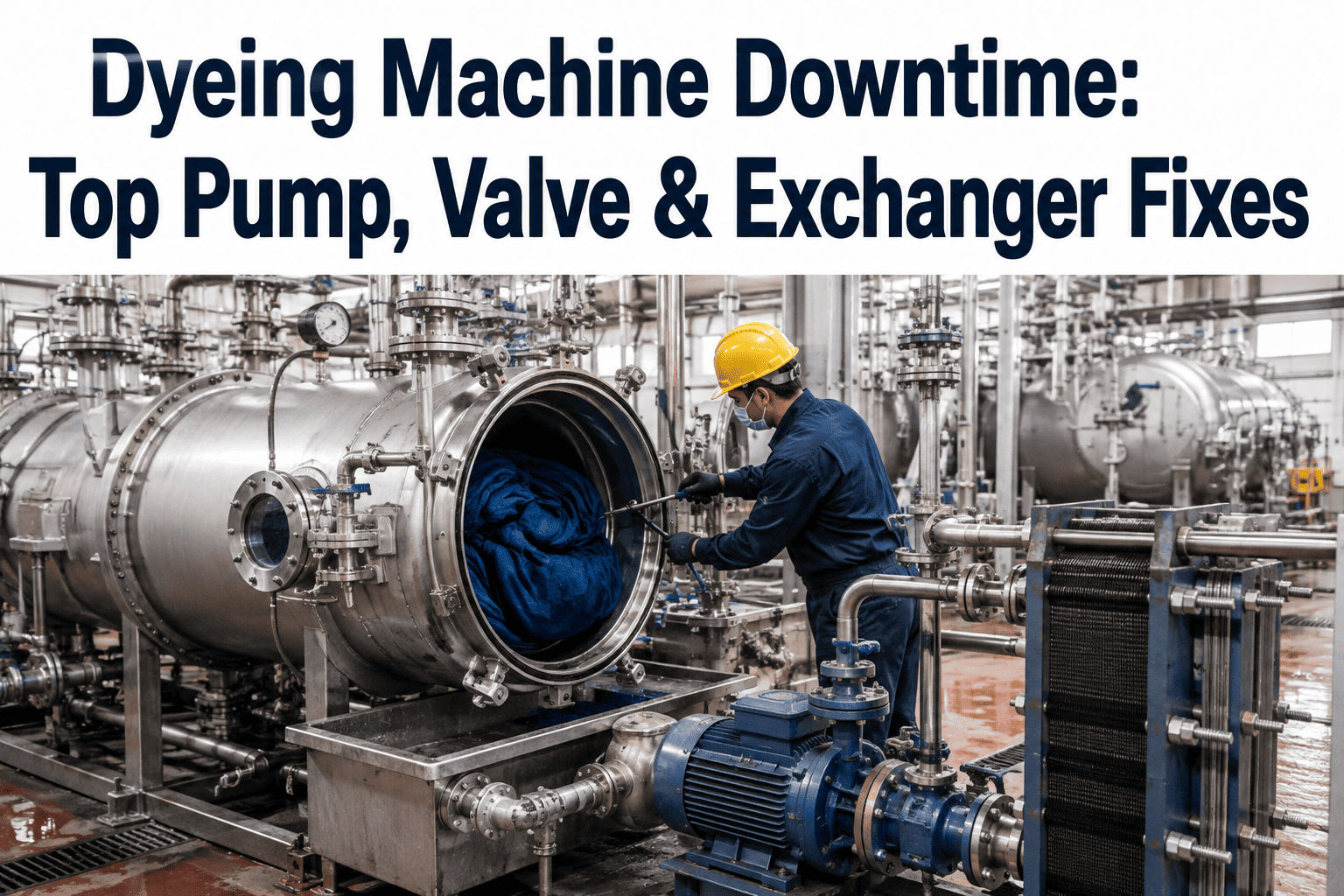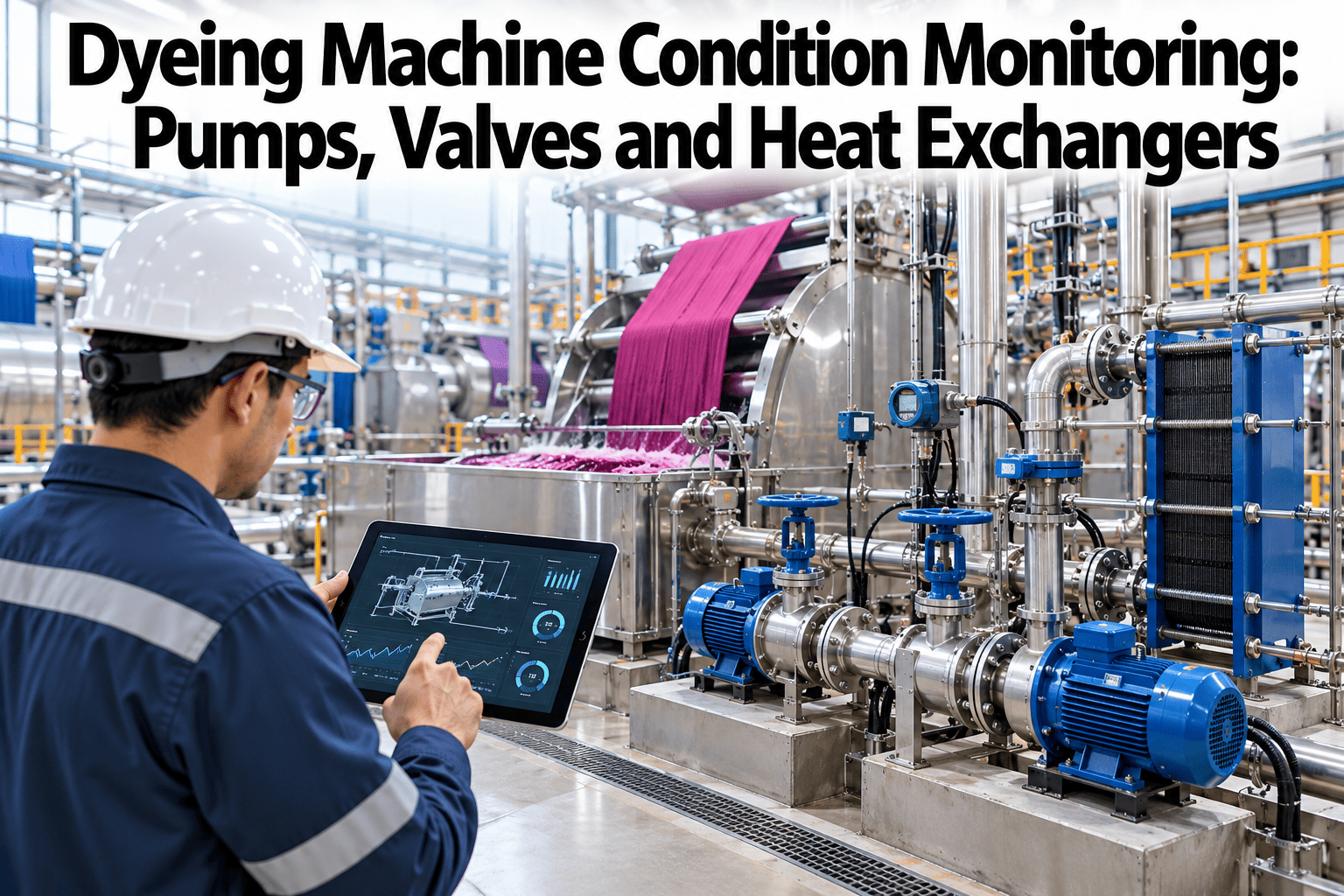
A dye beck's circulation pump losing a few percent of flow rate doesn't trip an alarm, it just quietly changes how evenly dye liquor moves through the fabric, and by the time that shows up as a shade variation on the finished batch, the actual cause, a wearing impeller or a partially fouled heat exchanger, has been drifting for weeks. Pumps, valves, and heat exchangers are the three components that most directly control temperature uniformity and cycle stability in a dyeing process, and none of them fail suddenly in a way a fixed-interval inspection reliably catches in time. Watching how their condition trends over time, rather than waiting for a batch quality problem to point backward at them, is what condition monitoring on dyeing equipment actually looks like on a real machine.
The Pump Doesn't Fail Loudly. The Batch Just Comes Out Wrong.
iFactory AI tracks pump, valve, and heat exchanger condition trends so a drift that would otherwise show up as a quality problem gets caught while it's still a maintenance item.
Why These Three Components Drive Batch Quality
A dyeing cycle depends on even liquor circulation and precise temperature control, and pumps, valves, and heat exchangers are what deliver both. A small change in any one of them changes the process the recipe assumes it's running.
Pump Wear Changes Liquor Flow Gradually
Impeller wear or seal degradation reduces flow rate slowly, which can produce uneven dye uptake across a batch long before the pump itself needs replacing.
Valve Response Lags Without Warning
A steam or cooling valve that responds a few seconds slower than it used to stretches out the time a batch spends outside its target temperature band on every cycle.
Heat Exchanger Fouling Builds Invisibly
Scale and residue accumulate inside a heat exchanger over months, reducing thermal transfer efficiency in a way that's invisible until cycle times start stretching.
What to Actually Monitor on Each Component
Each piece of equipment has a small set of signals that reveal condition changes well before a failure or a quality deviation occurs.
| Component | Signal to Track | What a Trend Indicates |
|---|---|---|
| Circulation Pump | Flow rate and motor current against baseline | Impeller wear, seal leakage, or cavitation developing |
| Steam/Cooling Valve | Response time from signal to measured effect | Actuator wear or seat fouling slowing control response |
| Heat Exchanger | Approach temperature between media streams | Fouling or scaling reducing thermal transfer efficiency |
Tracking these signals against each machine's own historical baseline, rather than a single fixed threshold across the whole dye house, is what catches a slow drift specific to one machine's actual condition.
Check Your Own Equipment Against Its Baseline
Bring recent cycle data from one machine to a 30-minute session and see how its current condition compares to its own history.
From Condition Signal to Maintenance Action
A trend on its own isn't useful until it's connected to a specific, actionable response before the drift reaches a quality-affecting point.
Connecting Equipment Condition to Batch Outcomes
The real value of condition monitoring isn't the maintenance savings alone, it's being able to trace a quality deviation back to a specific equipment condition instead of guessing.
An Illustrative Comparison: Catching Drift Before It Affects Quality
The figures below are a labeled illustrative composite, not a reported customer result, showing how quality-related rejects tied to equipment condition can change once drift is tracked and addressed proactively.
The dye houses that get the most value from condition monitoring are the ones that connect it directly to quality data, not the ones that treat it as a separate maintenance dashboard. A pump trend chart is interesting on its own, but it becomes genuinely useful the moment a shade deviation on batch 4,120 can be checked against that same machine's flow rate trend from that exact cycle, turning a guess into a confirmed root cause.
Frequently Asked Questions
Do we need new sensors to monitor pumps, valves, and heat exchangers?
Many dyeing machines already have motor current, flow, and temperature instrumentation feeding the machine's own control system, which can often be read directly, though some older machines may need additional sensors added for complete coverage. Assess what your current equipment already exposes in a short session.
How is a normal baseline established for each machine?
A baseline is built from a machine's own historical cycle data over a representative period, rather than a single fixed specification shared across every machine in the dye house, since equipment of the same model can still vary in its own normal operating range. Ask the iFactory AI team how baselines are established for your equipment.
Can this actually help us trace a past quality problem back to a cause?
Yes, if equipment condition data from the relevant cycle was captured and retained, a past batch's quality result can be checked against that machine's pump, valve, and heat exchanger readings from the same run, which is often how a recurring but unexplained quality pattern finally gets traced to its root cause. Review a past quality incident against equipment data in a demo.
How much advance warning does a drift trend actually give us?
The lead time depends on how gradually a specific component degrades, but trend-based monitoring generally gives weeks rather than days of notice for the kind of slow wear that pumps, valves, and heat exchangers typically exhibit, which is enough time to schedule a repair at a planned changeover. See typical lead times for your equipment types on a call.
Does this replace our existing CMMS or maintenance scheduling system?
No, condition trend data is built to feed into the CMMS or maintenance system you already use, triggering a work order when a meaningful drift is flagged rather than replacing how your team schedules and tracks maintenance work. Discuss integration with your current CMMS with the support team.
Catch the Drift Before It Reaches the Batch
iFactory AI tracks pump, valve, and heat exchanger condition against each machine's own baseline. Book a walkthrough built around your own dye house.