A jet dyeing machine running at 130°C and several bar of internal pressure doesn't give much warning before a worn pump seal or a fouled heat exchanger turns into a ruined batch — and by the time uneven shading shows up on the fabric, the liquor circulation problem that caused it has usually been building for weeks. Neglecting dyeing machine maintenance leads to a predictable cascade of expensive failures — fouled heat exchangers, clogged filters, and worn pump seals don't just cause downtime, they cause inconsistent heating and poor circulation that ruins entire batches through uneven dyeing. The liquor circulation path itself — tank, heat exchanger, pump, filter, nozzle, and back — gives a natural structure for a maintenance schedule, since each stage has its own specific wear points and failure signs. This guide walks through that circulation path stage by stage, covering pump seal replacement, valve maintenance, heat exchanger cleaning, and the safety systems that protect operators around a pressurized, high-temperature vessel. Mills standardizing jet dyeing maintenance across their wet processing floor can book a 30-minute demo to see how iFactory schedules and logs jet dyeing PM tasks automatically.
Jet Dyeing Machine Maintenance — Pump, Valve & Heat Exchanger Guide
A stage-by-stage maintenance walkthrough following the liquor circulation path, covering pump seal replacement, valve maintenance, heat exchanger cleaning, and safety system checks.
The Liquor Circulation Path — Where Maintenance Actually Happens
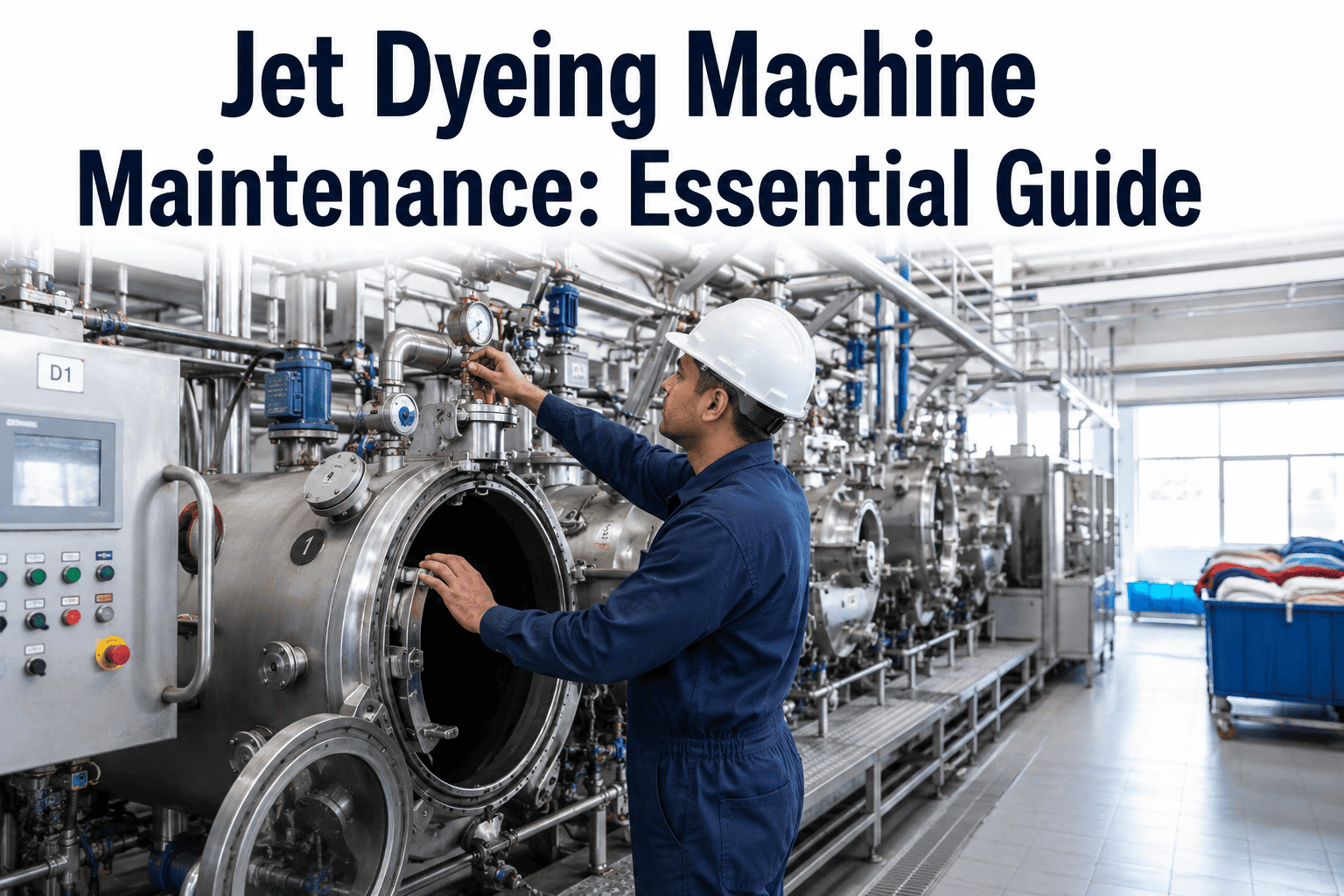
Dye solution fills the dye tank, reaches the heat exchanger to be heated, passes to the centrifugal pump, then to the filter chamber before reaching the tubular chamber where the fabric is loaded — and the cycle repeats continuously throughout the dyeing run. Each stage below is a maintenance checkpoint along that same path.
Dye & Chemical Tank
Heat Exchanger
Circulation Pump
Filter Chamber
Nozzle & Autoclave
Pump Maintenance — Where Seal Wear Costs the Most
The circulation pump runs continuously through every dyeing cycle, and its seal is the single most common point of failure across the whole machine.
Seal Inspection
Worn pump seals are a common issue that leads to inconsistent heating and poor circulation, resulting in entire batches ruined through uneven dyeing — inspection should happen at defined intervals rather than only after a visible leak appears.
Shaft & Pressure Control
Inspecting the safety valve, main pump shaft, and auxiliary tank pump shaft ensures pressure control and mechanical stability across the circulation system.
Belt Tension
Drive belts should be inspected and re-tensioned regularly to maintain optimal tension and prevent slippage, vibration, or uneven power transmission into the pump.
Valve Maintenance — Pressure Integrity Under Load
Every jet dyeing machine runs a network of flow control, bypass, and safety valves, and a small leak in any one of them shows up first as a subtle process deviation rather than an obvious fault.
Flow & Bypass Valves
Flow control valves and bypass valves allow fine adjustment of liquor flow quantity, and their condition directly affects circulation consistency throughout the dyeing cycle.
Safety Valve Verification
The autoclave is pressurized by compressed air, and pressure gauges along with the necessary safety valves must be verified as functioning correctly before each run.
Seal Ring Condition
The sealing ring is crucial to daily maintenance — variance in how well each machine seals affects cylinder-to-cylinder color consistency, and air leakage at a joint both wastes heat energy and creates a safety risk.
Heat Exchanger Cleaning — Protecting Batch Consistency
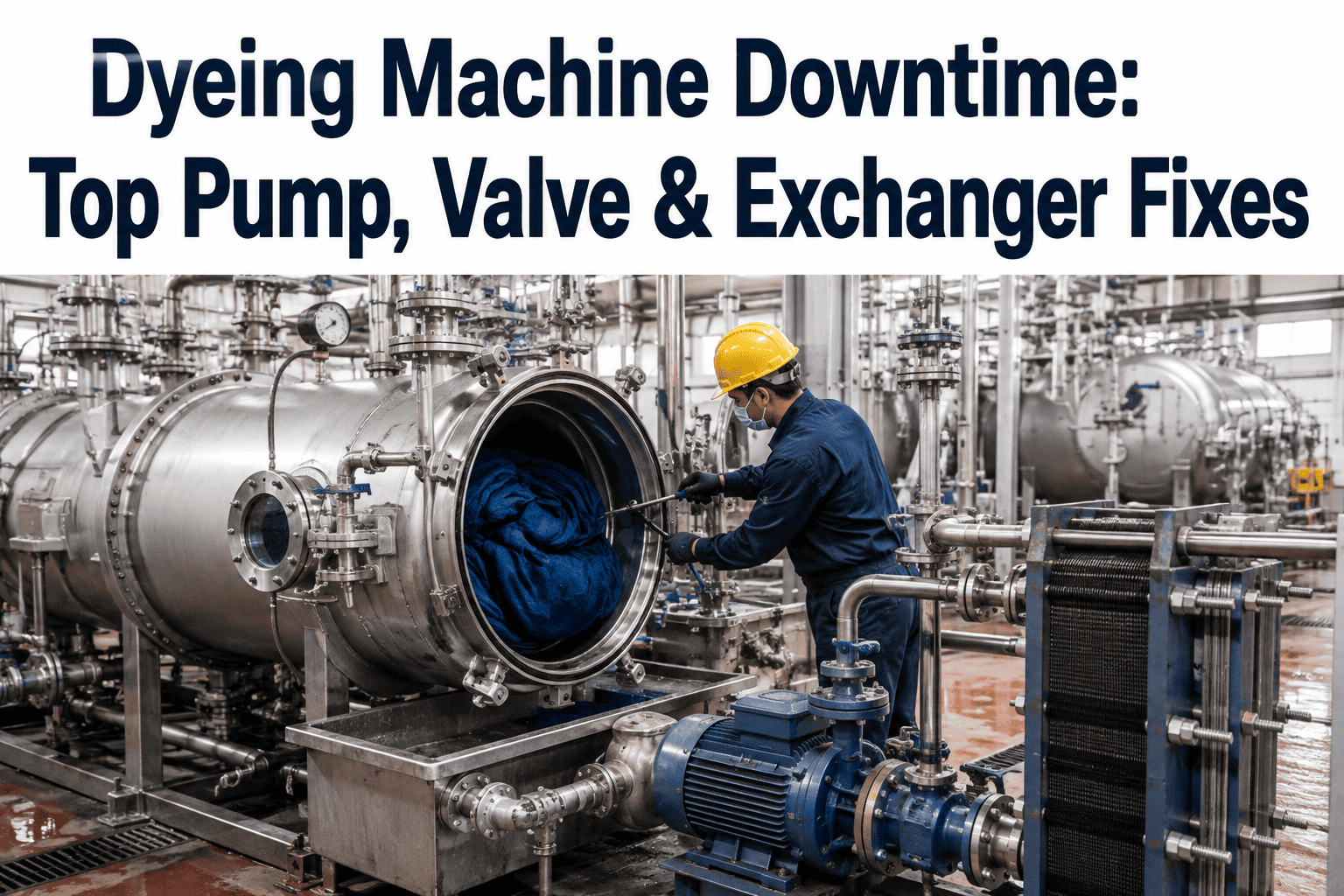
The heat exchanger does the heaviest thermal work in the system, cycling liquor from ambient temperature to well over 100°C, and fouling here degrades every batch that follows until it's cleaned.
Fouling Prevention
Fouled heat exchangers cause inconsistent heating and poor circulation — one of the most expensive failure modes because it damages fabric quality before anyone notices a mechanical problem.
Bolt Torque & Frame Integrity
Re-torquing all bolts on the heat exchanger and across the machine frame is essential early-stage maintenance to withstand the thermal expansion the equipment experiences during operation.
Temperature Range Verification
A shell-and-tube heat exchanger is engineered to raise dye liquor temperature from roughly 30°C to 130°C and to cool it back down from 130°C to 80°C — verifying it still hits these ranges is a direct check of exchanger health.
Safety Systems — Non-Negotiable Checks
A jet dyeing machine combines high pressure and high temperature in a single vessel, which makes its safety systems as much a maintenance priority as any component that affects dye quality.
Pressure gauges and safety valves must be provided and verified as functioning on the pressurized autoclave before every operating cycle.
Safety valve, thermometer, and pressure gauge readings should be checked against a temperature-to-saturated-steam-pressure reference table, with any discrepancy investigated immediately rather than deferred.
Air leakage at any sealed joint is both a heat-energy waste and a potential safety hazard, requiring prompt adjustment once detected rather than being treated as a minor cosmetic issue.
Building the Maintenance Plan By Machine Type
Not every dyeing machine on the floor runs the same maintenance plan, and treating them all identically is one of the more common mistakes mills make when standardizing a PM schedule.
Jet, Overflow, Beam, or Winch
Dyeing machine maintenance procedures must be customized for each machine type — jet, overflow, beam, or winch — since each has its own operational profile defined by mechanical design, heat tolerance, and pressure thresholds.
High-Velocity Jet Systems
Machines operating at high velocity with closed-loop dye circulation depend on high-pressure pumps, medium-range nozzles, airflow speed, and mechanical seals functioning together — these are the most critical components for routine maintenance.
A fouled heat exchanger doesn't announce itself — it shows up as a ruined batch three cycles later.
iFactory schedules pump, valve, and heat exchanger maintenance by machine type, logs seal and belt condition history, and flags overdue safety checks before a pressurized run starts.
Frequently Asked Questions
How do we know if uneven dyeing is a maintenance issue versus a recipe or chemistry problem?
Uneven shading with a consistent pattern across every batch on a specific machine, regardless of dye recipe or fabric type, points strongly toward a mechanical cause — most often a fouled heat exchanger, a worn pump seal reducing circulation consistency, or an air leak affecting one section of the vessel more than others. Uneven shading that varies by recipe or appears across multiple well-maintained machines points more toward a chemistry or process parameter issue rather than a maintenance gap. The fastest diagnostic step is checking whether the unevenness pattern repeats in the same location on the fabric or the same section of the machine across multiple runs — a repeating physical pattern is a strong signal to inspect the heat exchanger and circulation pump before adjusting the dye recipe. Book a demo to see how machine-level maintenance history can be cross-referenced against batch quality data.
How often should pump seals actually be replaced, not just inspected?
Replacement frequency depends heavily on the specific machine's duty cycle, the chemistry being circulated, and operating temperature and pressure, which is why a single universal interval across all jet dyeing machines tends to be either wasteful or risky depending on which direction it's wrong in. The more reliable approach is inspecting seals at a defined interval — checking for early signs of wear, minor weeping, or pressure inconsistency — and replacing proactively once those early signs appear rather than waiting for a full seal failure mid-run. Machines running higher temperatures and more aggressive chemistry profiles typically need shorter inspection intervals than lower-temperature, gentler processing machines, even if both eventually need the same seal replaced.
What's the actual safety risk if we skip a scheduled safety valve check to keep production moving?
A jet dyeing machine operates as a pressurized vessel at elevated temperature, and the safety valve exists specifically to release pressure if it exceeds the safe operating threshold — skipping its verification means running a pressurized system without confirming its primary pressure-relief mechanism actually works. This is not a theoretical risk category; a safety valve that fails to actuate under an unexpected pressure spike can lead to vessel damage or a serious operator safety incident, which is precisely why pressure gauge and safety valve verification should happen before every operating cycle rather than on a periodic sampling basis. No production schedule pressure justifies skipping this specific check, and any facility treating it as optional under deadline pressure is carrying real risk it likely hasn't fully priced in.
Our machine runs both jet and overflow dyeing modes — does that change the maintenance plan?
Yes, meaningfully. Maintenance procedures must be customized for each machine type since jet, overflow, beam, and winch systems each carry their own operational profile defined by mechanical design, heat tolerance, and pressure thresholds. A machine capable of running in multiple modes needs its maintenance plan to account for the more demanding of the two profiles rather than defaulting to whichever mode runs more often, since the pump, seal, and pressure system are exposed to the highest stress condition regardless of how frequently that mode is actually used. Facilities running dual-mode machines should document which components see stress under each mode and inspect accordingly, rather than assuming a single generic schedule covers both operating profiles adequately.
How do we build a maintenance log that actually helps us catch recurring problems instead of just documenting them after the fact?
The key is logging maintenance findings against the specific machine and the specific component, not just recording that "maintenance was performed" as a generic checkbox — a log that captures seal condition, valve leak location, and heat exchanger cleaning results by machine over time reveals patterns a single inspection never would. A machine showing recurring pump seal wear every few months, for instance, points to something beyond normal wear — possibly a misalignment issue, an aggressive chemistry profile, or a pressure setting worth reviewing — but that pattern is invisible without a log detailed enough to compare across cycles. Contact iFactory Support to set up component-level maintenance tracking across your jet dyeing fleet.
Pump seals, valves, and heat exchangers each fail differently — track them that way, not as one generic PM line item.
iFactory logs component-level maintenance history for every jet dyeing machine on the floor, so recurring problems get traced to their real cause instead of repaired the same way every time.