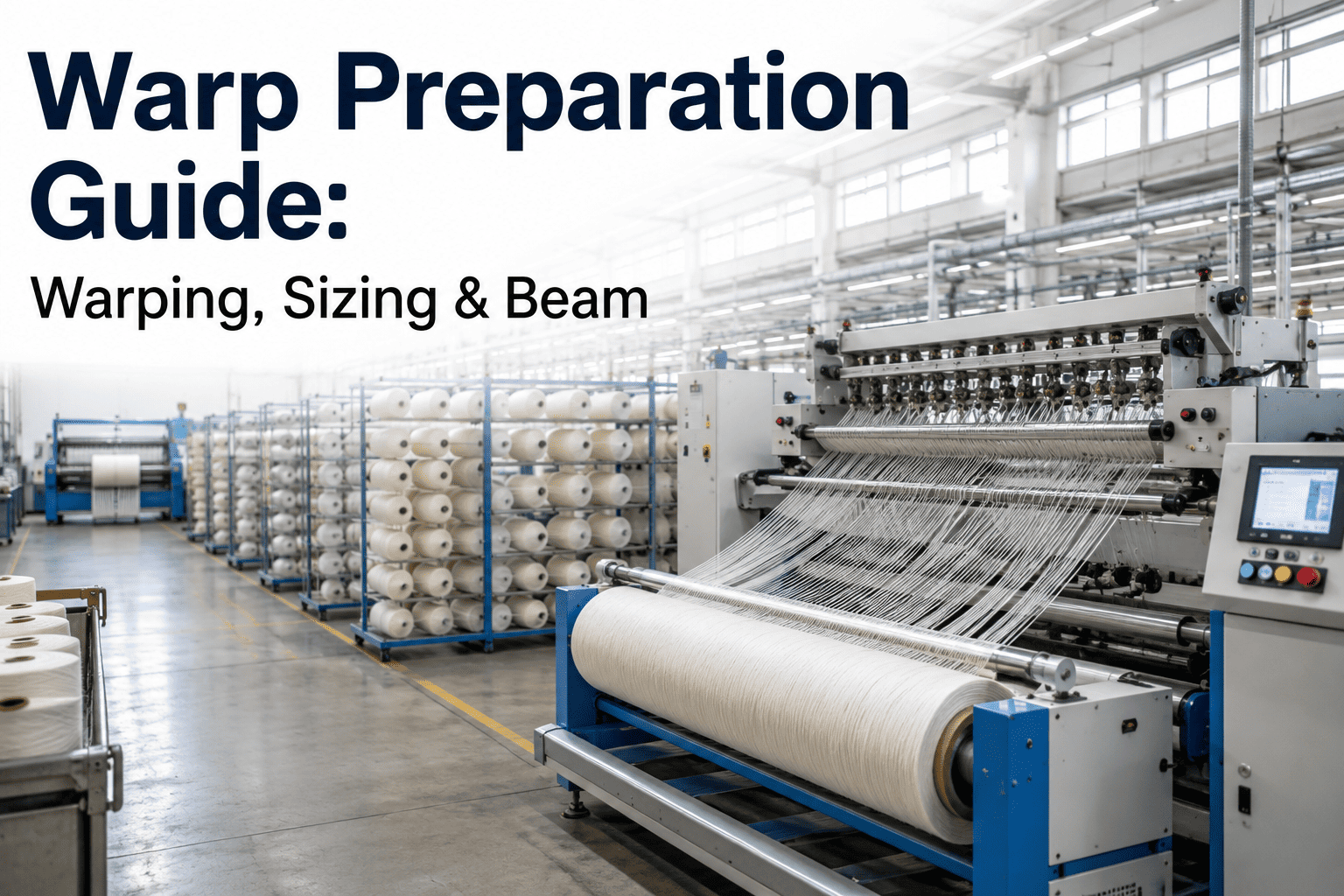
Nothing exposes a poorly maintained warping machine faster than the loom that has to run against it — uneven tension across a warp beam doesn't just create a cosmetic streak, it produces broken ends, stop-motion trips, and fabric that gets pulled for rework long after the warping department has moved on to the next beam. A beam that looked fine coming off the warper can carry a tension inconsistency that only becomes visible under weaving load, which is exactly why creel and tension device maintenance deserves the same discipline as any machine directly touching fabric quality. Catching that drift before it reaches the loom is what a strong warping maintenance schedule delivers, and it's the kind of upstream quality data iFactory's equipment tracking platform helps mills stay ahead of.
Warping Department Reliability
Warping Machine Maintenance: Complete Checklist
Creel tension device calibration, brake adjustment, and beam building parameter verification that keeps every beam leaving the warping department defect-free before it ever reaches a loom.
Why Warping Defects Are So Expensive to Catch Late
A tension inconsistency introduced during warping is invisible on the beam itself in most cases — it only becomes apparent once that beam is under weaving tension, at which point the defect has already consumed loom time, operator attention, and in many cases produced fabric that has to be pulled for rework. This is what makes warping maintenance disproportionately valuable relative to its cost: a defect prevented at the warping stage never touches the more expensive downstream processes at all, while a defect caught at weaving or later has already accumulated cost at every stage it passed through.
Warping
Lowest cost to catch
→
Weaving
3-5x cost to catch
→
Finishing
8-12x cost to catch
→
Customer Return
Highest cost, reputational risk
The Complete Warping Machine Maintenance Checklist
The checklist below covers the maintenance points that most directly affect beam quality and machine reliability. These should be organized into daily, weekly, and periodic categories rather than treated as a single undifferentiated list, since mixing high-frequency and low-frequency tasks together is one of the most common reasons maintenance schedules quietly slip.
Daily Checks
✓
Visual inspection of creel yarn paths for tangles, snags, or uneven unwinding
✓
Confirm stop-motion sensors trigger correctly on simulated yarn breaks
✓
Check beam surface for visible unevenness or soft spots before removal
Weekly Checks
✓
Tension device calibration verification across a sample of creel positions
✓
Brake adjustment check on beam winding mechanism for consistent take-up
✓
Lubrication of drive gears and bearing points per manufacturer schedule
Periodic Checks
✓
Full tension device recalibration across every creel position, not just a sample
✓
Beam building parameter audit against target density and width specifications
✓
Comprehensive mechanical inspection of drive train, gearing, and control electronics
Catch Tension Drift Before the Loom Does
Track Warping Maintenance Across Every Beam
A missed calibration check is invisible until it shows up as a weaving defect. Keep every warping maintenance interval visible and on schedule.
Tension Calibration: Direct Warping vs. Sectional Warping
The maintenance approach differs meaningfully between direct and sectional warping setups, since sectional warping introduces additional tension consistency requirements across each section as it's built onto the beam. Understanding which points matter most for your specific warping configuration prevents applying a generic checklist that misses the failure modes actually relevant to your equipment.
| Warping Type | Primary Maintenance Focus | Key Failure Mode If Neglected |
|---|
| Direct warping | Creel tension uniformity across all positions simultaneously | Streak defects from individual position tension drift |
| Sectional warping | Section-to-section tension and density consistency | Barre or banding defects visible after dyeing |
| Both types | Beam winding brake consistency and stop-motion reliability | Uneven beam density and undetected yarn breaks |
Frequently Asked Questions
How often should creel tension devices actually be recalibrated?
A sample-based check across a subset of creel positions weekly, combined with a full recalibration across every position on a monthly or quarterly basis depending on yarn type and creel size, catches drift early without requiring a full recalibration cycle every single week. Yarn types prone to more friction variation, like certain synthetic blends, may warrant tighter intervals than more stable natural fiber yarns.
Talk to our team for interval guidance specific to your yarn mix.
What's the most common cause of streak defects traced back to the warping stage?
Individual creel position tension drift is the most frequent root cause, where one or a small number of positions gradually fall out of calibration relative to the rest of the creel, producing a subtle but consistent tension variance that shows up as a streak once the fabric is woven and often becomes more visible after dyeing. Catching this requires checking tension uniformity across positions, not just confirming that tension is present at all.
Book a walkthrough to see how position-level tension tracking works.
Can beam winding brake issues cause problems that aren't visible until much later in production?
Yes, inconsistent brake pressure during beam winding can produce uneven beam density that isn't visually obvious on the finished beam but creates inconsistent yarn delivery once the beam is under weaving tension, often showing up as intermittent stop-motion trips that get attributed to the loom rather than traced back to the beam itself. Regular brake adjustment checks prevent this disconnect between where a defect originates and where it's actually noticed.
Reach out to our team for guidance on brake maintenance intervals.
How do we justify warping maintenance time to production when the machine looks like it's running fine?
The strongest justification is tracing downstream weaving defects and stop-motion trip rates back to their originating beam and warping session, which typically reveals that machines "running fine" from a pure uptime perspective are still producing tension inconsistencies that cost far more in downstream rework than the maintenance time itself would have cost. This kind of traceability requires connecting warping records to weaving quality data rather than treating the two departments as separate reporting silos.
Book a demo to see how this traceability works in practice.
Does sectional warping require a different maintenance schedule than direct warping?
The underlying maintenance categories are similar, but sectional warping adds section-to-section consistency as an additional check point that direct warping doesn't need in the same way, since sectional beams are built up in passes that each need to match the density and tension of the sections before them. Mills running both warping types often maintain slightly different checklists to reflect this difference rather than applying one generic schedule to both.
Talk to our team about tailoring a schedule to your specific warping mix.
Ready to Protect Your Beam Quality?
Stop Tension Drift Before It Reaches the Loom
Share your current warping maintenance process and we'll show you how to catch tension inconsistencies before they become weaving-floor defects.