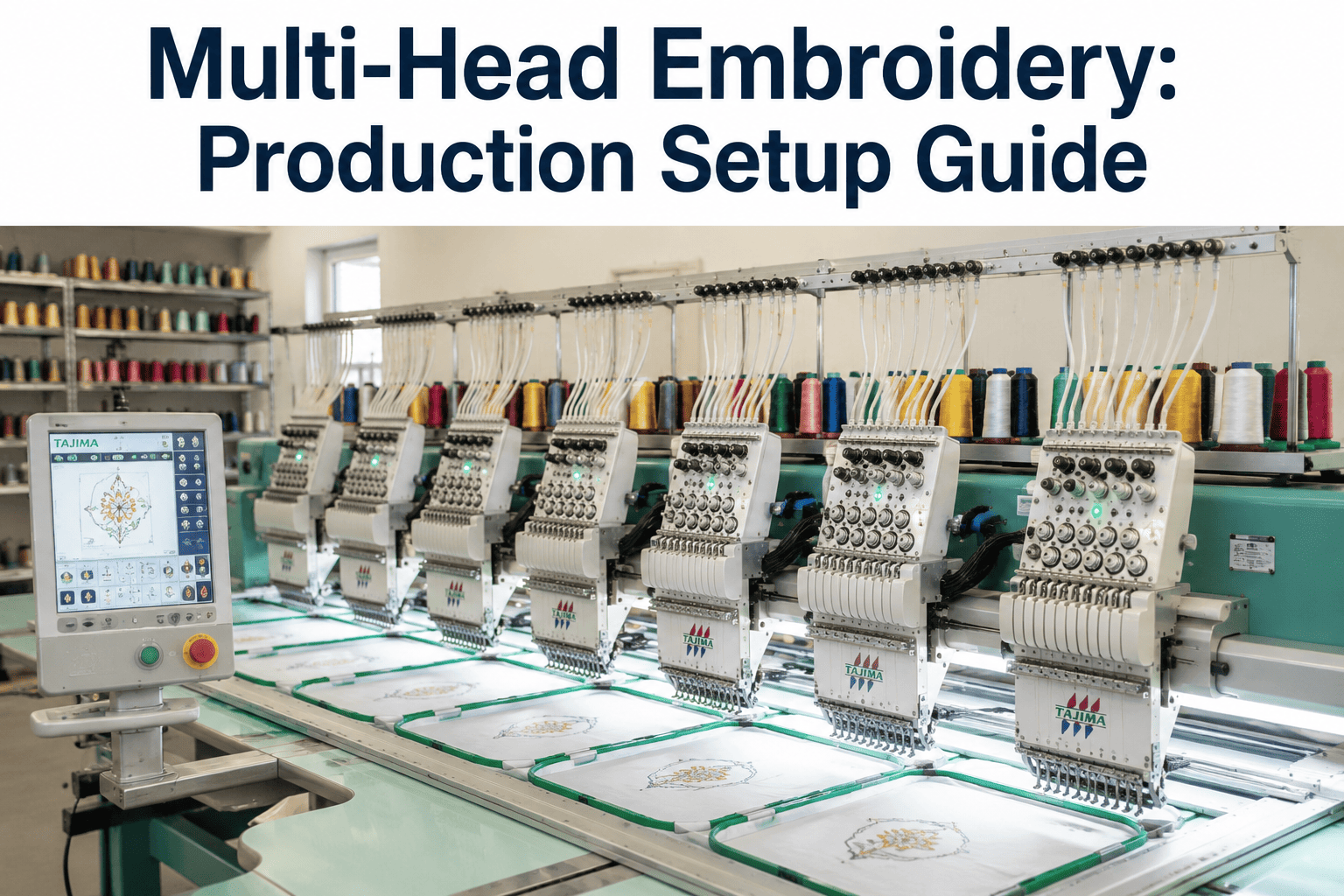
A single head sitting idle for a thread break used to mean the whole multi-head machine stopped with it, costing far more production time than the actual thread change. Modern networked multi-head embroidery systems changed that math, letting individual heads run and stop independently instead of forcing the whole bank of heads to halt for one problem. See how iFactory tracks per-head uptime, thread breaks, and design throughput across your embroidery floor with a Book a Demo.
One Stopped Head Shouldn't Cost You The Whole Bank's Output
Traditional multi-head machines stitch every head in lockstep, meaning a single thread break or hoop change halts the entire unit. Independently networked heads can keep the rest of the bank running, and the production difference between the two architectures is larger than most floors realize until they measure it.
Stitch Speed Ranges Across Common Machine Classes
Commercial multi-head machines vary meaningfully in top stitch speed, and the headline number rarely reflects sustained real-world throughput once thread changes, hoop swaps, and design complexity are factored in.
SPM: stitches per minute. Independently networked heads add throughput gains beyond raw stitch speed by eliminating whole-bank stoppages for single-head issues.
Stitch Speed On The Spec Sheet Rarely Matches Output On The Floor
iFactory tracks actual per-head runtime against rated speed, so you know exactly where production is really being lost.
Four Decisions That Determine Whether A Run Goes Smoothly
Getting a multi-head run started right the first time avoids the majority of mid-run stoppages, and most of the decisions that matter happen before a single stitch is sewn.
Design Digitizing
Converting artwork into a stitch-ready file determines stitch density, sequencing, and how the design behaves on the specific fabric it will be sewn onto.
Fabric And Thread Match
Not every fabric and thread combination behaves the same under a needle, and a mismatch is one of the most common causes of puckering, distortion, or thread fraying mid-run.
Stabilizer Selection
Embroidery punches thousands of tiny holes into the fabric, and without the correct backing the material shifts, stretches, or bunches during stitching.
Tension Calibration
Automatic thread tensioning systems reduce breaks significantly, but calibration still needs periodic verification, especially after a thread type or supplier change.
What Actually Stops A Multi-Head Run Mid-Production
The same handful of causes account for most unplanned stoppages on a multi-head floor, and tracking which one recurs most often on a specific head is usually more useful than tracking downtime in aggregate.
| Issue | Common Cause |
|---|---|
| Thread Breaks | Incorrect tension, poor thread quality, or needle wear |
| Puckering | Wrong fabric-thread-stabilizer combination for the design density |
| 3D Puff Collapse | Underlayers crushing foam instead of preserving loft during dense satin stitching |
| Design Misalignment | Hooping inconsistency between heads running the same design |
Track Which Head Is Actually Costing You Production
iFactory surfaces per-head thread break patterns and downtime causes so recurring issues get fixed instead of re-run.
What Floors Typically See After Adding Per-Head Production Tracking
Embroidery floors that move from aggregate machine output to per-head performance tracking tend to identify recurring maintenance and setup issues faster, before they compound across a full production run.
Frequently Asked Questions
Q: What is the real production advantage of independently networked embroidery heads?
On a traditional multi-head machine, every head stitches in lockstep, so a single thread break, hoop change, or design error on one head stops production across the entire bank until it's resolved. Independently networked heads keep running individually, meaning only the affected head goes idle while the rest of the bank continues producing, and this architecture can deliver up to double the effective output of a traditional lockstep setup over a full shift. Reach out through Support Contact if you want to evaluate whether your current setup is losing more time to lockstep stoppages than expected.
Q: Why does the same design sometimes pucker on one fabric but not another?
Puckering happens when the stitch density and fabric tension interact poorly, and different fabrics respond differently to the same needle penetration force and thread tension setting. A design digitized and tested successfully on a stable woven fabric can pucker badly on a stretch knit unless the digitizing accounts for the fabric's different give, which is why fabric and thread selection is treated as a design decision rather than just a material choice on a well-run embroidery floor.
Q: How often should thread tension calibration actually be checked?
While automatic tensioning systems reduce the frequency of manual adjustment considerably, calibration still drifts over time and should be verified whenever thread type, thread supplier, or needle batch changes, since even small variations in thread diameter or coating can shift the correct tension setting. Floors that only check tension after a visible defect appears tend to lose more product to marginal-quality stitching before the drift becomes obvious than floors that verify calibration on a fixed schedule. A Book a Demo session can walk through how tension drift shows up in production data before it becomes a visible defect.
Q: Why does 3D puff embroidery sometimes come out flat instead of raised?
Flat 3D puff results are usually caused by underlayer stitches crushing the foam before the dense satin top stitches are applied, which defeats the purpose of the foam entirely. Correct digitizing for 3D puff avoids heavy underlayers and uses dense satin stitching specifically designed to preserve loft, and stitch-density preview tools are commonly used during digitizing to catch this problem before a physical sample confirms it on the machine.
Q: What causes design misalignment when the same file runs across multiple heads?
Misalignment across heads running an identical design file is most commonly a hooping consistency issue rather than a software or digitizing problem, since each head's hoop placement has to match the design's registration point precisely. Manual hooping introduces operator-to-operator variation that becomes visible once garments from different heads are compared side by side, which is why standardized hooping guides and periodic spot checks across heads are a routine part of quality control on high-volume runs.
Stop Losing Bank Output To A Single Idle Head
iFactory gives your embroidery floor per-head visibility into uptime, thread breaks, and throughput.