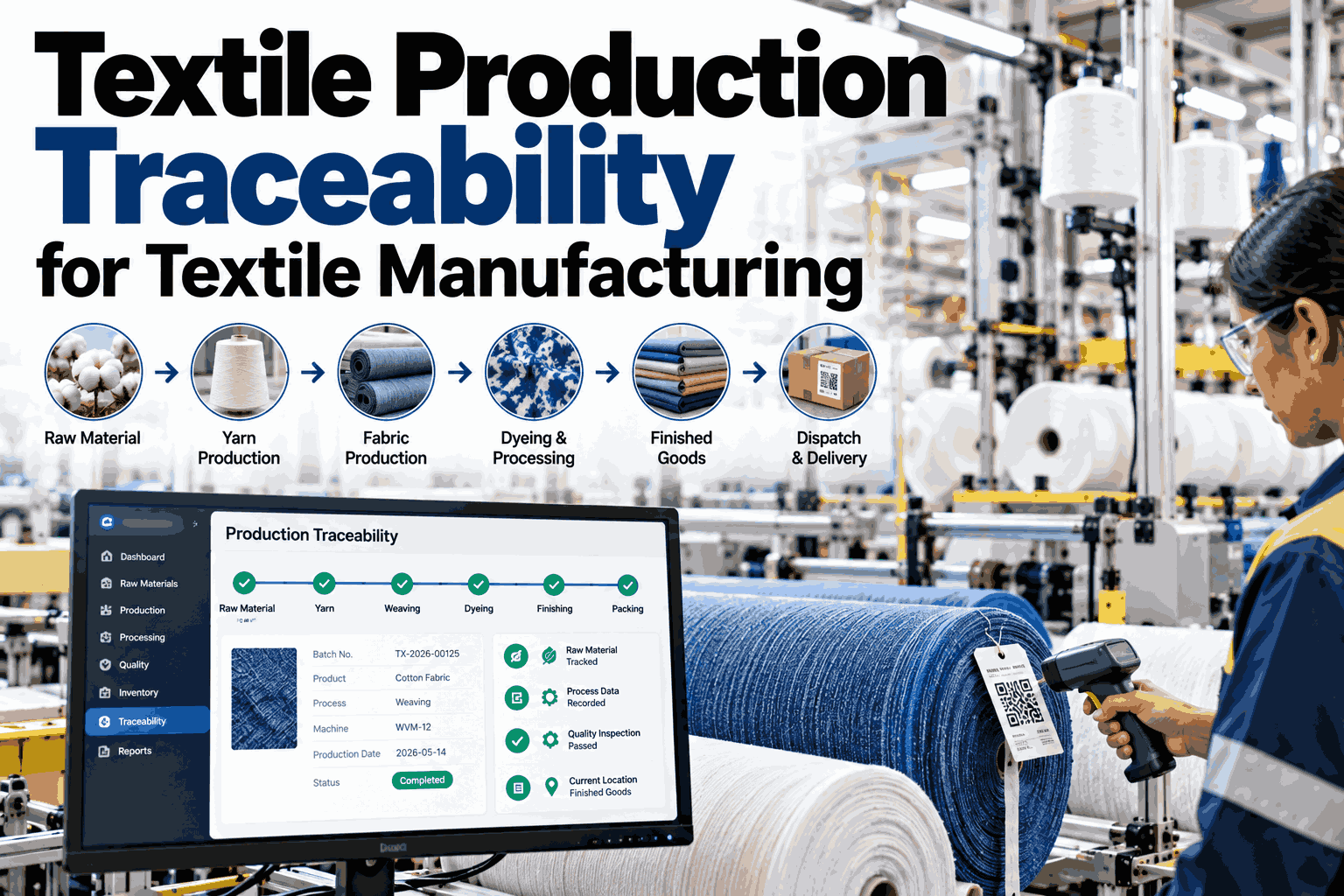
A single pair of jeans can pass through a cotton gin, a spinning mill, a weaving unit, a dyehouse, and a cut-and-sew floor before it ever reaches a garment rack, and at every handoff the paper trail that is supposed to follow it tends to get thinner. When a buyer asks which dye lot ended up in a shipped order, or a compliance audit asks for proof of fiber origin, most textile plants are still reconstructing the answer from spreadsheets, gate-pass registers, and someone's memory of which machine ran on a Tuesday. Building that answer automatically, from fiber receipt through finished garment, is what textile production traceability actually solves, and you can walk through what that looks like on your own floor with our team.
Fiber-to-garment visibility
Give Every Yard of Fabric a Traceable History, From Fiber to Finished Garment
See exactly which lot, which machine, and which shift produced every roll and every garment, so recalls, audits, and buyer questions stop turning into week-long investigations.
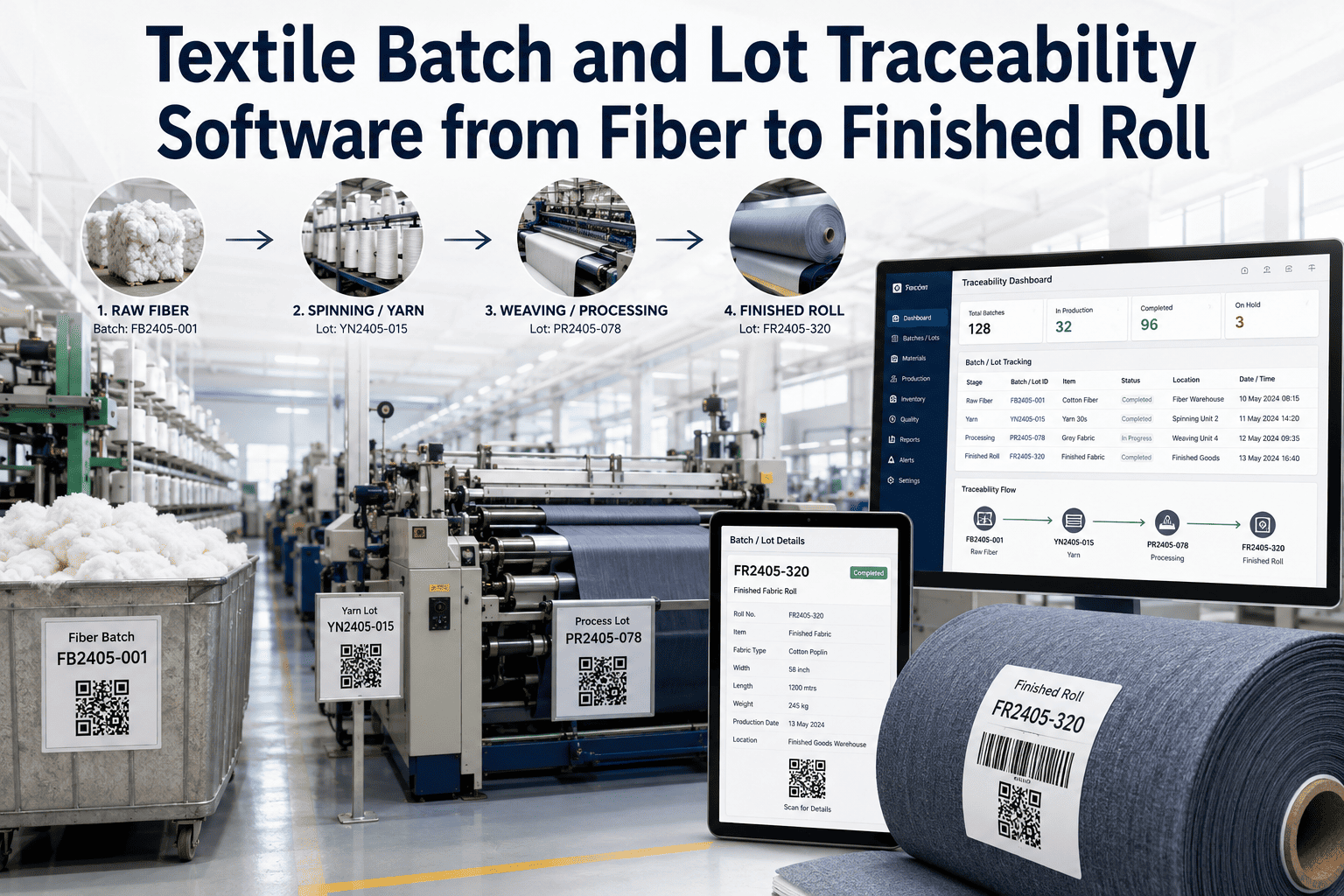
What one traced lot looks like end to end
Fiber batchLinked to supplier and intake date
Yarn lotLinked to spinning machine and shift
Fabric rollLinked to loom, dye recipe, and finish
Garment bundleLinked to cut ticket and sewing line
Why it matters now
Why Textile Traceability Became Non-Negotiable in 2026
Traceability used to be a compliance checkbox for a handful of export-heavy mills. That changed as buyers, regulators, and insurers all started asking the same question in different words: prove where this came from.
Buyer audits
Retail and brand partners now request lot-level sourcing proof before placing repeat orders, not just a general supplier certificate.
Recall exposure
Without lot-level links, a single defect can force a mill to recall far more fabric or garments than actually carried the fault.
Sustainability claims
Organic, recycled, and low-impact fiber claims only hold up if the fiber's path through the mill can actually be shown.
Faster root cause
When a quality issue shows up at inspection, knowing the exact machine and shift behind it turns a week of guessing into an hour.
The chain
The Six-Stage Chain Every Traceable Garment Passes Through
Traceability is only as strong as its weakest handoff. Most textile plants lose the thread at one of six predictable points between raw fiber and a finished, packed garment.
1
Fiber intake
Raw fiber bales are received and logged against a supplier batch and intake date.
2
Spinning
Fiber is converted into yarn, and the yarn lot needs to carry a link back to the fiber batch it came from.
3
Weaving or knitting
Yarn becomes greige fabric on a specific loom or knitting machine, during a specific shift.
4
Dyeing and finishing
Fabric takes on color and finish, and the dye recipe and batch become permanent attributes of that roll.
5
Cutting and sewing
Rolls are cut into panels and assembled into garments on a specific sewing line, by bundle.
6
Packing and shipping
Finished garments are packed against an order and carry their full history forward into the shipment record.
A traceability record that survives all six handoffs lets a plant answer a buyer's question about any single garment in minutes rather than days.
The gap
Where Textile Plants Actually Lose the Thread
None of these breakdowns are unusual. They are simply what happens when traceability depends on people remembering to write something down during a busy shift.
What commonly breaks
Paper tags separated from the roll during transport between departments.
Dye recipe changes logged on a whiteboard that gets wiped before shift end.
Cut tickets that reference a fabric roll number nobody can find later.
Supplier certificates stored separately from the batch they describe.
What a connected system fixes
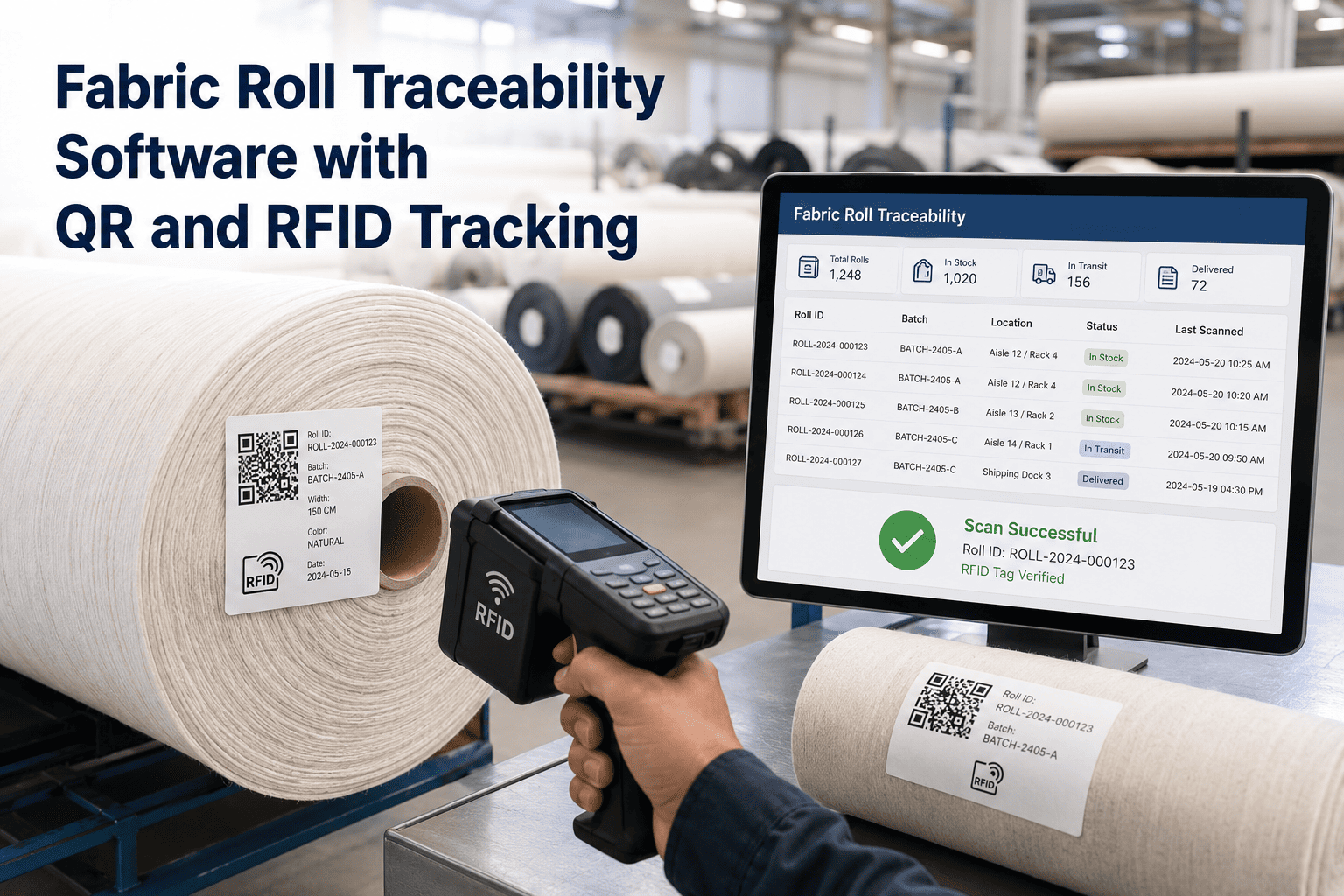
Every roll, bundle, and carton carries a digital lot identity from intake onward.
Dye and finish parameters are captured automatically at the machine.
Cut tickets stay linked to the exact roll and lot they were cut from.
Supplier documents attach directly to the batch record they belong to.
See Your Own Fiber-to-Garment Chain Mapped Out
Walk us through your current process and we will show exactly where the handoffs break and how a connected trace would close them.
Inside the record
What a Traceability Record Actually Captures
A traceable lot is not just a number stamped on a roll. It is a small set of facts, captured automatically, that stay attached to the material for its entire life inside the plant.
| Stage | Fields captured | Why it matters later |
| Fiber intake |
Supplier, origin, bale weight, intake date |
Backs sourcing and sustainability claims |
| Spinning |
Yarn lot, machine ID, shift, count |
Links quality defects to a specific spindle run |
| Weaving or knitting |
Loom or machine ID, fabric construction, roll length |
Isolates machine-specific fabric faults quickly |
| Dyeing and finishing |
Recipe code, dye lot, finish type, batch size |
Explains shade variation across an order |
| Cut and sew |
Cut ticket, bundle number, sewing line, operator shift |
Narrows a garment defect to one line and shift |
| Pack and ship |
Order number, carton ID, ship date |
Connects the finished garment back to every upstream stage |
Once these fields are captured once, correctly, at the source, no one has to re-enter them by hand at the next department.
Maturity check
Four Levels of Traceability Maturity Most Plants Pass Through
Few plants jump straight from paper tags to full digital traceability. Most move through a few recognizable stages, and knowing which one you are in makes the next step obvious.
Level 1
Paper and memory
Lot information lives on paper tags and in the heads of long-tenured supervisors, with no central record.
Level 2
Spreadsheet stitched
Each department keeps its own spreadsheet, and someone manually reconciles them when a buyer or auditor asks.
Level 3
Department-linked
Key stages are digitally connected, but gaps remain at one or two manual handoffs between departments.
Level 4
Fully connected
Every stage from fiber intake to shipment shares one lot identity, queryable in minutes for any garment produced.
Getting started
Building Fiber-to-Garment Traceability in Four Weeks
A full traceability rollout does not need to happen all at once. Most plants can get a working, end-to-end trace running on one product line within a month.
1
Pick one product line and map its current handoffs from fiber intake through packing.
2
Identify which handoffs already capture data digitally and which still rely on paper.
3
Connect the paper-based handoffs first, since these are usually where the trail breaks.
4
Run a live test by tracing one finished garment back to its fiber batch end to end.
Frequently asked questions
What Textile Plants Ask Before Starting
Do we need to replace our existing machines to get traceability?
No, most traceability systems connect to existing spinning, weaving, dyeing, and sewing equipment rather than replacing it, capturing lot and machine data from what is already running on the floor.
Ask support about your current setup before assuming a hardware change is needed.
How long does a fiber batch stay linked once it becomes yarn and then fabric?
With a connected system, the link persists for the material's entire life in the plant, since each new form (yarn, fabric, garment) carries a reference back to the lot it was produced from rather than starting a fresh, disconnected record.
See a live lot trace on a short call.
Can traceability data support sustainability or organic certification audits?
Yes, as long as fiber origin and chain-of-custody data are captured at intake and carried forward, the same lot-level record that supports a buyer audit can usually satisfy a sustainability or certification review as well.
Discuss your certification requirements with our team.
What happens if a defect is found after garments have already shipped?
A full fiber-to-garment trace lets you narrow a defect to the exact fabric roll, dye lot, or sewing line involved, which usually limits a recall to a fraction of what would otherwise be pulled under a blanket, order-wide recall.
Walk through a recall scenario with our specialists.
Is it realistic to trace multiple product lines at once, or should we start small?
Starting with a single product line is usually the faster path to a working system, since it lets a plant prove the trace end to end before scaling the same approach across additional lines and machines.
Plan your rollout sequence with our support team.
Trace every lot, close every gap
Bring Fiber-to-Garment Traceability to Your Production Floor
Book a session with iFactory AI to see how a connected trace would work across your own fiber, spinning, weaving, dyeing, and sewing stages.