Most textile manufacturers reading about the EU's Corporate Sustainability Due Diligence Directive assume it doesn't apply to them because they're not a European company — and then discover their largest EU buyer is already pushing due diligence clauses into next season's purchase contracts anyway. The CSDDD directly binds only large companies above specific size thresholds, but its real reach extends far past those companies into every Tier 1 supplier they source from, because in-scope brands are legally required to verify their supply chain rather than simply take a supplier's word for it. Recent Omnibus changes have narrowed the directive's scope and pushed back its compliance timeline, but they have not removed the underlying obligation, and mills that source into the EU market should understand exactly what their buyers will soon be asking for. This guide covers who the directive directly binds, what due diligence actually requires in practice, the current implementation timeline after the Omnibus revisions, and how the obligation cascades down to suppliers who are never directly regulated at all. Mills preparing for buyer due diligence requests can book a 30-minute demo to see how iFactory documents supply chain and working condition data buyers now request as part of CSDDD compliance.
EU CSDDD Explained — What It Requires and Who It Actually Reaches
Scope thresholds after the Omnibus revision, the due diligence obligations themselves, the current compliance timeline, and how the requirement cascades to suppliers who are never directly in scope.
Who the CSDDD Directly Binds — The Scope Test
The directive's scope has shifted since its original 2024 text, and mills need the current threshold, not the one still circulating in older compliance articles.
Only companies with more than 5,000 employees and over €1.5 billion in net annual turnover fall within the narrowed scope of the CSDDD.
For non-EU textile brands, the threshold is €1.5 billion in EU-generated net annual turnover, with no separate employee count applied.
Falls outside direct legal scope — but almost certainly not outside the practical reach of the directive, covered in the section below.
The Cascade Effect — Why Smaller Suppliers Feel This Too
A mill well under the size threshold can still find itself facing due diligence questionnaires, supplier code of conduct updates, and audit requests it never expected, because the obligation flows downstream through contracts rather than through direct regulation.
In-scope large companies cascade due diligence requirements down their value chains through contractual clauses in supplier agreements, updated codes of conduct, audit requirements, and capacity-building programs.
Suppliers to a large EU company should expect new due diligence expectations regardless of their own size, since SMEs generally fall outside CSDDD's direct scope but not outside its ripple effects.
Certain sectors face particularly intense scrutiny, including textile factories in regions flagged for potentially higher adverse human rights and environmental impacts.
What Due Diligence Actually Requires
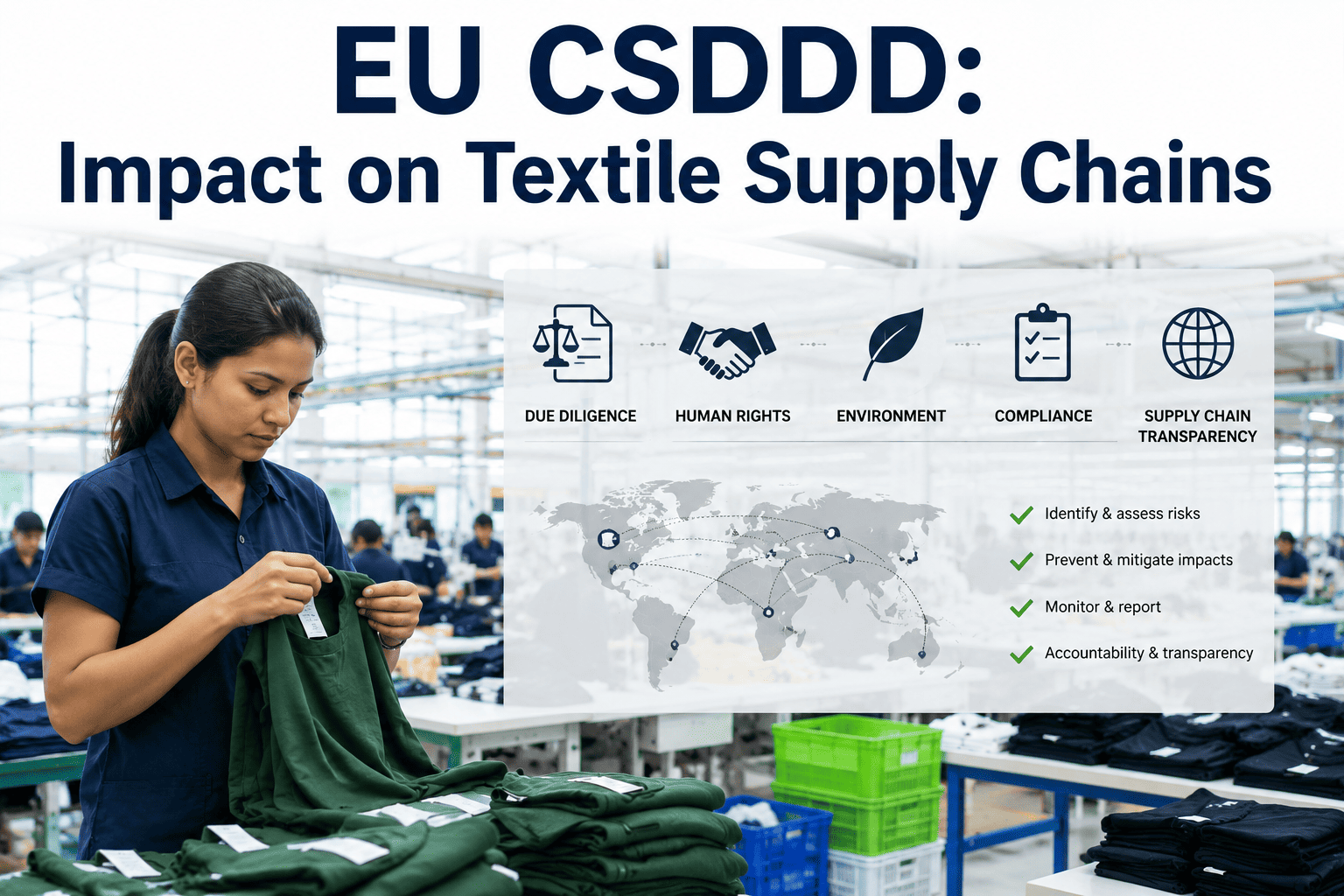
The directive's core obligation is described in dense legal language, but it breaks down into a sequence of practical steps that in-scope companies — and by extension their Tier 1 suppliers — need to be able to demonstrate.
Identify & Scope
Due diligence begins with an initial scoping assessment at the Tier 1 partner's level, based on reasonably available information to identify the most likely and severe adverse impacts.
Prioritize & Investigate
In-depth assessment of adverse impacts is limited to Tier 1 suppliers only, unless there is plausible information pointing to adverse impacts further down the chain.
Prevent & Mitigate
Companies must work toward prevention and mitigation, bringing to an end, minimisation, and remediation of actual or potential adverse human rights and environmental impacts connected to their operations and business partners.
Remedy & Report
Those affected by a failure to respect this duty must have access to justice and legal remedies, with the directive ensuring this route stays open.
Implementation Timeline — What the Omnibus Changed
The original 2024 timeline no longer applies. The Omnibus I package, approved by the European Parliament in December 2025, pushed dates back and changed several obligations along the way.
The Directive was published in the Official Journal of the European Union, confirming its legal status and triggering national implementation timelines.
The European Parliament voted to approve Omnibus I, narrowing the CSDDD's scope and changing how due diligence works in practice.
The CSDDD must be transposed by Member States into national law, with obligations then phasing in on a staggered basis by company size. The deadline for the Commission to publish additional guidance has also been brought forward to this date.
The Parliament agreed with the Commission's proposed delay, setting the compliance period start at 26 July 2028, though separate reporting places the compliance start as late as July 2029 — mills should confirm the current date directly with buyers rather than relying on either figure alone, since the timeline remains a moving target.
What Changed Under Omnibus I — Before and After
| Requirement | Original 2024 Text | After Omnibus I |
|---|---|---|
| Due diligence depth | Comprehensive supply chain mapping | Scoping exercise, in-depth review only for most severe likely impacts |
| Climate transition plan | Mandatory adoption required | Requirement removed entirely from CSDDD |
| Civil liability | Harmonized EU-wide rules | Deleted — liability determined under national laws instead |
| Review frequency | Annual review expected | Every five years for companies with 500+ employees |
| Maximum fine | Not uniformly capped | May not exceed 3% of global net turnover |
Building a Defensible Compliance Program Now
Waiting for the final transposition date to start preparing leaves mills scrambling against buyer deadlines that arrive faster than the regulatory timeline suggests, since brand contract clauses typically move well ahead of the legal compliance date.
Gap Assessment First
Begin with a gap assessment against OECD due diligence guidance expectations and existing national rules — companies already complying with laws like the German Lieferkettengesetz have a head start, but should not assume full CSDDD alignment.
Focus on High-Risk Segments
Move beyond policy documents into action by prioritizing the highest-risk segments of the value chain first, rather than attempting uniform coverage everywhere at once.
Digitize Documentation
Supply chain transparency platforms can automate risk scoring, track supplier performance, and maintain the documentation supervisory authorities will expect during inspections.
Buyer due diligence clauses are arriving well before the legal compliance date.
iFactory keeps working condition records, supplier documentation, and chain-of-custody data organized and audit-ready, so a due diligence request from an EU buyer draws from live production records instead of a scramble across departments.
Frequently Asked Questions
Our mill has 400 employees and no EU entity — do we need to do anything about CSDDD at all?
You fall outside the directive's direct legal scope, since the thresholds apply to much larger companies, but that does not mean the directive is irrelevant to your operations. If any of your buyers are large EU or non-EU companies crossing the €1.5 billion EU turnover threshold, they are legally required to conduct due diligence on their Tier 1 suppliers, which very likely includes you. In practice this means updated supplier codes of conduct, working condition questionnaires, and documentation requests arriving in your contracts well before any government inspector would ever contact you directly. Treating CSDDD as irrelevant because your mill is under the threshold misses the point — the obligation reaches you through your customer's contract, not through direct regulation.
Does the Omnibus revision mean CSDDD compliance requirements got significantly easier?
Narrower in scope, yes — fewer companies are directly bound, the transition plan mandate was removed, and in-depth investigation is now limited primarily to Tier 1 suppliers rather than the full multi-tier chain originally proposed. But easier does not mean optional or trivial for the companies still in scope, and it does not reduce what those companies will expect from their suppliers in practice. A brand still legally required to conduct due diligence on its Tier 1 suppliers is still going to ask those suppliers for documentation, still going to update its codes of conduct, and still going to build audit and monitoring programs — the Omnibus changed the shape of the compliance burden more than it reduced the pressure flowing down supply chains. Book a demo to see what documentation your current buyers are likely to request.
What's the actual difference between CSDDD and CSRD, since both keep coming up in the same conversations?
CSRD is a reporting directive — it requires in-scope companies to disclose sustainability information in a standardized format, similar in spirit to financial reporting. CSDDD is a due diligence directive — it requires in-scope companies to actively identify, prevent, and remediate human rights and environmental harms across their operations and supply chain, backed by legal liability for failing to do so. A company can be in scope for one, both, or neither depending on its size and structure, and the two obligations reinforce each other in practice: due diligence findings under CSDDD often become part of what gets disclosed under CSRD reporting requirements. Mills should ask their buyers which framework is actually driving a specific documentation request, since the underlying data needed often overlaps but the legal basis and reporting format differ.
If our buyer sends a due diligence questionnaire, what documentation should we actually have ready?
Working condition records, wage and hours documentation, health and safety incident logs, chemical management records, and supplier-of-suppliers information where it's reasonably available all tend to appear in these questionnaires, since they map directly to the human rights and environmental impact categories the directive targets. The scoping-first approach under the revised CSDDD means buyers are increasingly asking for a risk-based subset rather than exhaustive documentation of everything, so understanding which categories your buyer has flagged as high-risk for your region or product type helps you prioritize what to organize first. Facilities that keep this documentation current as a standing operational practice respond to these questionnaires in days rather than the weeks it takes to reconstruct records department by department. Contact iFactory Support to organize your documentation ahead of the next questionnaire.
Is the 2028 or 2029 compliance start date the one we should actually plan around?
Both dates appear in credible reporting because the exact figure has moved during the ongoing Omnibus negotiations, and further adjustment before Member States complete national transposition remains possible. Rather than anchoring compliance planning to either specific date, the more reliable approach is treating the current period as a preparation window that closes at an uncertain but approaching point, and building documentation and due diligence processes on a timeline you control rather than one set by the last regulatory headline you read. Buyers who are themselves in scope are generally moving faster than either compliance date requires, since they need to demonstrate due diligence progress to their own regulators well ahead of any enforcement deadline. Confirm the specific date your key buyers are working toward directly, since that contractual deadline will likely arrive before the legal one does.
The legal compliance date is years away. The buyer contract clause is not.
iFactory keeps supply chain, working condition, and chemical documentation current and exportable, so a CSDDD-driven due diligence request from a buyer gets answered from live records, not a department-by-department scramble.