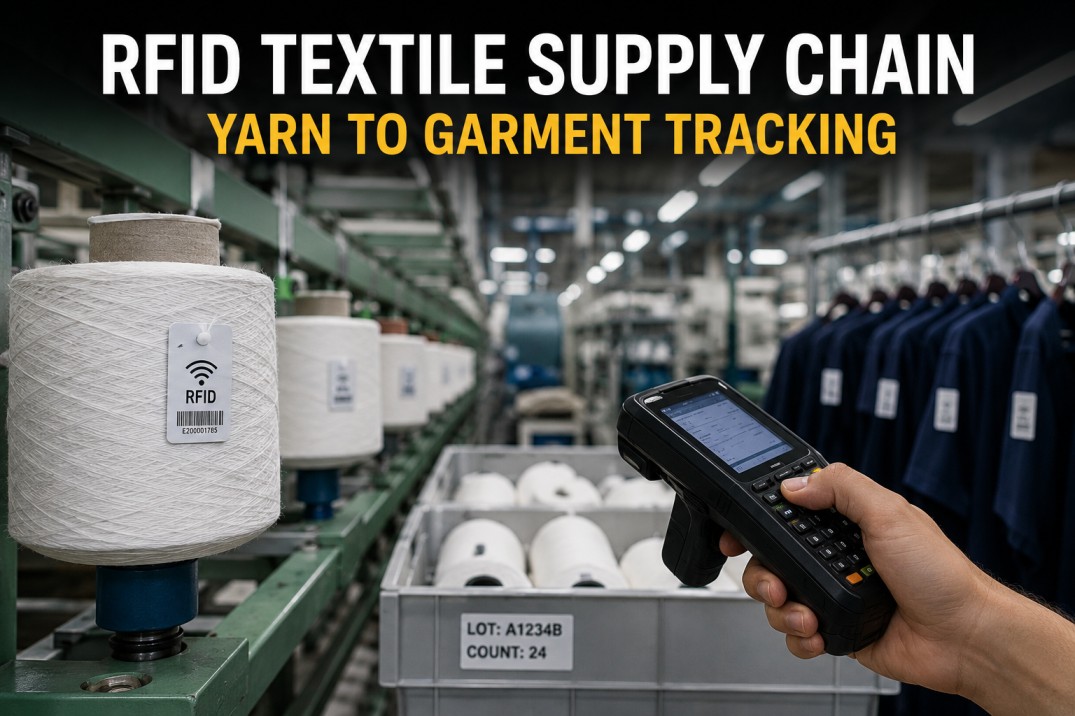
Radio frequency identification has evolved from a warehouse automation tool into a complete supply chain visibility platform that gives textile and apparel businesses item-level tracking precision across every stage of production — from raw yarn bobbins in the spinning mill to finished garments on the retail floor. Barcode and QR code systems require line-of-sight scanning that is impractical in high-speed textile production environments where products move on conveyor lines at 60 meters per minute, are stacked in dense pallets, and pass through multiple wet and dry processing stages that destroy paper labels. RFID tags, by contrast, can be read through fabric layers, plastic totes, cardboard cartons, and stainless steel cages at distances of 3 to 12 meters depending on the tag type and reader power, with read rates exceeding 500 tags per second in a single reader field. The textile supply chain presents uniquely challenging RFID deployment conditions — conductive fibers like carbon and metallic yarns interfere with antenna tuning, liquid baths in dyeing absorb RF energy, high-temperature drying and heat-setting processes exceed standard tag operating limits, and dense fabric rolls create near-field coupling effects that reduce read range. Each of these challenges has a proven technical solution involving specific tag selection, reader placement, antenna polarization, and frequency optimization. This guide covers the three RFID tag types suitable for textile applications, the six critical tracking points in the yarn-to-garment supply chain, read rate performance by material type, integration architecture for connecting RFID data to MES and ERP systems, and a cost-benefit analysis with validated payback periods from textile and apparel deployments.
Plan Your RFID Implementation — Book a 30-Minute Traceability Assessment
iFactory has deployed RFID tracking solutions across spinning mills, dye houses, fabric manufacturers, and garment factories. Get a free feasibility analysis with tag selection, reader placement, and investment estimate for your supply chain.
Three RFID Tag Types for Textile and Apparel Supply Chain Tracking
Selecting the correct RFID tag type is the single most important technical decision in a textile RFID deployment. The three tag categories — UHF passive, NFC passive, and washable UHF — serve different segments of the supply chain with different read ranges, data capacities, cost structures, and environmental tolerances. Using the wrong tag type at any tracking point creates read reliability problems that cascade through downstream processes.
Six Critical Tracking Points in the Yarn-to-Garment RFID Supply Chain
The textile and apparel supply chain moves products through six distinct stages where RFID tracking delivers measurable value — from raw material receipt through finished goods dispatch. Each tracking point requires specific reader hardware configurations, antenna placements, and tag-programming strategies to achieve consistent read rates above 99.5 percent. The flow below shows the six stages with the data captured at each point and the business decisions enabled by that data.
Map Your RFID Tracking Points — Schedule a Supply Chain Visibility Audit
iFactory's RFID engineering team will audit your current material flow, identify the highest-impact tracking points, and design a reader network that gives you item-level visibility from incoming yarn to finished goods dispatch.
RFID Read Rate Performance by Material Type and Tag Placement
RFID read reliability in textile applications is heavily influenced by the material composition of the tagged product and the placement of the tag relative to the product and the reader antenna. Conductive fibers, high-moisture content, dense fabric rolls, and metal components in garments each affect RF propagation differently. The matrix below shows validated read rate ranges for UHF passive tags across common textile materials and tag placement strategies, based on iFactory deployment data from 25-plus textile RFID installations.
RFID Integration Stack: From Reader to Enterprise Platform
RFID data must flow through a four-layer integration architecture to transform raw tag reads into actionable supply chain intelligence. Each layer adds processing, filtering, and contextualization that converts a stream of tag IDs into inventory movements, work-in-progress status updates, and shipment verifications that MES, WMS, and ERP systems consume as standard business events. The architecture ensures that tag read data is reliable, timely, and correctly associated with the right production order and product identifier.
RFID Supply Chain Tracking: Investment Analysis and Payback Periods
The financial case for RFID in textile and apparel supply chains depends on the scope of deployment — from single-department WIP tracking to end-to-end yarn-to-garment visibility. The table below presents validated investment ranges, operational savings, and payback periods for four common RFID deployment scenarios based on iFactory deployment data across 25-plus textile facilities and apparel manufacturing operations.
| Deployment Scope | Tag Volume | Initial Investment | Annual Savings | Payback Period | Key Savings Drivers |
|---|---|---|---|---|---|
| Warehouse Inventory Only | 50K–100K/yr | $35K–$60K | $25K–$40K | 10–16 months | Cycle count elimination, reduced stockouts, faster receipt |
| WIP Tracking in Spinning | 200K–500K/yr | $60K–$120K | $50K–$85K | 12–18 months | WIP reduction 15–25%, doff time tracking, bobbin traceability |
| Dye House Batch Tracking | 100K–300K/yr | $80K–$150K | $65K–$110K | 14–20 months | Batch reconciliation, shade repeat rate up 20%, rework down 30% |
| End-to-End Yarn to Garment | 500K–2M/yr | $200K–$400K | $150K–$280K | 16–22 months | Full traceability, chargeback elimination, counterfeit detection, inventory accuracy 99.7% |
RFID Textile Supply Chain Tracking: Frequently Asked Questions
Do RFID tags survive the dyeing and finishing processes in textile manufacturing?
Standard UHF passive RFID tags with paper or PET inlays are destroyed by dyeing and finishing processes due to high temperature, chemical exposure, and mechanical stress. However, washable UHF tags with silicone or thermoplastic polyurethane encapsulation are specifically designed to survive these conditions. These tags withstand continuous operating temperatures of 85 degrees Celsius with peak tolerance up to 130 degrees Celsius for short drying cycles, resist caustic soda, hydrogen peroxide, and reactive dye chemicals, and survive 200-plus industrial wash cycles. The trade-off is cost — washable tags range from $0.80 to $2.50 per tag versus $0.08 to $0.15 for standard UHF tags — so they are typically applied only at the fabric roll or garment level where the tag must follow the product through wet processing. For yarn and greige fabric tracking, tags are applied to the packaging (cones, tubes, or polybags) rather than the product itself, avoiding wet process exposure entirely.
How does RFID perform with conductive fibers like carbon, metallic, or anti-static yarns?
Conductive fibers present the most challenging RFID environment in textile manufacturing. Carbon fiber, stainless steel blended yarns, copper-core conductive threads, and silver-coated nylon used in anti-static and smart textile applications create a Faraday cage effect around the tag antenna, reducing read range by 60 to 90 percent compared to standard cotton or polyester. Solutions include increasing reader power within regulatory limits, using circularly polarized antennas to improve coupling through the conductive mesh, positioning the tag outside the conductive layer (for example, on a fabric edge or selvage), and using specially designed tags with tuned antenna geometries for conductive material environments. In extreme cases, dual-reader portals with cross-polarized antennas are required to achieve 98 percent-plus read rates. Pre-deployment site surveys with the actual tagged product are essential for conductive material applications.
What read range can I expect for RFID tags on fabric rolls and garment pallets?
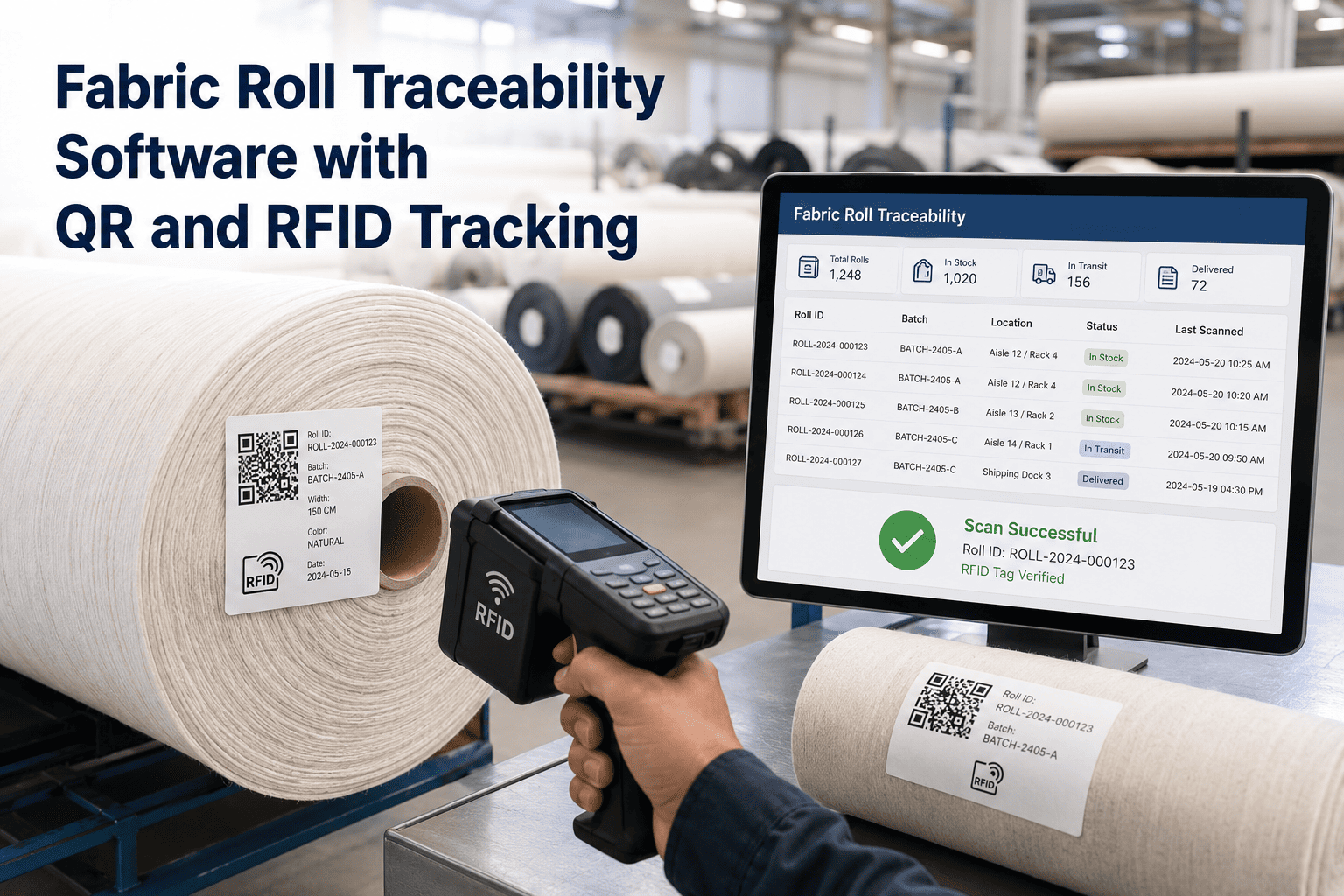
Read range for UHF passive tags on textile products varies significantly by product type and configuration. A single fabric roll with an exposed surface-mount tag achieves 6 to 10 meters read range in open air with a standard 30 dBm reader and 6 dBi linear antenna. Multiple fabric rolls stacked on a pallet reduce range to 3 to 6 meters due to inter-roll coupling and shadowing effects. Garment cartons with embedded hang tags achieve 4 to 7 meters range, while polybagged garments on pallets range from 3 to 5 meters depending on bag density. Portal read rates at conveyor speeds of 60 meters per minute achieve 99.5 to 99.9 percent for single-layer products and 97 to 99 percent for palletized loads. Handheld readers achieve 2 to 4 meters range for cycle counting in warehouse racks. These ranges assume standard cotton or polyester products — conductive or high-moisture materials reduce range as noted above.
Can RFID integrate with existing barcode and ERP systems, or does it require a separate infrastructure?
RFID middleware is designed to coexist with and enhance existing barcode systems rather than replace them. The middleware layer normalizes RFID tag reads into the same GS1-128 or EPCIS event format that barcode scanners produce, so the ERP and WMS receive inventory movements and receiving confirmations through the same interface regardless of the source technology. Many deployments operate in hybrid mode — barcode for supplier inbound shipments that arrive untagged and RFID for internal WIP and outbound shipments where the company controls the tagging. The middleware handles tag-to-barcode association, so a single RFID read of a pallet can trigger the same ERP transaction that would require 200 individual barcode scans. This hybrid approach allows mills and factories to phase in RFID gradually without disrupting existing barcode-dependent workflows.
What is the typical ROI timeline for an RFID deployment in a textile supply chain?
RFID payback in textile supply chains follows a predictable pattern based on deployment scope. Warehouse-only deployments — cycle counting and receiving — achieve the fastest payback at 10 to 16 months due to low tag volumes and immediate labor savings from eliminating manual counting. WIP tracking deployments in spinning or weaving mills pay back in 12 to 18 months, driven primarily by WIP inventory reduction of 15 to 25 percent and reduced work-in-process search time. Dye house batch tracking deployments require 14 to 20 months but deliver the highest per-tag ROI through reduced shade matching rework, batch reconciliation labor, and chemical waste reduction. End-to-end yarn-to-garment deployments have the longest payback at 16 to 22 months but generate the highest absolute returns through combined inventory reduction, labor savings, chargeback elimination, and counterfeit prevention. Most textile RFID deployments achieve positive net present value within 18 months and deliver 200 to 400 percent five-year ROI.
Ready to Deploy RFID Across Your Textile Supply Chain?
iFactory's RFID solutions team will conduct a site survey, select the optimal tag types for your products and processes, design reader portal placements, and deliver a complete deployment plan with hardware specification, integration architecture, and projected payback.