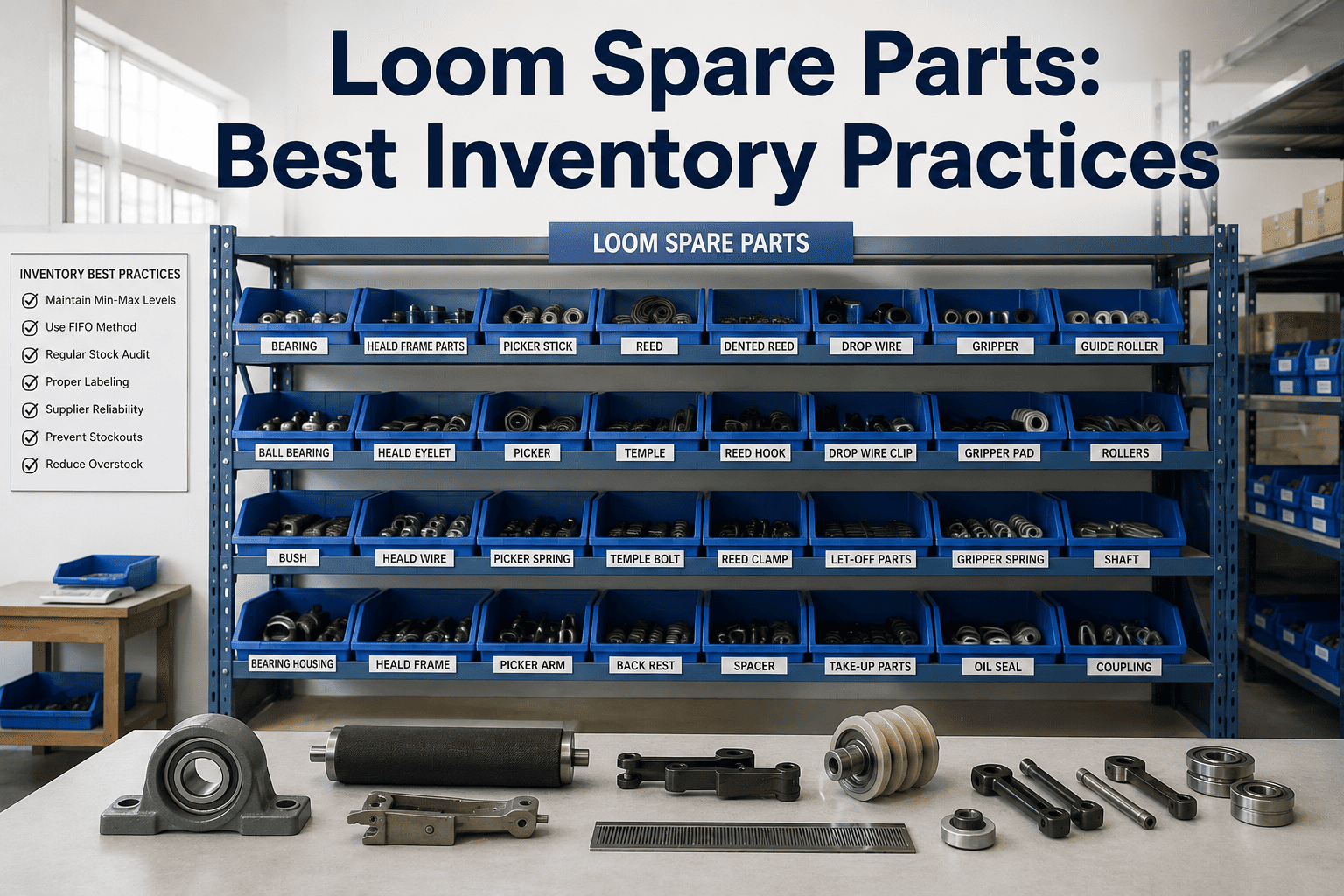
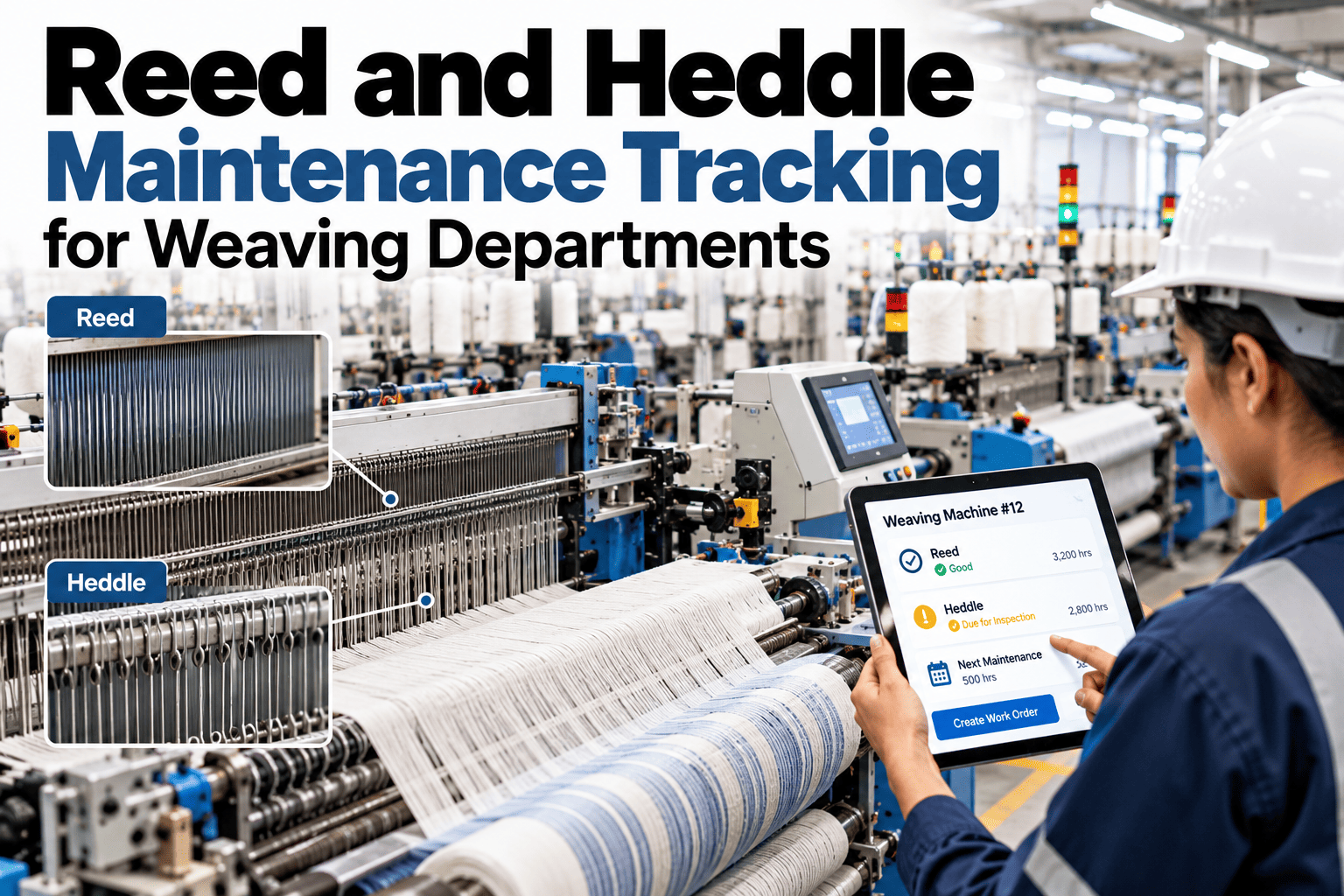
A weaving shed with 200 looms and no structured spare parts strategy is one failed heald frame away from an unplanned stop that can idle a machine for 6-24 hours waiting on a part that should have been sitting on a shelf. Spare parts inventory mistakes run in both directions: mills that stock too conservatively face repeated emergency procurement at premium prices and freight, while mills that overstock tie up working capital in reeds, healds, and bearings that may sit unused for years before a matching machine model is retired. Book a demo to see how iFactory tracks spare parts consumption against loom uptime.
Spare Parts Intelligence
The Right Reed, Heald, or Bearing Should Never Be a 3-Day Wait Away
Building a spare parts strategy for reed, heald, bearing, and other critical loom components - the classification, reorder points, and vendor practices that keep looms running without tying up excess capital.
6-24 Hrs
Downtime per stockout event
20-30%
Typical excess inventory carried unnecessarily
15-20%
Parts cost premium on emergency orders
80/20
Critical parts vs total inventory value
Classifying Loom Spares: Not Every Part Deserves the Same Stock Strategy
The single biggest mistake in loom spare parts management is treating every component the same way. A structured classification by failure impact and lead time determines exactly how much of each part to hold, and gets that decision right for parts that would otherwise be either dangerously understocked or wastefully overstocked.
Tier 1 - Critical
Stops the loom immediately on failure, long lead time to replace. Reed, heald frame, main shaft bearing.
Stock: 2-4 weeks demand on-site
Tier 2 - High Impact
Causes quality defects or partial slowdown, moderate lead time. Picking mechanism components, tension springs.
Stock: 1-2 weeks demand on-site
Tier 3 - Routine
Scheduled replacement, predictable consumption, short lead time. Drop pins, general fasteners, filters.
Stock: Just-in-time or min-max
Tier 4 - Low Risk
Non-critical, redundant systems, easily sourced locally. General hardware, non-loom-specific consumables.
Stock: Order on demand
Calculating Reorder Points Without Guesswork
Reorder points set from gut feel are the most common source of both stockouts and overstock in weaving mill stores. A reorder point built from actual consumption data and supplier lead time removes the guesswork and adjusts automatically as machine age or production volume changes.
Worked Example: Reed Sets on a 60-Loom Weaving Shed
Average usage: 3 reed sets consumed per month across the shed
Supplier lead time: 3 weeks from order to delivery
Safety stock buffer: 1.5 weeks to cover demand spikes and delivery delays
Resulting reorder point: trigger a new order once stock drops to 3-4 reed sets
Are Your Reorder Points Based on Data or on Habit?
iFactory tracks real consumption rates against your current reorder points, flagging parts where the trigger is set too high, too low, or hasn't been updated since machines were added.
Vendor Management: Balancing Cost, Lead Time, and Reliability
Spare parts vendor strategy is not just a procurement question, it directly determines how large a safety stock buffer a mill needs to carry. A vendor with unreliable lead times forces higher safety stock across every part they supply, while a reliable local vendor can let a mill carry leaner inventory even for critical parts.
Single OEM Vendor
Guaranteed fit and quality match
Typically longest lead time and highest cost
Best for Tier 1 critical parts with tight tolerance requirements
Approved Alternate Suppliers
Reduces single-source risk and often shortens lead time
Requires quality validation before approval for critical parts
Best for Tier 2 parts where multiple qualified sources exist
Local Fabrication or Distributor
Fastest turnaround for standard, non-proprietary components
Cost-effective for high-volume routine consumables
Best for Tier 3 and Tier 4 parts without tight tolerances
The Cost of Getting Inventory Strategy Wrong
Both understocking and overstocking carry real, quantifiable cost, and most mills are surprised to learn how much capital is tied up in slow-moving inventory when a full stores audit is finally done.
| Scenario |
Typical Annual Impact |
Root Cause |
| Emergency procurement premium | 15-20% cost markup | No reorder point triggering ahead of stockout |
| Unplanned downtime from stockout | $3K-$15K per event | Critical parts not classified or tracked properly |
| Capital tied in slow-moving stock | 20-30% of stores value | No usage-based review of Tier 3/4 inventory levels |
| Obsolete parts write-off | 5-10% of stores value | Parts retained after machine model retirement |
From Reactive Ordering to Managed Inventory: A 4-Step Path
Mills moving from ad-hoc ordering to a managed spare parts program typically follow a consistent sequence that builds data confidence before automating reorder decisions.
Step 1
Classify Every Part Into Tiers
Walk the full parts catalog and assign each item to a criticality tier based on failure impact and lead time, not just historical stocking habit.
Step 2
Establish Consumption Baselines
Pull 12 months of issue history for each tiered part to calculate real average usage rather than relying on memory or anecdote.
Step 3
Set Data-Driven Reorder Points
Apply the usage-and-lead-time formula to calculate a reorder point and safety stock level specific to each part and its supply chain reliability.
Step 4
Automate Alerts and Review Quarterly
Set automatic reorder alerts when stock crosses the trigger point, and review classification and reorder points quarterly as machine fleet and production volume shift.
Frequently Asked Questions
Which loom spare parts should always be stocked on-site regardless of usage rate?
Tier 1 critical parts that stop the loom immediately on failure and have long procurement lead times should always be stocked on-site, even if their usage rate is low, because the cost of downtime far exceeds the carrying cost of holding a few units. This typically includes reeds, heald frames, main shaft bearings, and picking mechanism components specific to the loom model. The key indicator is not how often a part fails but how much production time is lost if it fails and no replacement is available immediately.
Book a demo to see how iFactory helps classify your parts inventory.
How do you calculate the right reorder point for a spare part?
The standard reorder point formula multiplies average consumption per week by the supplier lead time in weeks, then adds a safety stock buffer to cover demand variability and potential delivery delays. For example, a part used 3 times per month with a 3-week supplier lead time and a 1.5-week safety buffer would trigger a reorder once stock drops to roughly 3-4 units. This calculation needs actual 12-month consumption data rather than estimates, since guessed reorder points are the leading cause of both stockouts and unnecessary overstock in weaving mill stores.
What percentage of spare parts inventory is typically excess or slow-moving?
Mills that conduct a full stores audit commonly find that 20 to 30% of their total inventory value sits in slow-moving or excess stock, often parts retained from retired machine models or ordered in bulk without matching actual consumption patterns. This capital could otherwise fund better stocking of genuinely critical Tier 1 parts or reduce overall working capital tied up in stores. Regular usage-based review, ideally quarterly, is the most effective way to identify and address this excess before it accumulates further.
Contact our support team to discuss a stores inventory review.
Should critical loom parts always be sourced from the original equipment manufacturer?
For Tier 1 critical parts with tight tolerance requirements, such as reed dent spacing or bearing fit specifications, OEM sourcing is generally the safer default since it guarantees dimensional and material match to the machine, even though it typically comes with longer lead time and higher cost. For Tier 2 and lower-tier parts, approved alternate suppliers or local fabrication can often meet quality requirements at a lower cost and faster turnaround, but any alternate source for a critical part should go through a formal quality validation process before being approved for regular use.
How much does an unplanned stockout typically cost a weaving mill?
An unplanned stockout on a critical part typically costs a weaving mill between $3,000 and $15,000 per event when accounting for lost production time, expedited freight charges for emergency procurement, and the labor cost of managing the disruption, with the exact figure depending on loom downtime duration and the value of the production lost. Beyond the direct cost, repeated stockouts also damage delivery reliability to customers, which carries a harder-to-quantify but often larger long-term cost in lost order confidence.
Stop Losing Production Hours to Parts That Should Have Been on the Shelf
iFactory connects consumption tracking, reorder point automation, and vendor lead time data into one view of your loom spare parts inventory.