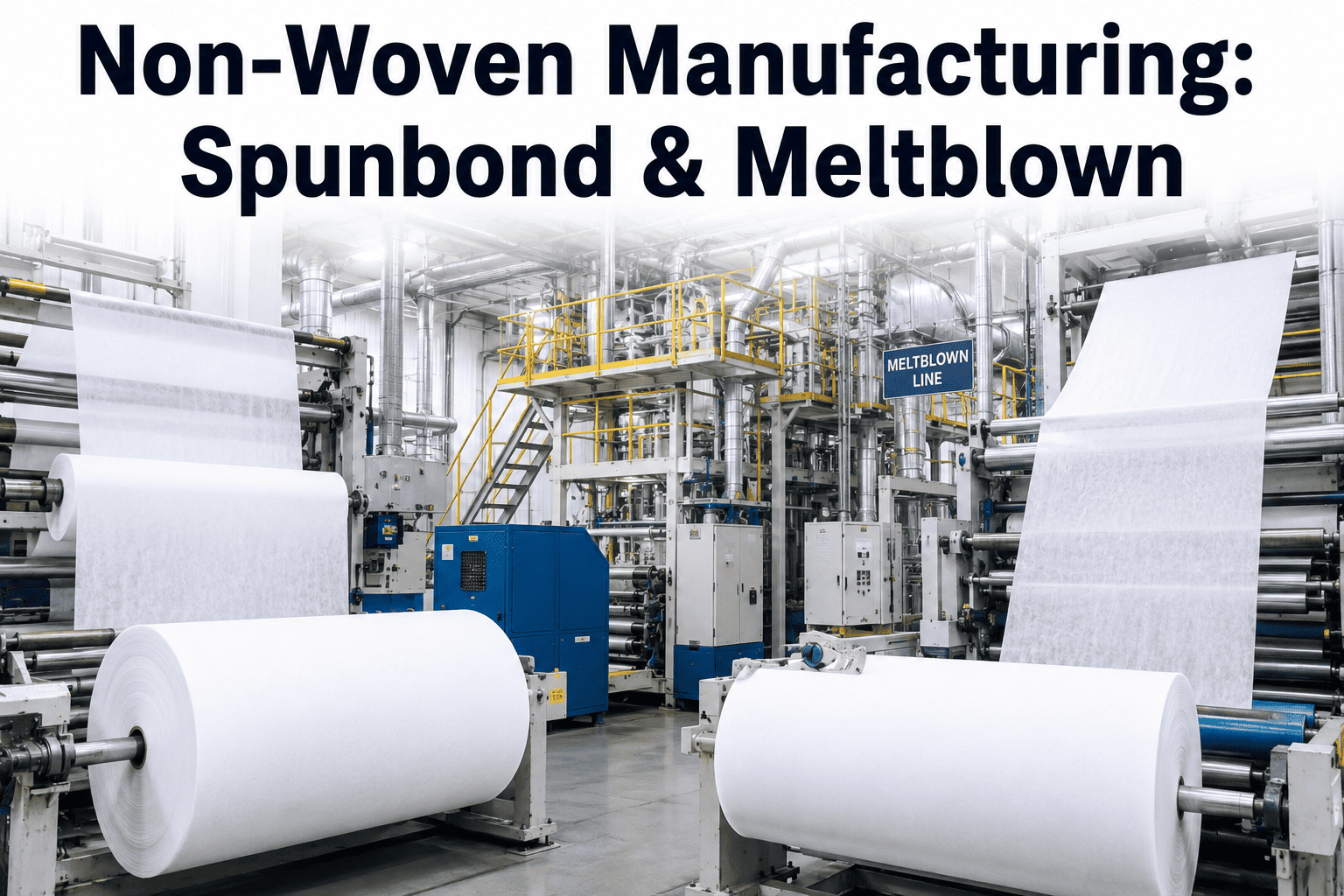
Spunbond gives a nonwoven fabric its strength, meltblown gives it filtration, and neither technology alone produces a fabric that does both well. That's exactly why the majority of medical and hygiene nonwovens in production today are actually composite structures, layering fibre types with fundamentally different characteristics into a single roll. See how iFactory tracks fibre diameter, basis weight, and bonding parameters across every nonwoven line with a Book a Demo.
Spunbond Gives Strength. Meltblown Gives Filtration. SMS Gives You Both.
Spunbond, meltblown, and needle-punch each produce nonwoven fabric through entirely different mechanisms, and each is suited to a different end application. Understanding which technology is doing what inside a composite structure like SMS is the difference between specifying the right fabric and guessing.
Three Manufacturing Methods, Three Different Fibre Structures
Nonwoven fabric is built directly from fibres rather than woven or knitted yarn, and the manufacturing method chosen determines fibre diameter, web uniformity, and mechanical properties far more than any finishing step applied afterward.
Spunbond
Continuous filaments are extruded, drawn, and laid directly onto a moving belt, then thermally bonded. Produces high tensile strength fabric with fibre diameters typically 10–30 microns, well suited to applications needing durability.
Meltblown
Molten polymer is extruded through fine nozzles into a high-velocity air stream, producing microfibers as fine as 1–10 microns that trap particles effectively but offer comparatively low tensile strength on their own.
Needle-Punch
Mechanically entangles fibres using barbed needles rather than thermal or chemical bonding, producing a denser, more textured fabric commonly used in geotextile and industrial applications.
Filtration Efficiency And Tensile Strength Come From Different Layers
iFactory tracks fibre diameter, basis weight, and bonding temperature per layer so composite nonwoven quality is verified layer by layer, not just at the finished roll.
Inside An SMS Laminate: What Each Layer Is Doing
SMS, or Spunbond-Meltblown-Spunbond, is the most common composite structure for medical and hygiene applications specifically because it lets each layer contribute the property the others can't. Basis weight across a typical SMS structure ranges from roughly 15 to 200 grams per square meter depending on end use, with the outer spunbond layers and inner meltblown layer independently tunable.
| Layer | Function | Typical Basis Weight |
|---|---|---|
| Outer Spunbond | Mechanical strength, abrasion resistance | 6–20 gsm per layer |
| Inner Meltblown | Bacterial and particulate filtration | 0.5–6 gsm |
| Outer Spunbond | Surface finish, second strength layer | 6–20 gsm per layer |
Because spunbond and meltblown layers can use different polymers within the same SMS web, formulation choices for each layer can be optimized independently for its specific job rather than compromising on a single shared polymer.
Matching Fabric Structure To End Application
Choosing the wrong nonwoven structure for an application is a common and costly specification mistake, since a fabric optimized for strength alone will underperform on filtration, and vice versa.
Hygiene Products
Lightweight spunbond, typically 10–25 gsm, prioritizes softness and breathability for diaper and feminine hygiene topsheets and backsheets.
Medical & Surgical
SMS composite structures dominate surgical drapes and gowns, balancing bacterial filtration with the mechanical strength needed for procedural use.
Geotextile
Heavier spunbond or needle-punch fabric, often 150+ gsm, prioritizes tensile and puncture strength for soil stabilization and drainage applications.
Filtration
Meltblown-dominant structures with carefully controlled fibre diameter and pore size are tuned specifically for air and liquid filtration efficiency.
Basis Weight On The Spec Sheet Doesn't Guarantee Basis Weight On The Line
iFactory verifies actual production basis weight and fibre diameter against target specification in real time, not just at final QC.
Where Nonwoven Production Quality Most Often Slips
Nonwoven manufacturing defects tend to be process-driven rather than raw material driven, which means the same handful of process control gaps show up repeatedly across different lines and product types.
Uneven Basis Weight Distribution
Inconsistent polymer flow or air velocity across the web width produces basis weight variation that only becomes obvious once the roll is tested at multiple points.
Poor Interlayer Bonding
Bonding roll temperature that's too low fails to fuse composite layers together properly, risking delamination under mechanical stress in the field.
Fibre Diameter Drift
Meltblown fibre diameter is highly sensitive to temperature and air velocity, and small drift can meaningfully shift filtration performance without a visible change in the fabric.
Mismatched Polymer Selection
Using the same polymer melt flow rate for both spunbond and meltblown layers, rather than optimizing each independently, limits the performance ceiling of the composite structure.
What Producers Typically See After Adding Layer-Level Process Monitoring
Nonwoven producers that move from finished-roll spot checks to continuous layer-level process tracking tend to catch basis weight and bonding issues before they compound into a full batch of out-of-spec material.
Frequently Asked Questions
Q: Why do medical and hygiene nonwovens use composite structures instead of a single technology?
Spunbond fabric alone offers excellent tensile strength but limited filtration efficiency, while meltblown fabric alone offers strong filtration but comparatively low strength on its own. Layering them together in an SMS structure lets the outer spunbond layers carry the mechanical load while the inner meltblown layer handles bacterial and particulate filtration, achieving a combination of properties that neither technology delivers independently. This is why SMS and similar composite structures dominate surgical gowns, drapes, and high-performance protective apparel rather than single-technology fabrics. Reach out through Support Contact if you're evaluating which nonwoven structure fits a specific application.
Q: How does basis weight actually affect nonwoven fabric performance?
Basis weight, measured in grams per square meter, directly correlates with fabric density, strength, and material cost, but the relationship isn't purely linear across applications. A lightweight hygiene topsheet at 10–15 gsm prioritizes softness and breathability over strength, while a heavy geotextile at 150 gsm or more prioritizes puncture and tensile resistance over any consideration of hand feel, meaning the correct basis weight target depends entirely on which property matters most for the end use rather than a single universal quality standard.
Q: Can the spunbond and meltblown layers in an SMS fabric use different polymers?
Yes, since the layers are bonded together as separate webs rather than co-extruded as a single homogeneous material, formulators can select different polymer grades or even different base polymers for each layer to optimize independently for strength versus filtration. This flexibility is one of the underappreciated advantages of composite nonwoven manufacturing, since it avoids the compromise that would result from forcing a single polymer formulation to perform both jobs simultaneously. A Book a Demo session can walk through how per-layer polymer and process data can be tracked across a composite production line.
Q: What causes meltblown filtration performance to vary between production runs even with the same recipe?
Meltblown fibre diameter is controlled by extrusion temperature, air velocity, and die-to-collector distance, and small drift in any of these variables shifts the resulting fibre diameter enough to measurably change filtration efficiency, even though the polymer formulation and basis weight target remain unchanged. This sensitivity is precisely why meltblown lines require tighter process control than spunbond lines, and why filtration-critical applications like medical-grade nonwovens typically demand continuous process monitoring rather than periodic spot testing.
Q: Why does interlayer delamination happen in composite nonwoven fabrics?
Delamination typically traces back to insufficient bonding roll temperature or pressure during thermal spot bonding, which fails to adequately fuse the spunbond and meltblown layers together at a molecular level even though the fabric may appear visually intact when it leaves the line. Fabric that delaminates under field stress, such as during a surgical procedure or industrial application, represents a serious quality failure, which is why bonding roll temperature is one of the most closely monitored parameters on a composite nonwoven line.
Get Composite Fabric Quality Right Layer By Layer
iFactory connects fibre diameter, basis weight, and bonding parameters across every layer of your nonwoven line.