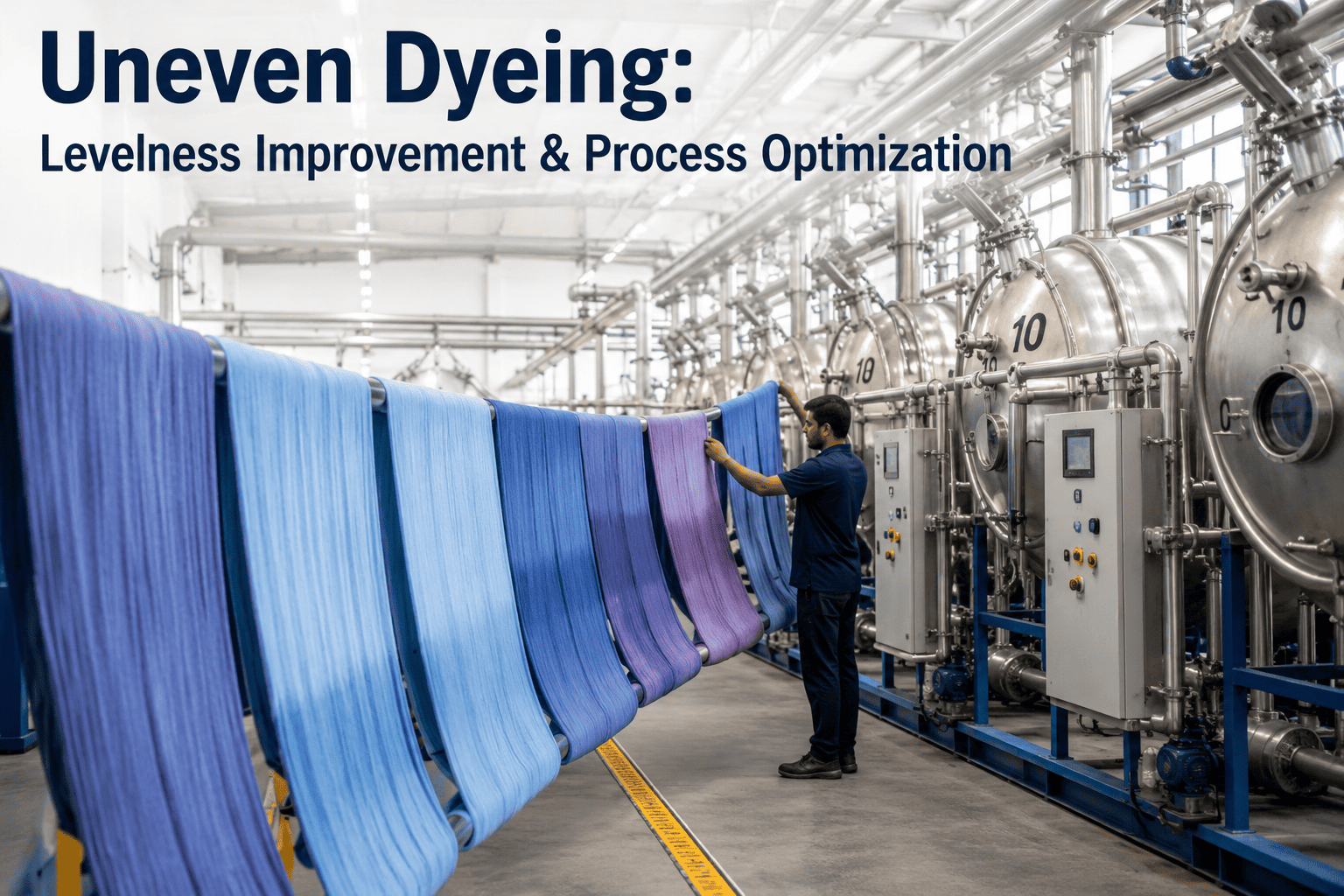
Most shade complaints get blamed on the dyeing machine, the recipe, or the dye lot, when the real cause was decided hours earlier at desizing, scouring, and bleaching. Fabric that goes into the dye bath with uneven residual size, patchy absorbency, or inconsistent whiteness will never dye level no matter how precisely the dyeing parameters are controlled, because pre-treatment sets the starting condition every downstream step has to work with. A mill can tune pH, temperature, and time perfectly and still see rejections if the greige fabric entering the bath was not uniformly prepared. Book a demo to see pre-treatment quality tracked against dyeing outcomes.
Trace Every Shade Issue Back to Its Real Origin
iFactory links pre-treatment checkpoint data with downstream dyeing results, so you can see whether a rejection started at scouring, bleaching, or the dye bath itself instead of guessing.
The Three Pre-Treatment Checkpoints That Decide Dyeing Outcome
Each stage of pre-treatment removes a different barrier to even dye uptake, and a gap at any one of them carries forward into the dye bath.
1
Desizing Residual
Incomplete size removal leaves starch or synthetic size film on the yarn surface, physically blocking dye penetration in patches. Residual size is typically checked with an iodine spot test, and any uneven staining pattern across the fabric width signals inconsistent desizing rather than a uniformly clean substrate.
2
Scouring Absorbency
Natural waxes, oils, and impurities left behind after inadequate scouring reduce fabric wettability, which shows up as slower and uneven dye liquor absorption. A drop test measuring how quickly a water droplet is absorbed into the fabric is the standard way to verify scouring effectiveness before fabric proceeds further.
3
Bleaching Whiteness
Inconsistent whiteness leaves a variable base tone across the fabric that shifts the perceived shade even when the same dye recipe is applied uniformly. Whiteness index measurement catches variation between rolls or across a batch that visual inspection alone often misses under standard lighting.
How a Pre-Treatment Gap Shows Up Downstream
The connection between a pre-treatment shortfall and a dyeing defect is not always obvious on the shop floor, which is why root cause is so often mis-assigned to the wrong stage.
Pre-Treatment Gap
Uneven desizing residual
leads to
Dye Bath Behavior
Blocked dye penetration in patches
leads to
Finished Fabric Defect
Patchy, uneven shade on the roll
Pre-Treatment Gap
Low scouring absorbency
leads to
Dye Bath Behavior
Slow, uneven liquor uptake
leads to
Finished Fabric Defect
Light or dark streaks along the length
Pre-Treatment Gap
Inconsistent bleach whiteness
leads to
Dye Bath Behavior
Same recipe, different base tone
leads to
Finished Fabric Defect
Shade drift between rolls in one lot
Verification Methods Compared
| Checkpoint | Standard Test | Frequency Recommended |
| Desizing Residual |
Iodine spot test across fabric width |
Every batch, multiple points |
| Scouring Absorbency |
Water drop absorption timing |
Every batch, sampled rolls |
| Bleaching Whiteness |
Whiteness index measurement |
Every lot, roll-to-roll comparison |
| pH After Pre-Treatment |
Residual alkali pH check |
Every batch before dyeing |
Building Pre-Treatment Verification Into the Process
1
Sample at multiple points across fabric widthA single spot check near the selvedge can miss uneven treatment across the width, so sampling at several points gives a truer picture of consistency before fabric proceeds to dyeing.
2
Log results against the batch and machine, not just pass or failRecording the actual measured value rather than a simple pass or fail lets you spot a gradual drift in absorbency or whiteness before it crosses the rejection threshold.
3
Hold fabric that fails a checkpoint rather than proceeding on schedule pressureSending fabric with known desizing or scouring gaps into the dye bath to keep to a production schedule almost always costs more in re-dyeing than the delay would have cost upstream.
4
Correlate pre-treatment data with dyeing outcomes over timeConnecting checkpoint measurements to the shade and fastness results of the batches that came from that fabric reveals which pre-treatment gaps actually matter most for your specific dye classes and fabric constructions.
5
Review pre-treatment recipes when fiber source or lot changesA desizing or scouring recipe tuned for one cotton source may not fully clean a different lot with different natural wax content, so recipe review at source change reduces the risk of a systematic gap.
Connect Pre-Treatment Data to the Dyeing Results It Actually Causes
iFactory tracks desizing, scouring, and bleaching checkpoints alongside downstream shade and fastness outcomes, showing exactly which pre-treatment gaps are driving your dyeing rejections.
Results Mills Report After Tightening Pre-Treatment Verification
3
Checkpoints Tracked Per Batch
Roll-to-Roll
Whiteness Comparison Standard
Before
Bath, Not After Rejection
We kept treating every shade complaint as a dyeing problem and adjusting recipes that were already correct. When we finally started checking scouring absorbency batch by batch, we found one preparation range was consistently under-scouring a particular cotton source, and every dyeing correction we had made before that was compensating for a problem we hadn't actually fixed.
Quality Assurance Head
Composite Textile Mill — Tamil Nadu
Frequently Asked Questions
QHow do we know if a shade defect started at pre-treatment or at the dye bath?
The clearest signal is whether the defect pattern correlates with pre-treatment checkpoint data or with dyeing process parameters for the same batch. A patchy, irregular defect that does not follow the dyeing machine's flow pattern often points back to uneven desizing or scouring, while a defect that follows a clear liquor circulation pattern is more likely a dyeing-stage issue. Comparing checkpoint records against the defect location is far more reliable than guessing from the finished fabric alone.
QIs whiteness verification necessary for dark shades where the base tone seems irrelevant?
Whiteness still matters for dark and medium shades because an inconsistent base tone shifts how the dye reads once applied, even if the effect is less visually obvious than it would be on a pastel shade. Mills producing predominantly dark shades sometimes skip whiteness checks assuming it does not matter, then struggle to explain subtle shade drift between lots that whiteness variation would have explained.
QWhat is the fastest checkpoint to add if we currently verify none of these three?
Scouring absorbency via a simple drop test is typically the fastest to implement since it requires no special equipment beyond a stopwatch and water, and absorbency issues tend to have an outsized impact on shade evenness compared to the other two checkpoints. Starting there while building out desizing and whiteness verification gives the quickest initial improvement.
Talk to an expert about a phased rollout for your floor.
QDo synthetic and blended fabrics need the same pre-treatment checkpoints as cotton?
The specific tests differ since synthetic fibers do not carry natural waxes the way cotton does, but the underlying principle holds across fiber types: whatever preparation step removes barriers to even dye uptake needs its own verification checkpoint. Polyester and blended fabrics typically substitute a heat-setting and scouring verification step for the desizing check, while whiteness verification remains relevant wherever bleaching is part of the preparation sequence.
QHow much does tightening pre-treatment verification typically reduce re-dye rates?
The reduction varies by mill and current baseline, but plants that previously had no formal pre-treatment checkpoints and add all three typically see the most meaningful drop in re-dyeing tied specifically to unevenness and patchiness, since those defect types are most strongly linked to preparation quality rather than dyeing parameters.
Book a demo to see the correlation data for your fabric types.
Fix the Defect at Its Actual Origin
iFactory connects desizing, scouring, and bleaching checkpoint data with downstream dyeing outcomes, so root cause stops defaulting to the dye bath by assumption.