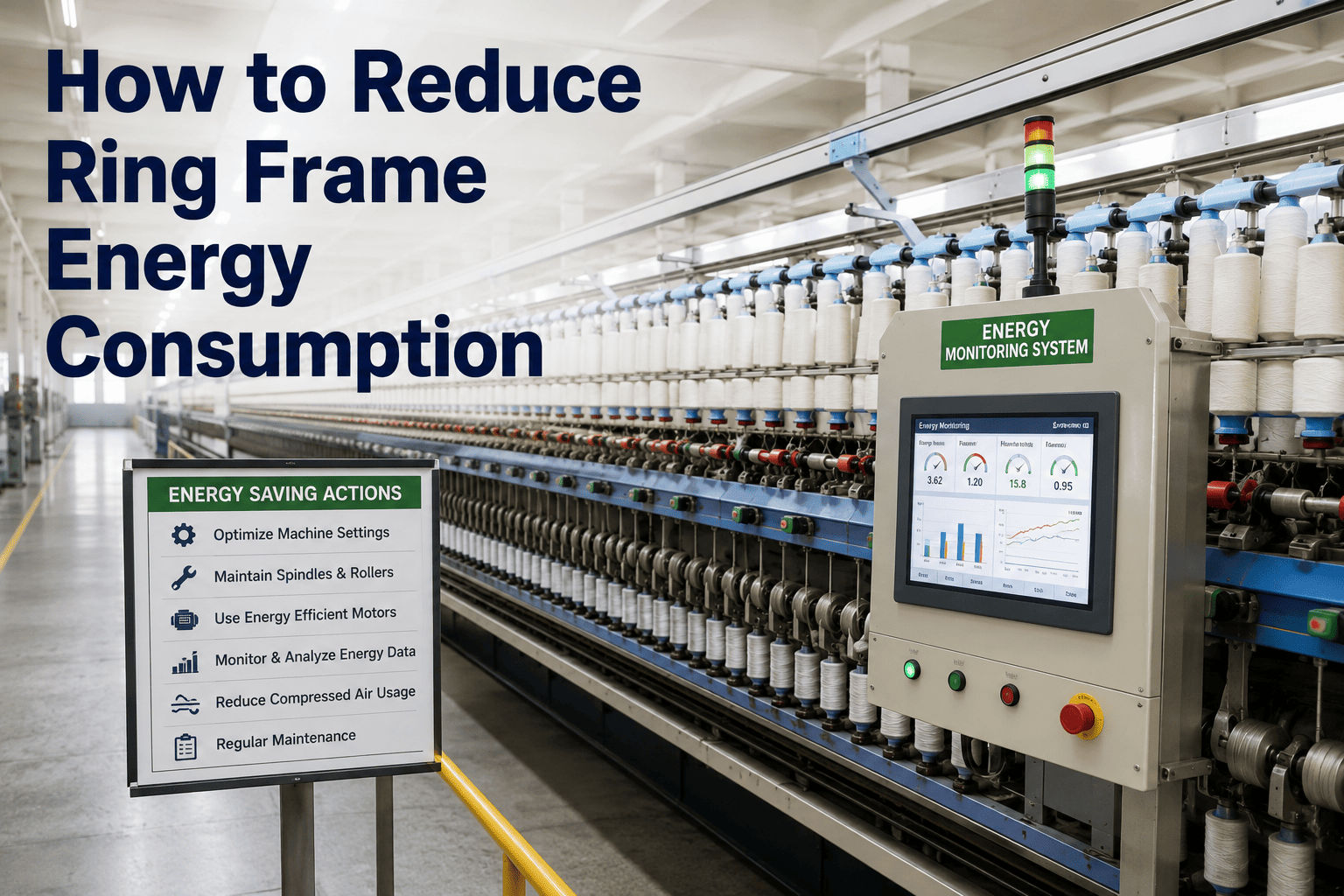
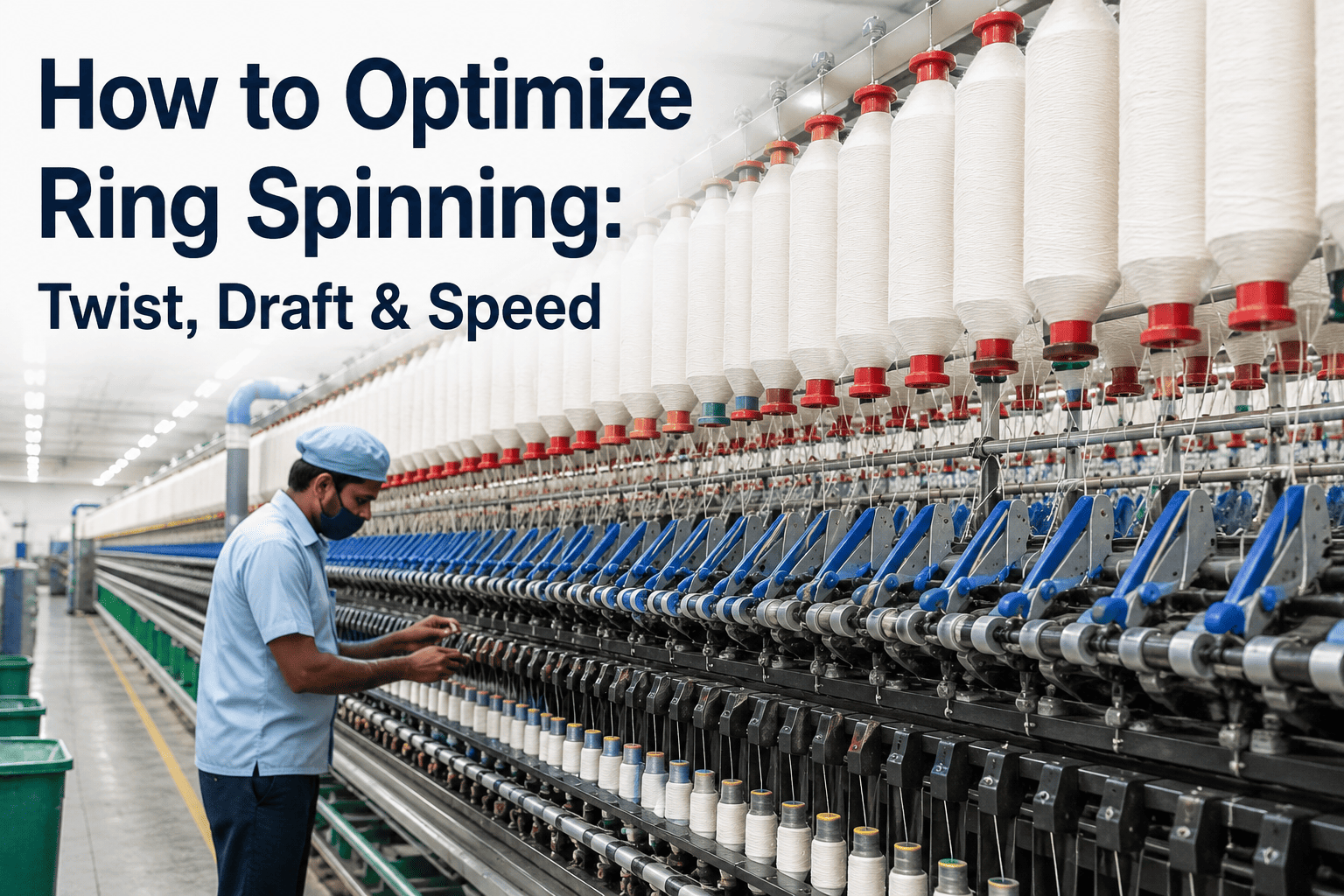
Ring frames are the single largest electricity consumer on most spinning mill floors, often accounting for close to half of total connected load, which means even a small percentage improvement in ring frame energy efficiency moves the mill's power bill more than almost any other intervention available. Most mills know this in the abstract but have never actually benchmarked their kWh per kilogram of yarn against what a well-optimized frame running the same count should achieve. The gap between average and optimized is usually larger than people expect, and it's almost always closeable without new capital equipment. If you want to know where your ring frames actually sit on that curve, book a demo with our team and we'll benchmark it against your own energy data.
Textile Manufacturing · Spinning Process
Reducing Ring Frame Energy Consumption: A Practical Guide to VFDs, Motors, and Drive Optimization
Ring frames typically account for 40-50% of a spinning mill's connected electrical load. This guide covers VFD application, motor efficiency upgrades, and drive system optimization to bring your kWh-per-kg down without new capital equipment.
40-50%
Of mill electrical load from ring frames
8-15%
Typical energy savings from VFD retrofit
2-4 yrs
Common payback period on drive upgrades
Where Ring Frame Energy Actually Goes
Before optimizing anything, it helps to know where the electricity is actually being spent, because the intuitive answer — spindle drive — is only part of the picture. Suction, lighting, and pneumatic systems attached to the frame all draw continuously, and some of them run at full load even during idle or low-production periods when they don't need to.
Suction / Pneumatic System
Note: this is a representative breakdown for a standard ring frame. Actual proportions vary by machine age, spindle count, and whether suction is centralized or frame-mounted.
How VFDs Actually Cut Ring Frame Energy Use
A variable frequency drive doesn't save energy by magic — it saves energy specifically because ring frame spindle speed requirements change across a doff cycle, and running a fixed-speed motor at full power throughout that cycle wastes energy during the ramp-up and ramp-down phases where full speed isn't yet needed.
01
Ramp-Up Match
VFD ramps spindle speed to match yarn tension requirements as the bobbin builds, instead of running full speed from the first second.
→
02
Load-Based Adjustment
Motor draws power proportional to actual load rather than a fixed maximum, cutting waste during lighter-load portions of the cycle.
→
03
Soft Stop at Doff
Controlled deceleration at doff avoids the energy spike of abrupt braking, while also reducing mechanical stress on the drive train.
Benchmarking Your kWh per Kilogram
Energy per kilogram of yarn produced is the metric that actually lets you compare performance across counts, shifts, and machines, because raw kWh consumed says nothing without production volume attached to it. The table below gives typical ranges — your own baseline is what actually matters for tracking improvement.
Yarn Count
Typical kWh/kg (Fixed Speed)
Typical kWh/kg (VFD Optimized)
Coarse (below 20s)
0.9-1.1
0.8-0.95
Medium (20s-40s)
1.3-1.6
1.15-1.4
Fine (above 40s)
1.9-2.4
1.65-2.0
See Your Real kWh-per-kg Across Every Ring Frame
iFactory pulls energy meter data and production output together automatically, so you get a live kWh-per-kg figure per frame, per count, per shift — not an end-of-month estimate.
Beyond VFDs: Other Levers Worth Checking
VFD retrofits get most of the attention because the payback math is easy to show a finance team, but several other factors influence ring frame energy consumption and are worth checking before or alongside a VFD program, since some of them cost nothing to fix.
Spindle Tape Tension
Over-tensioned tapes increase drag on every spindle across the frame, adding up to a meaningful energy penalty across hundreds of spindles that's invisible without direct measurement.
Bearing Condition
Worn or under-lubricated bearings increase friction load on the drive motor gradually, showing up as slowly rising energy consumption long before the bearing fails outright.
Suction System Sizing
Oversized centralized suction systems run at fixed high capacity regardless of actual spindle count in operation, wasting energy on frames running below full spindle load.
Power Factor Correction
Poor power factor across multiple ring frame motors increases apparent power draw and can trigger utility penalty charges independent of actual energy used for production.
Building the Business Case for a Drive Upgrade
Finance teams approve energy projects on payback period, not engineering elegance, so building the case means connecting the technical improvement directly to a cost figure the mill's leadership already tracks. A structured comparison across before, during, and after states is usually the fastest way to get sign-off.
Phase 1
Baseline Measurement
Measure kWh-per-kg on target frames across at least two full weeks covering different counts, to establish a credible baseline before any changes are made.
Phase 2
Pilot on 2-3 Frames
Retrofit a small number of frames first, ideally covering a range of counts, and measure the actual kWh-per-kg improvement against the established baseline.
Phase 3
Fleet-Wide Rollout
Use the pilot's real payback figure, not a vendor estimate, to secure budget for the remaining frames, prioritizing the oldest and least efficient units first.
Frequently Asked Questions
How much energy can a VFD retrofit actually save on a ring frame?
Typical savings range from 8% to 15% of the ring frame's total energy consumption, with the actual figure depending heavily on the count mix being spun and how much of the current cycle involves fixed-speed operation at less-than-full load. Mills running a wide variety of counts with frequent doffing tend to see savings toward the higher end of that range, since VFDs capture more waste during the ramp-up and ramp-down phases that occur more often on shorter runs.
What's a good kWh-per-kg benchmark for ring frame spinning?
Benchmarks vary significantly by yarn count, roughly 0.8 to 1.1 kWh/kg for coarse counts up to 1.65 to 2.4 kWh/kg for fine counts, with VFD-optimized frames typically running 10 to 20 percent below fixed-speed equivalents. Because count mix has such a large effect, comparing your own kWh-per-kg over time on a consistent count basis is more useful than comparing against a single industry-wide number.
Book a session with our team to see how your mill compares.
Is a VFD retrofit worth it on older ring frames nearing end of life?
It depends on remaining service life and how many operating hours are left on the frame — a retrofit with a two to four year payback period only makes financial sense if the frame will still be running well past that point. For frames within a few years of planned replacement, the better move is often to prioritize VFD investment on frames with longer remaining service life and address the older units through other levers like bearing maintenance and tape tension, which cost far less and still deliver meaningful savings.
Can spindle tape tension really affect energy consumption noticeably?
Yes — over-tensioned spindle tapes increase mechanical drag across every spindle on the frame, and because a single ring frame can have anywhere from 400 to 1,000-plus spindles, even a small per-spindle energy penalty compounds into a measurable increase in total frame energy draw. This is one of the lowest-cost levers available since it requires only a tensioning adjustment and inspection rather than capital investment, and it's worth checking before assuming a VFD retrofit is the only path to savings.
How does iFactory help track ring frame energy performance?
iFactory connects energy meter data directly to production output per frame, giving you a live kWh-per-kg figure broken down by frame, shift, and count rather than a single mill-wide number calculated at month end. This makes it possible to spot a specific frame drifting away from its normal energy baseline — often a sign of bearing wear, tape tension drift, or suction imbalance — well before it shows up as a meaningful cost increase on the utility bill.
Find Out Where Your Ring Frames Sit on the Efficiency Curve
Most mills are running 15-20% higher kWh-per-kg than a well-optimized frame on the same count. iFactory shows you exactly which frames, shifts, and settings are driving that gap.