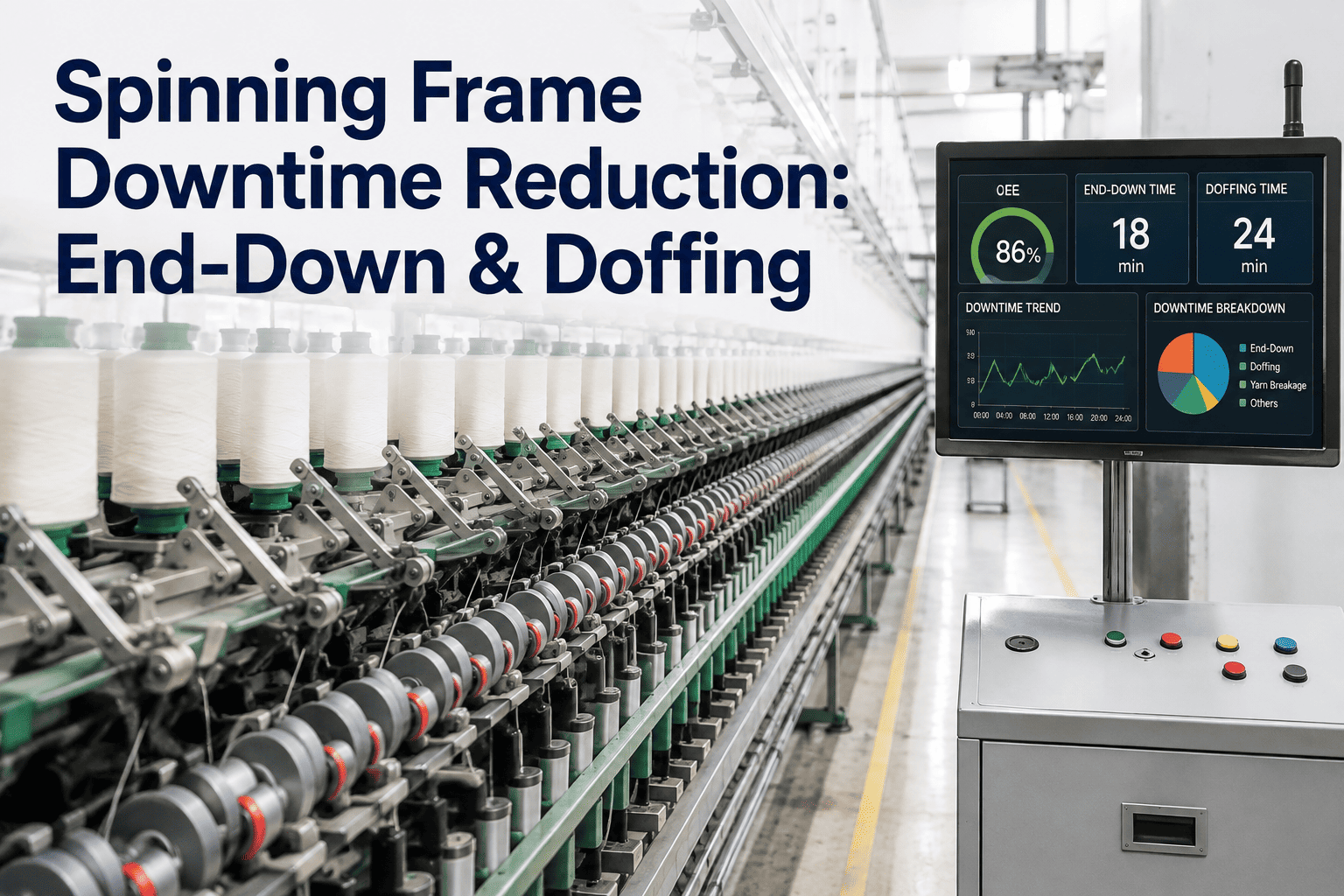
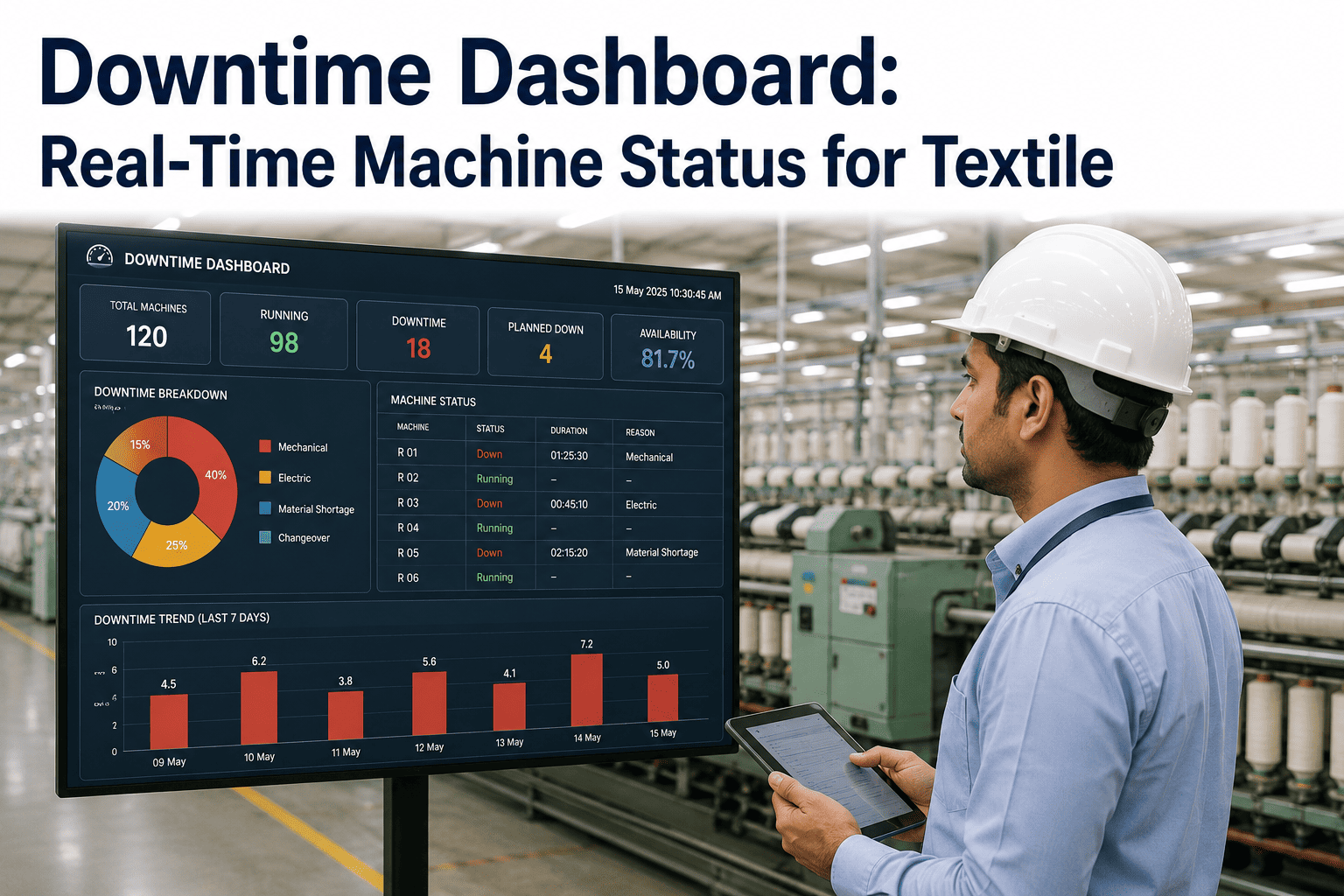
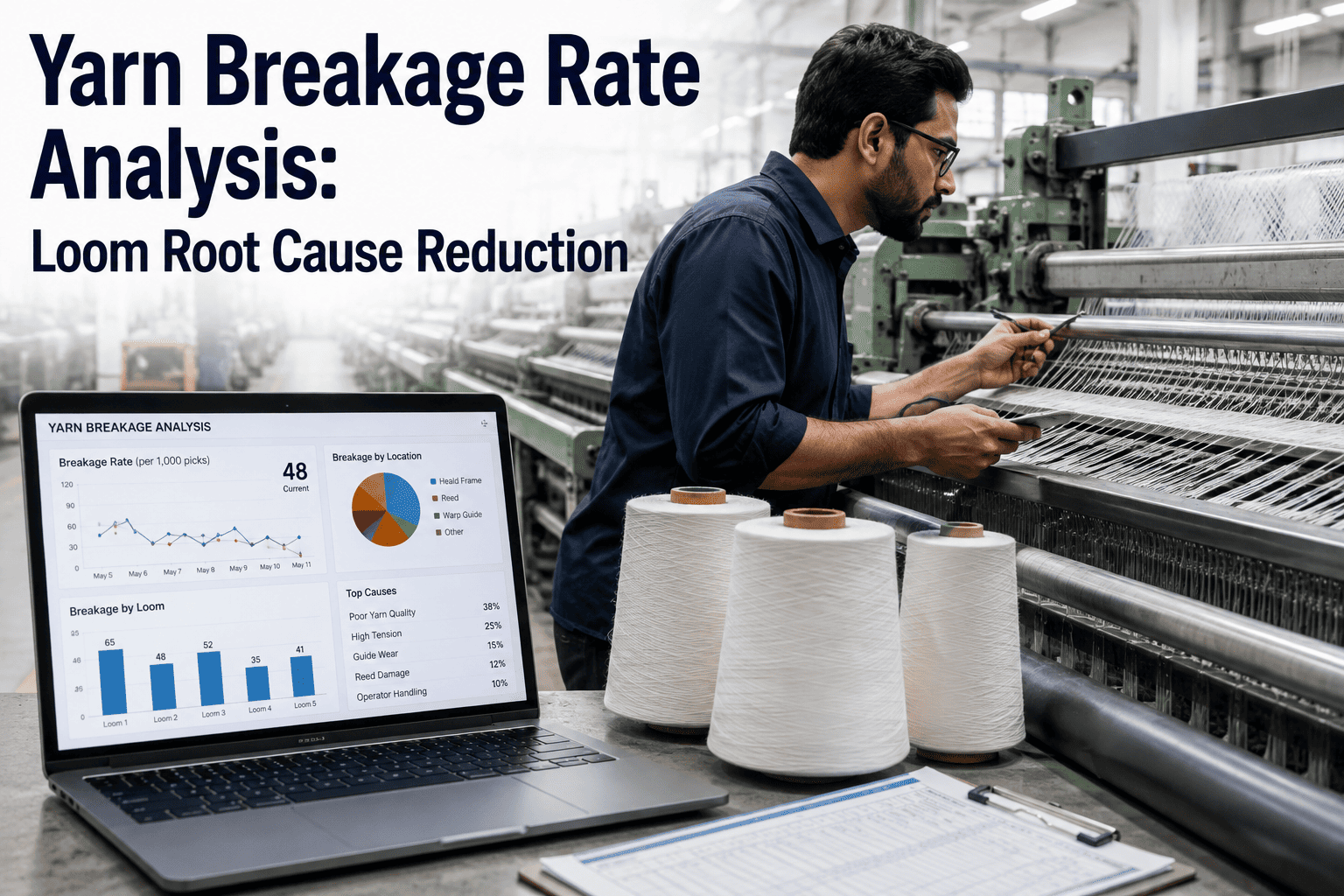
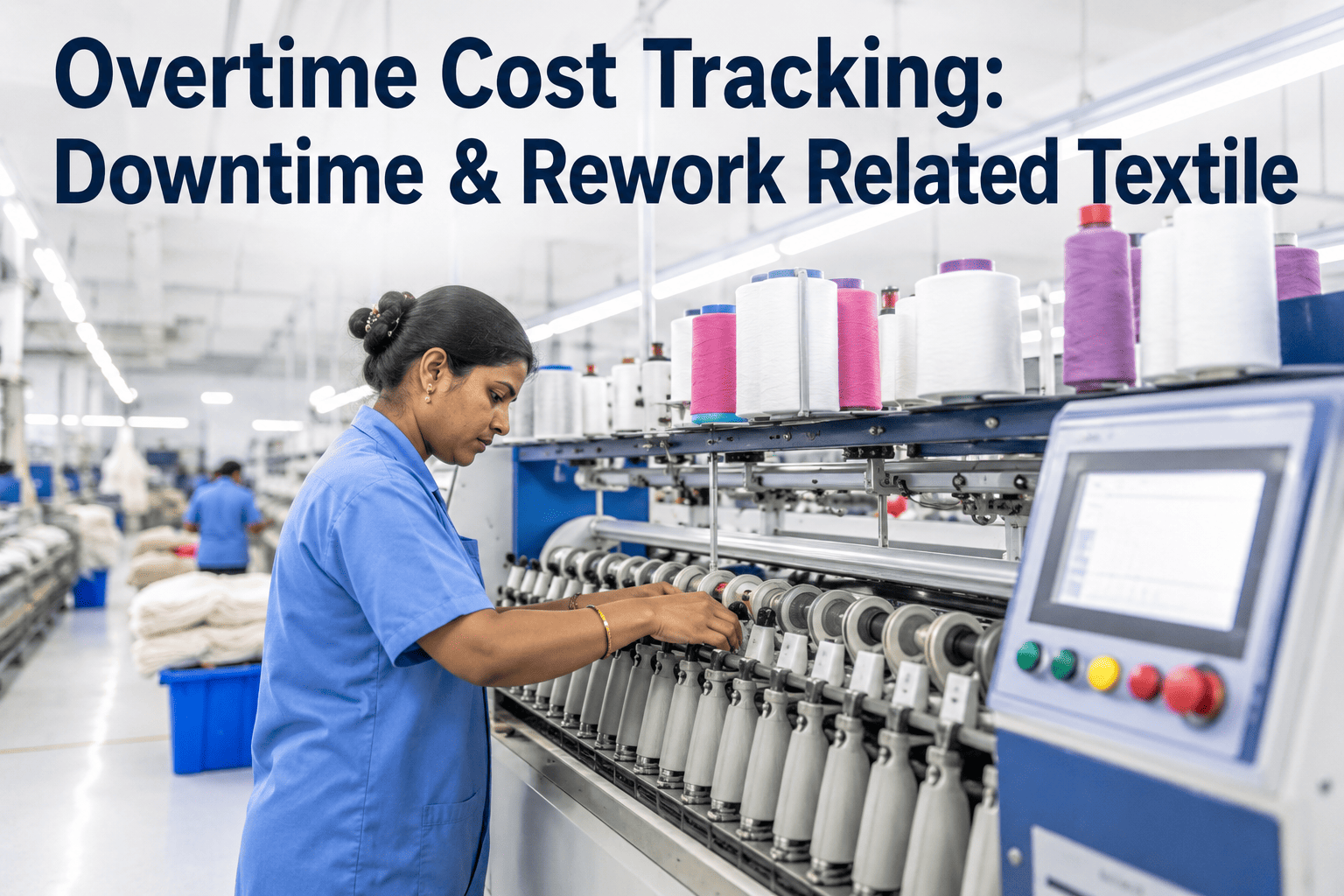
A ring spinning frame loses time in two very different ways, and most mills only ever measure one of them well. End-down stoppages happen constantly, in small bursts spread across hundreds of spindles, while doffing is a scheduled, predictable event that still manages to run long more often than anyone likes to admit. Fixing one without measuring the other usually just shifts the bottleneck instead of removing it, which is why breakage rate and doffing cycle time need to be tracked side by side, not as separate projects. Book a demo to see end-down and doffing losses measured together on your own spinning floor.
Spinning · Downtime Reduction
End-Downs Happen a Thousand Times a Shift. Doffing Happens Eight. Both Cost You the Same Hours.
Automated breakage rate tracking and doffing cycle measurement that shows exactly where a spinning frame's productive hours are actually going.
1000+
Typical end-down events across a frame in a single shift
6-8
Scheduled doffing cycles per frame per day on most mills
Two Loss Types, Two Different Fixes
End-down loss and doffing loss both show up as reduced spindle utilization, but they need entirely different interventions, and confusing the two usually means the wrong department gets asked to fix a problem it does not control.
End-Down Loss
Individual spindles stop when a yarn end breaks, and stay stopped until a piecer reaches them. High-frequency, low-duration, and spread unevenly across the frame based on yarn quality and roller condition.
Doffing Loss
The entire frame stops for bobbin exchange on a fixed schedule. Low-frequency, higher-duration, and driven by auto-doffer cycle time or manual doffing crew efficiency.
What Drives Breakage Rate Up Without Anyone Noticing
Breakage rate creeps upward gradually in most mills, which is exactly why it survives so long without a fix — no single shift looks bad enough to trigger an investigation.
01
Traveler Wear
A worn traveler increases yarn tension unevenly across the ring rail, raising breakage on specific spindle ranges before it affects the whole frame.
02
Roving Quality Drift
Inconsistent roving from an upstream frame introduces breakage spikes that get blamed on the spinning frame itself.
03
Humidity and Temperature Swings
Fiber moisture regain outside the target range changes yarn elasticity enough to measurably shift end-down frequency by shift.
04
Draft Roller Condition
Worn or contaminated draft rollers create thin places that break under normal spinning tension, concentrated at specific roller positions.
Measure Breakage Rate by Spindle Position, Not Just by Frame.
iFactory tracks end-down frequency down to the spindle range, so a traveler or roller problem shows up as a pattern instead of getting lost in a frame-wide average.
Where Doffing Cycles Actually Lose Time
A doffing cycle has a target duration, but the gap between target and actual is where a meaningful share of frame utilization quietly disappears every single day.
| Doffing Stage | Common Delay Source |
| Frame Stop and Ring Rail Drop | Auto-doffer calibration drift adds seconds per cycle that compound across a full shift. |
| Bobbin Exchange | Empty tube supply gaps force the crew to wait mid-cycle on frames without buffered tube feed. |
| Yarn End Preparation | Manual piecing after doffing takes longer when breakage rate was already elevated before the stop. |
| Restart and Ramp-Up | Frames restarted at full speed immediately see a short-term breakage spike that a gradual ramp would avoid. |
We had assumed our doffing time was the main productivity issue because it was the easiest thing to time with a stopwatch. Once we started tracking end-down frequency by spindle position, it turned out one specific range on each frame — the same range across every frame in the department — was breaking far more than the rest. It traced back to a ring rail alignment issue introduced during a rebuild two years earlier. Fixing that alignment recovered more spinning hours in a month than every doffing improvement we had made in the previous year combined.
— Spinning Superintendent, Ring Spinning Mill, Tamil Nadu
Piecing Efficiency: The Link Between the Two Loss Types
Piecing efficiency connects end-down loss and doffing loss directly, because the same crew and the same skill level determine how fast both problems get resolved.
Piecer Coverage Ratio
The number of spindles assigned per piecer directly determines how long a broken end sits idle before it is caught and repaired.
Walking Pattern Efficiency
A poorly sequenced walking route across assigned frames adds idle time between end-down events that has nothing to do with skill.
Doffing Crew Cross-Training
Crews trained on both piecing and doffing can shift resources during a doffing cycle without leaving end-downs unattended elsewhere.
Spinning Frame Downtime — Frequently Asked Questions
Why does tracking end-down loss by spindle position matter more than a frame-wide average?
A frame-wide breakage rate can look completely normal even when one section of the frame is breaking far more than the rest, because the average smooths out the difference. Mechanical issues like ring rail misalignment, traveler wear concentrated on one ring size, or a roller problem on a specific gear train almost always show up as a pattern tied to spindle position rather than an even distribution across the whole frame. Without position-level tracking, that pattern is invisible until someone happens to walk the floor at the right moment.
Contact support for help setting up spindle-position tracking on your existing frames.
How much doffing time is realistic to recover through auto-doffer optimization?
The recoverable amount depends heavily on current auto-doffer calibration and tube supply reliability, but mills that have never audited doffing cycle timing in detail commonly find ten to twenty percent of doffing time is avoidable delay rather than genuinely required mechanical time. The most common sources are calibration drift that accumulates gradually and tube supply gaps that force the crew to wait mid-cycle, both of which are identifiable once cycle timing is measured consistently across every doff rather than spot-checked occasionally.
Does humidity control actually make a measurable difference to breakage rate?
Yes, and the effect is usually larger than expected once it is measured against shift-level breakage data rather than assumed qualitatively. Fiber moisture regain outside the target range changes yarn elasticity and static behavior enough to shift end-down frequency noticeably between a well-controlled shift and a poorly controlled one, particularly during seasonal transitions when ambient humidity swings are largest. Tracking breakage rate alongside spinning room humidity readings over a full season usually makes the correlation clear enough to justify tighter climate control.
Should piecer coverage ratio be adjusted based on breakage rate or kept fixed?
Coverage ratio works best when it responds to measured breakage rate rather than staying fixed regardless of yarn count or roving quality on a given day. A count or roving batch running with elevated breakage needs tighter piecer coverage temporarily, while a well-behaved batch can run with a looser ratio without idle-time cost. Mills that track breakage rate in real time can adjust coverage dynamically instead of setting one ratio for every product, which tends to leave capacity underused on easier counts and understaffed on harder ones.
What is the fastest way to find out whether end-down or doffing loss is the bigger issue on a specific frame?
Compare total minutes lost to each category over at least two full weeks rather than relying on which one feels more disruptive during a single shift. End-down loss is easy to underestimate because each event is short, while doffing loss is easy to overestimate because it is visible and scheduled. Automated tracking that logs both categories against the same time base is the most reliable way to settle the question, since it removes the bias toward whichever loss type happens to be more noticeable on the floor.
Stop Choosing Between Fixing End-Downs or Fixing Doffing.
Measure both loss types together, by spindle position and by cycle, so your next improvement project targets whichever one is actually costing more hours.