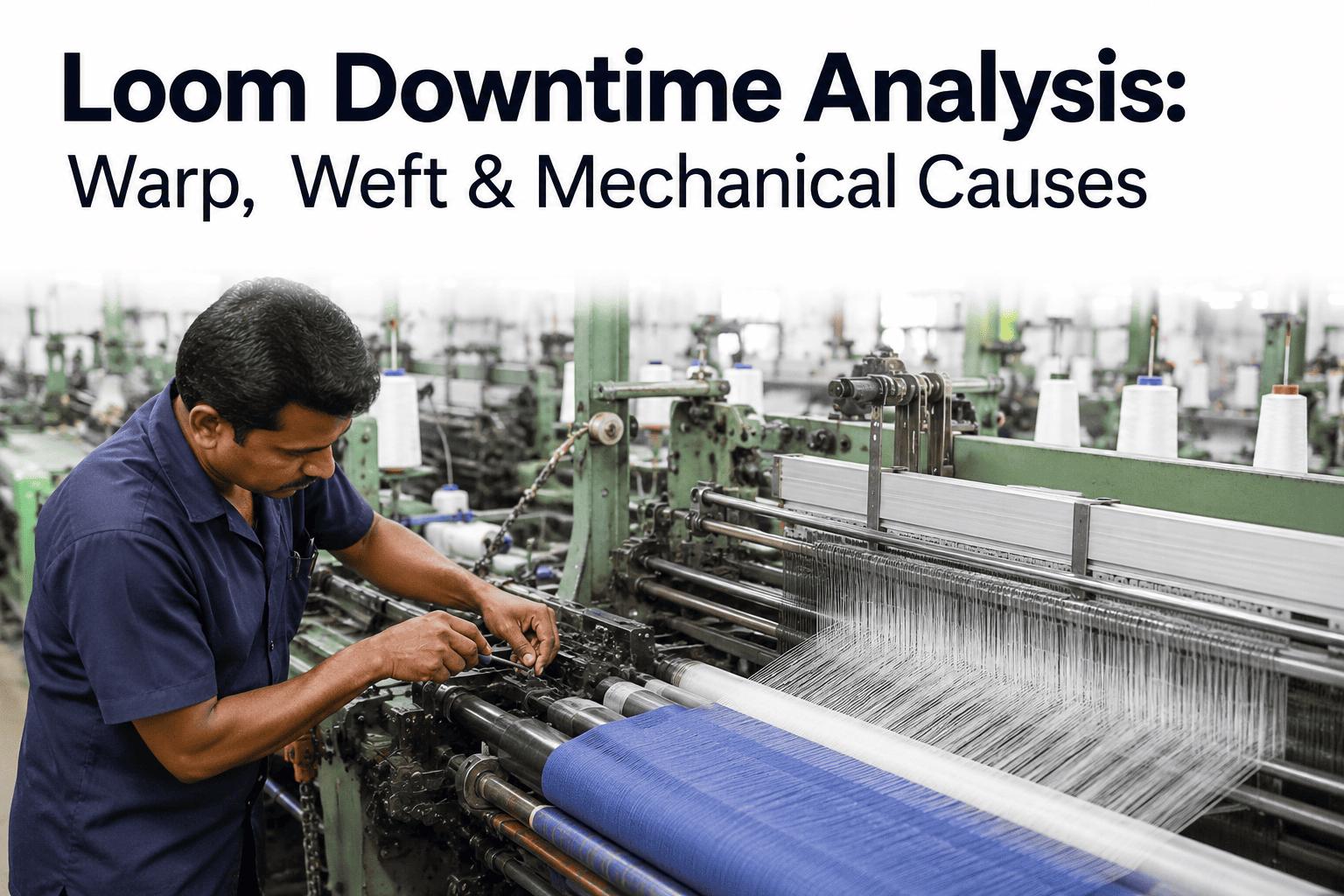
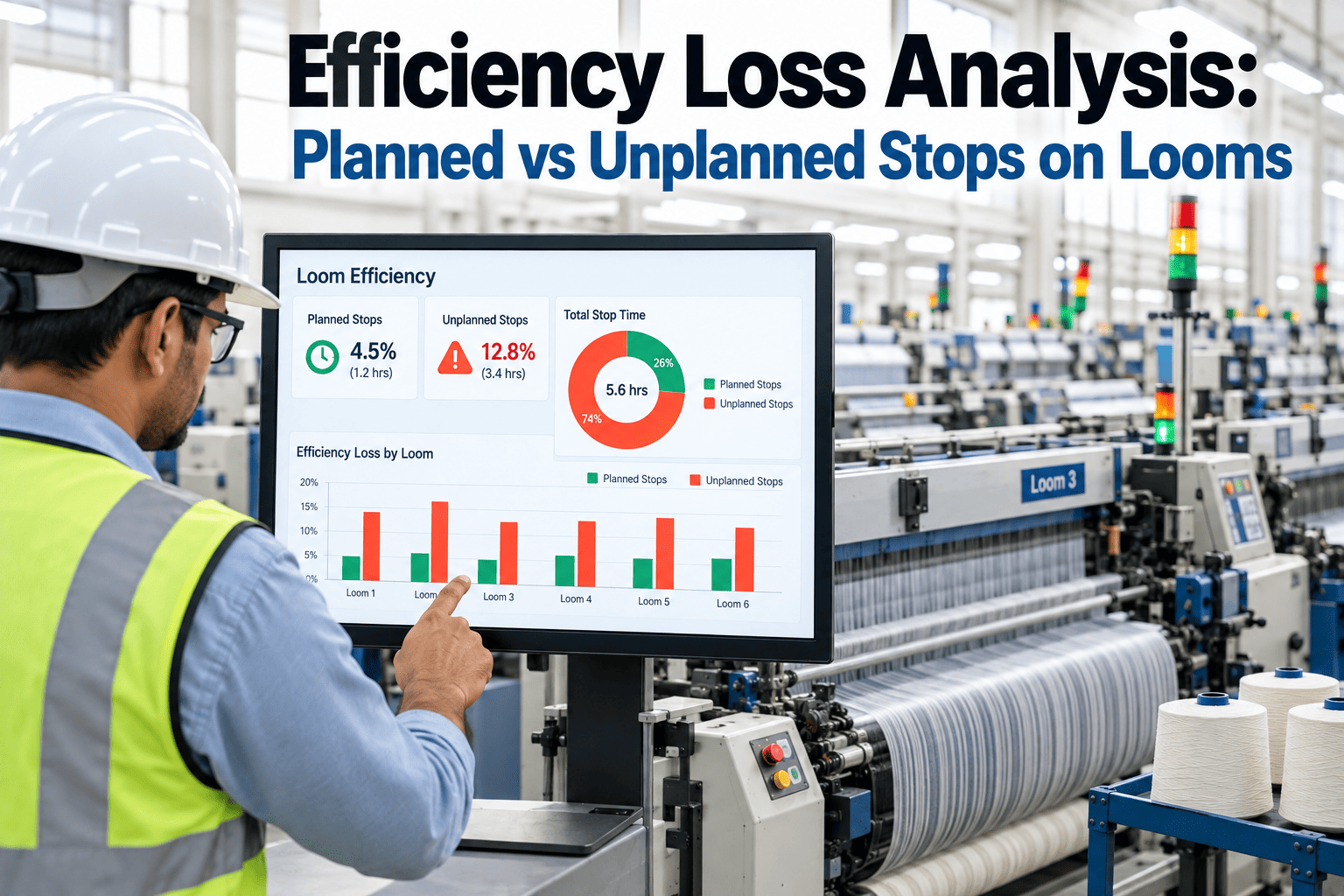
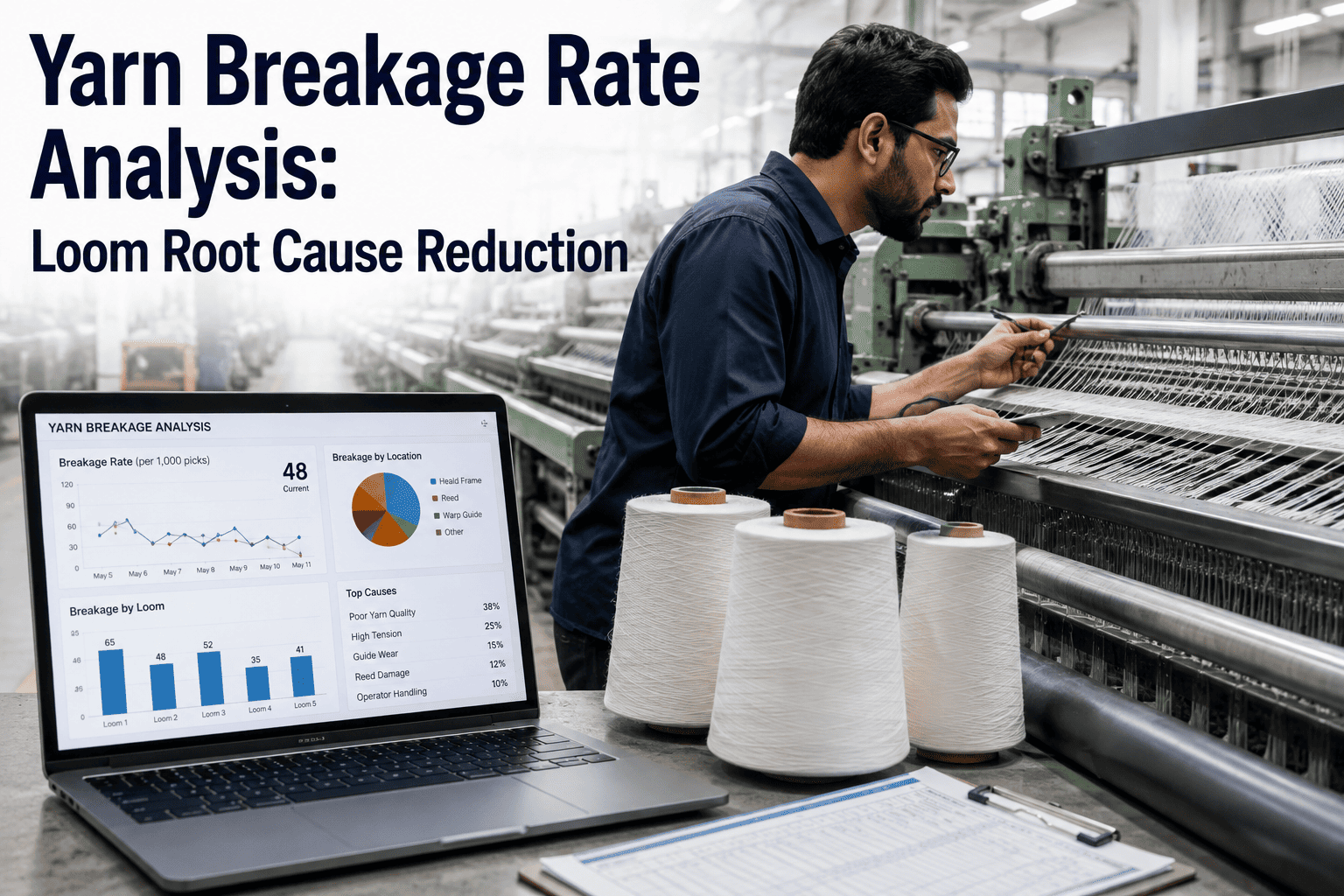
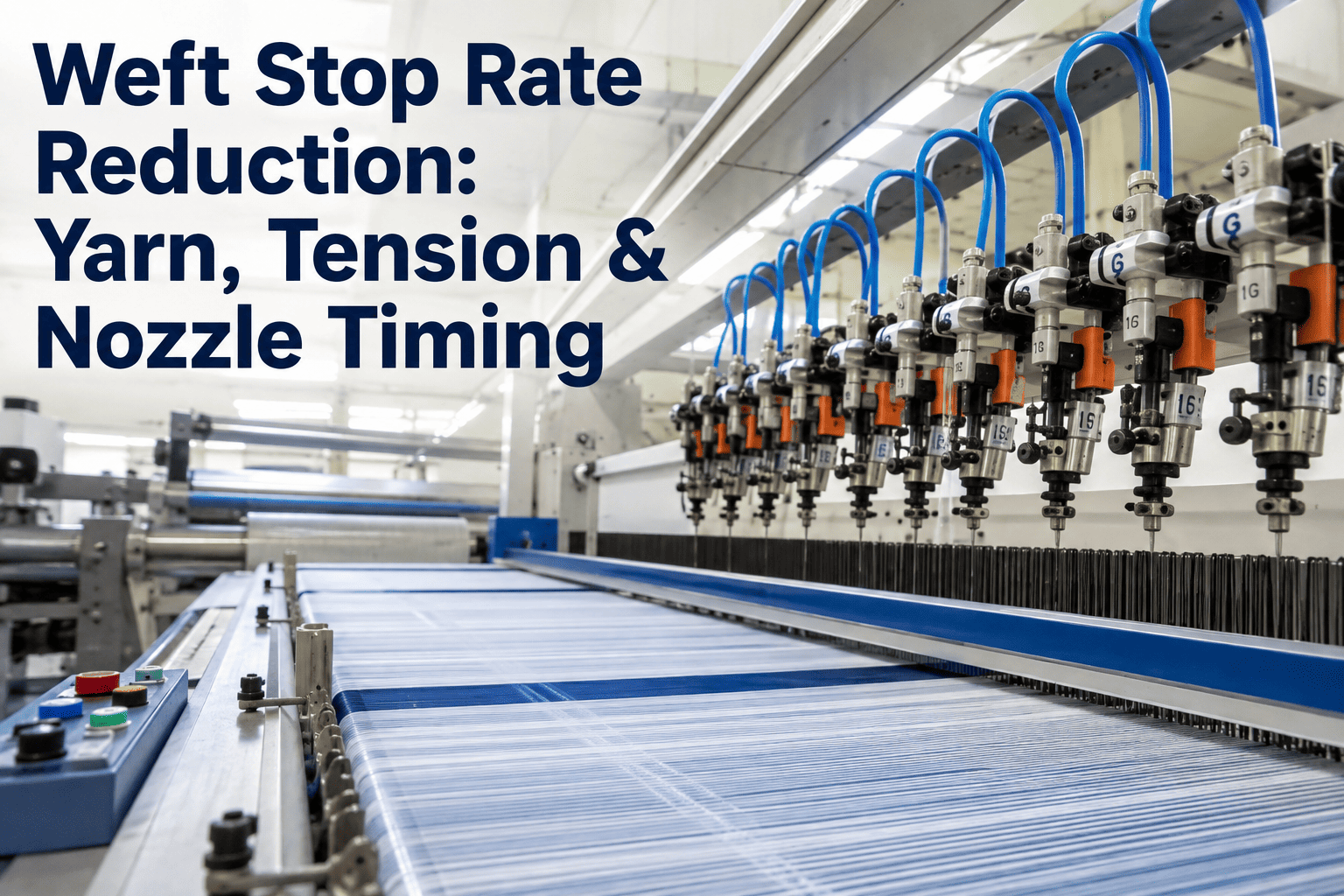
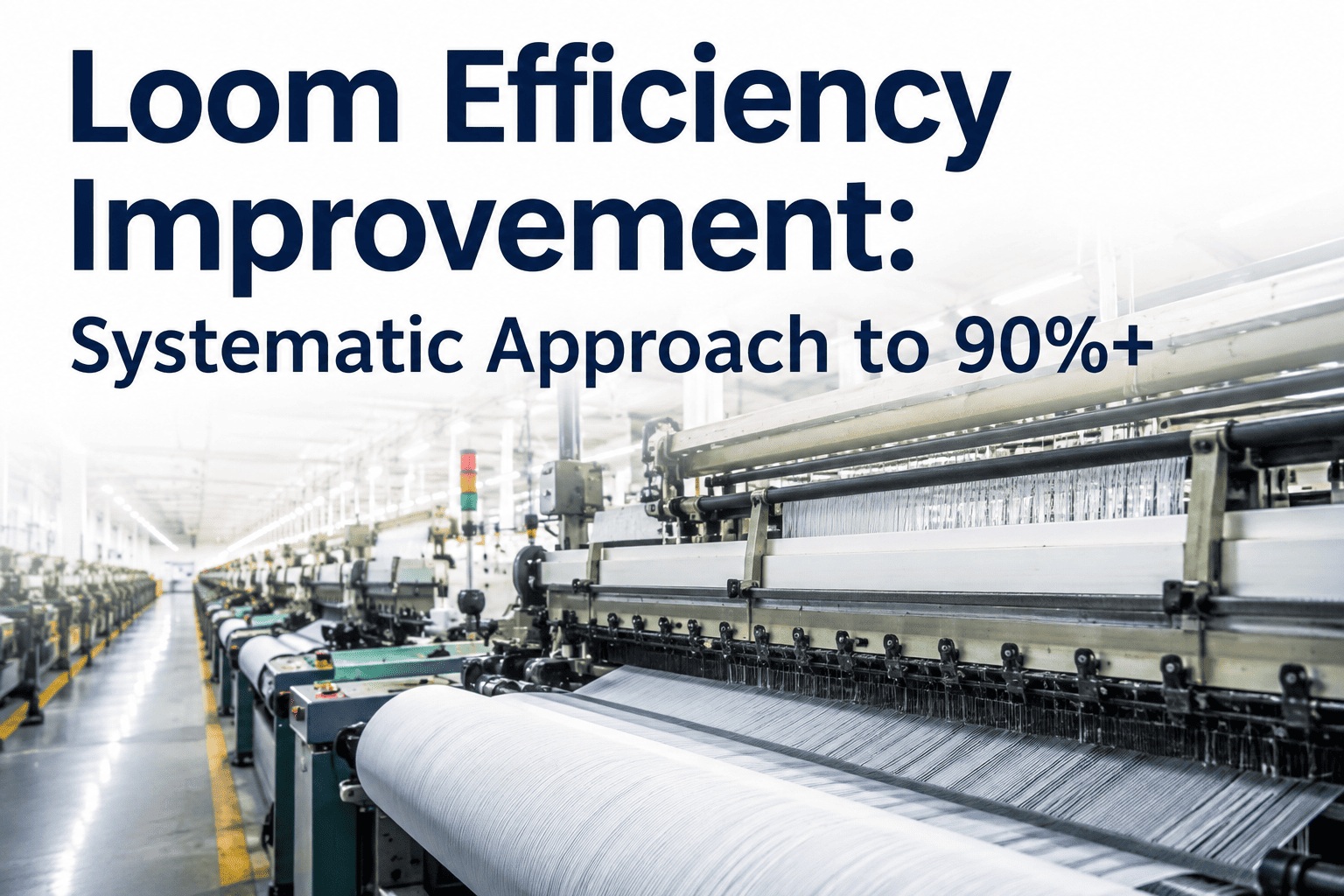
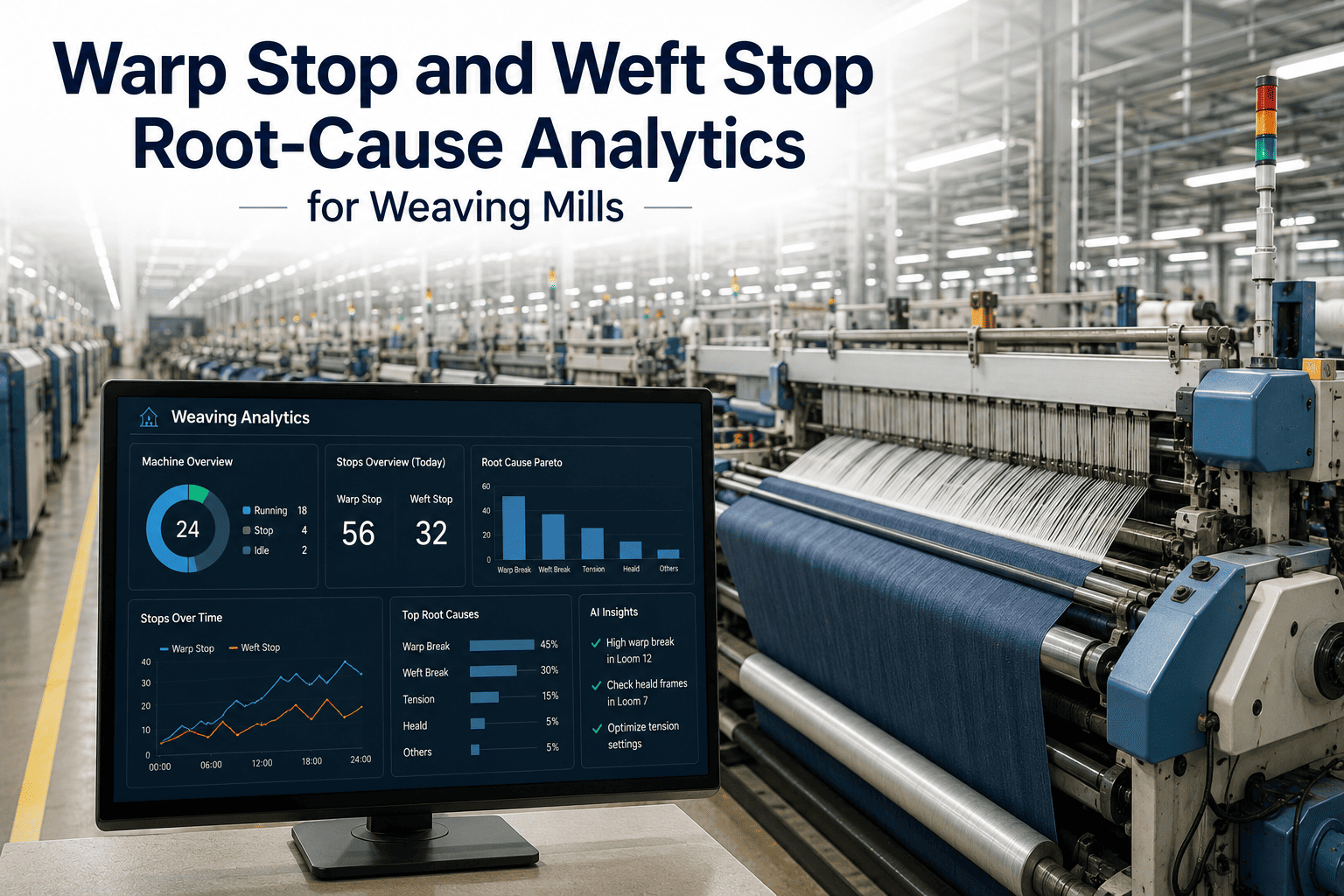
Ask five people on a weaving floor why a loom stopped last shift and you will usually get five different answers, because loom downtime is rarely one problem — it is four different categories of stop competing for the same log sheet. Warp-related stops, weft-related stops, mechanical faults, and electrical faults each have their own frequency pattern, their own fix, and their own cost, and a Pareto ranking across those four categories is the fastest way to find out which one is actually worth a capital request. Book a demo to see loom stop causes ranked automatically on your own weaving shed.
Weaving · Downtime Analysis
Four Categories of Loom Stop. One Ranked List of What to Fix First.
Automated cause capture for warp, weft, mechanical, and electrical stops, ranked by minutes lost so your maintenance and production teams stop arguing over which stop mattered most.
The Four Categories That Every Loom Stop Falls Into
Most looms already generate a stop signal. What is usually missing is a consistent way to classify that stop into a category that points toward a fix, instead of a vague note like "loom down" that tells nobody anything useful three weeks later.
Warp-Related
End breaks, beam run-out, size film failure, and tension irregularities that stop the loom from the warp side.
Weft-Related
Pick failures, weft breaks, filling supply faults, and insertion errors specific to shuttle, rapier, or air-jet mechanisms.
Mechanical
Shedding, beating, and take-up mechanism wear, along with bearing, gear, and cam faults unrelated to yarn.
Electrical
Sensor faults, drive faults, control board errors, and wiring issues that stop the loom without any yarn-side cause.
Why a Pareto Ranking Changes the Conversation
A Pareto ranking sorts every stop category by total minutes lost rather than by how memorable or dramatic the stop was. A single catastrophic gearbox failure feels urgent, but if warp breaks are quietly consuming three times the total downtime across a month, the gearbox is not where the next improvement budget should go.
| Stop Category |
Typical Share of Total Downtime |
Usual Owner |
| Warp-Related |
30% – 40% on most conventional looms |
Warping and sizing department |
| Weft-Related |
25% – 35%, higher on air-jet looms |
Weaving preparation and loom operators |
| Mechanical |
15% – 25%, rising with machine age |
Maintenance and reliability team |
| Electrical |
5% – 15% on well-maintained looms |
Electrical maintenance team |
See Your Loom Stops Sorted Into a Real Pareto Ranking, Automatically.
iFactory classifies every loom stop into warp, weft, mechanical, or electrical from the controller signal itself, so the ranking is built from real minutes, not memory.
Inside Warp-Related Stops: The Category That Usually Wins the Pareto List
Warp stops are frequent, individually short, and easy to dismiss one at a time — which is exactly why they dominate total downtime without ever feeling like the biggest problem in the shed.
End Breaks
The single largest contributor on most looms, often traced back to yarn quality, sizing coverage, or excessive let-off tension.
Beam Run-Out
Predictable in theory but frequently mistimed in practice, causing an avoidable full stop instead of a planned changeover.
Size Film Failure
Inadequate size add-on or poor size penetration shows up as clustered end breaks concentrated in specific warp sections.
Tension Irregularity
Uneven let-off tension across the beam width creates a slow drift toward more frequent breaks rather than a single obvious event.
Inside Weft-Related Stops: Where the Insertion Mechanism Matters
Weft stop patterns look completely different depending on loom type, which is why a generic downtime category without a mechanism breakdown tends to mislead more than it helps.
Air-Jet LoomsInsertion faults dominate, often tied to nozzle pressure drift or filament yarn irregularity that a manual log rarely distinguishes from a true weft break.
Rapier LoomsTransfer faults between the giver and taker rapier are the most common weft stop, frequently linked to gripper wear or timing drift.
Shuttle LoomsPirn changes and shuttle-related weft breaks remain the dominant cause, with mechanical wear on the picking mechanism a secondary factor.
We had budgeted for a full loom overhaul because mechanical breakdowns felt like the constant fire we were fighting every week. When we finally categorized six months of stop data instead of relying on the maintenance log, mechanical stops were only 18% of total downtime. Warp breaks were 38%, and almost all of it traced back to one sizing recipe used on a specific yarn count. We fixed the sizing formulation instead of spending on an overhaul, and loom efficiency moved more in three weeks than the previous year of mechanical work had managed.
— Weaving Manager, Composite Mill, Gujarat
Turning a Ranked List Into an Improvement Project
A Pareto ranking only creates value once it is converted into a scoped project with an owner and a measurable target, not just circulated as a chart in a review meeting.
1
Confirm the Category
Validate that the top category is consistent across at least four weeks and multiple shifts before committing resources.
2
Drill Into the Sub-Cause
Break the category down further — by yarn lot, loom, shift, or fabric construction — to find the specific driver.
3
Assign a Single Owner
Route the project to the department that actually controls the root cause, not the department that happened to log the stop.
4
Re-Measure Against Baseline
Compare the category's share of downtime after the fix against its pre-project baseline, not against overall loom efficiency.
Loom Downtime Analysis — Frequently Asked Questions
Why do warp-related stops usually rank highest even when mechanical breakdowns feel more urgent?
A single mechanical breakdown is dramatic and easy to remember, while warp breaks happen many times a shift in amounts small enough to seem routine. When those small stops are added up over a full week, they typically account for the largest share of total downtime on a conventional loom, even though no single event felt significant enough to investigate. Automated categorization is what makes this pattern visible, because it aggregates every short stop instead of relying on which ones someone happened to note down.
Contact support if you want help reviewing your current stop categorization.
How does automated stop classification tell the difference between warp and weft causes?
Most modern loom controllers already generate a distinct stop code depending on which sensor triggered the halt — a warp stop motion, a weft feeler, a shedding fault, or a drive fault each produce a different signal. Automated classification maps these controller-level codes into the four categories consistently across every loom in the shed, removing the variation that comes from different operators describing the same stop in different words on a paper log.
Should electrical stops be tracked separately from mechanical stops if they are a small share of downtime?
Yes, because a small average share can hide a growing trend on a specific loom or drive type that only becomes visible once electrical stops are isolated from mechanical ones. Electrical faults also tend to require a different specialist and different spare parts, so combining them with mechanical stops in one bucket makes it harder to plan the right maintenance resource even if the total downtime number looks similar.
How long should a Pareto ranking be tracked before acting on it?
A minimum of four weeks across all shifts and the range of products normally run is usually enough to separate a consistent pattern from a temporary spike caused by one bad yarn lot or a single unusual changeover. Shorter windows are useful for spotting an emerging problem early, but committing capital or a major process change should wait for a ranking that holds steady across that longer window.
Can this same four-category approach be applied to knitting or other fabric formation machines?
The same logic — separating yarn-related stops from mechanical and electrical faults — applies well beyond weaving, though the specific sub-categories change. On a knitting machine, warp and weft become needle-related and yarn-feed-related stops, but the underlying principle of ranking by minutes lost rather than by memorable events works the same way across almost any cyclic textile machine.
Stop Guessing Which Loom Stop Category Matters Most.
Get every warp, weft, mechanical, and electrical stop classified automatically and ranked by real downtime minutes, so your next improvement project targets the actual biggest loss.