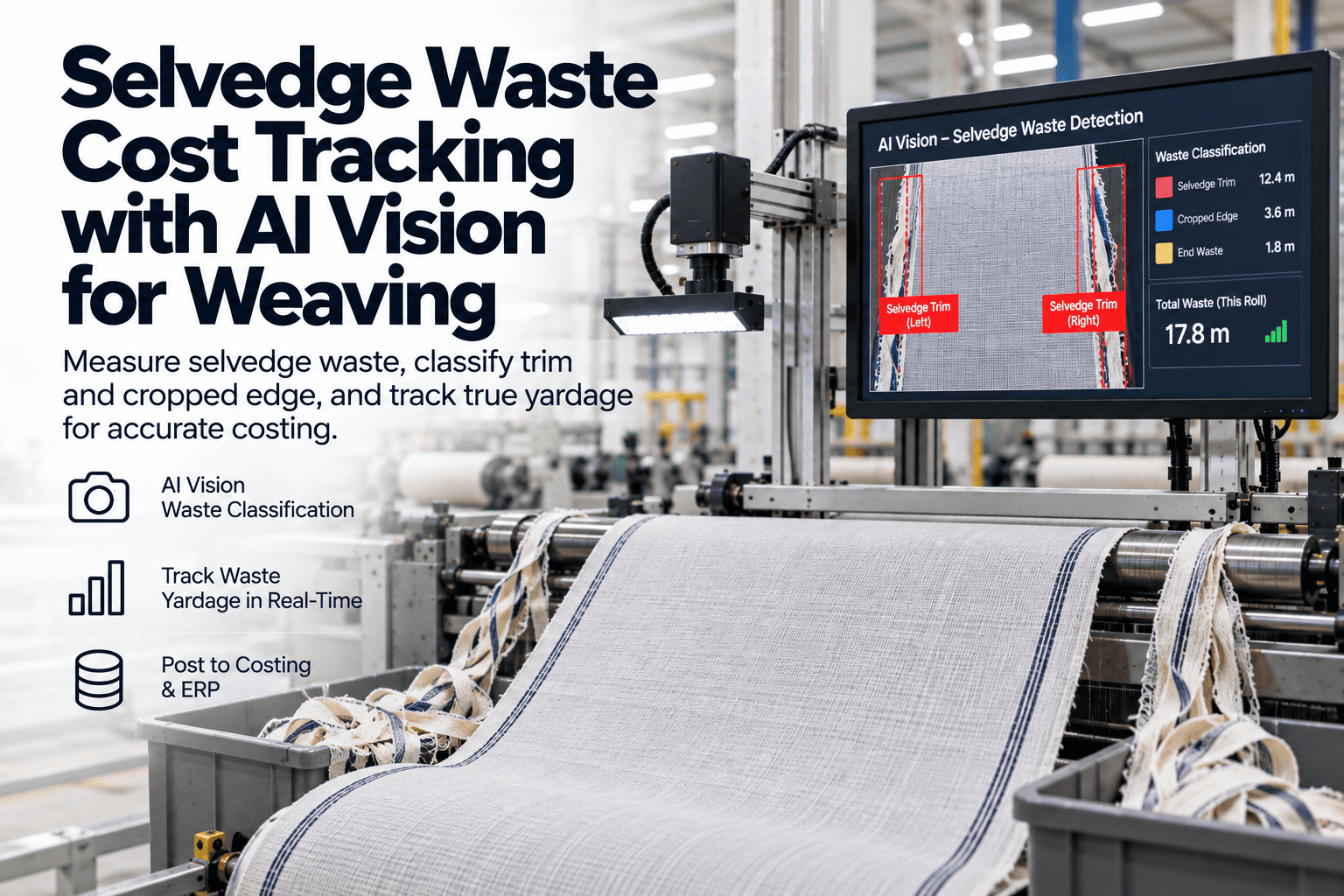
Selvedge waste is the fabric expense finance never sees on the P&L and operations never sees on the OEE board — the trim, cropped edge, end waste, and weft feeder waste that leave the loom as scrap rather than fabric. In a shed running 24-inch cropping trim on every roll, feeder waste of 3-6% depending on loom type, and end-of-beam waste per warp change, the yardage adds up to substantial cost that is invisible because nobody measures it as cost. Vision AI classifies each waste category, converts to yardage, and posts true waste into ERP costing.
iFactory / Selvedge waste cost tracking
Turn Invisible Selvedge Waste into a P&L Line Item Finance Can Act On
Vision-based classification of selvedge trim, cropped edge, end waste, and weft feeder waste on the loom — converted to true yardage and posted into ERP costing so waste that never touched the P&L becomes visible cost with named recovery targets.
Trim · crop · end · feeder
waste categories
The Problem in Weaving Waste Costing
A typical weaving mill accounts for fabric produced but not fabric wasted. Financial reporting shows metres shipped and metres in stock; operations shows OEE and defect metres; nowhere does the P&L or the operations dashboard show yardage that left the loom as selvedge trim, cropped edge, end-of-beam waste, or weft feeder waste. In a shed running 60 looms at 800 metres per loom-day, selvedge and edge waste of 4-8% by yardage represents 2,000-4,000 metres per day of yarn cost nobody measures as waste. Annual invisible cost runs into six or seven figures. Finance can't attack what it doesn't see.
Where Weaving Waste Actually Hides
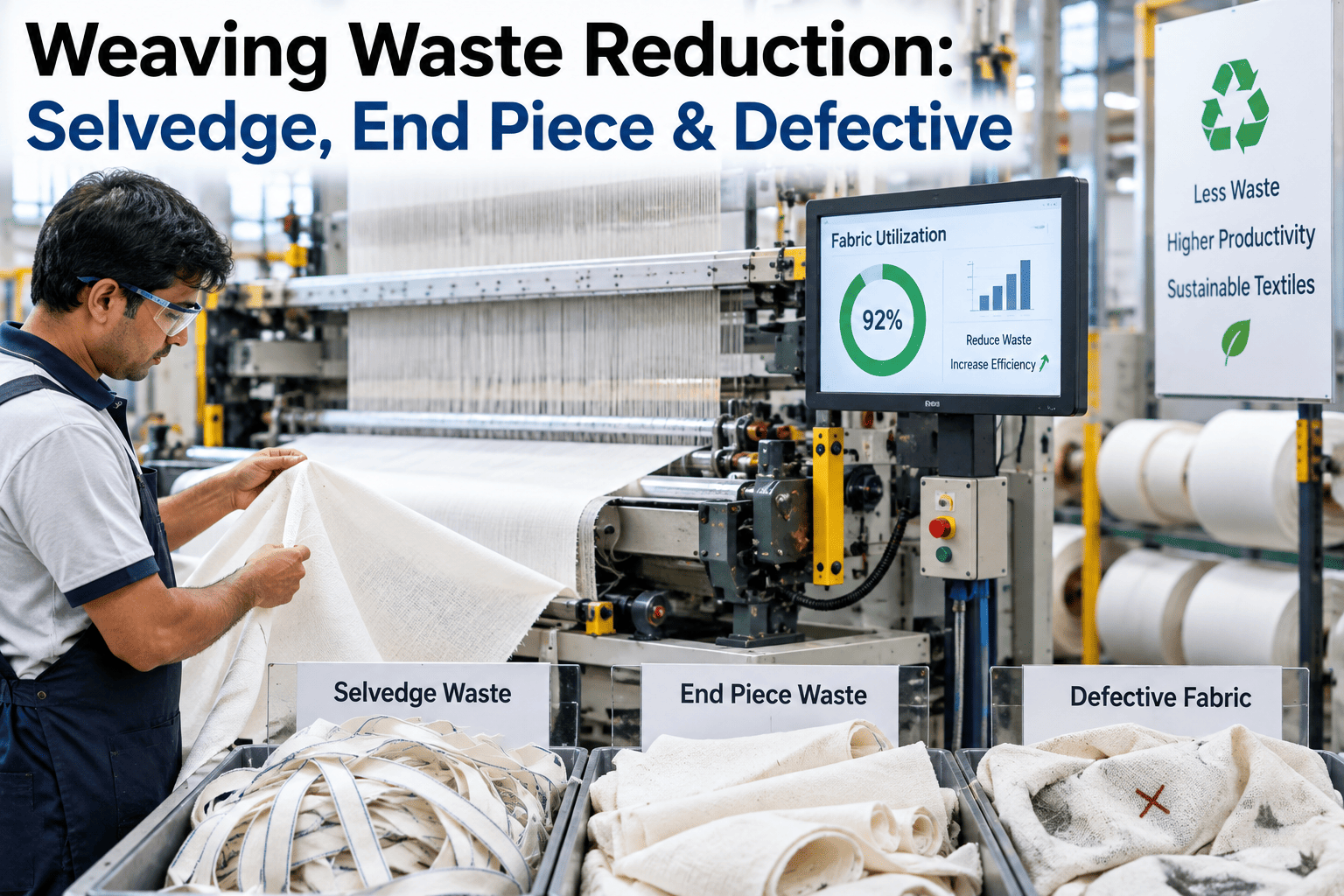
Weaving waste categories are consistent across shuttleless looms. Each has a specific yardage profile and a specific recoverable fraction.
Selvedge trim
Trim removed at each roll edge — typically 12-24 mm each side per running metre. Adds up to 2-4% of yardage. Nowhere in the OEE report; nowhere in the P&L.
Cropped edge
Additional cropping per finishing requirement — 20-100 mm typical. Another 1-3% of yardage. Sometimes counted at finishing but rarely attributed back to weaving decisions.
End-of-beam waste
Fabric left on beam at warp change plus the settling metres before consistent quality. 0.5-1.5% of yardage. Beam-change frequency drives the multiplier.
Weft feeder waste
Yarn discarded from weft feeder at package change, weft break clearing, and pick miss recovery. 1-3% by yarn weight. Direct yarn cost, no fabric recovered.
What Good Looks Like in Waste Cost Tracking
A working waste cost tracking holds four disciplines together — vision-based waste classification at the loom, true yardage conversion, ERP cost posting, and named recovery targets by category.
Vision Classification
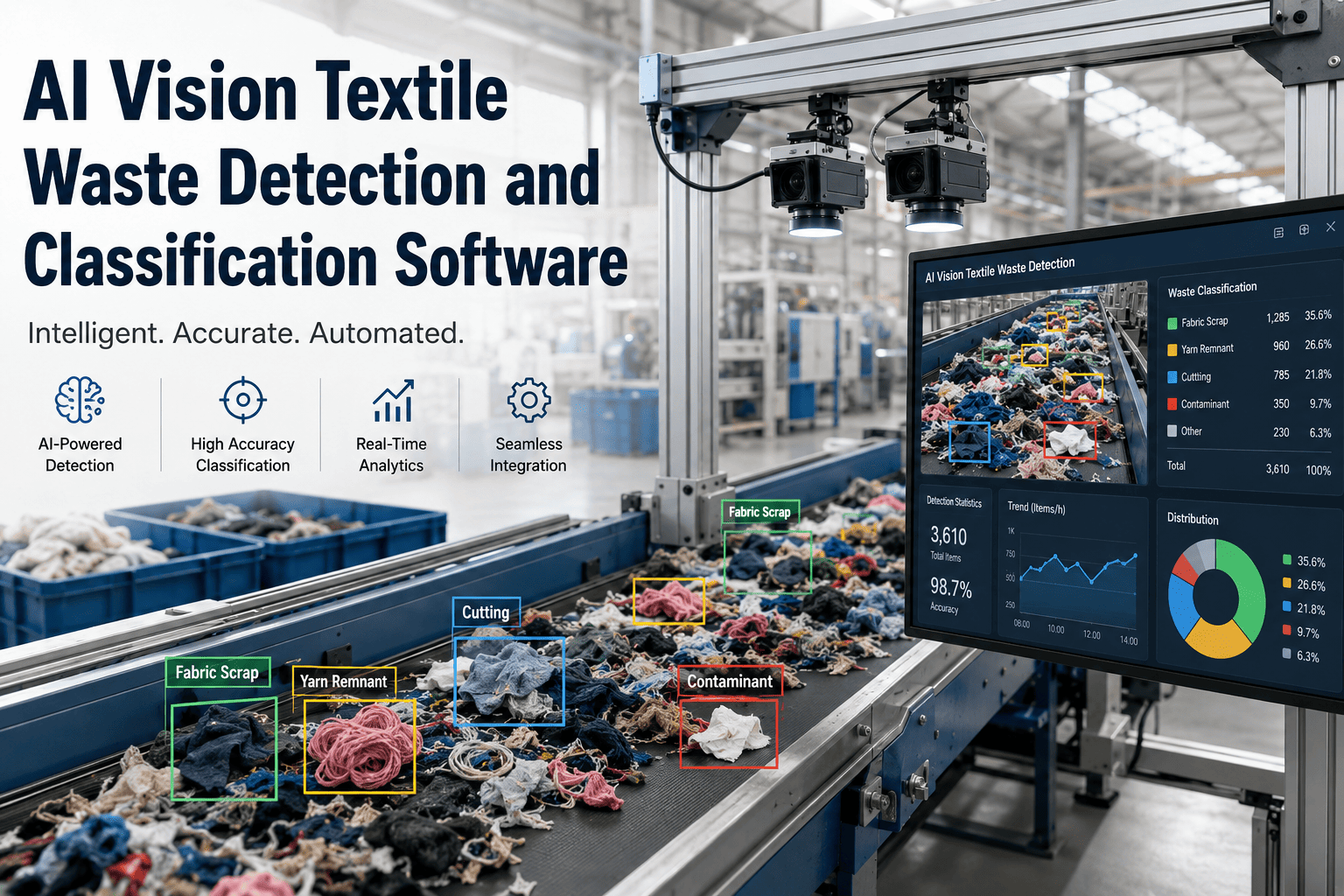
Vision at loom exit and beam change points classifies each waste stream — trim, cropped edge, end waste, feeder waste. Each stream captured distinctly with volume measurement.
Distinct streams
True Yardage
Waste measured by actual yardage (or yarn weight for feeder waste), not estimated from standard rate. Loom-level, shift-level, style-level detail.
Measured, not estimated
ERP Cost Posting
Waste yardage converted to cost using current yarn and processing cost and posted to ERP as a named cost line — visible to finance without operations translation.
Named cost line
Category Recovery Targets
Each waste category with named recovery target — selvedge trim (loom-setup improvement), feeder waste (package quality), end-of-beam waste (beam-change discipline). Improvement targets specific.
Named per category
How iFactory AI Fits
iFactory AI overlays your looms, weaving MES, and ERP costing (SAP, Oracle, Microsoft Dynamics) — providing the waste vision layer that classifies streams the OEE report ignores and posts true cost data to finance systems.
Waste Vision
Vision Layer
Vision at loom exit and beam-change points classifying waste streams — trim, cropped edge, end waste, feeder waste. Each stream measured distinctly with volume and yarn weight.
Yardage Converter
Vision + Analytics
Waste volume converted to actual yardage per stream. Loom-level, shift-level, style-level breakdown. Standard-rate estimates replaced with measured reality.
ERP Cost Poster
Vision + ERP
Yardage converted to cost via current yarn and processing cost. Posted to ERP as named line — visible in P&L and management reporting without operations translation.
Category Targets
Vision + Improvement
Each waste category with recovery target and improvement owner. Trend visible on operations and finance dashboards. Recovery targeted at the categories with largest measured cost.
Ask your weaving finance analyst what percentage of loom output leaves as selvedge, edge, end, or feeder waste — and what that costs annually. If either answer is "we don't track it that way," the invisible cost is the specific recovery vision tracking exists to enable. Book a selvedge waste cost review.
10-Week Waste Cost Vision Pilot on One Shed
One shed section, ten weeks. The pilot mounts waste vision at loom exit and beam-change points, activates yardage conversion, connects to ERP costing, and closes the first month of true waste cost visibility.
Weeks 1–2
Vision Deploy
Vision at loom exit and beam-change points across pilot shed. Baseline current-state waste estimates (if any). Loom types and product mix inventoried.
Weeks 3–5
Classification Live
Waste stream classification live. Yardage conversion per stream. Loom-, shift-, style-level breakdown available on operations dashboard.
Weeks 6–8
ERP Posting
ERP cost posting live via API. Named waste cost line appears in finance reporting. Cost visible to management for the first time as a specific item.
Weeks 9–10
Recovery Targets
Recovery targets assigned per category with named owners. Improvement trend measured against baseline. Rollout to remaining shed sections scoped.
Who Owns the KPI
Waste cost tracking crosses weaving finance, operations, production, and yarn supply. Each function owns a specific KPI or waste stays invisible.
Weaving Finance Analyst
Waste cost line in P&L
Owns the finance visibility — waste cost appearing as a named line item in P&L and management reporting. What's visible is what can be improved.
Weaving Section Head
Selvedge trim recovery
Owns the trim recovery — improvement on selvedge trim through loom setup, temple positioning, and edge management. Measurable against baseline.
Production Manager
Feeder waste recovery
Owns the feeder waste recovery — through package quality, weft break reduction, and pick recovery discipline. Direct yarn cost recovered.
Yarn Supply
Yarn cost per shipped metre
Owns the overall yarn efficiency — total yarn cost per metre of fabric shipped. Waste recovery reduces the ratio.
FAQ
How does vision measure yardage of trim that's cut off and thrown away?
Vision at the loom exit measures the trim width and length in real time before it separates from the fabric. Trim width is directly measurable from the vision frame; trim length equals fabric-metre production (the trim runs continuous with the fabric). Total trim yardage per shift equals trim width times fabric metres. For cropped-edge waste added downstream at finishing, vision at the finishing cropping station measures the same way. End-of-beam waste is measured from the loom-recorded beam-change events combined with vision of the pre-change and post-restart fabric. Feeder waste is measured via yarn-weight recovery at the feeder discharge. Each stream has its own measurement approach; each produces yardage or yarn-weight data with confidence intervals reported.
How does this integrate with our ERP (SAP, Oracle, Microsoft Dynamics)?
ERP integration writes waste cost postings through the ERP's documented API. SAP S/4HANA and ECC accept postings via OData or IDoc; Oracle Cloud accepts via REST API; Microsoft Dynamics 365 accepts via OData or Dataverse. The posting includes the cost centre (weaving shed or specific line), the cost element (named waste category), the period, and the amount. Where cost accounting rules require the posting to originate from a specific work order or product, the workflow generates the appropriate ERP object. Where finance requires waste to appear as a specific KPI rather than a cost line, the workflow supports both simultaneously. What the workflow provides is the underlying measurement; the specific ERP posting shape follows your organisation's chart of accounts and cost accounting practice.
Book a demo to see ERP posting live.
What about waste that has secondary value (sold as recycled yarn or fabric scrap)?
Secondary value handling is straightforward. Waste categories that carry secondary value (feeder waste sold as recycled yarn, cropped edge sold as industrial rag) get netted against the gross waste cost automatically — the posted cost reflects the net waste after secondary revenue. Where secondary value is realised through internal reuse (re-spinning of feeder waste for utility yarn), the workflow tracks the reuse volume and the net cost effect. What matters is that the P&L shows the true net waste cost after all recovery — because pretending secondary revenue offsets waste when it doesn't leads finance and operations to under-invest in prevention. Where secondary value is significant enough to change waste priorities, the workflow surfaces that specifically.
Stop letting selvedge waste hide from finance.
Post True Waste Cost from One Shed — Live
Bring one shed section's last month of fabric production, current waste estimation approach (if any), and one ERP posting example for a comparable cost. We'll walk what waste vision would have quantified, and demonstrate the ERP cost posting workflow.