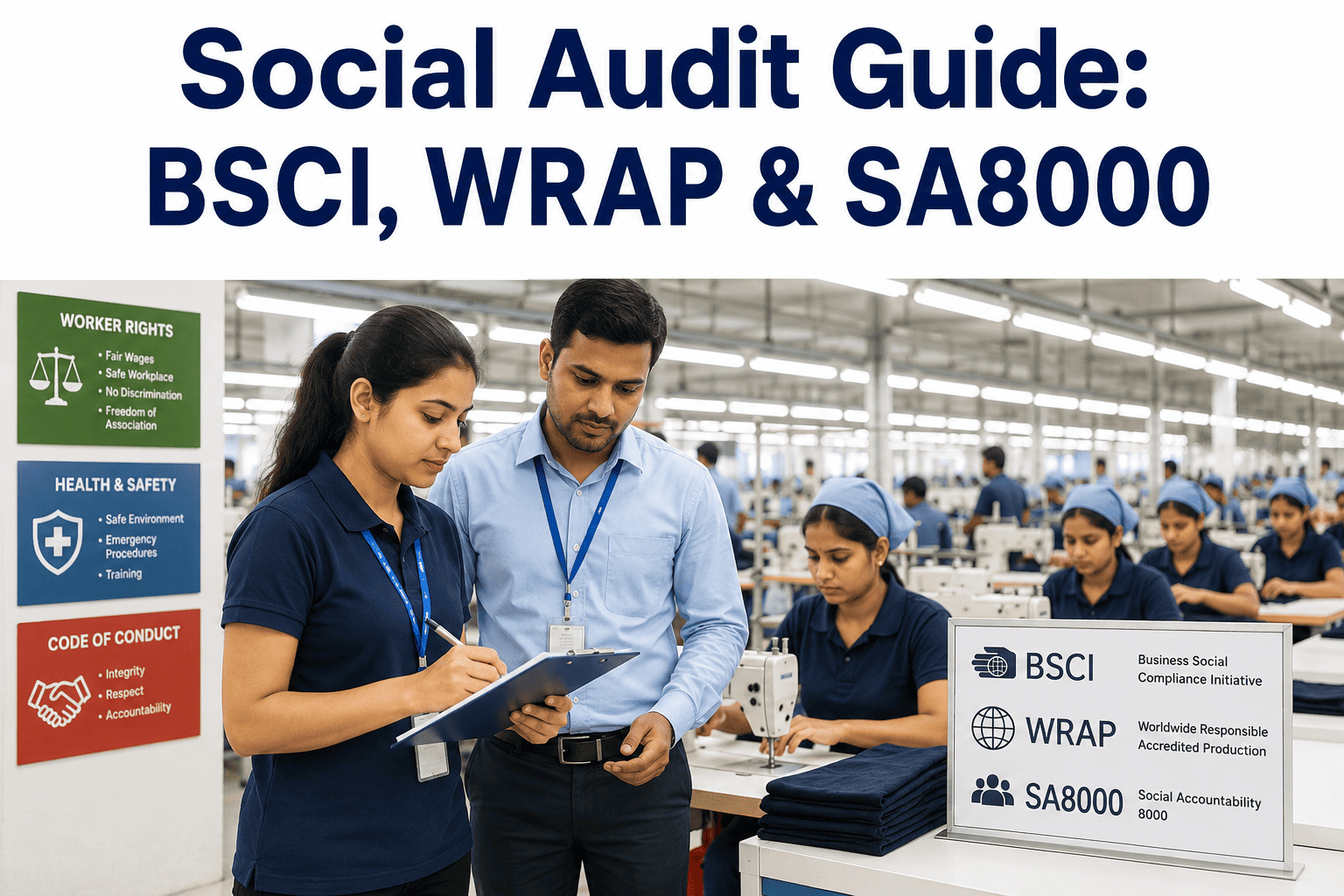
A failed social compliance audit does not just cost a corrective action plan, it can freeze purchase orders from a buyer that requires BSCI, WRAP, SA8000, or SEDEX certification as a condition of doing business at all. Textile mills are audited more frequently and against more overlapping standards than almost any other manufacturing sector, and the mills that pass consistently are the ones that treat compliance as a daily operating discipline rather than a scramble in the weeks before an announced audit date. This guide breaks down what each major standard actually checks, the non-conformances that appear most often in textile facilities, and how to build a corrective action process that holds up under repeat scrutiny. iFactory helps mills maintain the documentation and floor-level records that auditors ask for first, and you can book a demo to see how audit readiness data stays current between audits.
Social Compliance Audit Readiness for Textile Manufacturers
Every major social compliance standard checks the same core areas of a mill's operation through a different lens, and understanding where they overlap and where they diverge is the fastest path to passing on the first attempt.
The Non-Conformances That Show Up Most Often in Textile Audits
Auditors from different schemes tend to find the same categories of problems in textile facilities, because the sector shares common operational pressures, such as seasonal order spikes that push working hours up, and common documentation gaps, such as incomplete records for subcontracted processes like dyeing or embroidery. Knowing which categories are most likely to trigger a finding lets a compliance team focus its preparation time where it matters most instead of treating every clause of every standard as equally urgent. It also helps explain why two mills with similar underlying labor practices can receive very different audit outcomes, since the mill with clean, consistent documentation is able to demonstrate compliance quickly while the mill relying on informal or inconsistent records struggles to prove the same underlying practice was actually followed.
Overtime hours recorded on paper timesheets frequently do not match biometric attendance data, and excessive overtime during peak seasons is one of the most commonly cited findings across every major standard, especially in mills without a system that flags hours approaching legal limits in real time.
Mills that subcontract dyeing, printing, or embroidery to unlisted third parties struggle to provide audit evidence for those processes, since the standard applies to the full production chain, not just the facility being audited, and an unlisted subcontractor discovered mid-audit is treated as a serious transparency finding.
Blocked fire exits, missing personal protective equipment for chemical handling, and expired fire extinguisher inspection tags are consistently among the top findings in wet processing and finishing areas, where chemical exposure and heat risk are highest.
Piece-rate wage calculations that do not clearly demonstrate compliance with local minimum wage requirements after accounting for deductions are a recurring finding, particularly where wage slips are not itemized clearly enough for an auditor to verify the math independently.
How BSCI, WRAP, SA8000, and SEDEX Actually Differ
The four standards a textile mill is most likely to encounter share roughly seventy percent of their scope, covering labor rights, health and safety, and management systems in similar terms, but they diverge in certification structure, audit frequency, and how findings are scored. Understanding these differences helps a compliance team avoid preparing for the wrong type of audit or duplicating work that a single well-documented system could satisfy across multiple standards at once, and it also clarifies which buyer relationships are likely to require an entirely separate audit versus which ones might accept a shared report.
BSCI
A monitoring system rather than a certification, BSCI audits result in a graded rating from A to E rather than pass or fail, with lower grades requiring a shorter re-audit cycle and closer buyer follow-up until the rating improves.
WRAP
A certification specific to the apparel and footwear sector, WRAP issues a formal certificate valid for one year and places particular emphasis on customs and import compliance alongside the standard set of labor and safety criteria.
SA8000
The most management-systems-focused of the four, SA8000 requires a documented management review process and formal worker representation structure, not just clause-by-clause compliance demonstrated at the point of audit.
SEDEX / SMETA
SEDEX is a data-sharing platform rather than a standard itself, with SMETA as its associated audit methodology, allowing one completed audit report to be shared with multiple buyers who use the same platform.
The Eight Areas Every Social Compliance Audit Covers
Regardless of which specific standard a buyer requires, the audit itself walks through a consistent set of scope areas, gathering evidence through a combination of document review, facility walkthrough, and confidential worker interviews. Preparing documentation and floor readiness against these eight areas covers the overwhelming majority of what any of the four major standards will actually check.
Child Labor and Young Workers
Age verification records for every worker and documented protections for any young workers legally employed under local law.
Forced Labor
Evidence that no worker's identity documents are withheld and that recruitment fees, if any, were not deducted from wages.
Health and Safety
Fire safety systems, chemical handling protocols, machine guarding, and emergency evacuation readiness across every production area.
Working Hours
Regular and overtime hours compared against local legal limits and the buyer's code of conduct across a full sampling period.
Wages and Benefits
Minimum wage compliance, correct overtime premium calculation, and legally required social insurance contributions.
Freedom of Association
Worker access to grievance mechanisms and freedom to organize or join worker committees without retaliation.
Discrimination
Fair hiring, promotion, and disciplinary practices that do not disadvantage workers based on gender, religion, or origin.
Management Systems
Documented policies, internal audit history, and a management review process that shows compliance is actively maintained, not reconstructed for the audit.
Why Documentation Gaps Are the Real Cause of Most Failed Audits
Very few mills fail a social compliance audit because of a single dramatic violation discovered on the floor. Far more commonly, the finding is a documentation gap that makes it impossible for the auditor to verify a practice that is, in fact, compliant. A mill that pays correct overtime premiums but calculates them in a spreadsheet that does not clearly separate regular and premium hours will still receive a wage finding, because the auditor's job is to verify evidence, not to take a compliance manager's word for it. This is why the mills that pass consistently invest more in record-keeping systems than in last-minute floor cleanup before an announced audit date. Attendance data pulled directly from biometric terminals rather than manually transcribed timesheets removes an entire category of discrepancy findings. Digitized wage records that automatically calculate overtime premiums against the correct legal baseline remove another. Subcontractor tracking that flags any dyeing, printing, or embroidery order sent outside the facility ensures that process is either brought into audit scope proactively or excluded from the order in the first place. None of these are floor-level operational changes, they are documentation and data infrastructure changes, which is exactly why they tend to be underinvested in relative to their impact on audit outcomes.
Managing a Corrective Action Plan After a Finding
A finding during an audit is not automatically a failure if the corrective action process that follows is well managed, since every major standard builds in a defined window to remediate issues and demonstrate the fix through a follow-up review. The stages below reflect the corrective action process most textile mills go through after receiving an audit report with findings.
Root Cause Analysis
Each finding is traced to its underlying cause, distinguishing a genuine policy gap from an isolated documentation lapse that requires a different type of fix.
Corrective Action Plan
A written plan with named owners and target dates is submitted to the auditing body within the standard's required response window, typically two to four weeks.
Implementation and Evidence
The fix is implemented on the floor and documented with dated evidence, such as updated policies, training records, or corrected wage calculations.
Follow-Up Verification
A follow-up audit, sometimes a desktop review of evidence and sometimes a full facility revisit, confirms the corrective action closed the finding permanently.
| Preparation Approach | Reactive Pre-Audit Scramble | Continuous Compliance Readiness |
|---|---|---|
| Attendance Records | Timesheets reconciled manually days before the audit | Biometric attendance data available and accurate every day |
| Wage Calculations | Spreadsheet formulas checked only before an announced visit | Overtime premiums calculated automatically against legal baseline |
| Subcontractor Tracking | Discovered during the audit walkthrough itself | Flagged and documented the moment an order is placed |
| Corrective Action History | Scattered across emails and individual manager files | Centralized log with owners, dates, and evidence attached |