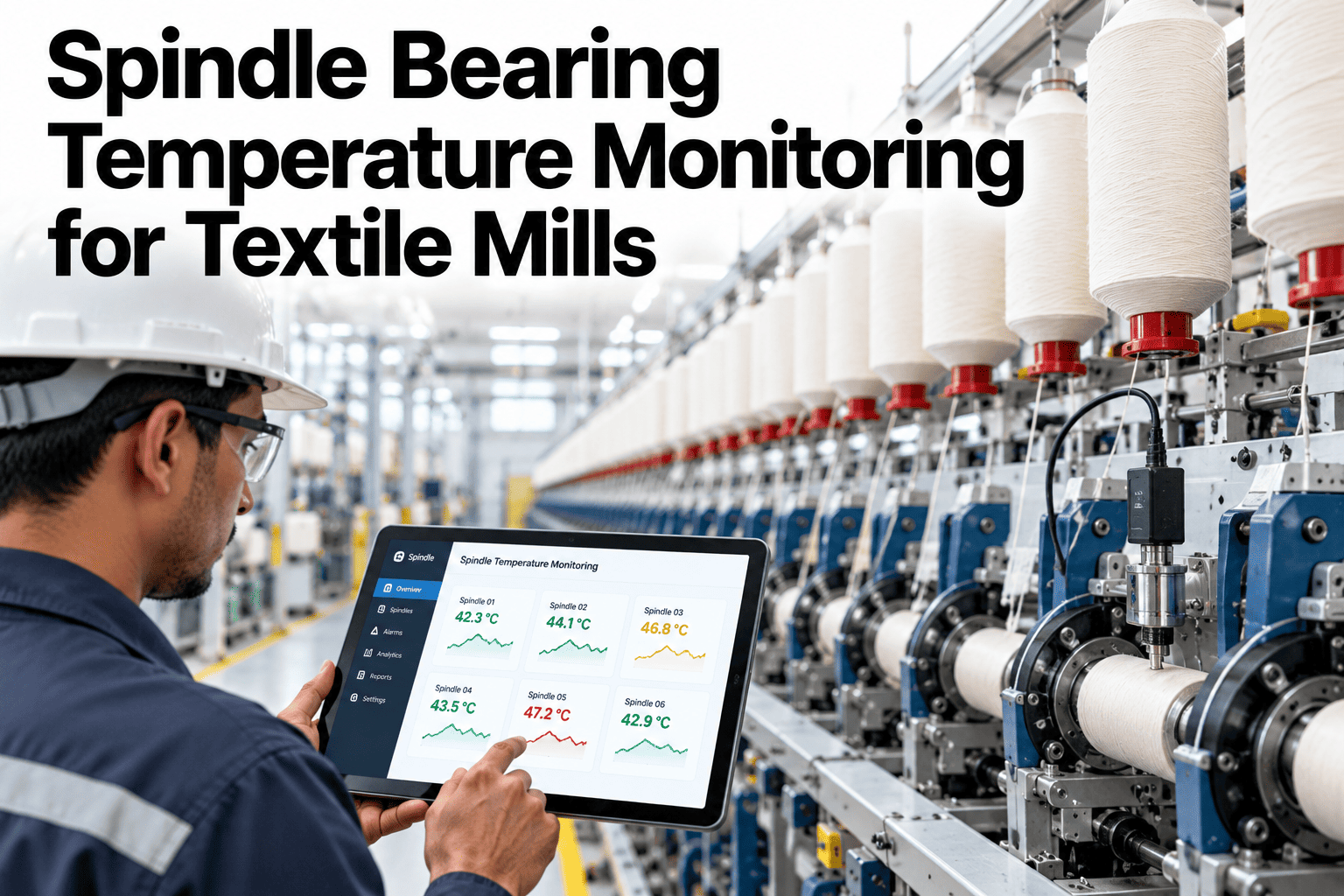
A ring frame can run thousands of spindles at over 20,000 rpm, and one overheating bearing rarely shows up on a shift report until yarn quality or breaks suffer. Temperature trends by machine and spindle position give the maintenance team an earlier signal. See how iFactory AI trends spindle temperature by position across a spinning shed.
Find the One Hot Spindle Before It Seizes
iFactory AI trends bearing temperature for every monitored spindle against its own history and its neighbors, so overheating, oil problems and early wear reach the fitter as a ranked list.
Why Spindle Bearing Temperature Deserves Its Own Watch
A spindle is a small part repeated many times. That scale is exactly why a failing one hides so well, since nobody can touch every spindle on every shift.
High speed
One lubricant vendor describes ring frame spindles reaching 22,000 rpm, so bearings have little margin for poor oil.
Heat has one way out
In high speed spindles, heat escapes through the bearings, which conduct heat poorly, so friction shows up as temperature.
Oil ages
Constant movement leaves residues and breaks oil down, which hinders lubrication and can end in seizure.
Scale hides it
One mill in a vendor advertorial describes 2 lakh spindles across four units, far too many to check by hand.
Temperature is not the only signal of a worn spindle, but it is one of the easiest to trend. A rising reading says friction has changed, and the trend shows how fast.
Most mills already hold some of this data in separate places, such as speed in the frame controller, oil dates in a logbook and repairs in a work order system. Bringing them together is usually the first win, because each record explains the others.
Start small, with one frame and a handful of sections. A narrow pilot reaches its first useful heat map sooner, and it teaches the team which rules and records matter most before the rest of the shed is added.
Map Every Reading to a Machine and Position
A temperature with no address cannot be acted on. Each reading needs a frame, a side, a section and a spindle position, so the fitter walks straight to the right spindle.
| Level | What it identifies | Used for | Typical gap |
|---|---|---|---|
| Spinning shed | Mill, shed and frame row | Comparing sheds and shifts | Frames named differently by shift |
| Ring frame | Machine number, make and model | Frame-to-frame trends | Model and age not recorded |
| Side | Left or right side of the frame | Airflow and drive effects | Sides swapped in records |
| Section | Group of spindles on one rail | Section median for fair comparison | Section size not stored |
| Spindle position | Number along the frame | Finding the exact spindle | Numbering restarts after repairs |
| Spindle record | Bearing batch, oil type, last service | Linking heat to maintenance events | Service kept on paper only |
Read the Trend, Not the Single Number
Different heat shapes point to different causes. A trained eye, or a good rule set, can tell them apart quickly.
One spindle runs warm
A single position sits above its section median and keeps climbing. The bearing or its oil is the first suspect.
A whole section rises
Many spindles move together. Look at the rail, the oil batch, airflow or a drive change, not one bearing.
Slow weekly drift
A gentle rise over weeks points to oil ageing or wear that is building quietly.
Jumps after speed changes
Temperature steps up with speed. Judge it against speed before raising an alarm.
Hot after service
A new bearing or fresh oil that runs warm hints at a fitting or oil-fill problem.
Hot beside a neighbor
Heat can pass along a rail. Check neighbors before blaming the hottest spindle alone.
See Your Spindle Heat Map on Real Data
Book a 30-minute session and iFactory AI will show how your frame layout, speeds and service records become a ranked spindle watch list.
Connect Temperature to Lubrication
Many hot spindles are lubrication stories. Oil that breaks down leaves residue, and residue makes the next hour of running harder on the bearing.
| Oil signal | What it may mean | First check |
|---|---|---|
| Warm spindles after an oil change | Wrong grade, wrong fill level or air in the bearing | Grade used and fill level on those positions |
| Slow climb across one oil batch | Oil ageing faster than planned | Batch age and the spindle speeds it served |
| Hot spindle in a cool section | Local bearing wear or contamination | Last service record and bearing batch |
| Heat rises after restarts | Start-up wear before the oil film forms | Stop and start counts for the frame |
| Whole frame warms in summer | Room heat and airflow, not bearings | Shed temperature against offset |
Warm Bearing to Stopped Spindle
Failure is a slope, not a switch. Seeing the early steps gives the team time to plan a fix between doffs.
Offset starts to rise
Only a trend shows it. The spindle still runs and yarn looks normal.
Offset holds high
The spindle stays above its section. Plan a check at the next planned stop.
Speed and breaks change
Mills that track spindle breakage and speed trends can spot a rogue spindle here.
Seizure risk
Residue and heat can lock the bearing. The cost is a stopped spindle and an unplanned fix.
Alert Rules That Respect the Shop Floor
Too many alerts get ignored. Build rules around change and comparison, and send the right level of message to the right person.
| Rule | What it watches | Message goes to | Expected action |
|---|---|---|---|
| Offset above section | Spindle against section median | Shift fitter | Add to the next check round |
| Offset keeps rising | Slope of offset over several shifts | Maintenance planner | Schedule a bearing or oil check |
| Section moves together | Share of spindles rising at once | Maintenance lead | Inspect the rail, oil batch and airflow |
| Hot after service | Offset in first days after a repair | Service fitter | Recheck fitting and oil fill |
| Sensor gone quiet | Flat or missing readings | Automation team | Test the sensor before trusting the data |
A Worked Walkthrough on One Frame
The story below is illustrative and does not describe a real mill. It shows how the pieces fit on an ordinary week.
Baseline looks flat
All sections sit close to their medians. One position in section 4 is slightly warmer than its neighbors.
Offset begins to climb
The same position shows a higher offset on three shifts in a row, and the speed has not changed.
Watch list entry
The position moves to the top of the planner's list, with its last oil event shown beside the trend.
Planned check
The fitter inspects the spindle during the planned stop, finds a fill problem and fixes it before any break.
Shift Handover and Daily Routine
A heat map only helps if the shift team uses it. Keep the routine short enough to survive a busy handover.
Who Does What
| Role | Looks at | Acts on | Records |
|---|---|---|---|
| Shift fitter | Watch list and heat map | Flagged spindles on the round | Finding and fix per position |
| Spinning supervisor | Section and frame summary | Speed and stop decisions | Reason for any speed change |
| Maintenance planner | Slope and repeat offenders | Planned checks and spare parts | Work orders and closure notes |
| Lubrication owner | Oil events against trends | Grade, fill and interval changes | Oil batch and fill records |
| Reliability lead | Frame and shed comparisons | Bearing supplier and design choices | Monthly review notes |
Mistakes That Make Spindle Monitoring Fail
One global limit
A fixed number ignores speed, oil and room heat, and floods the team with noise.
No position address
A reading that cannot be traced to a spindle cannot be fixed.
Ignoring service history
Heat read without oil and repair events leaves the cause unclear.
No closure
Alerts that never end in a finding teach the team to ignore them.
How to Judge the Results
Pick a few simple measures at the start, so the pilot can be judged by facts. Compare them with the months before go-live.
| Measure | How to count it | What good looks like |
|---|---|---|
| Planned versus unplanned spindle work | Spindle jobs raised ahead of a stop, against jobs after a stop | More work planned, less at short notice |
| Alerts ending in a finding | Alerts with a real fault found, divided by all alerts | A rising share as rules are tuned |
| Repeat offenders | Positions flagged more than once in a quarter | Few, with a clear cause for each |
| Spindle stoppages | Stopped spindles per frame per month | Fewer stops linked to bearings |
| Record quality | Share of fixes logged with position and cause | Close to every fix recorded |
Choosing a Sensing Approach
There is no single best way to read bearing temperature on a ring frame. Match the method to your frame age, budget and the questions you want answered.
Handheld infrared rounds
Low cost and quick to start. Readings depend on who takes them, so keep route, distance and timing fixed.
Fixed sensors per section
Steady data at a set time step. Coverage is by section, which suits trend and neighbor comparison.
Sensors on each spindle
Full coverage with exact addresses. Higher cost, so many mills start with a pilot frame.
Built-in machine sensing
Newer frames may offer spindle data already. Check what the maker supports before adding hardware.
Tie Findings to the Maintenance System
A finding that stays on a screen does not fix a bearing. Link the watch list to work orders, spares and planned stops.
Seasons, Product Changes and Fair Reading
Spinning sheds change through the year, and so do counts and fibers. Good rules allow for these shifts and still catch a real fault.
Review the rules each quarter with the same team that acts on them. If a rule keeps firing without findings, loosen it. If faults appear without a warning, tighten it and add the missing signal.
What Data You Need to Get Started
Start with what is easy to obtain, and add detail as the first results prove their worth.
Bearing or rail readings by position, at a steady time step.
Frame speed and changes, at the machine controller.
Doffs, breaks and stops, so heat is read in context.
Oil, bearing and repair records for each position.
Shed temperature, so seasonal heat is separated out.
Rollout Checklist for a Pilot Frame
How iFactory AI Supports Spindle Monitoring
iFactory AI joins temperature, speed, stop and service records, and keeps one clear view of every monitored spindle.
Position heat map
Every frame, side and section shown with each spindle's offset.
Own-baseline trends
Each position learns its normal range and flags movement away.
Neighbor comparison
A fair view against the section median at the same speed.
Oil event overlay
Oil and repair events marked on the temperature line.
Ranked watch list
Spindles sorted by offset and slope, ready for the fitter's round.
Work order link
Alerts become work orders in your maintenance system.
A 90-Day Starting Plan
Pick and map
Choose a pilot frame and fix its position numbering.
Record the baseline
Capture normal running and load oil and service history.
Switch on rules
Start offset alerts and train fitters on the heat map.
Review and extend
Count findings, tune rules and plan more frames.
Frequently Asked Questions
Do we need a sensor on every spindle?
Not always. Many mills start with a pilot frame or a sample of positions, then widen coverage as results build confidence. Book a demo to plan your sensor coverage on one frame first.
Is there one temperature limit for all spindles?
No single number fits every frame, oil and speed. Comparing each spindle with its own history and its section works better. Book a demo to see offset trending, or ask support about alert rules.
Can it work with our oil and service records?
Yes. Oil grade, fill dates and repair records can be loaded per position, so heat is read beside each event. Book a demo to map your service records to spindle positions.
How do we avoid false alarms when speed changes?
Readings carry the running speed and a short warm-up window, and alerts use offset against the section median. Book a demo to tune alert rules against your own speed plan.
How long does a spindle monitoring pilot take?
The turnkey build runs 6–12 weeks, with the first heat map after the baseline period. Book a demo to build your pilot timeline around your shutdown calendar.
Catch the Hot Spindle While It Is Still Cheap to Fix
iFactory AI turns spindle temperature into a ranked watch list for your fitters. Book a walkthrough on your own frame layout.