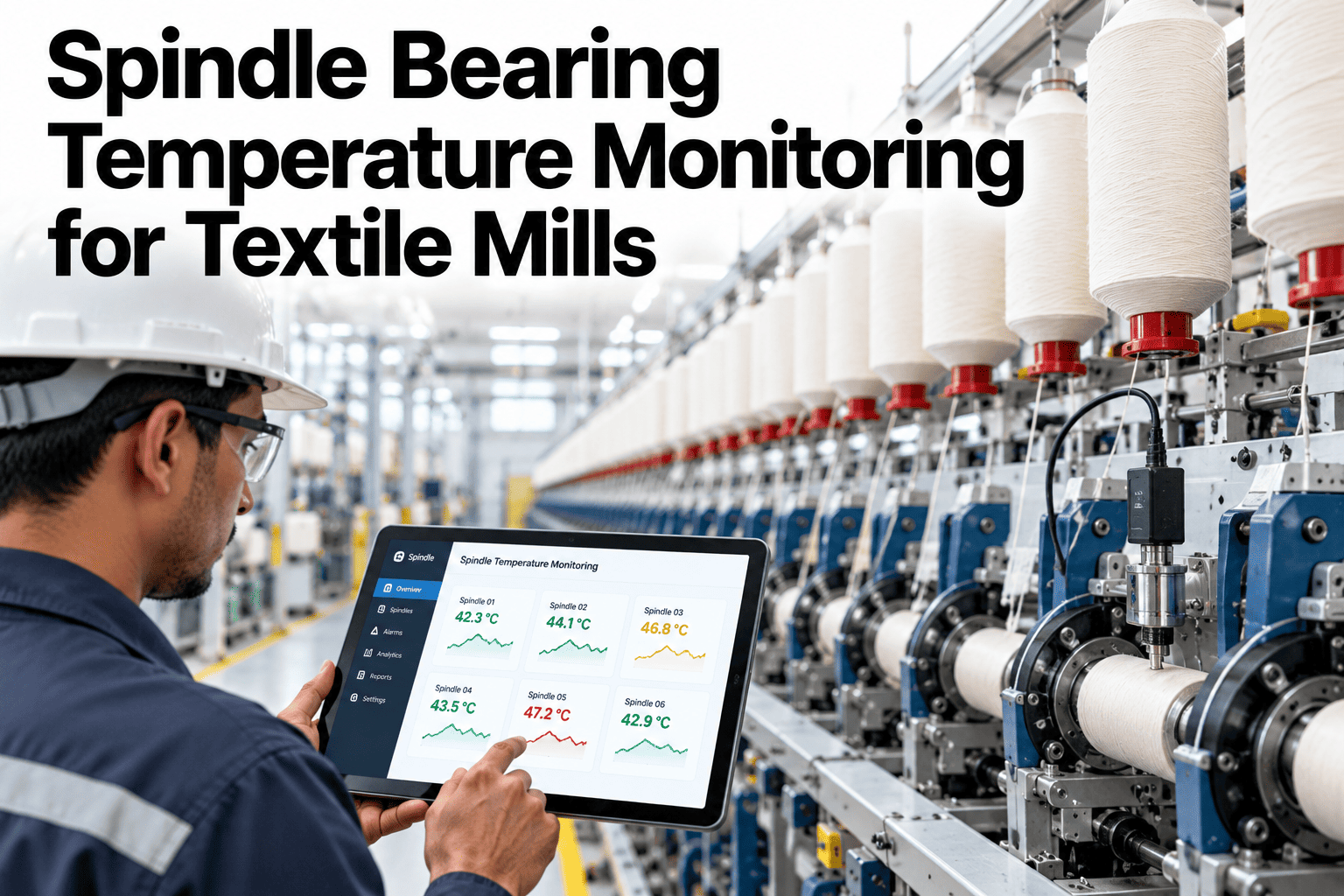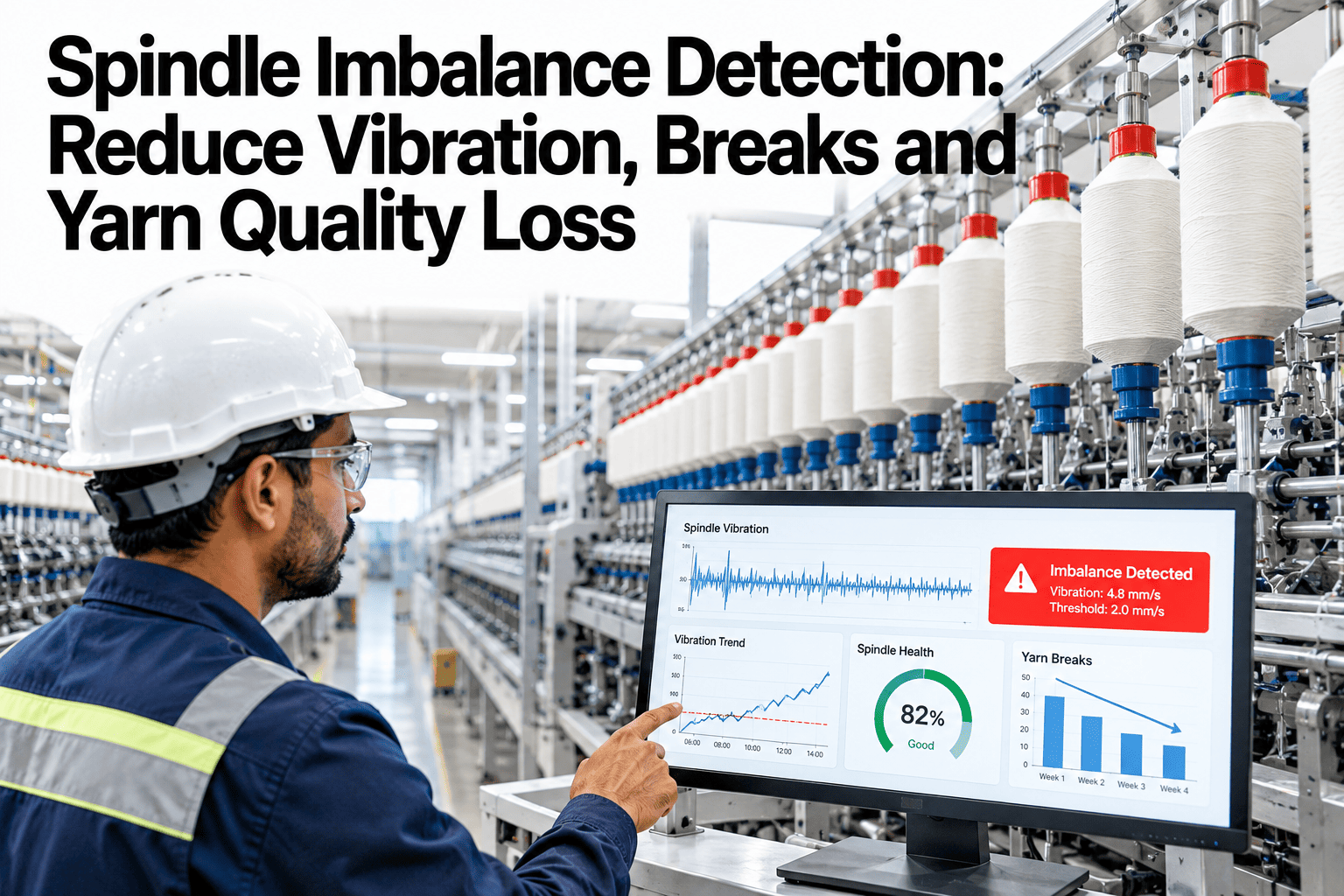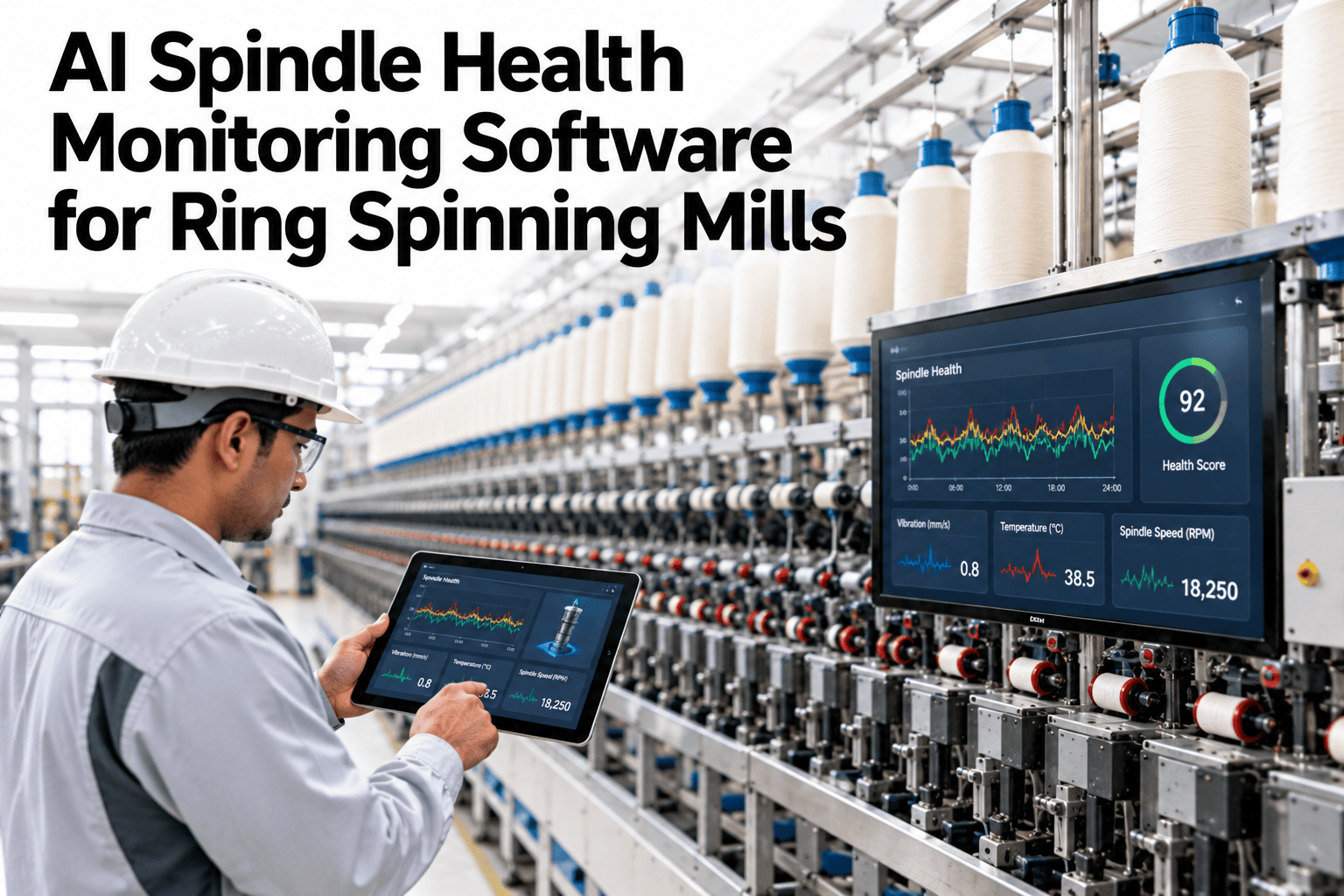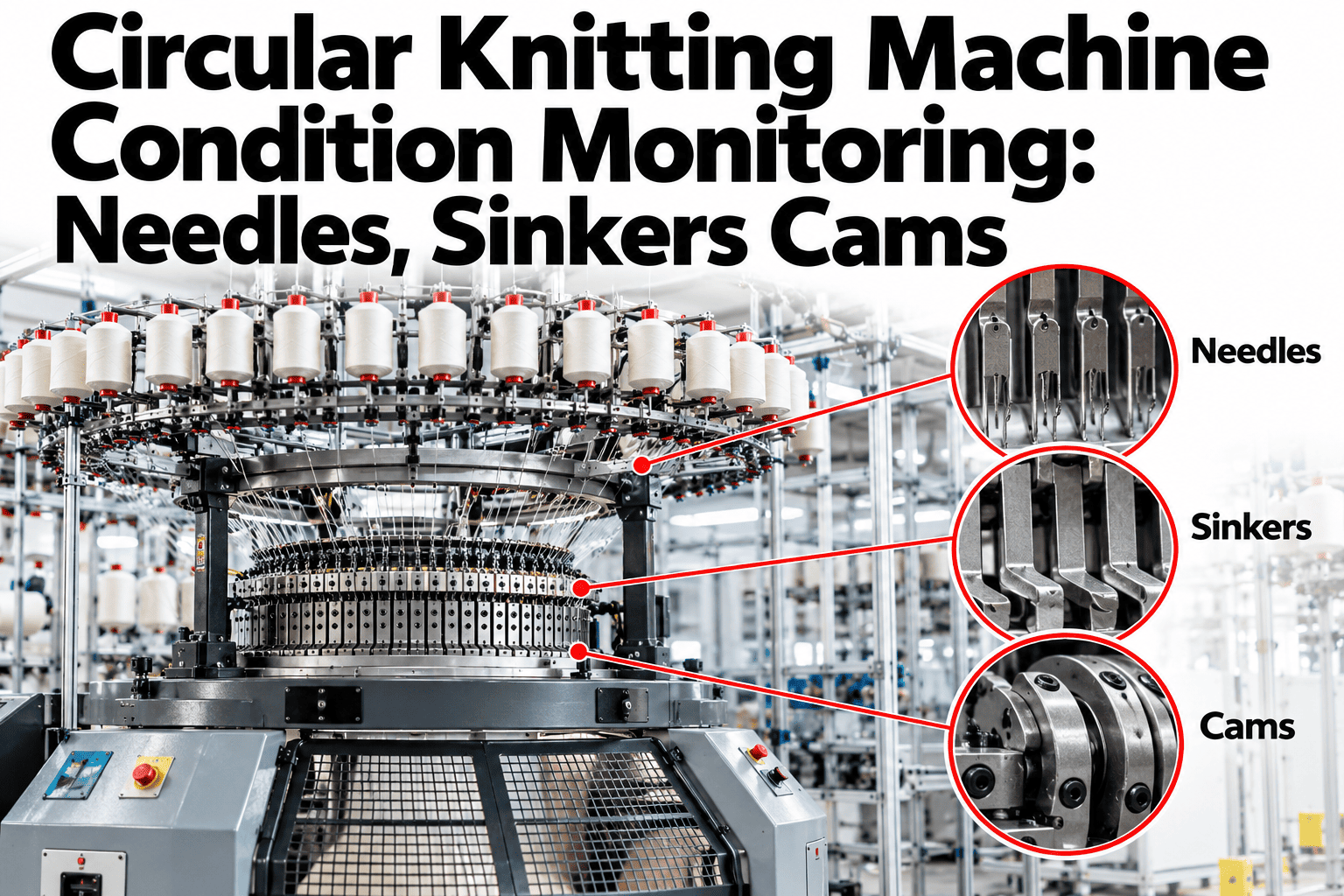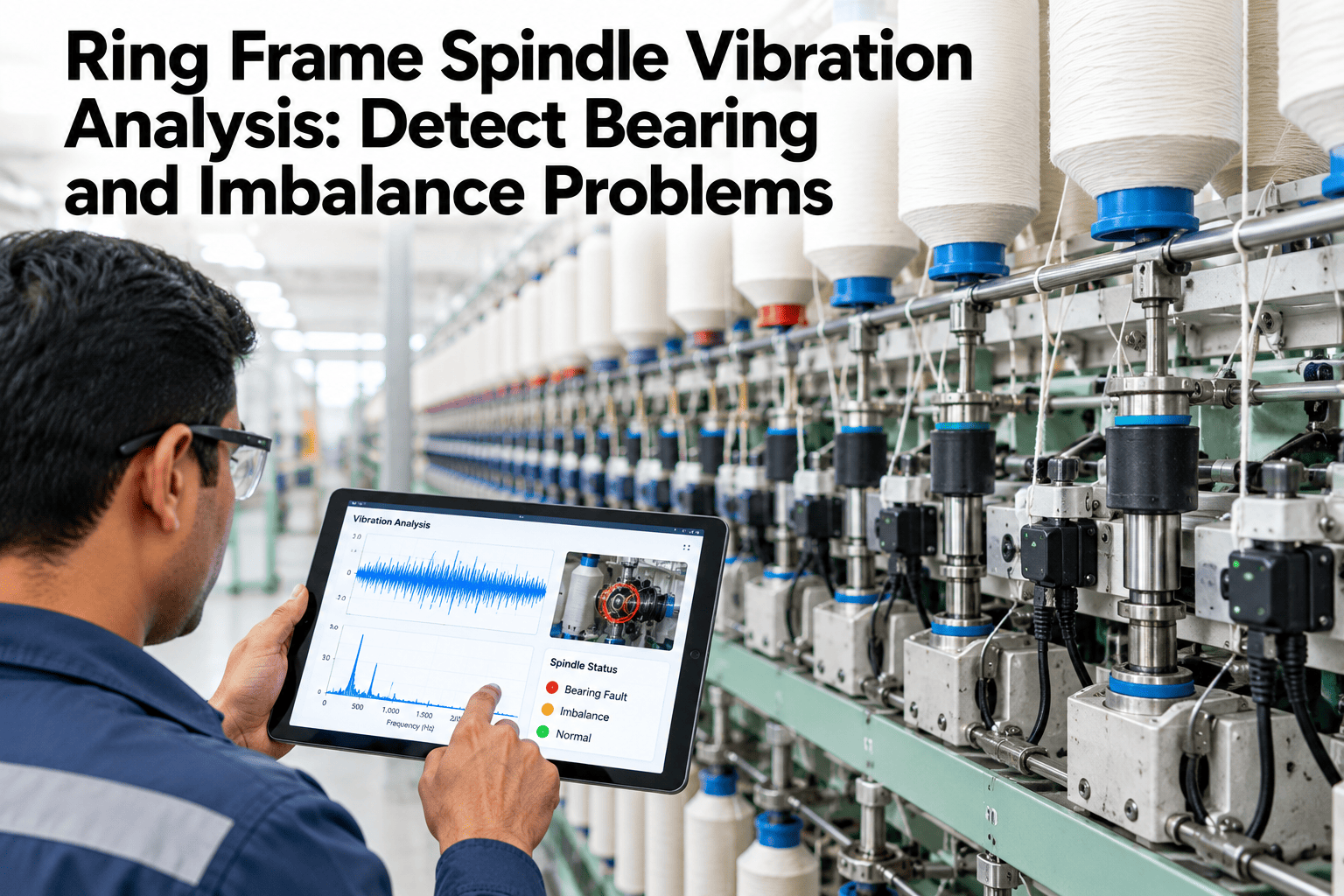
Ring frame spindles rotate between 15,000 and 25,000 revolutions per minute, and every revolution loads the bearing, the bolster and the blade. A spindle that develops bearing wear or a mass imbalance does not stop immediately. It changes its vibration signature first, weeks before it produces a noisy bearing, a wobbling cop or a pattern of end breaks that nobody can trace to one position. Vibration analysis reads that signature and turns a hidden fault into a scheduled repair. Teams running ring frames at scale can book a walkthrough with iFactory AI to see spindle vibration tracked per position.
Ring Frame Spindle Vibration Analysis: Detect Bearing and Imbalance Problems
Use vibration data from every spindle position to catch outer-race spalls, bolster wear, blade eccentricity and mass imbalance before they cause end breaks, yarn defects or unplanned frame stops. iFactory AI collects and trends the data.
Why Vibration Is the First Signal a Spindle Gives
A ring spindle is a precision rotating assembly. Its blade sits in a bolster bearing, held in position by an oil film measured in microns. When the bearing surface develops a pit, a scratch or a wear band, the oil film cannot bridge the gap at full speed. The blade moves through the damaged zone once per revolution, and that impulse travels through the housing as a vibration event.
The same physics applies to imbalance. A spindle whose mass distribution is not centred on the rotation axis produces a once-per-revolution radial force. At 20,000 RPM that force repeats more than 300 times per second, and even a tiny mass offset creates a measurable vibration at the 1x frequency.
Reactive pattern
Bearing damage discovered only when the operator hears noise, sees a wobbling cop, or records a cluster of end breaks on the same spindle. By that point the bearing surface is badly scored and the spindle may need a full rebuild rather than a simple pack renewal.
Predictive pattern
A rising vibration trend flags the spindle four to eight weeks before the bearing reaches a critical state. The maintenance team schedules a pack change during a planned doff, and the spindle returns to service without an unplanned frame stop or a yarn quality event.
The gap between the two approaches widens with frame size. A 1,200-spindle frame running at 96 percent efficiency can produce yarn valued at tens of thousands of dollars per day. One unplanned stop that takes an hour to diagnose and repair affects every spindle on that frame, not just the one that failed. Vibration data gives the maintenance team a way to act before the frame stops, and teams looking to build that capability can schedule a session with iFactory AI to review their current spindle monitoring approach.
Five Fault Types and Their Vibration Signatures
Each mechanical fault produces a distinct vibration pattern. Knowing which pattern belongs to which fault lets the analysis separate a bearing problem from an imbalance problem, even when both are present on the same spindle.
Outer Race Spall
A pit or flake on the outer race produces a repeating impulse at the ball pass frequency outer race (BPFO). The frequency depends on the number of rolling elements, the contact angle and the running speed. On a spindle at 20,000 RPM with a typical bolster bearing geometry, the BPFO may sit between 3,000 and 5,000 Hz, well above the running speed frequency.
Inner Race Wear
Inner race faults produce an impulse at the ball pass frequency inner race (BPFI), modulated by the shaft speed because the fault zone rotates with the blade. The modulation creates sidebands around the BPFI peak, and their growth is a reliable indicator of worsening damage.
Mass Imbalance
An off-centre mass shows up as a strong 1x peak in the radial direction. Common causes include a bent blade, residual yarn wound unevenly on the wharve, or a replacement part that was not balanced after machining. The 1x amplitude rises with speed squared, so the same imbalance is far more damaging at 22,000 RPM than at 15,000 RPM.
Blade Eccentricity
Eccentricity means the blade centre does not coincide with the ring centre. The result is a once-per-revolution variation in yarn tension and traveller speed, which shows up as a 1x component with a noticeable 2x harmonic in the axial direction. Eccentricity also causes uneven ring wear and shortened traveller life.
Bolster Oil Film Breakdown
When the oil film thins or contaminates, the blade makes intermittent metal-to-metal contact with the bolster surface. This produces a broadband noise floor rise rather than a single discrete peak. The vibration amplitude may not spike sharply, but the overall RMS level climbs steadily over days.
Distinguishing these patterns is the core value of vibration analysis. A spindle flagged for imbalance needs a different corrective action than one flagged for an outer race spall. Treating every vibration alert as a generic bearing change wastes good packs and misses real faults. Teams ready to map these signatures on their own frames can request a vibration data walkthrough from iFactory AI.
What Vibration Data Looks Like Per Spindle
A useful vibration dataset ties each reading to a spindle position, a timestamp and a frame. That structure lets the analysis separate a single spindle problem from a frame-wide issue like a drive belt fault or a floor resonance.
| Data Field | Source | What It Reveals |
|---|---|---|
| Spindle position ID | Frame map, physical label | Which exact spindle is changing |
| Overall vibration amplitude (RMS) | Accelerometer on housing | General health trend per spindle |
| 1x amplitude and phase | Spectrum analysis | Imbalance and eccentricity |
| BPFO and BPFI peaks | High-resolution spectrum | Bearing race damage location |
| Broadband noise floor | Envelope analysis | Lubrication failure and general degradation |
| Spindle speed (RPM) | Tachometer or drive signal | Speed-normalised comparison between spindles |
| Temperature | Contact or infrared sensor | Confirms vibration findings with thermal evidence |
A single vibration reading tells you the state at one moment. The real power comes from trending: plot each spindle's RMS value over weeks and a bearing moving toward failure draws a rising curve that is easy to read even without deep vibration expertise.
How Spindle Faults Reach the Yarn
Vibration analysis is not only a maintenance tool. It is also a quality tool. A spindle with a growing vibration problem changes the yarn it produces before it changes the noise the operator hears.
Correlating vibration data with yarn quality data closes the loop. When a spindle flagged for rising vibration also shows a CV increase on the corresponding bobbin, the case for a planned repair is beyond question. Maintenance and quality speak the same language when they share the same data, and teams wanting to see that correlation built on their own production records can arrange a live data session with iFactory AI.
See Spindle Vibration Per Position
Book a 30-minute session and iFactory AI will show how vibration, temperature and speed data combine into a per-spindle health view across your ring frames.
Severity Bands for Spindle Vibration Readings
Not every elevated vibration reading means a repair is needed this week. Severity bands give the maintenance team a framework for deciding which spindles to schedule now, which to watch and which are running normally. The bands below are illustrative; your plant should calibrate them against your own bearing types, speeds and experience.
Baselines must be set per spindle, not per frame. Structural resonance differences between positions on the same frame mean that a spindle near the drive end may naturally read slightly higher than one near the tail. Per-spindle baselines eliminate false alarms that make operators distrust the system.
Common Causes of Elevated Spindle Vibration
Before calling every vibration alert a bearing problem, check the surrounding conditions. Some of the most common causes have nothing to do with the bearing itself.
Tape tension variation
Uneven tape tension across a group of four spindles driven by the same tape creates a speed variation that looks like imbalance on the vibration spectrum. Adjusting the jockey pulley often resolves it without touching the spindle.
Worn or misaligned bolster
A bolster that has lost its bore concentricity after repeated bearing pack changes no longer holds the blade in its designed position. The vibration pattern mimics eccentricity but persists after the blade is replaced.
Oil level and contamination
Bolster oil below the minimum mark or contaminated with cotton fly degrades the film. Vibration rises as broadband noise, and temperature follows within days. A routine oil top-up and check of the seal condition is the cheapest fix on the list.
Floor and frame resonance
If multiple spindles on the same frame section all show elevated vibration at the same frequency, the source may be the floor or the frame structure rather than the spindles. A tap test on the frame bed can confirm a structural resonance.
Speed ramp-up after doffing
Some frames ramp spindle speed aggressively after a doff. A transient vibration spike during ramp-up is normal and should not be confused with a developing fault. The monitoring system should filter or tag ramp-up windows separately.
A good vibration analysis workflow starts with these checks before opening a work order for a bearing change. Teams that want help building that triage workflow can contact iFactory support for guidance on configuring alert rules.
Setting Up Spindle Vibration Monitoring
Moving from periodic handheld checks to continuous or semi-continuous monitoring follows a predictable path. The steps below outline the typical sequence for a ring spinning mill.
Select pilot frames
Choose two to four frames that run the highest-value counts or have the worst end-break history. These frames give the fastest payback and the clearest data for baseline building.
Install sensors and edge hardware
Accelerometers mount on the spindle rail or housing at positions that capture radial vibration. An edge gateway collects data from the sensors and forwards it to the analysis platform. Cabling and commissioning for eight frames typically takes a single maintenance shift.
Run a baseline period
Collect data for two to four weeks under normal production conditions. The baseline captures each spindle's healthy vibration profile, accounting for position-specific resonance and normal operating variation.
Configure alert thresholds
Set watch, alert and critical bands per spindle using the baseline data. Include rules for 1x amplitude (imbalance), bearing frequencies (BPFO and BPFI) and broadband RMS (oil film health).
Validate against known faults
When a spindle is flagged, inspect it and record what was found. Over two to three months this builds a local evidence base that refines thresholds and confirms the analysis is catching real faults.
iFactory AI is smart manufacturing and industrial software built as a turnkey server that racks in, plugs into power and Ethernet, and goes live. For spinning mills it joins vibration, temperature and speed records into a per-spindle health view the maintenance team can act on. Deployment typically reaches a working pilot in six to twelve weeks. Mills ready to scope a pilot can book a scoping session with the iFactory team.
Frequently Asked Questions
How many spindles can be monitored per frame?
Every spindle on a frame can carry its own vibration profile. The iFactory AI platform ingests data across all positions and trends each one individually, so the maintenance team sees which specific spindle needs attention rather than a frame-level average. Book a session to see full-frame coverage on a live spinning floor.
Does vibration monitoring require stopping the frame?
No. Sensors collect data while the frame is running at full production speed. The analysis works on live data, and alerts are generated without interrupting the spinning cycle. Sensor installation itself is done during a planned maintenance window, but once installed the monitoring is continuous.
Can vibration analysis distinguish bearing wear from imbalance?
Yes. Bearing faults produce high-frequency peaks at ball pass frequencies, while imbalance shows as a dominant 1x peak in the radial direction. The two patterns are spectrally distinct and the platform separates them automatically. Book a demo to see fault classification applied to ring frame spindle data.
What happens if a spindle crosses the critical threshold?
The platform flags it for immediate action and can generate a work order in the mill's maintenance system. The maintenance team receives a prioritised list of spindles ranked by severity, so they repair the most urgent positions first during the next available doff window. Book a walkthrough to see the alert-to-work-order flow in action.
Does iFactory AI replace our existing maintenance system?
No. It reads from existing plant systems and adds a vibration analytics layer. Work orders, spare parts records and maintenance history stay in your current CMMS or ERP. The platform connects rather than replaces. Ask support about integration with your specific system.
Catch Spindle Faults Weeks Earlier
iFactory AI joins vibration, temperature and speed data into a per-spindle health view your maintenance team can act on. Book a walkthrough built around your ring frames.