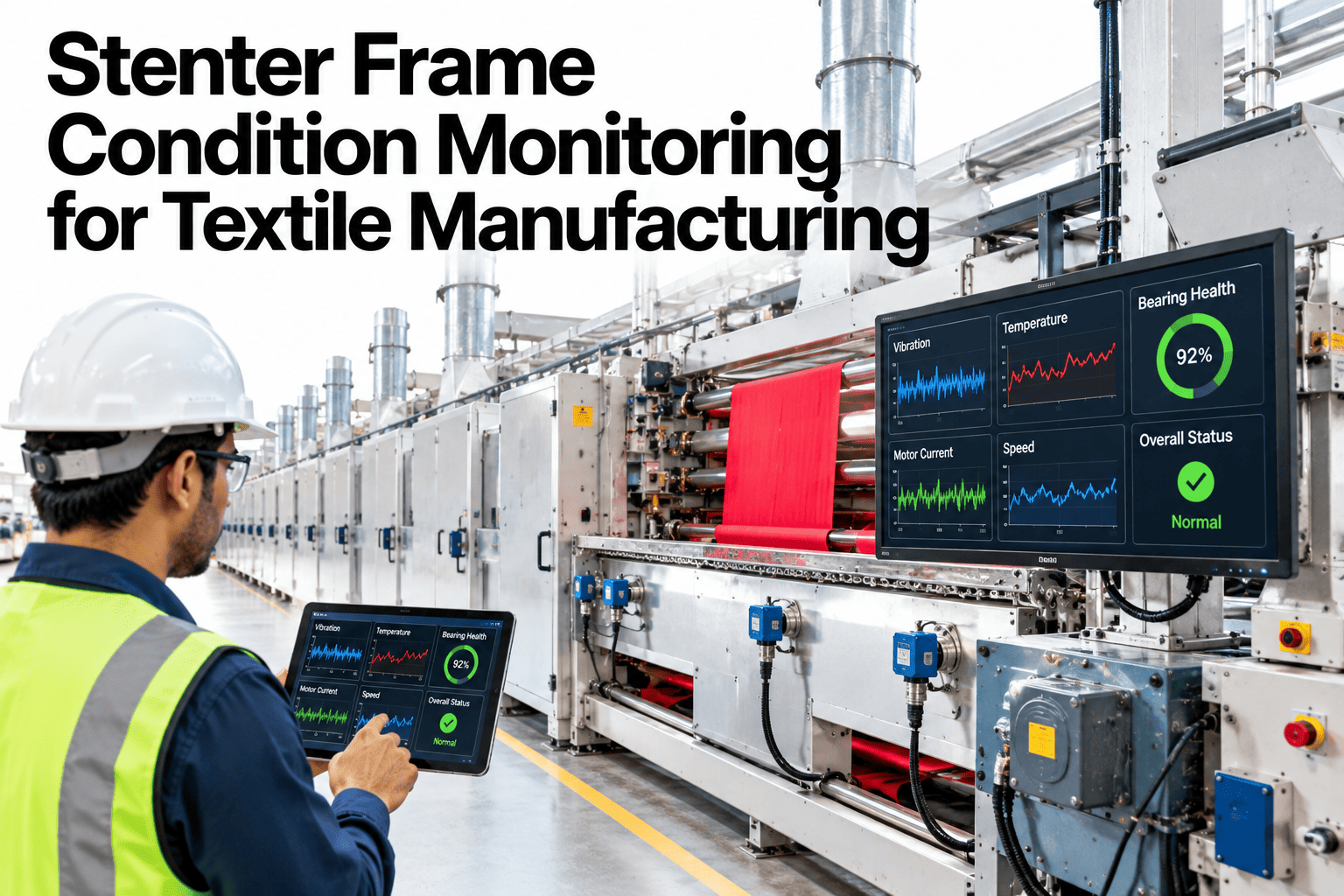
A stenter frame failure rarely happens without warning, it happens without anyone watching the right signal. Chain wear, clip damage and zone temperature drift all build up gradually over weeks of running, and by the time a fabric defect or an unplanned stop reveals the problem, the condition behind it had likely been visible in the data for some time. A mill checking the stenter during scheduled maintenance rounds only sees a snapshot, not the trend that would have flagged the issue early. Condition monitoring that tracks temperature uniformity, chain tension and clip condition continuously catches the drift while there is still time to plan a fix instead of reacting to a stop. Finishing teams rethinking this visibility can see stenter condition tracked continuously on a live frame before the next unplanned stop.
Stenter Frame Condition Monitoring for Textile Manufacturing
Temperature uniformity, chain tension and clip condition tracked continuously, not checked at a scheduled round.
Why a Scheduled Round Misses the Drift
A periodic inspection only captures a single point in time, not the trend leading up to it.
A weekly or monthly round shows the condition that day, not how it has been trending.
Chain and clip wear build slowly, often invisible until the failure is already close.
Temperature drift in one zone can affect fabric quality long before it triggers an alarm.
Continuous tracking turns a gradual drift into a trend line the maintenance team can act on before it becomes a stop.
What Each Signal Indicates
Each monitored parameter points to a different failure mode, which is why tracking all three together matters.
| Signal | What It Indicates | Typical Lead Time |
|---|---|---|
| Temperature uniformity | Zone heating element or airflow issue | Days to weeks before fabric quality is affected |
| Chain tension | Chain stretch or wear progressing | Weeks before a failure or unplanned stop |
| Clip condition | Clip wear affecting fabric grip and width | Days before fabric edge defects appear |
See How Far Along Your Own Frame's Wear Trend Is
Book a 30-minute session and bring your last maintenance round data. iFactory AI will show the trend behind each signal.
From Signal to Scheduled Fix
Catching a drift early turns an unplanned stop into a scheduled maintenance task.
What iFactory AI Supports
Condition data is tracked continuously and turned into a maintenance plan, not just a dashboard reading.
Continuous Zone Monitoring
Temperature uniformity across every zone is tracked without waiting for a scheduled check.
Chain Tension Trending
Chain tension is tracked against baseline to catch wear progressing gradually.
Clip Condition Tracking
Clip wear is monitored to catch fabric grip issues before edge defects appear.
Scheduled Maintenance Alerts
A drift is flagged early enough to plan the fix rather than react to a stop.
iFactory AI connects to existing stenter sensors and maintenance data. Scope covers data integration, baseline setup, team training and ongoing support.
Expert Review
Clip condition is the signal most finishing teams underestimate. It builds slowly and rarely causes a dramatic stop, but it shows up repeatedly as fabric edge defects that get investigated as a quality problem when the real cause was mechanical wear that had been building for weeks.
The lead time between a flagged trend and an actual failure is usually long enough to schedule the fix during a planned stop, which is the whole point of continuous monitoring over a periodic round. Mills that act on early trend flags consistently convert what would have been unplanned stops into routine maintenance.
Frequently Asked Questions
Does this require new sensors on the stenter frame?
Many stenters already have temperature sensors per zone that can be connected to, while chain tension and clip condition may need additional sensors depending on the frame's existing instrumentation. Ask about your current stenter's sensor setup in a working session.
How is chain tension actually measured without stopping the line?
Chain tension can be tracked through load sensors or by analyzing motor current patterns that correlate with chain condition, both of which run continuously without requiring the frame to stop for a manual check. Ask support about the measurement approach for your frame type.
What counts as a meaningful trend versus normal variation?
The threshold is tuned to the specific frame's own baseline history, since normal operating variation differs between machines and even between zones on the same machine. A consistent directional trend over days or weeks is treated differently from short-term fluctuation. Request a sample trend threshold setup.
Can this integrate with our existing CMMS for maintenance scheduling?
Yes, a flagged trend can generate or link to a work order in the existing CMMS, so the maintenance team's scheduling process does not change, only the lead time they have to act on it. Contact support about connecting to your CMMS.
How long before the baseline and trend thresholds are reliable?
Most frames have a reliable baseline established within six to nine weeks of continuous data collection, long enough to capture normal operating variation before trend thresholds are set with confidence. Book a session to estimate your own timeline.
Catch Wear Early Enough to Plan the Fix
iFactory AI tracks temperature, chain and clip condition continuously on your stenter frame. Book a walkthrough.