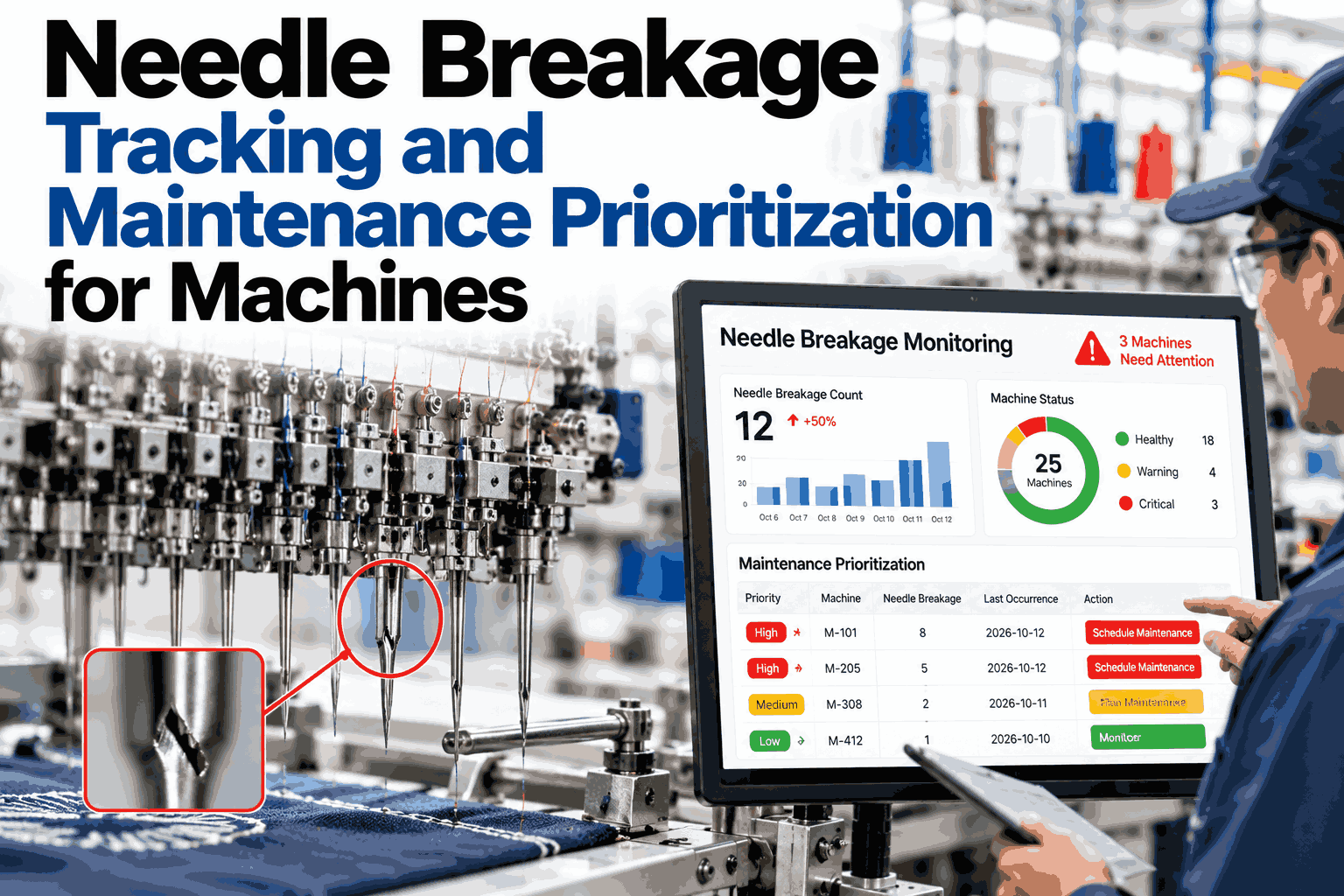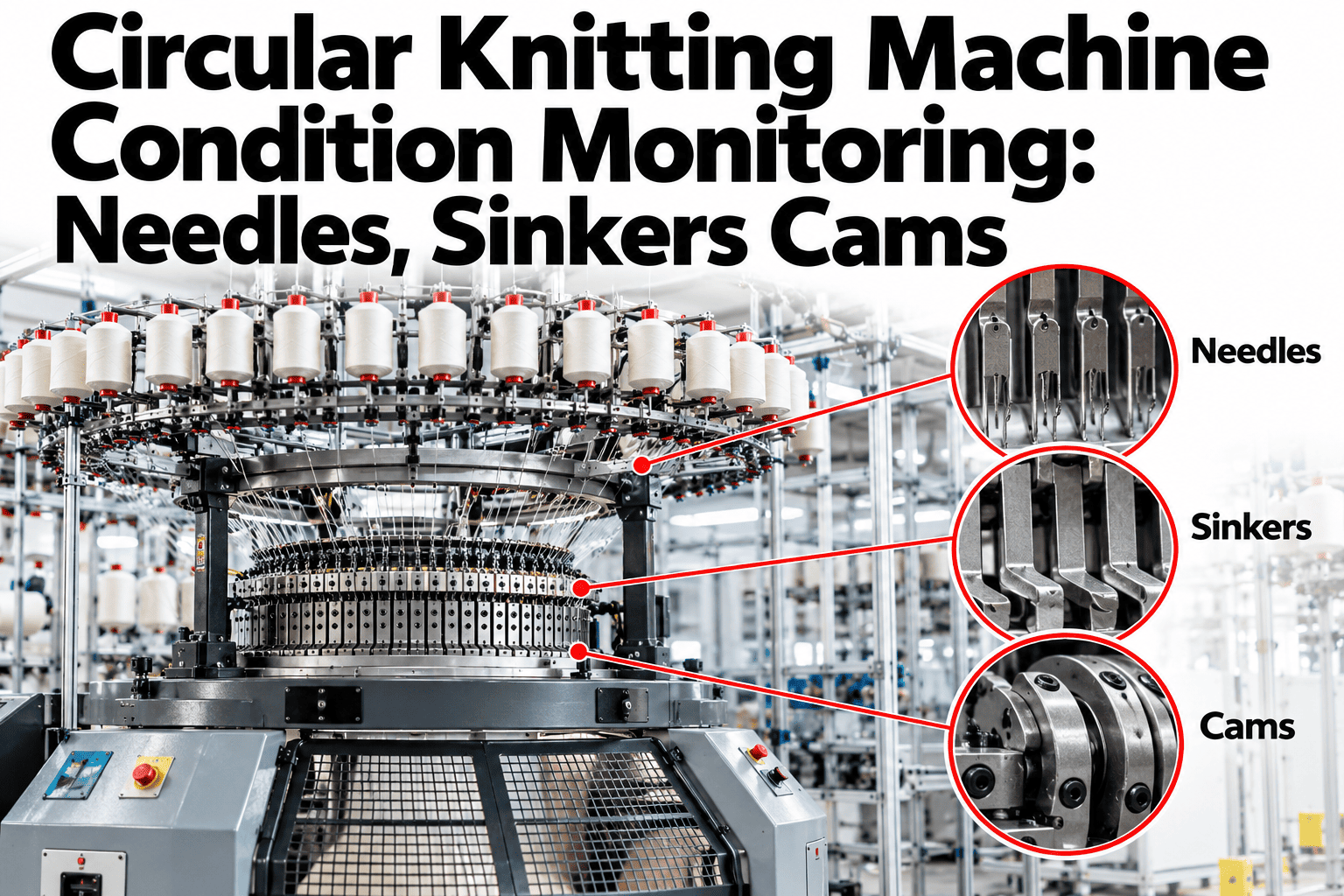
A circular knitting machine makes thousands of loops a minute, and every one depends on tiny, hard-working parts. Needles, sinkers and cams wear, lint builds up and tension drifts, and the first sign is often a line in the fabric. Condition monitoring watches those parts and their symptoms continuously, so wear is caught before it shows as a defect. Knitting mills who want that can ask iFactory AI how knitting machine condition is monitored needle by needle and shift by shift.
Watch Needles, Sinkers and Cams Before They Mark the Fabric
iFactory AI follows stop events, needle breakage, tension and lubrication on every circular knitting machine, so wear shows up as a trend and not as a roll of rejected fabric.
The Four Part Groups That Decide Fabric Quality
Most knitting problems trace back to a few part groups. Knowing them tells you what to watch.
Needles
Hooks, latches and butts wear and bend, causing dropped stitches and lines.
Sinkers
Wear and misalignment affect loop formation and fabric appearance.
Cams
Worn cam tracks change needle movement and stitch size.
Yarn feeders and tension
Uneven feeding changes loop length and creates barre.
Wear Signs and What They Do to the Fabric
Parts tell on themselves before they fail. This table links wear signs to their effect.
| Component | Wear Sign | Effect on Fabric |
|---|---|---|
| Needles | Bent hooks, worn or sticky latches, broken butts | Dropped stitches, vertical lines, holes |
| Sinkers | Worn throats or bent noses | Uneven loops and a rough surface |
| Cams | Polished or grooved tracks | Stitch size drift and needle stress |
| Feeders and guides | Worn eyelets and uneven tension | Barre and tension marks |
| Oil and lint system | Low oil or heavy lint build-up | Heat, friction and faster wear everywhere |
Which Signals Reveal Which Problem
The matrix, shown as an illustration, links machine signals to the problems they reveal.
| Problem | Stop Events | Needle Breakage Count | Yarn Tension | Oil and Lint Data |
|---|---|---|---|---|
| Needle wear and breakage | Moderate | High | Low | Low |
| Cam or sinker wear | Moderate | Moderate | Moderate | Low |
| Yarn feeding issues | High | Low | High | Low |
| Lubrication or lint problems | Moderate | Moderate | Low | High |
What Stops Knitting Machines
The chart shows an illustrative ranking of stop causes on circular machines.
See Which Knitting Machines Are Wearing Out Before They Show It
Book a 30-minute session and iFactory AI will review your knitting stops and defect records to show where wear trends are visible in your data.
The Monitoring Chain From Signal to Service
A useful system is a short chain that ends in a maintenance action.
How Knitting Maintenance Maturity Grows
Mills move through clear stages. Knowing yours shows what to build next.
Calendar Replacement or Condition-Based Replacement
Replacing parts on a fixed schedule wastes good parts and still misses early failures.
Building a Monitoring Routine in Five Steps
A first routine works best on a small group of machines.
Pick the machines that run the most sensitive fabrics.
Log needle changes, stops and defects by machine.
Learn each machine's normal level of stops and tension.
Review machines drifting away from normal each shift.
Replace parts in a planned window and record the result.
Knitting Machine Inspection Checklist
Use this list at every shift start and weekly. Each box should be answerable from records.
A Composite Scenario: The Line That Appeared at Week Three
This is a composite example, not a named mill. It shows how a trend precedes a defect.
Mistakes in Knitting Machine Monitoring
These habits hide wear.
Changing needles only after a defect
The fabric has already paid for the failure.
Not recording which needles were changed
Wear patterns stay invisible.
Ignoring lint and oil
Friction speeds wear everywhere.
Judging machines against the fleet average
Each machine has its own normal.
What iFactory AI Adds to Knitting Machine Monitoring
iFactory AI is smart manufacturing and industrial software for knitting and other textile operations. Explore knitting monitoring in a live product tour on realistic machine data.
Review of Circular Knitting Machine Condition Monitoring
A practical review of what makes knitting monitoring useful, written as editorial guidance rather than a named expert quote.
Compare each machine with itself
Baselines make small drifts visible.
Record part changes
Wear patterns appear only when replacements are logged.
Do not neglect lint and oil
Housekeeping drives wear across all part groups.
Frequently Asked Questions
Replace Knitting Parts Before the Fabric Pays for the Wear
iFactory AI follows machine condition by needle group, shift and machine, so wear is caught in time. Book a walkthrough to see it on your own knitting floor.