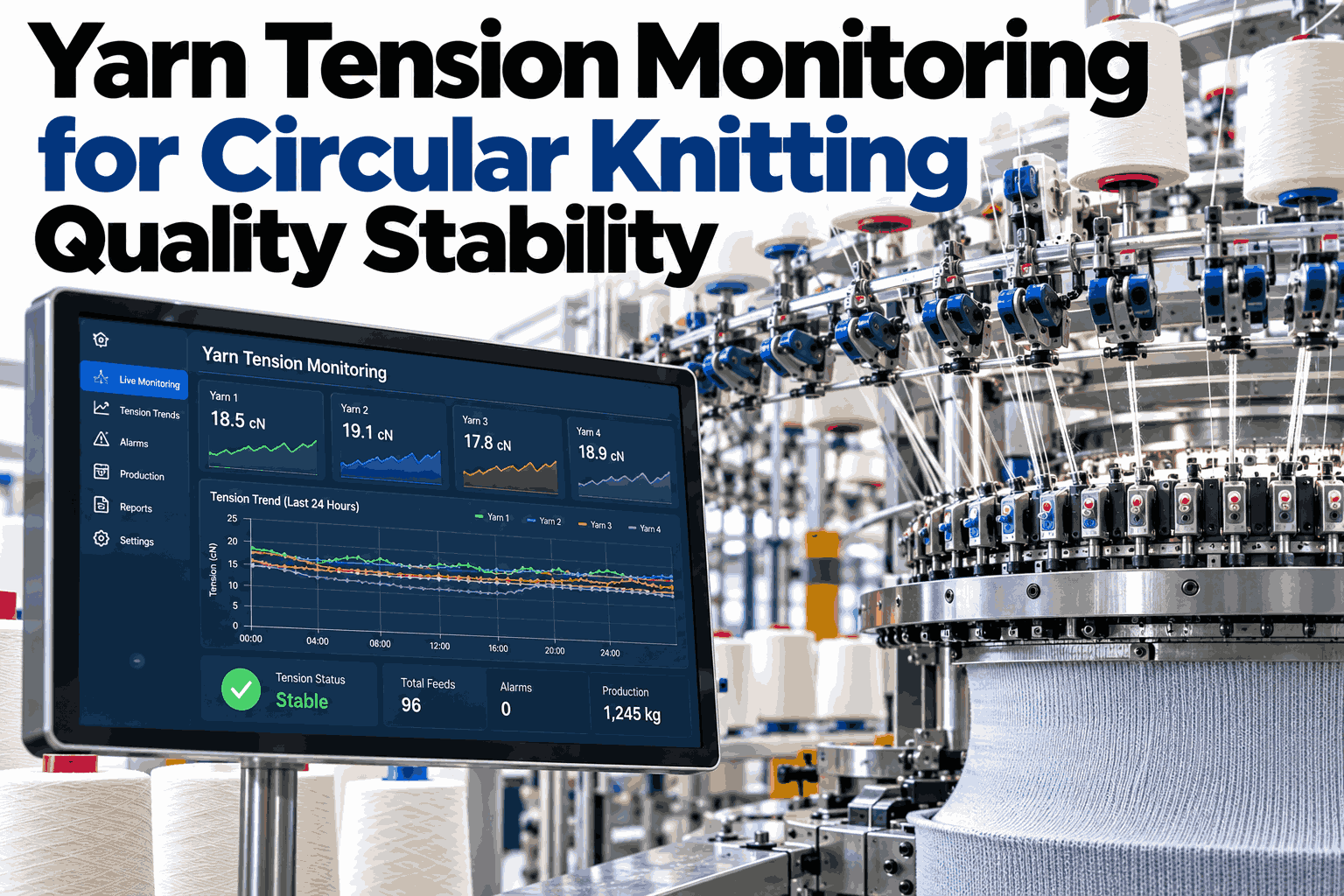
Most circular knitting floors judge a run by what comes off the take-down roll, not by what happened at each feeder while the fabric was being built. By the time a GSM check or a fabric inspector flags a problem, the machine has already run for minutes or hours with the same drifting tension, and every metre in between carries the same hidden flaw. Tension is set once at changeover and then largely left alone, even though package build, yarn friction and guide wear keep moving it. A clearer view of what is happening feeder by feeder, course by course, changes how early a problem gets caught, and mills can see live feeder tension data walked through on their own machines in a short session.
Catch Tension Drift Before It Becomes a Fabric Defect
iFactory AI watches tension at every feeder of your circular knitting machines in real time, so GSM stays stable and defects get caught courses before they reach the roll.
Twelve Feeders, One Fabric, Many Places to Hide
A circular knitting machine can carry anywhere from a handful of feeders to well over a hundred, each one pulling yarn through its own tensioner and guide. Average tension across the whole machine can look fine while one or two feeders quietly run tight or loose.
A single misbehaving feeder shows up as a faint vertical streak, a looping stitch, or a thin band of lower GSM that repeats around every course that feeder touches. Nobody chases a single feeder manually course by course, which is exactly why this kind of defect so often reaches the fabric inspection table before anyone catches it.
| Defect | Likely Zone | Typical Tension Signature | First Check |
|---|---|---|---|
| Dropped or loose stitches | Needle bed | Sudden low reading on one feeder | Needle timing and feeder guide wear |
| Vertical streaking | Tensioner / feeder | One feeder reading consistently high or low | Disc tensioner setting and yarn path |
| GSM drifting across a roll | Take-down | Slow upward or downward trend over time | Take-down speed against knitting speed |
| Needle or yarn breaks | Creel / package | Sharp spikes, often repeating | Package build, balloon control, humidity |
| Barré or shade banding | Multiple feeders | Small but consistent gap between feeders of the same lot | Cross-feeder tension matching |
See Your Own Feeders, Not a Sample Chart
Book a 30-minute walkthrough and iFactory AI will show feeder-level tension on a run from your own circular knitting machines.
Four Zones Where Tension Can Drift
Yarn passes through four distinct zones on its way from package to fabric, and each one can introduce its own kind of tension problem.
Creel and Yarn Package
Package build, winding tightness and remaining yarn diameter all change the pull-off tension as a cone or cheese empties, especially in the last quarter.
Tensioner and Feeder
Disc tensioners wear unevenly, guides collect lint, and a feeder set correctly at changeover can drift within a single shift.
Needle Bed
Needle timing, cam track wear and sinker condition decide whether the yarn the feeder delivers actually forms a consistent loop.
Take-Down and Rolling
Take-down speed relative to knitting speed sets fabric density. Too fast stretches courses thin, too slow lets the fabric pile and distort.
Tension Control and GSM: The Direct Line
GSM is the number a buyer checks, but tension is the number that actually decides it. Looser loops pull less yarn into the same area and raise fabric weight unpredictably; tighter loops do the opposite.
GSM variance inside one roll is often more costly than an average that is slightly off target, because it is the kind of inconsistency a customer notices by hand before they ever put the fabric on a scale.
Signals Your Tension Profile Needs a Look
These are the early tells that a profile set at changeover no longer matches what the machine is actually doing.
A Week on the Floor: Before and After Tension Monitoring
One knitting floor tracked defect rate across two machines over the same seven-day pattern, once before feeder-level monitoring and once after. Each circle below is one shift's illustrative defect rate.
Where iFactory AI Fits on Your Knitting Floor
Tension sensors, GSM checks and fabric inspection records usually sit in separate systems, or in no system at all. iFactory AI connects them feeder by feeder and machine by machine.
Per-Feeder Tension Capture
Live tension from every feeder is logged continuously, not sampled, so a drift on one feeder shows up the moment it starts.
Defect Correlation
Inspection records are matched back to the tension reading at the same point in the run, turning guesswork into a traceable cause.
GSM Variance Alerts
Alerts trigger on widening variance between feeders, not just on the average drifting outside spec.
Machine and Shift Comparison
Compare tension stability across machines, shifts and yarn lots on a normalised basis to find where training or maintenance helps most.
Frequently Asked Questions
Do we need new sensors on every feeder to start?
Not always. Many circular knitting machines already carry feeder-level tension sensors that are under-used, and the first step is usually reading and logging what already exists. Where gaps remain, additional sensors can be added selectively on the feeders tied to the most frequent defects. Support can review your current machine setup before anything is added.
How does this differ from a standard GSM check?
A GSM check gives one number for a whole swatch, taken after the fact. Feeder-level tension monitoring shows what is happening while the fabric is being formed, at the resolution of a single feeder and a single course, which is where most defects actually start.
Can tension bands be set per yarn type?
Yes, and this matters because a cotton blend, a fine filament yarn and an elastane-core yarn behave differently under the same tensioner setting. Separate bands by yarn and machine combination usually catch drift far earlier than one general band used across everything. See how bands are set for your own yarn mix in a short session.
Will this slow down changeovers?
No, the monitoring runs in the background once a machine starts. If anything, it shortens the settling period after a changeover, because operators can see tension stabilise across feeders instead of waiting for the first inspection to confirm the setup is correct.
What does this connect to beyond tension itself?
Tension readings link to GSM variance, defect records, needle break logs and shift comparisons, so a single feeder issue can be traced to its downstream cost in rejects and rework. Ask support how tension data rolls into your existing quality reports.
Give Every Feeder the Same Level of Attention
iFactory AI turns feeder-level tension into early warnings, so GSM stays stable and defects get caught courses before they ever reach the roll. Book a walkthrough on your own machines.