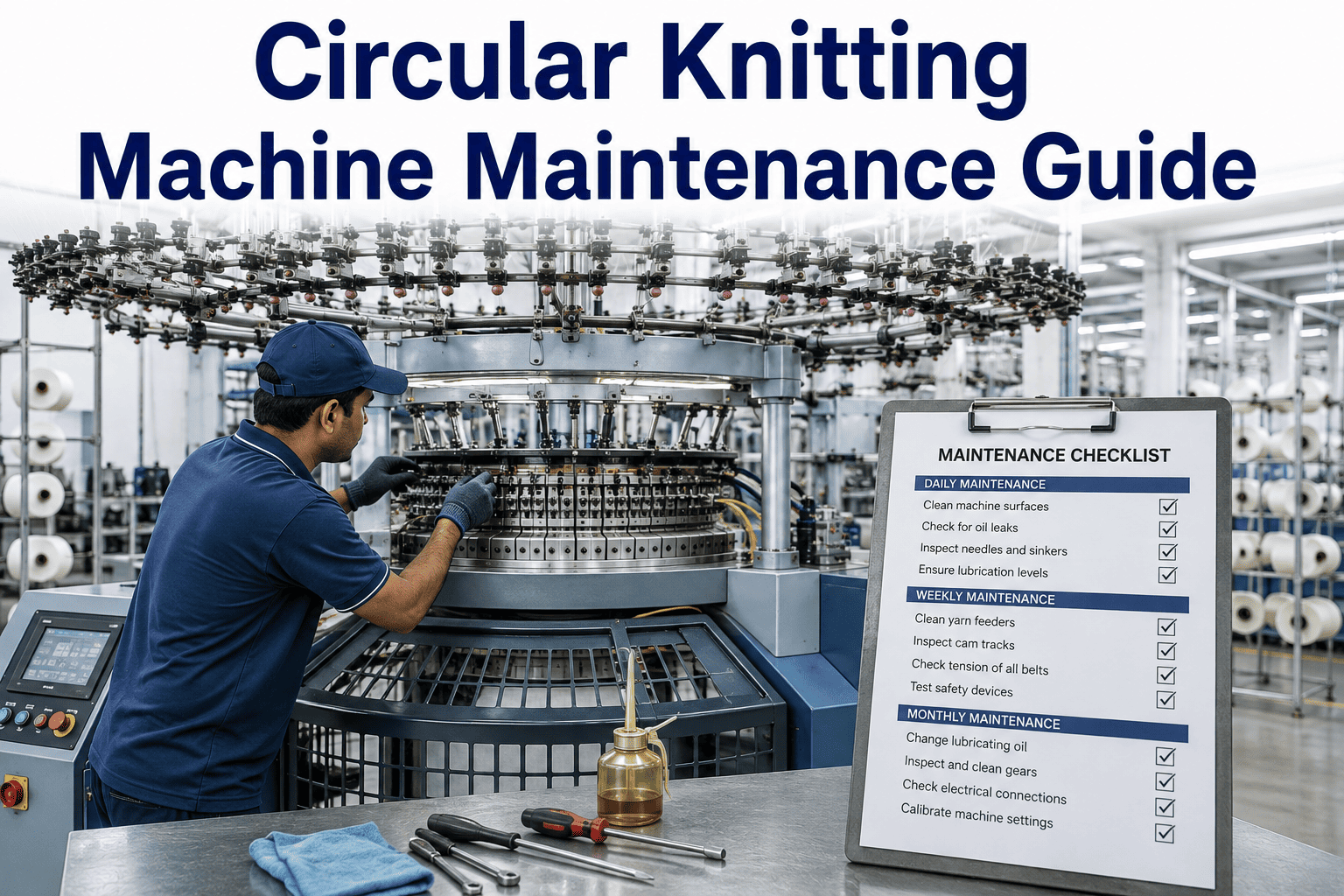
A single broken needle on a high-speed circular knitting machine can turn into a running fabric fault that isn't caught until an entire roll has already been produced, sometimes hours later at the inspection table. Needle, cam, and cylinder wear are the three most common root causes behind repeat knitting defects, yet most mills still replace needles reactively, when a defect has already shown up in the fabric rather than before. iFactory's condition monitoring for circular knitting operations tracks needle wear patterns, cam track condition, and cylinder-dial alignment continuously, catching drift long before it reaches the fabric — connect with iFactory support to see it running on your machine floor.
Knitting Floor Reliability · Circular Knitting
Fabric Defects Rarely Start in the Fabric. They Start in the Needle, Cam, or Cylinder Days Earlier.
iFactory tracks needle condition, cam track wear, and cylinder-dial alignment on every running machine, flagging degradation while it's still a maintenance task — not yet a quality claim from a buyer.
Where Failures Actually Start
Three Zones Responsible for the Vast Majority of Knitting Fabric Defects
Zone 1
Needles
Latch wear, hook damage, and butt wear cause dropped stitches, press-off, and vertical streaks that are often blamed on yarn quality instead of the actual needle condition.
Zone 2
Cam Tracks
Worn or chipped cam surfaces change needle lift timing, producing subtle course-wise irregularities that only become visible once several meters have already run.
Zone 3
Cylinder & Dial
Misalignment or bearing wear in the cylinder-dial assembly shows up as fabric distortion, tension bands, and uneven loop formation across the full circumference.
The Detection Problem
By the Time a Defect Is Visible in the Fabric, the Root Cause Has Usually Been Building for Days
Needle and cam wear are gradual processes. A latch doesn't snap instantly — it fatigues over thousands of knitting cycles, and the earliest signs are subtle: a slightly inconsistent stitch tension, a marginal increase in machine vibration at a specific rotational position, or a small rise in needle breakage frequency on one feeder relative to the others. None of these signs are dramatic enough for an operator doing a visual walk-through to catch reliably, especially on a high-speed machine running dozens of feeders at once.
The mills that consistently produce lower defect rates aren't the ones with the newest machines — they're the ones that catch this gradual drift with sensor and inspection data before it becomes visible fabric damage, and that requires monitoring at a resolution finer than a periodic manual inspection can realistically achieve.
Inspection Cadence
A Realistic Preventive Maintenance Rhythm for Circular Knitting Machines
Preventive Schedules Catch What They're Scheduled to Catch. Continuous Monitoring Catches What Happens in Between.
iFactory layers continuous vibration and stitch-quality signal monitoring on top of your existing PM calendar, so drift between scheduled inspections doesn't turn into a full production run of defective fabric.
Needle Replacement Criteria
Five Signs a Needle Should Be Replaced Before It Fails, Not After
✓
Visible latch wobble or loose hinge — a latch that doesn't snap closed crisply is already producing inconsistent stitch formation, even if no defect is visible yet.
✓
Hook wear beyond manufacturer tolerance — a worn hook profile changes how the needle picks up yarn, gradually increasing dropped stitch frequency on that specific position.
✓
Repeat breakage at the same feeder position — a needle that has already been replaced once at a given position and fails again quickly usually indicates a cam track issue at that station, not just a bad needle.
✓
Butt wear affecting cam engagement — a worn butt changes how cleanly the needle engages the cam track, producing subtle timing shifts that show up as tension inconsistency.
✓
Discoloration or heat marks near the shank — heat stress from friction is often an early indicator of misalignment elsewhere in the needle bed, not just a needle-specific problem.
Field Example
Tracing a Recurring Stripe Defect Back to a Single Worn Cam After Months of Guesswork
A knitwear mill running several large-diameter circular machines had been dealing with an intermittent faint stripe defect for months, appearing on roughly one in six rolls with no obvious pattern. The quality team had cycled through yarn lot changes, tension adjustments, and even a full needle bed replacement on the suspect machine, with no lasting improvement. After connecting vibration and stitch-quality sensors through iFactory, a subtle but consistent vibration signature appeared at one specific feeder position, correlating almost exactly with the rolls that showed the stripe defect. Physical inspection confirmed a single worn cam track segment at that position — a component that had never been flagged in routine visual inspection because the wear wasn't visible without close measurement. Replacing that one cam segment eliminated the defect entirely.
1 in 6Rolls affected before root cause found
MonthsDuration of unresolved defect
1 componentActual root cause once isolated
Typical Impact
What Mills Report After Adding Continuous Knitting Machine Monitoring
27%
Fewer Fabric Defects Traced to Machine Condition
3–5 days
Earlier Detection of Developing Needle and Cam Wear
18%
Reduction in Emergency Needle Replacement Events
31%
Faster Root Cause Identification on Repeat Defects
Frequently Asked Questions
Circular Knitting Machine Maintenance — Common Questions
How does sensor-based monitoring actually detect needle or cam wear before a defect appears?
Vibration sensors mounted near the cylinder and cam box pick up subtle changes in the machine's rotational signature as components wear — a worn cam track or a needle with hook damage alters the timing and force profile of that specific position just enough to register as a detectable pattern shift, well before the change is large enough to show up as a visible fabric fault. iFactory's platform compares each machine's current signature against its own historical baseline rather than a generic threshold, which makes the detection specific to that machine's actual wear pattern.
Book a Demo to see the detection model on a live feed.
Do we need to stop production to install the monitoring sensors?
No — sensor installation on most circular knitting machines is done during a routine changeover or scheduled maintenance window and typically takes under an hour per machine, since the sensors are externally mounted rather than requiring modification to the needle bed, cam box, or cylinder assembly itself. Production resumes normally once installation is complete and the sensor connection is verified.
Can this replace our existing needle replacement schedule entirely?
It's better understood as a layer on top of your existing preventive schedule rather than a full replacement — scheduled inspections still catch routine wear on a predictable cycle, while continuous monitoring catches the irregular cases that fall between scheduled checks, such as a needle that fails early due to a yarn-related snag rather than normal wear. Most mills find the combination reduces both unplanned defects and unnecessary early replacements.
Contact support to discuss how this fits alongside your current PM calendar.
Does this work across different knitting machine brands and gauges?
Yes — the underlying vibration and stitch-quality monitoring approach is not tied to a specific machine brand, and iFactory has been deployed across common single-jersey, rib, and interlock circular knitting configurations at a range of gauges. The baseline calibration process accounts for each machine's specific mechanical characteristics, so the same monitoring approach adapts to older and newer machine models on the same floor.
How long before we see a measurable reduction in defect rates?
Most mills see the first actionable wear alerts within two to three weeks of installation, once the system has gathered enough operating data to establish a reliable baseline for each machine. Measurable improvement in overall defect rates typically follows within one to two production cycles after maintenance teams begin acting on those alerts consistently.
Book a Demo for a rollout timeline specific to your knitting floor.
Catch the Worn Cam or Needle Before It Becomes a Roll of Rejected Fabric.
See continuous needle, cam, and cylinder condition monitoring running on a live circular knitting machine.