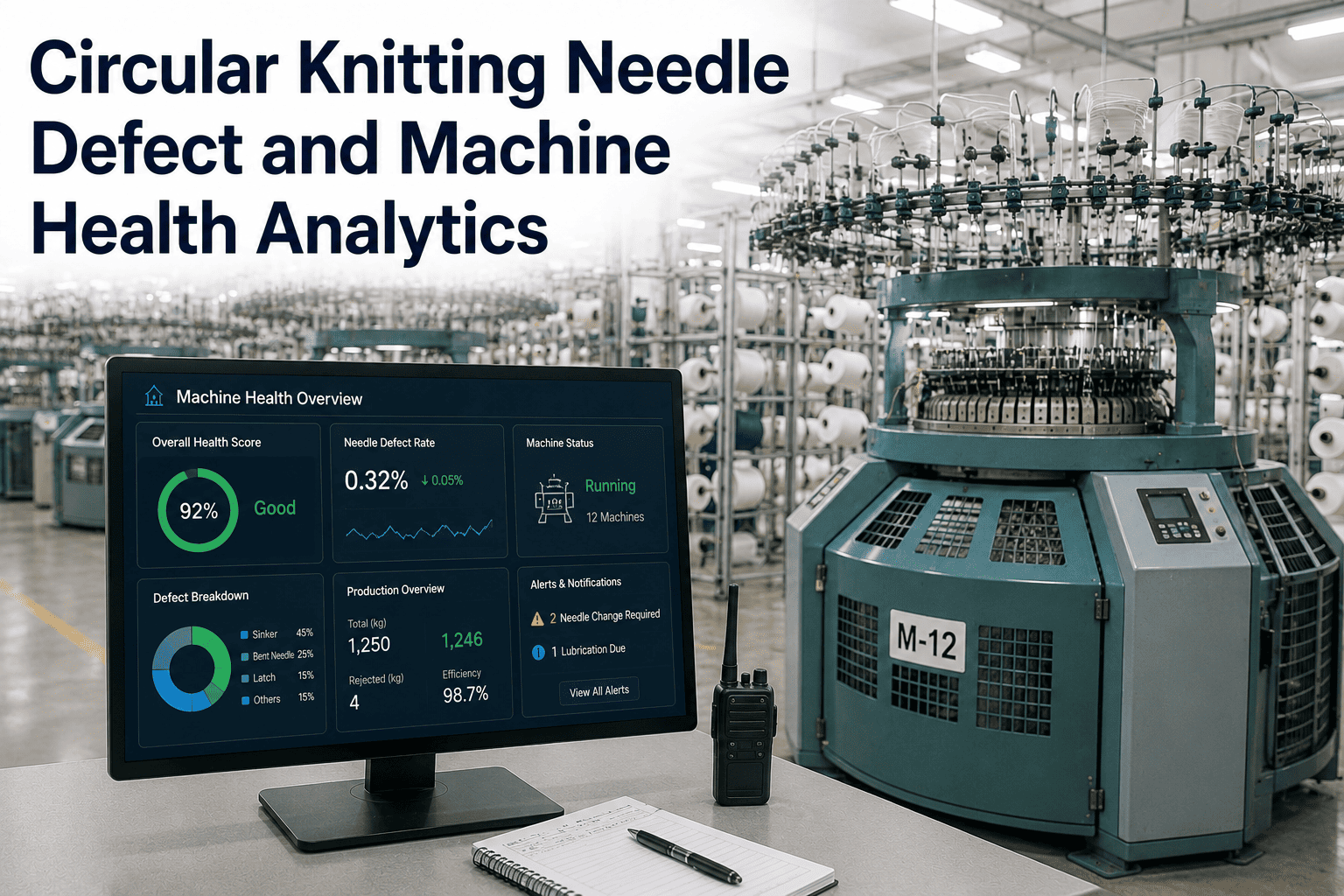
Circular knitting operations form the backbone of modern textile manufacturing, yet they remain plagued by needle defects, yarn breaks, feeder faults, and vibration anomalies that cascade into costly fabric quality issues. Traditional reactive maintenance and manual inspection approaches are no longer sufficient to meet the demands of Industry 4.0. iFactory's predictive quality analytics platform offers a transformative solution by continuously monitoring machine health parameters and correlating them with fabric defect data in real time. This enables knitting plant managers to identify root causes of needle line defects, optimize machine settings, and drastically reduce repeat defects. By leveraging advanced machine learning algorithms, iFactory provides actionable insights that empower maintenance directors to shift from reactive firefighting to proactive optimization. Book a Demo to see how our knitting analytics can elevate your production efficiency.
Transform Your Knitting Operations Today
Unlock the power of predictive quality analytics to eliminate needle defects and boost fabric quality.
The Cost of Needle Defects in Circular Knitting
Needle defects are among the most pervasive and expensive issues in circular knitting. A single defective needle can create continuous vertical lines, holes, or tuck stitches across thousands of meters of fabric, leading to massive waste and rework. In high-speed production environments, even a minor needle malfunction can escalate quickly, causing yarn breaks, machine stoppages, and reduced overall equipment effectiveness (OEE). Traditional inspection methods rely on visual checks by operators, which are time-consuming and prone to human error. By the time a defect is spotted, significant damage has already occurred. iFactory's machine health analytics provide continuous, real-time monitoring of needle performance, vibration patterns, and yarn tension. This allows for immediate detection of anomalies and correlation with quality data, enabling maintenance teams to address issues before they affect fabric quality. The financial impact is substantial: reducing needle defects by even 10% can save a mid-size knitting mill hundreds of thousands of dollars annually in waste, labor, and downtime costs.
Real-Time Needle Monitoring
iFactory's sensors capture needle impact forces and timing deviations, flagging bent, broken, or worn needles instantly. This data is correlated with fabric inspection results to pinpoint defect sources.
Yarn Break Detection
Advanced tension sensors and machine learning models predict yarn breaks before they occur, allowing preemptive intervention. This reduces machine stops and improves fabric consistency.
Feeder Fault Analysis
Feeder malfunctions cause irregular yarn feed, leading to fabric defects. iFactory analyzes feeder timing and pressure data to identify and alert on faults in real time.
Vibration Analytics
Excessive vibration indicates mechanical wear or misalignment. iFactory's vibration monitoring uses spectral analysis to detect early signs of bearing failure or imbalance, preventing unplanned downtime.
How iFactory Correlates Machine Health with Quality
Data Acquisition
High-frequency sensors on knitting machines collect data on needle motion, yarn tension, vibration, feeder timing, and fabric inspection results. This data is streamed to iFactory's cloud platform in real time.
Feature Engineering
Machine learning algorithms extract relevant features from raw sensor data, such as needle impact force variance, vibration harmonics, and tension spikes. These features are labeled with quality inspection outcomes.
Correlation Modeling
iFactory builds correlation models that link specific machine health parameters to fabric defects. For example, a 5% increase in needle impact variance is correlated with a 20% rise in needle line defects.
Predictive Alerts
When the model detects a pattern that historically precedes a defect, an alert is sent to maintenance and production teams. This allows for proactive intervention, often preventing defects entirely.
Machine Learning Models for Needle Defect Prediction
iFactory employs a suite of machine learning models tailored to circular knitting operations. Random forest classifiers are used to predict needle defects based on vibration and tension data, achieving accuracy rates above 95%. Gradient boosting models identify feeder faults by analyzing timing deviations, while recurrent neural networks (RNNs) capture temporal patterns in sensor data to forecast yarn breaks. These models are continuously retrained with new data, adapting to machine wear and changing production conditions. The result is a self-improving system that becomes more accurate over time, reducing false positives and ensuring that maintenance resources are focused on genuine risks. iFactory's platform also provides interpretability features, showing operators which sensor signals contributed most to a prediction, enabling informed decision-making and trust in the system.
Key Metrics for Circular Knitting Machine Health
| Metric | Normal Range | Alert Threshold | Defect Correlation |
|---|---|---|---|
| Needle Impact Variance | < 3% | > 5% | Needle line defects |
| Yarn Tension (cN) | 20-30 | > 35 or < 15 | Yarn breaks, holes |
| Vibration (mm/s) | < 2.5 | > 4.0 | Bearing wear, misalignment |
| Feeder Timing Deviation | < 2 ms | > 5 ms | Feeder faults, fabric defects |
| Machine Speed (RPM) | 20-30 | < 18 or > 32 | Overall efficiency drop |
OEE Dashboard
Real-time visibility into availability, performance, and quality metrics for each knitting machine. Drill down into specific defect types and machine health indicators.
Root Cause Analysis
Automated correlation engine that identifies the most likely cause of a defect, such as a specific needle or feeder, reducing diagnostic time from hours to minutes.
Predictive Maintenance Scheduling
iFactory recommends optimal maintenance windows based on predicted failure probabilities, minimizing production disruption and extending machine life.
Stop Needle Defects Before They Start
Empower your team with predictive analytics that transform maintenance from reactive to proactive.
Integrating Knitting Machine Health with Quality Management Systems
iFactory's platform seamlessly integrates with existing quality management systems (QMS) and enterprise resource planning (ERP) solutions. This enables a unified view of production data, from raw material properties to final fabric inspection results. By linking machine health data with quality metrics, manufacturers can trace defects back to specific shifts, operators, or maintenance events. This integration supports continuous improvement initiatives, such as Six Sigma and Lean Manufacturing, by providing data-driven insights into process variability. iFactory also supports standard communication protocols like MQTT and OPC UA, ensuring compatibility with a wide range of knitting machines and sensors. The result is a holistic analytics solution that not only predicts defects but also drives systematic improvements in production processes.
Case Study: 40% Defect Reduction at a Major Knitting Mill
A leading circular knitting mill producing 500,000 meters of fabric per month implemented iFactory's predictive quality analytics. Within three months, needle line defects decreased by 40%, yarn breaks by 30%, and overall fabric quality improved by 20%. The mill's maintenance team used iFactory's root cause analysis dashboard to identify that 70% of needle defects were caused by worn needles in a specific machine model. By adjusting the needle replacement schedule and improving lubrication practices, the mill saved $200,000 annually in waste and rework costs. The OEE of the knitting machines increased from 72% to 88%, and operator training was enhanced using insights from the platform. This case demonstrates the tangible ROI of integrating machine health analytics into knitting operations.
Scalable Architecture
iFactory supports from a single machine to a full factory floor of hundreds of machines, with cloud-based scalability and edge computing options for low-latency applications.
Customizable Dashboards
Role-based dashboards for operators, maintenance teams, and plant managers, with drag-and-drop widgets for key metrics and trend analysis.
Mobile Alerts
Push notifications and SMS alerts for critical machine health events, ensuring rapid response regardless of location.
Frequently Asked Questions
How does iFactory detect needle defects in circular knitting machines?
iFactory uses high-frequency vibration sensors and needle impact force sensors mounted on the knitting machine. These sensors capture data at rates up to 10 kHz, detecting even subtle changes in needle behavior. Machine learning algorithms analyze this data to identify patterns associated with bent, broken, or worn needles. The system correlates these patterns with fabric inspection results, enabling precise defect attribution. For more details, visit our support page or book a demo for a personalized walkthrough.
What types of fabric defects can be correlated with machine health data?
iFactory correlates machine health data with a wide range of fabric defects, including needle lines, holes, tuck stitches, drop stitches, and yarn breaks. By analyzing vibration, tension, and feeder timing data, the platform can identify the root cause of each defect type. For example, needle line defects are often linked to specific needle impact variance, while holes may be caused by yarn tension spikes. This correlation enables targeted maintenance actions. Learn more about defect correlation in our knowledge base or schedule a demo.
How long does it take to implement iFactory's predictive quality analytics?
Implementation typically takes 4-8 weeks, depending on the number of machines and existing infrastructure. The process includes sensor installation, platform configuration, data integration, and model training. iFactory provides dedicated project management and technical support throughout the deployment. Pilot projects can be set up in as little as two weeks on a single machine to demonstrate value. For a detailed timeline, contact our support team or book a demo to discuss your specific requirements.
Can iFactory integrate with my existing knitting machines and ERP system?
Yes, iFactory is designed for seamless integration with most circular knitting machines, including those from leading manufacturers like Mayer & Cie, Terrot, and Pailung. The platform supports standard industrial protocols such as MQTT, OPC UA, and Modbus. Integration with ERP systems like SAP, Oracle, and Microsoft Dynamics is supported via REST APIs. Our integration specialists work with your IT team to ensure smooth data flow. For more information, visit our integration guide or book a demo to see it in action.
What kind of ROI can I expect from implementing iFactory's knitting analytics?
Customers typically see a return on investment within 6-12 months. ROI drivers include reduced fabric waste (up to 40%), lower maintenance costs (up to 30%), increased OEE (10-20% improvement), and reduced quality inspection labor. For example, a mid-size mill producing 500,000 meters per month can save over $200,000 annually. Calculate your potential ROI by booking a demo or contacting our sales team for a personalized analysis.
Ready to Transform Your Knitting Operations?
Join industry leaders who have eliminated needle defects and boosted fabric quality with iFactory.