
A geotextile roll destined for a highway subgrade project and a filtration fabric destined for a hospital ventilator cartridge can come off looms sitting twenty feet apart in the same weaving shed, yet the tolerance for failure on each is almost nothing alike. One tears if a road settles unevenly for a decade, the other fails if a single stray fiber compromises a sterile barrier. Technical textile weaving carries that pressure on every pick, because the fabric is never judged on appearance, it is judged on whether it performs the engineering function it was built for. Our textile process engineers work with weaving mills producing geotextiles, agrotextiles, medical textiles, and industrial fabrics where a single undetected tension deviation can turn a full roll into scrap.
Non-Woven Fails Quietly. Technical Weaving Fails Structurally.
Geotextiles, agrotextiles, medical textiles, and protective fabrics are engineered products first and fabric second. When a weaving deviation goes uncaught, it doesn't just look wrong, it fails the specification the buyer paid for.
Four Fabrics, Four Different Definitions of Failure
Technical textiles are grouped by application category rather than by fiber or weave type, because the application is what sets the performance specification the fabric has to hit. A geotextile has to survive years buried under soil and load. An agrotextile has to control light, temperature, and moisture over a full growing season. A medical textile has to meet cleanliness and biocompatibility requirements a fashion fabric never touches. A protective or industrial fabric has to hold up against heat, chemicals, or mechanical abrasion on the very first day it's put into service. Our engineering team has worked across all four categories and the one constant is that the weaving process, not just the fiber choice, determines whether the fabric actually meets spec.
The market pressure behind all four categories is building at a similar pace. Global geotextile fabric demand is climbing at close to eleven percent a year as infrastructure spending accelerates across road, rail, and coastal defense projects worldwide, while the broader technical textiles category is on track to roughly double in value over the next decade as construction, healthcare, agriculture, and industrial buyers all increase their reliance on engineered fabric solutions over traditional materials. Asia Pacific alone accounts for close to half of global technical textile revenue today, driven largely by the same infrastructure and manufacturing expansion that is pushing geotextile and industrial fabric orders higher across the region.
What this growth means at the mill level is straightforward: order volumes are rising, buyer specifications are getting tighter rather than looser, and the cost of a quality miss is going up as more of that output feeds into infrastructure and healthcare applications where a field failure carries real liability. A weaving floor that can't verify its own output against spec in real time is going to feel that pressure first as a rise in customer returns and re-inspection costs, well before it shows up anywhere else.
Geotextiles
Woven and nonwoven polypropylene or polyester fabrics used for soil separation, filtration, drainage, and reinforcement in road, rail, and coastal defense projects.
Agrotextiles
Shade nets, crop covers, and mulch fabrics engineered for precise light transmission, moisture retention, and weed suppression across a full growing cycle.
Medical Textiles
Sterile barrier fabrics, surgical drapes, and implant-grade textiles requiring tight fiber consistency and contamination control from loom to packaging.
Industrial & Protective Fabrics
Filter media, coated fabrics, and worker safety textiles built for chemical resistance, flame resistance, and mechanical durability under daily strain.
Where Technical Weaving Actually Breaks Down
Every weaving defect that would be a minor cosmetic issue on an apparel fabric becomes a specification failure on a technical textile. A geotextile roll with inconsistent warp tension doesn't just look uneven, its load-bearing capacity varies along its length in ways that don't show up until it's already buried under a road. This is the core operating challenge in technical textile production: the defect and its consequence are separated in time and space, and by the time the consequence appears, the roll has usually already shipped.
Modern shuttleless looms run at hundreds to over a thousand picks per minute, which means a timing or tension deviation that lasts even a few seconds can already be woven into several meters of fabric before a human inspector walking the line would ever notice it. That gap between when a deviation starts and when it gets caught is where most technical textile scrap and field failures actually originate.
Industry-wide, unplanned downtime and quality defects together are estimated to cost textile manufacturers somewhere between eight and fifteen percent of annual revenue, a range that reflects how often defects are found late rather than caught at the source. For a mid-size mill running tens of millions of dollars in annual production, that percentage translates into a material seven- or eight-figure loss every year, split between scrapped fabric, re-inspection labor, and the customer credits issued when a specification failure is found after a roll has already shipped and been converted into a finished product downstream.
The stops-per-hundred-meters metric that weaving mills already track internally is a useful proxy for this problem, since a rising stop count on a given loom is usually the earliest visible sign that something in the tension, timing, or mechanical condition of that machine has started to drift. The challenge has never been a lack of data at the loom controller level, most modern looms already generate detailed operating data internally, it has been the lack of a system that pulls that data together, compares it against the specification for the exact fabric being run, and surfaces the deviation to a person who can act on it before the next several meters are already woven.
What Continuous Loom Monitoring Changes
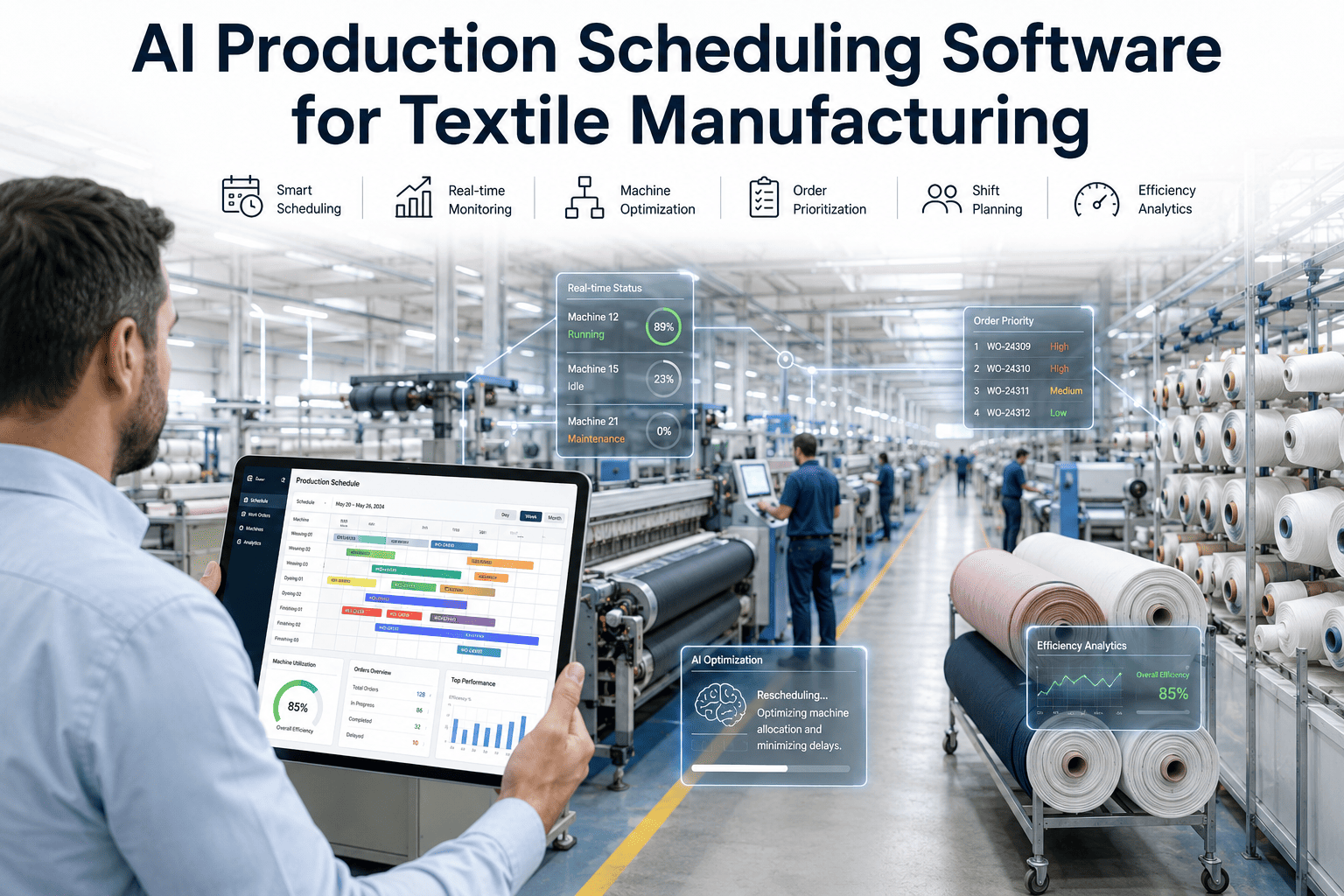
A connected weaving line pulls warp tension, weft insertion timing, shed timing, reed density, and take-up speed directly from loom controllers and sensors in real time, rather than relying on periodic manual spot checks. When any parameter drifts outside its tolerance band for the fabric being run, the system flags it immediately, tagging the exact meter of fabric affected so quality teams can isolate the section rather than scrapping or re-inspecting the entire roll.
This is a meaningfully different operating model from the scheduled inspection walk that most weaving floors still rely on, where an operator or quality technician checks a sample section of fabric on a fixed interval and assumes the material woven since the last check was acceptable unless something visibly wrong caught their eye. Continuous monitoring removes that assumption entirely, since every meter of fabric is checked against specification as it's being woven rather than sampled after the fact, which is the only way to catch a short-duration tension spike or a timing drift that corrects itself before the next scheduled inspection would have found it.
The same monitoring layer also builds a running picture of each loom's mechanical health over time, since a gradual increase in tension variance or a slow drift in shed timing consistency is often the earliest signal of bearing wear, reed damage, or a heddle frame starting to go out of alignment. Catching that trend early turns a maintenance event into a scheduled repair during a planned changeover rather than an unplanned stoppage that halts a production run mid-roll.
Application-Specific Quality Windows
A tolerance band that is acceptable for an agrotextile shade net would be a rejection on a medical barrier fabric, which is why generic quality thresholds don't hold up across a mill producing multiple technical categories. The specification has to travel with the work order, not sit fixed at the machine level, so the same loom can run a wide-tolerance agrotextile job in the morning and a tight-tolerance medical fabric job in the afternoon without a manual reconfiguration step being missed.
| Application | Primary Tolerance Focus | Consequence of Drift |
|---|---|---|
| Geotextile (road/rail) | Warp tension, tensile strength uniformity | Uneven load distribution under subgrade |
| Agrotextile (shade/mulch) | Reed density, porosity consistency | Inconsistent light and moisture control |
| Medical textile (barrier) | Fiber consistency, contamination control | Sterile barrier breach risk |
| Industrial filter fabric | Weft insertion accuracy, pore uniformity | Filtration efficiency loss |
| Protective/coated fabric | Weave integrity, coating adhesion base | Localized abrasion or chemical weak point |
This variation across categories is also why a single blanket quality standard applied uniformly across a mixed-portfolio weaving floor tends to under-serve the tightest specification jobs while over-inspecting the loosest ones. A tolerance band wide enough to be practical for an agrotextile shade net run would let real defects through on a medical barrier fabric job, while a tolerance band tight enough for that medical job would flag countless false positives on the agrotextile run and slow the line down for no quality benefit. Matching the tolerance profile to the actual specification of the work order in progress is what lets a single weaving floor serve all four categories without compromising on either efficiency or precision.
The Traceability Requirement Technical Buyers Actually Ask For
Buyers of geotextiles for infrastructure projects, medical textile converters, and industrial fabric purchasers increasingly ask for lot-level traceability as a condition of the purchase order, not as a nice-to-have. They want to know that the roll they received was woven within specification for its entire length, with a documented record they can reference if a field issue ever surfaces years later. Meeting that requirement manually means archiving paper inspection logs against roll numbers, a process that is slow to search and easy to lose.
Infrastructure buyers in particular are used to this kind of documentation from other construction materials, concrete batch records and structural steel mill certificates being common examples, and are increasingly expecting the same standard from geotextile suppliers given how central these fabrics have become to long-life civil engineering structures. A road or coastal defense project with a design life measured in decades creates real pressure on the supplier to be able to answer, with data rather than assurance, exactly what conditions a specific roll was woven under if a performance question ever comes up during that lifespan.
Medical textile buyers apply a similar logic for a different reason, since regulatory audits for sterile barrier products often require the converter to demonstrate a documented chain of custody and process control back to the raw fabric stage. A weaving mill that can produce that documentation instantly from production data, rather than needing days to reconstruct it from shift logs, has a real competitive advantage when bidding for that category of business.
- Quality records tied to shift logs, not individual rolls
- Root cause analysis on a field failure takes days of manual log review
- Buyer traceability requests answered with incomplete data
- Every roll linked to its exact loom parameter history in real time
- Deviation events searchable by roll, meter, and timestamp instantly
- Buyer documentation generated directly from production records
What Changes on the Production Floor Once This Is Running
The shift from periodic inspection to continuous monitoring changes the daily rhythm of a weaving floor in a few concrete ways. Quality technicians spend less time walking the floor doing scheduled spot checks and more time investigating the specific deviations the system flags, which is a more targeted use of their expertise. Loom operators get direct feedback when a parameter starts drifting on their machine, rather than finding out days later when a finished roll gets rejected downstream, which shortens the loop between cause and correction considerably.
Production planning also benefits in a less obvious way. Once tolerance profiles are tied to work orders rather than fixed at the machine, scheduling a tight-spec medical textile run right after a wide-tolerance agrotextile job on the same loom becomes a routine changeover rather than a manual reconfiguration that depends on someone remembering every setting that needs to change. That flexibility matters most for mills that deliberately run a mixed product portfolio to diversify demand across construction, agriculture, healthcare, and industrial buyers rather than depending on a single end market.
| Floor Activity | Before Continuous Monitoring | After Continuous Monitoring |
|---|---|---|
| Deviation detection | Found at scheduled inspection or downstream rejection | Flagged in real time at the meter it occurred |
| Scrap decision | Often whole-roll rejection to be safe | Section-level isolation, most of roll ships good |
| Maintenance planning | Reactive, triggered by a breakdown or defect spike | Scheduled around trending wear signals |
| Buyer documentation | Manually reconstructed from shift logs | Generated directly from production records |
None of these changes require a mill to abandon the quality processes it already trusts, they simply give those processes better data to work from. A quality manager who has spent years developing an instinct for what a good roll looks and feels like is still the person making the final call on a flagged deviation, the monitoring layer just makes sure the right roll and the right meter reach their desk before it ships rather than after a customer complaint arrives.
Frequently Asked Questions
See Every Meter of Fabric Before It Leaves the Loom
Share your current weaving floor setup and the technical categories you produce. We'll show you where a real-time monitoring layer would have caught the deviations you're catching downstream today.


.jpg)