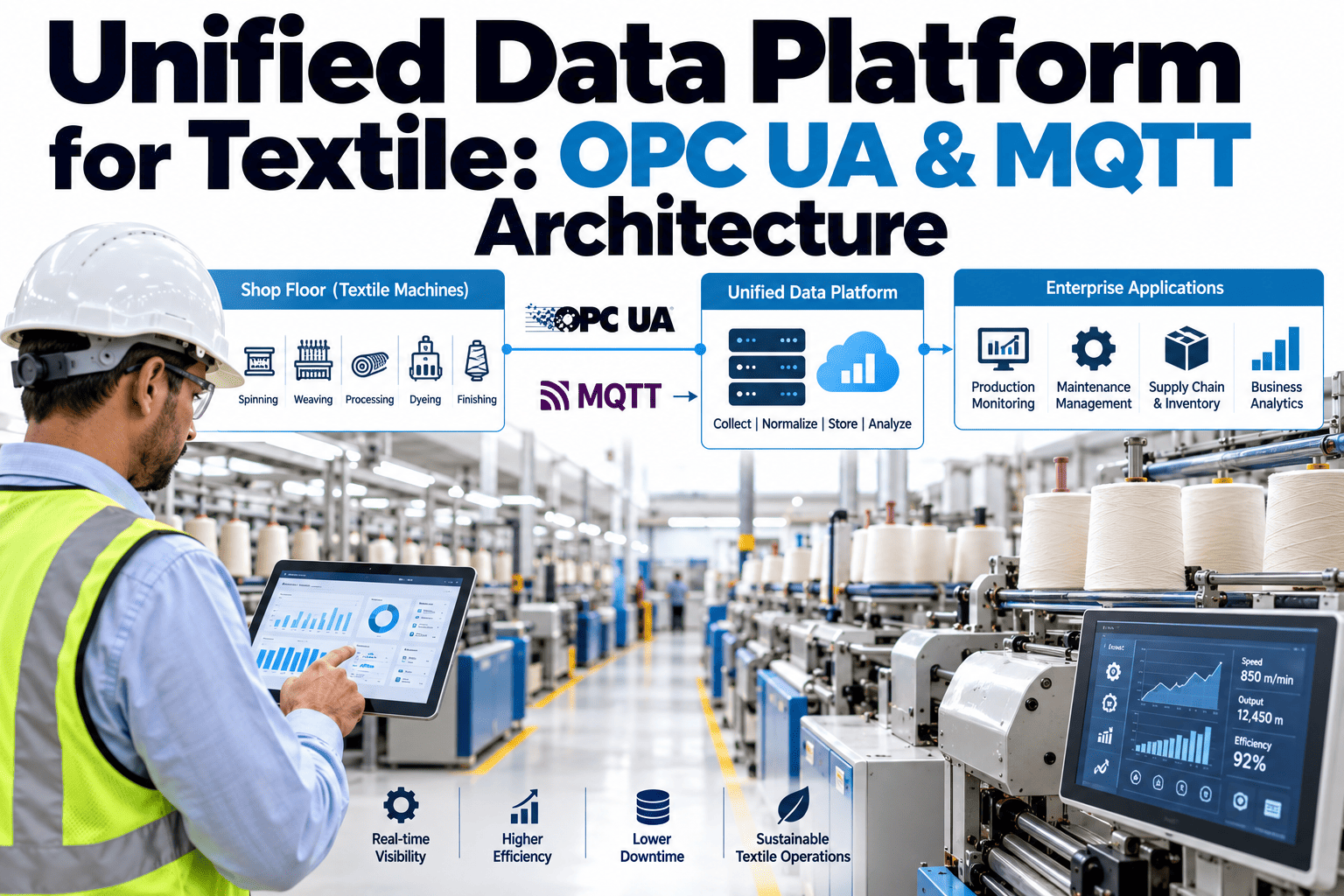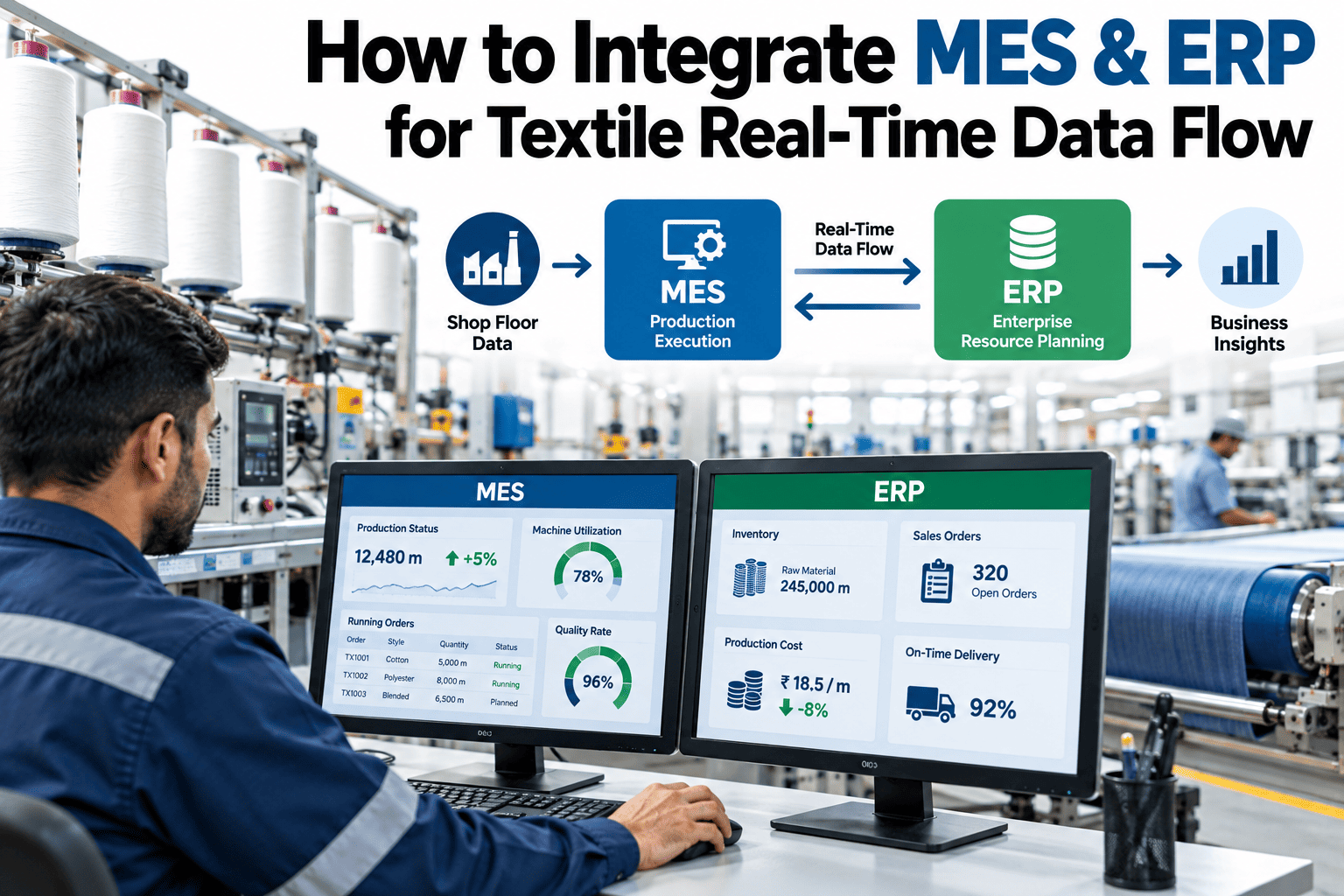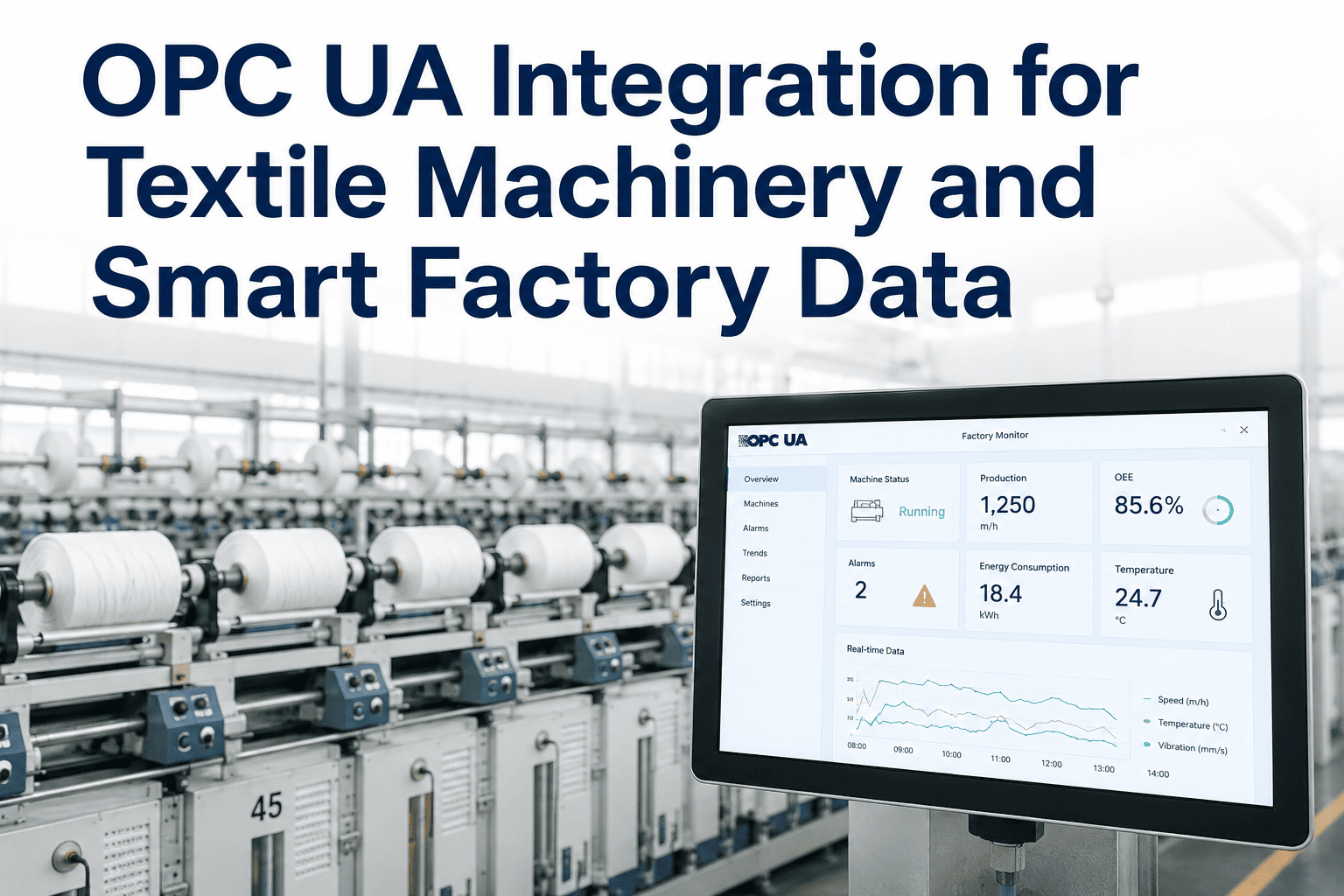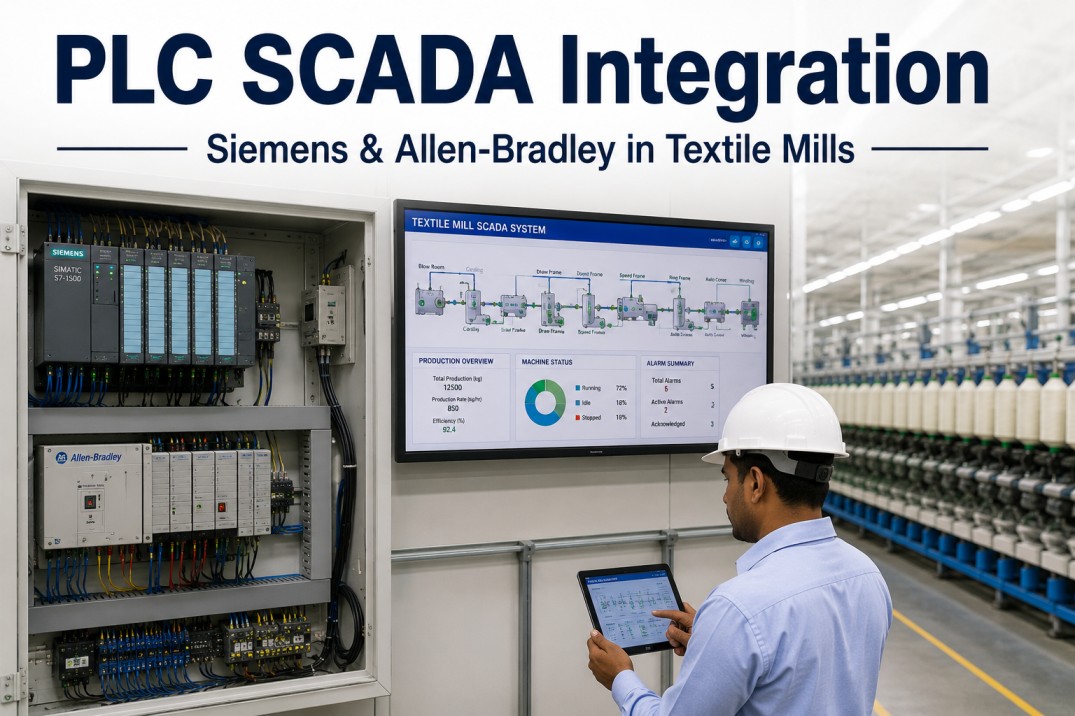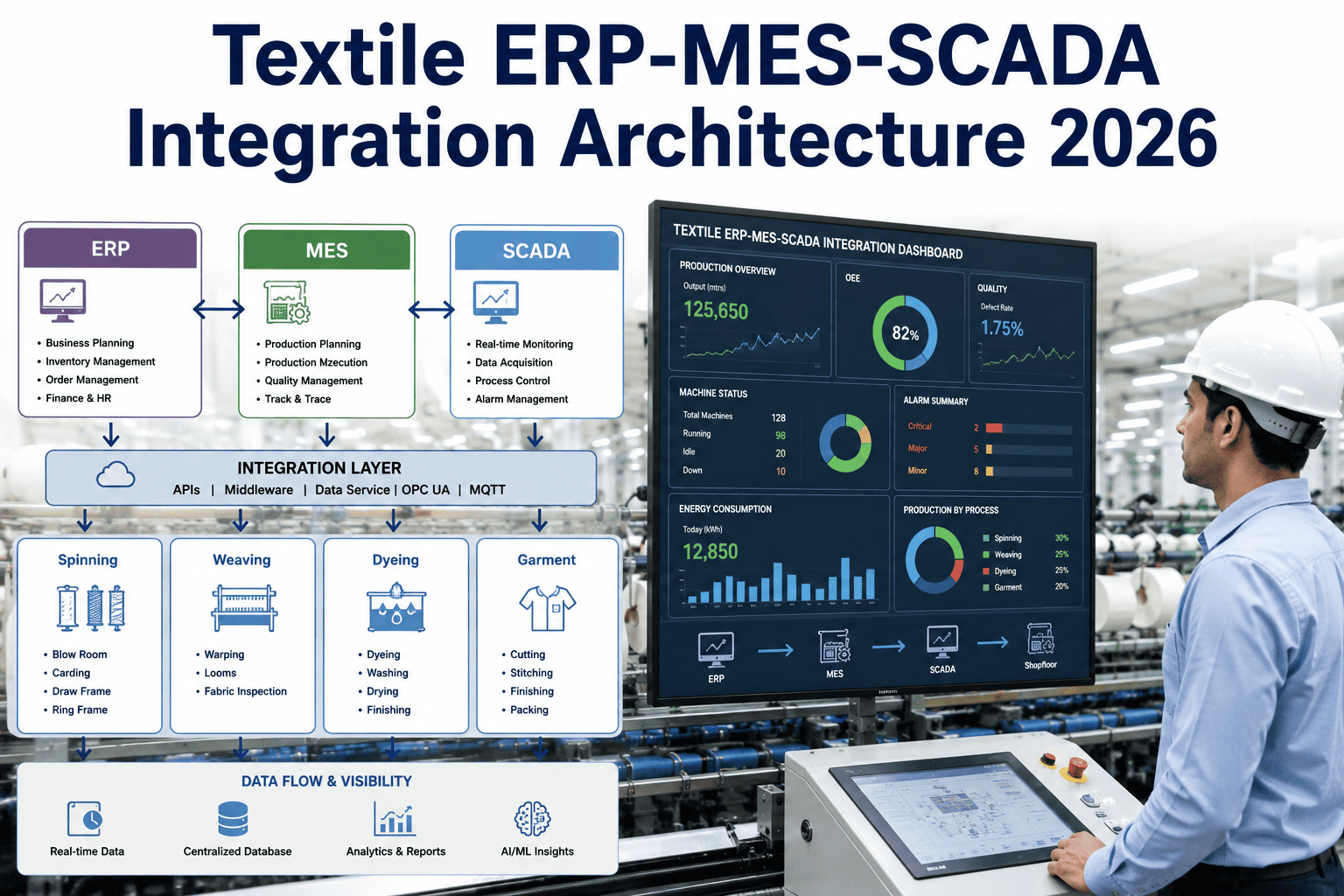
Three systems typically govern a modern textile mill's digital operations, and each one was designed to answer a different question at a different level of detail. ERP answers what to plan and what it costs. MES answers what is actually happening on the floor right now. SCADA answers what a specific machine is doing at this exact second. Problems start when mills try to make one of these systems answer questions it was never built for, or worse, when the three never talk to each other at all and every layer operates on its own disconnected version of reality. Mills mapping out this architecture for their own operation can Book a Demo to see a working integration layer.
Why Layer Confusion Is the Root of Most Failed Integrations
The most common architectural mistake in textile mill digitization is asking one layer to do another layer's job. ERP systems, built for financial and planning granularity measured in days and weeks, are frequently pressed into service tracking shift-level production execution because a mill already owns an ERP license and wants to avoid buying additional software. The result is an ERP module straining to capture data at a frequency and granularity it was never architected for, producing a system that is simultaneously slow for planning users and inadequate for floor-level execution tracking.
The opposite mistake happens just as often. SCADA systems, which excel at millisecond-level machine monitoring and control, sometimes get extended with custom reporting modules attempting to serve as the mill's execution-tracking and quality system. This produces brittle, hard-to-maintain SCADA customizations that break every time a machine vendor pushes a firmware update, because SCADA vendors design their systems around control reliability, not around the kind of flexible business-logic reporting an execution layer needs to support.
The architecture that actually works respects what each layer does well and builds clean, well-defined interfaces between them rather than blurring their boundaries. ERP plans. MES executes and tracks. SCADA controls and senses. The integration challenge is not making one system do everything — it is making sure the right data crosses each boundary at the right frequency, in a format the receiving layer can actually use.
Data Flow Direction: What Moves Up and What Moves Down
A working three-layer architecture moves specific categories of data in specific directions, and understanding this flow is what separates a coherent integration design from an ad hoc collection of point-to-point connections that becomes unmaintainable as the mill grows.
The Middleware Decision: Point-to-Point vs. Integration Bus
Once the data flow requirements are clear, mills face a specific architectural choice about how connections between layers are actually implemented. Two approaches dominate in practice, and the choice between them has significant long-term maintainability consequences that are easy to underestimate during initial rollout.
Point-to-point integration connects each system pair directly — ERP talks to MES through one custom connection, MES talks to each SCADA system through separate custom connections, and any new system added to the architecture requires building fresh custom connections to every existing system it needs to exchange data with. This approach is often faster to stand up initially, since a single connection between two known systems is a relatively contained engineering task. But the number of connections required grows sharply as more systems join the architecture, and each connection is a separate piece of custom logic that has to be maintained, tested, and updated independently whenever either system on either end of it changes.
An integration bus or middleware layer takes a different approach: every system connects once to a shared data layer, which handles translation and routing between systems rather than requiring direct custom connections between every pair. Adding a new system to the architecture means connecting it once to the bus, not building fresh connections to every existing system individually. This approach requires more upfront architectural investment and discipline around data standards, but it scales considerably better as a mill's system landscape grows, and it isolates the impact of any single system's changes rather than letting a single vendor update ripple across a web of point-to-point connections.
For textile mills specifically, where the number of distinct floor-level systems tends to be high — separate SCADA or monitoring systems for spinning frames, looms, dye house batch controllers, and finishing lines, each potentially from a different equipment vendor — the integration bus approach tends to pay for its additional upfront complexity relatively quickly once more than a handful of systems are involved.
Real-Time Connectivity: What Actually Needs to Be Instant
Not every piece of data crossing the ERP-MES-SCADA architecture needs to move in real time, and treating every data point as equally urgent is a common source of unnecessary system load and cost. A useful way to think about connectivity requirements is by matching each data type's actual decision-making urgency to the connectivity investment it deserves.
Over-engineering real-time connectivity where it is not needed is a common and costly mistake. Building sub-second connectivity all the way up into ERP planning modules adds infrastructure cost and complexity without any corresponding decision that actually benefits from that speed, since planning decisions operate on a much longer time horizon than machine control decisions do. Matching connectivity investment to actual decision urgency at each layer keeps the architecture both leaner and more reliable.
Data Standardization: The Unglamorous Work That Makes the Architecture Work
Beyond the layer boundaries and connectivity patterns already covered, one factor determines more than any other whether an ERP-MES-SCADA architecture actually functions smoothly in production: whether the data crossing each boundary is standardized before it needs to be, or whether standardization is left as an afterthought each system's downstream consumers have to sort out on their own.
Item and material identifiers are the most common source of friction here. An ERP system might identify a fabric using an internal SKU code, while the MES layer's lot tracking references the same material by a production-floor batch code, and the SCADA system controlling the relevant machine references it by a recipe number that has no obvious mapping to either of the other two. Without a deliberate mapping table maintained as part of the integration layer, every report that needs to correlate data across these three identifier systems becomes a manual reconciliation exercise, which defeats much of the purpose of building the integration in the first place.
Units of measure present a similar challenge specific to textiles, where the same physical material is tracked in different units depending on which process stage is referencing it — kilograms of fiber, meters of yarn, meters or yards of fabric, and pieces of finished garment. A well-designed integration layer handles these conversions consistently and transparently, applying documented conversion factors at defined points in the data flow, rather than leaving each report or dashboard to implement its own conversion logic independently, which inevitably produces inconsistent numbers across different reports pulling from what should be the same underlying data.
Timestamp and shift-boundary conventions round out the most common standardization gaps. A mill running rotating shifts needs the entire architecture to agree on exactly when one shift ends and the next begins, and how partial-shift production gets attributed, since ERP-level daily reporting, MES-level shift reporting, and SCADA-level continuous logging all need to reconcile to the same production day and shift definitions for cross-layer reporting to add up correctly.
Security and Access Boundaries Across the Three Layers
An integration architecture that connects planning, execution, and control layers also needs a deliberate security model, since these three layers historically carried very different risk profiles and were often isolated from each other for exactly that reason. SCADA systems in particular have traditionally been kept on isolated networks specifically because unauthorized access to machine-level control carries physical safety and equipment damage risk that a compromised ERP report simply does not.
A well-designed integration preserves this risk-appropriate separation rather than flattening it for convenience. The middleware layer typically enforces a one-directional or tightly filtered data path from SCADA outward — machine data flows up into MES and eventually ERP for reporting and planning purposes, but write access back down into SCADA-level machine control is restricted to a much smaller, carefully audited set of authorized commands, such as recipe or setpoint pushes explicitly designed for that purpose, rather than open bidirectional access that would let any system further up the stack issue arbitrary machine commands.
Getting this boundary right during architecture design avoids a common and costly retrofit later, where a mill that built open, unrestricted connectivity between layers for the sake of initial convenience later has to walk back that access and rebuild proper boundaries once a security review or an actual incident makes the risk concrete.