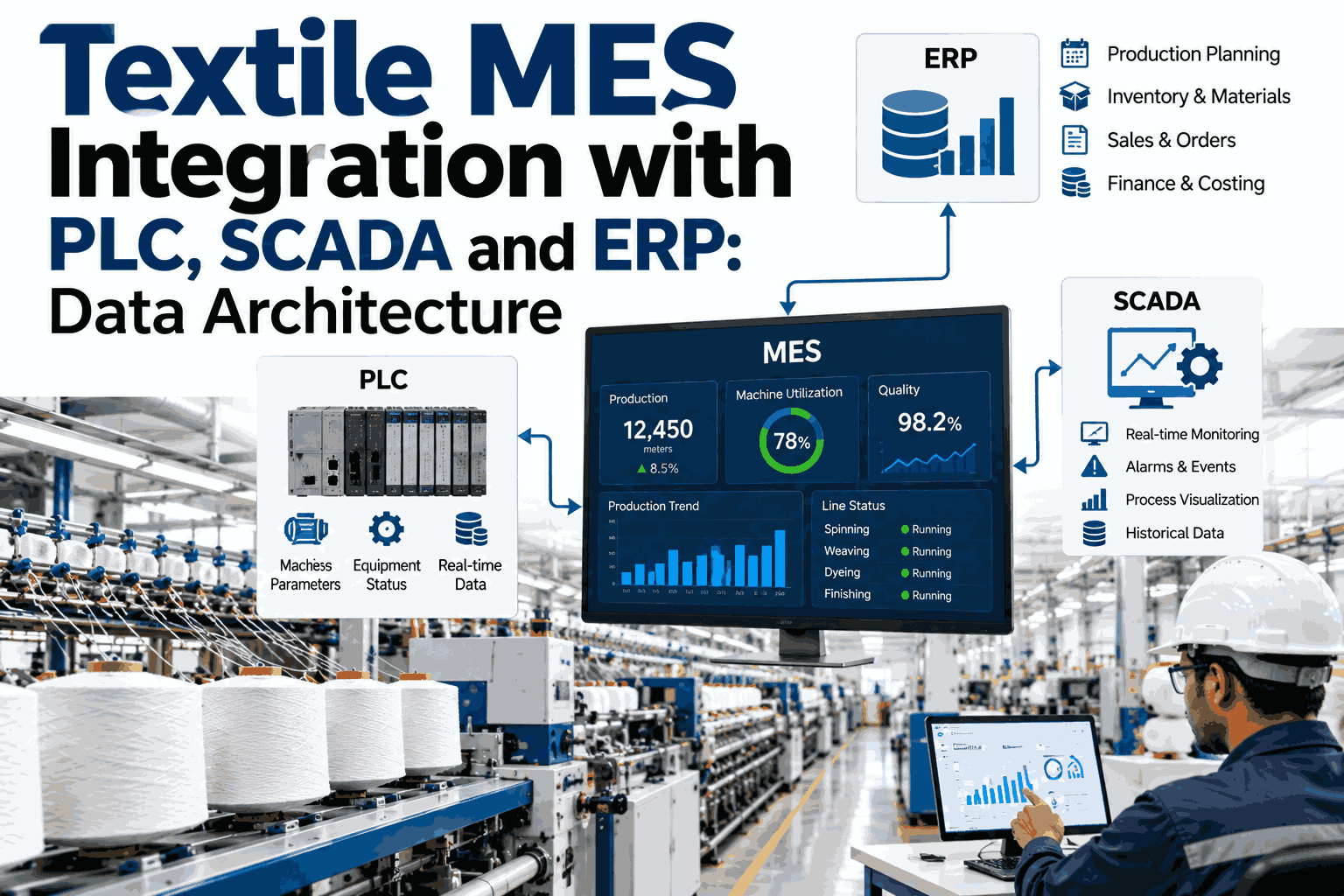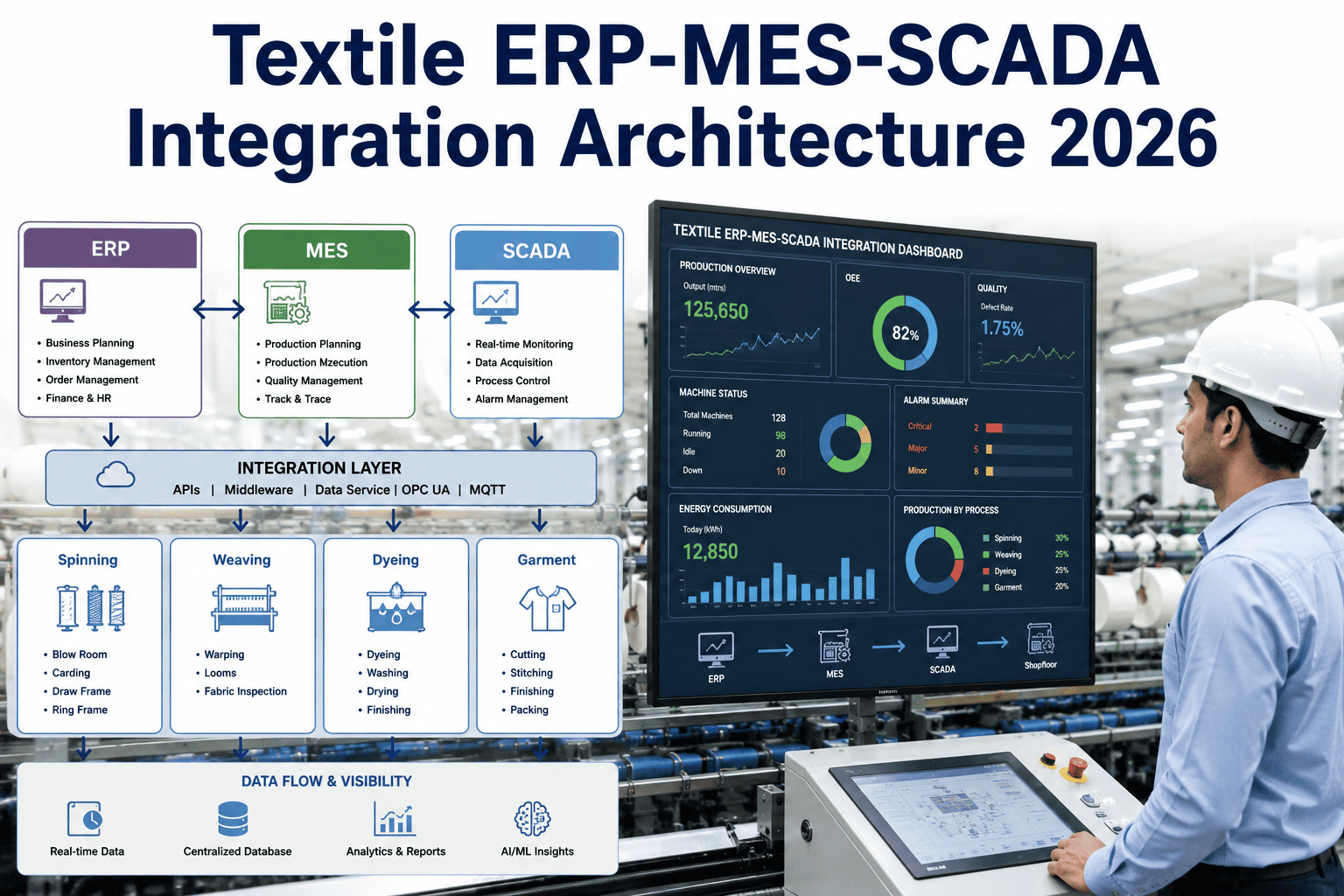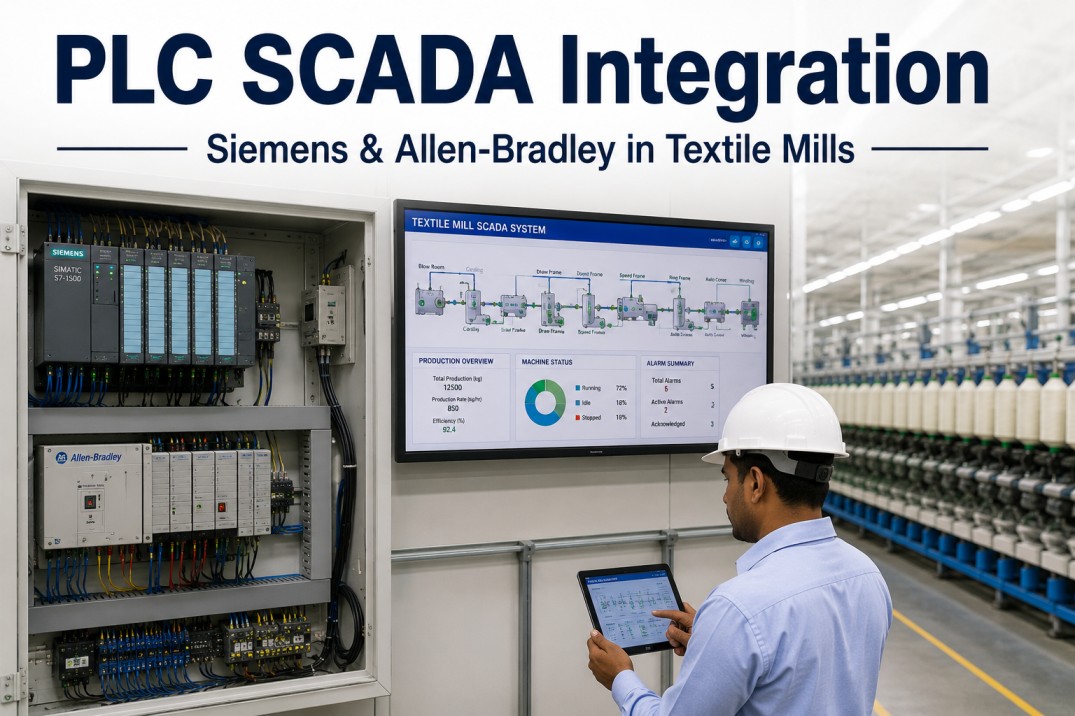
Programmable Logic Controllers are the backbone of textile mill automation, controlling everything from opening and carding machines through spinning frames, weaving looms, dyeing vats, and finishing ranges. A typical mid-size textile mill operates 80 to 200 PLCs across its production lines, spanning multiple vendors — Siemens S7 series dominates European and Asian mills, Allen-Bradley ControlLogix and CompactLogix are common in US and export-oriented mills, while ABB AC500 and Mitsubishi PLCs serve specialized applications and retrofit projects. The challenge is that these PLCs speak different industrial protocols — Profinet and Profibus for Siemens, EtherNet/IP and ControlNet for Allen-Bradley, Modbus TCP for many third-party devices, and a growing number of OPC UA-native controllers — and they all need to feed data into a unified SCADA system and ultimately into the MES, CMMS, and ERP layers. Without a well-architected PLC integration strategy, mills end up with data silos, manual clipboard-based machine readings, and production reports that are 24 to 48 hours stale by the time they reach the plant manager's desk. iFactory's integration platform connects to any PLC model via native protocols or OPC UA, normalizes the data into a unified tag structure, and streams it to SCADA dashboards, MES production tracking, and CMMS maintenance modules in real time.
Connect Every PLC in Your Mill — Siemens, AB, ABB, and More
iFactory Integration Hub connects to all major PLC models via native protocols or OPC UA, with pre-built tag mappings for textile-specific machine data points.
PLC Platform Comparison — Specs, Protocols, and Connectivity
Each PLC platform has different strengths in processing speed, protocol support, and integration maturity. The ladder below compares the three most common textile mill PLCs across integration-critical specifications.
Industrial Protocol Speed Comparison — Real-World Throughput
Protocol selection directly affects the update rate of production data reaching your SCADA and MES systems. The chart below shows real-world throughput for the five most common industrial protocols in textile mill environments.
Signal Types in Textile Mill PLC Integration — What Gets Measured and How
Every machine in a textile mill generates a combination of digital and analog signals that must be correctly wired, addressed, and mapped into the SCADA tag database.
From Raw Signals to Production Insights — All Protocols, One Platform
iFactory connects to any PLC via native protocol or OPC UA, maps signals to textile-specific tag structures, and streams data to your dashboards in real time.
OPC UA Migration — The Path to Vendor-Neutral Integration
OPC UA is the industry-standard communication framework for industrial automation that enables secure, platform-independent data exchange between PLCs, SCADA, MES, and cloud systems. Migrating from proprietary protocols to OPC UA is the single most impactful step a textile mill can take toward future-proofing its automation architecture.
Frequently Asked Questions
Can iFactory connect to my existing Siemens S7-1200 PLCs without additional hardware?
Yes, if your S7-1200 firmware supports OPC UA server functionality (firmware V4.0 or higher). The S7-1200 OPC UA server can expose up to 1,000 data items depending on the CPU model. For S7-1200 models without built-in OPC UA, or when you need higher tag counts, iFactory Edge Gateway connects via Profinet or S7 protocol and exposes an OPC UA server interface with no limit on tag count. For Siemens S7-300 or S7-200 legacy PLCs that do not support OPC UA, a protocol gateway is required — iFactory supports all Siemens models through Profinet, Profibus, or the S7 communication protocol directly.
How often should PLC data be polled for real-time SCADA and MES visibility?
Polling frequency depends on the data type and its use case. Machine status signals (running, stopped, alarm) should be polled at 1-second intervals for real-time OEE dashboards. Production count pulses require sub-second polling (100–500 ms) to avoid missing counts on high-speed machines — a spinning frame producing 200 meters per minute generates a production pulse every 300 ms. Analog process values (temperature, pressure, speed) can be polled at 1–5 second intervals for control room dashboards. Energy consumption data (power meters connected via Modbus) is typically polled at 5–15 second intervals. OPC UA subscription-based communication is preferred over polling for high-frequency data because the server pushes data changes to the client only when values change, reducing network load by 80–95 percent compared to traditional polling. iFactory's OPC UA client uses subscription-based data access with configurable sampling intervals per tag group.
What is the difference between Profinet and Profibus, and which one should my mill use?
Profinet is the industrial Ethernet successor to Profibus, offering 100 Mbps speed versus Profibus's 12 Mbps maximum. Profinet uses standard Ethernet cabling (Cat5e or Cat6) and supports up to 256 devices per network segment, while Profibus uses RS-485 cabling with a maximum of 126 devices per segment. For new installations, Profinet is the clear choice — it provides faster cycle times (250 µs vs 5 ms for Profibus), easier integration with IT networks, built-in OPC UA support on Siemens S7-1500, and higher bandwidth for data-intensive applications like vision systems and drives. Profibus remains relevant for existing installations with large numbers of Profibus devices, where migration costs would outweigh benefits. In many textile mills, a hybrid approach works best: new machines connect via Profinet or OPC UA, while legacy machines with Profibus interfaces remain connected through a Profinet-to-Profibus gateway (e.g., Siemens IE/PB Link or iFactory protocol gateway).
How do you handle PLC data when the network goes down?
PLC data buffering is essential for network interruptions. The iFactory Edge Gateway maintains an on-device buffer that stores up to 30 days of time-series tag data at 1-second resolution (approximately 2.6 million data points per tag per month). When the network connection to the SCADA server or MES is restored, the gateway replays buffered data in chronological order with timestamps, ensuring no production data is lost. For mission-critical data streams — such as production counts in high-speed spinning or weaving — the gateway also supports store-and-forward with duplicate detection to prevent double-counting. On the PLC side, standard practice is to maintain production counters in retentive memory so that power cycles or network interruptions do not reset accumulated counts. Most modern textile machine PLCs already store production counts, machine hours, and alarm histories in retentive memory — the gateway simply reads these values when connectivity is restored.
How many tags can iFactory handle across multiple PLCs in a single mill?
iFactory's integration platform is designed for enterprise-scale textile mills with thousands of PLCs and hundreds of thousands of tags. The platform uses a distributed gateway architecture where each Edge Gateway handles up to 2,000 tags from 20–50 PLCs, and multiple gateways aggregate into a central SCADA/MES server. The central server handles up to 100,000 tags per instance, with horizontal scaling available for larger deployments. A typical large textile mill with 150–200 PLCs across spinning, weaving, dyeing, and finishing generates approximately 12,000–18,000 tags. iFactory's tag management console includes bulk import from CSV, automatic tag discovery for OPC UA servers, tag hierarchy organization by department and machine type, and real-time tag browser with search, filter, and diagnostic tools. The platform also supports deadband filtering — analog tags only update when the value changes by more than a configurable threshold — which reduces historian storage requirements by 60–80 percent without losing meaningful data.
One Integration Platform for Every PLC in Your Mill
iFactory connects Siemens, Allen-Bradley, ABB, and any OPC UA-compatible PLC into a unified data stream — no protocol gateways, no custom scripting, no data loss.