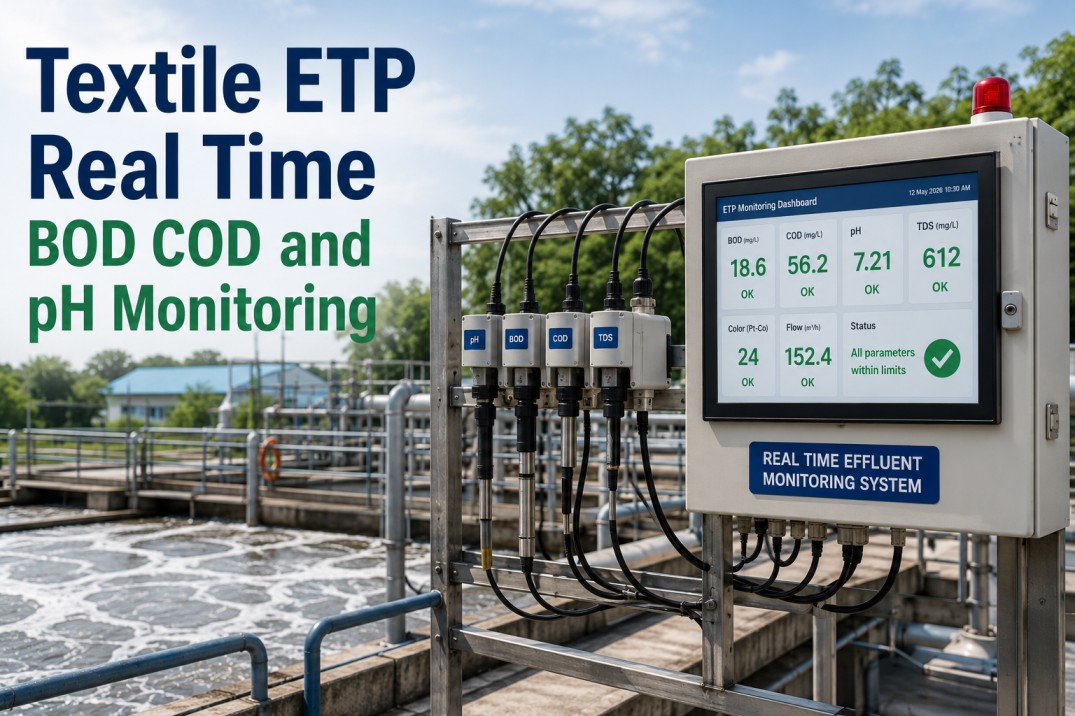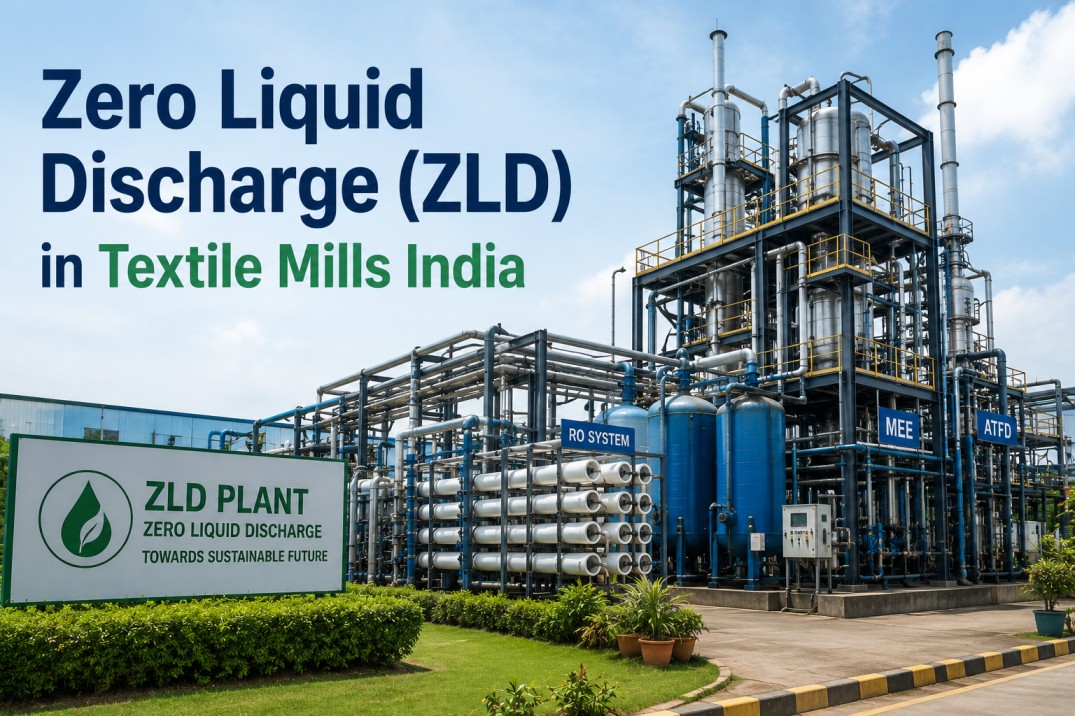
Zero Liquid Discharge is no longer a forward-looking choice for Indian textile mills — it is a regulatory mandate enforced by State Pollution Control Boards across every major textile cluster. Tirupur, Erode, Panipat, Bhilwara, and Tarapur have all issued directions requiring ZLD compliance, with non-compliant facilities facing closure notices and water connection disconnections. A typical ZLD plant combining Reverse Osmosis, Multi-Effect Evaporator, and Agitated Thin Film Dryer recovers 92 to 96 percent of process water for reuse, but the operating cost ranges from ₹180 to ₹350 per kilolitre of treated water, driven primarily by energy consumption in the thermal stages. iFactory ZLD Intelligence Platform continuously monitors RO membrane performance, evaporator steam economy, and ATFD solids discharge, applying AI models that optimize recovery rates, predict membrane fouling 48 to 72 hours before flux decline, and reduce overall ZLD operating cost by 22 percent through real-time parameter tuning and predictive maintenance scheduling.
Make Your ZLD Plant Profitable — Not Just Compliant
iFactory ZLD Intelligence connects to your existing RO, MEE, and ATFD control systems to deliver real-time visibility into every stage of the treatment train. Facilities using the platform report 22 percent reduction in ZLD operating cost, 18 percent increase in RO recovery rate through optimized antiscalant dosing and membrane cleaning schedules, and 34 percent reduction in unplanned evaporator downtime through predictive maintenance. The platform learns your plant's unique water chemistry and loading patterns within 14 days, then begins recommending setpoint adjustments that directly reduce steam consumption and chemical dosing.
The Three Stages of ZLD Technology
A complete ZLD system combines membrane separation with thermal evaporation and solid crystallization. Each stage plays a distinct role in the water recovery chain, and understanding the technology stack is essential for identifying where AI-driven optimization delivers the greatest cost impact.
The ZLD Treatment Train: From Effluent to Solid Waste
Wastewater moves through four distinct stages in a complete ZLD system. Each stage transforms the stream composition and prepares it for the next. Monitoring and optimization at every stage is essential for minimizing the total operating cost while maintaining compliance.
Primary Treatment
Equalization, neutralization, and clarification remove suspended solids and adjust pH before the wastewater enters the membrane stage. Proper primary treatment directly affects RO membrane life and fouling rate.
RO Membrane
Reverse Osmosis separates 70–80% of the feed as permeate that returns to the process. The remaining 20–30% becomes brine concentrate at 3–5% TDS, which feeds into the evaporator stage.
MEE Evaporator
Multi-Effect Evaporator concentrates the brine to 20–25% solids using steam across multiple effects. Distillate is recycled to the process. Steam consumption makes this the highest-cost stage in the ZLD train.
ATFD Dryer
Agitated Thin Film Dryer evaporates remaining moisture from the MEE concentrate to produce dry mixed salt at 90–95% solids, which is collected as disposable waste. Steam and power consumption determine the per-kg disposal cost.
Cut Your ZLD Operating Cost by 22 Percent With AI
iFactory ZLD Intelligence connects to your plant within 7 days and begins delivering optimized setpoint recommendations within 14 days as the AI models learn your facility's unique water chemistry and loading patterns. The platform integrates with existing RO, MEE, and ATFD control systems from all major OEMs including VA Tech, Degremont, Ion Exchange, and Aquatech — so there is no need to replace equipment you already own. Facilities using the system report an average 22 percent reduction in ZLD operating cost, 18 percent increase in RO recovery rate, and 34 percent reduction in unplanned evaporator downtime. The typical payback period is 9 to 14 months from steam savings and membrane replacement avoidance alone.
ZLD Operating Cost: Conventional vs. AI-Optimized
For a typical Indian textile mill processing 2,000 m³/day of effluent through a full ZLD train with a three-effect MEE and two-stage RO, the annual operating cost and savings potential break down across five categories. AI optimization targets the highest-cost levers first.
- Conventional: ₹1.48 Cr/yr — 52% of total ZLD cost
- AI-optimized: ₹1.07 Cr/yr — 48% of total ZLD cost
- Savings: ₹0.41 Cr from optimized steam pressure per effect
- Conventional: ₹0.57 Cr/yr — 20% of total ZLD cost
- AI-optimized: ₹0.44 Cr/yr — 20% of total ZLD cost
- Savings: ₹0.13 Cr from VFD optimization and peak load management
- Conventional: ₹0.43 Cr/yr — 15% of total ZLD cost
- AI-optimized: ₹0.33 Cr/yr — 15% of total ZLD cost
- Savings: ₹0.10 Cr from real-time dosing optimization
- Conventional: ₹0.23 Cr/yr — 8% of total ZLD cost
- AI-optimized: ₹0.22 Cr/yr — 10% of total ZLD cost
- Extended membrane life offsets replacement cost increase
What AI-Driven ZLD Optimization Delivers
Beyond direct cost reduction, AI-powered monitoring and control of ZLD plants delivers measurable improvements in reliability, recovery rate, and compliance confidence. The metrics below represent averages across iFactory deployments in Indian textile ZLD facilities.
Frequently Asked Questions
What is the typical operating cost of a ZLD plant in Indian textile mills, and how does iFactory reduce it?
ZLD operating cost for a textile mill processing 2,000 m³/day typically ranges from ₹2.5 to ₹3.2 crore per year, with steam consumption in the MEE accounting for 50 to 55 percent of the total. iFactory ZLD Intelligence reduces this by 22 percent on average through AI-optimized steam pressure management, predictive membrane cleaning that extends CIP intervals from 30 to 55 days, and real-time antiscalant dosing adjustment. The savings breakdown for a typical plant is approximately ₹0.41 Cr from improved steam economy, ₹0.10 Cr from chemical optimization, and ₹0.12 Cr from reduced membrane replacement and maintenance costs.
Which Indian textile clusters have mandatory ZLD requirements?
Tirupur was the first Indian textile cluster to mandate ZLD in 2010 following a High Court order. The requirement has since expanded to Panipat (Haryana), Bhilwara (Rajasthan), Tarapur (Maharashtra), Erode (Tamil Nadu), and multiple clusters in Gujarat and Andhra Pradesh. State Pollution Control Boards enforce ZLD compliance through periodic inspections, discharge consent condition reviews, and continuous effluent monitoring data submission. Non-compliant facilities face consent-to-operate revocation, water connection disconnection, and in some cases prosecution under the Water (Prevention and Control of Pollution) Act.
How does the platform integrate with existing RO, MEE, and ATFD systems from different OEMs?
iFactory ZLD Intelligence supports Modbus RTU and TCP, OPC-UA, OPC-DA, Profibus, and analog 4-20 mA / 0-10 V signal interfaces. The platform has been integrated with RO systems from VA Tech, Ion Exchange, Suez, Hydranautics, and DuPont; MEE systems from Degremont, Aquatech, Veolia, and 3E; and ATFD systems from Buss-SMS and local Indian fabricators. If your existing control system produces a standard signal output, the platform connects without requiring a control system replacement. A typical integration involves connecting to 8 to 15 existing data points plus installing 3 to 5 additional sensors at key measurement gaps.
How does the platform predict RO membrane fouling before flux decline is noticeable?
The platform continuously monitors normalized permeate flow, differential pressure across stages, salt rejection percentage, and feed water temperature, SDI, and conductivity. The AI model compares real-time readings against the membrane's baseline performance curve and detects deviations of 2 to 3 percent in normalized parameters that indicate the onset of scaling, biofouling, or colloidal fouling — typically 48 to 72 hours before visible flux decline occurs. Operators receive an alert with the likely fouling type based on which parameters are shifting and a recommended cleaning protocol, enabling targeted CIP that restores performance with less chemical usage and shorter downtime compared to reactive cleaning triggered by production loss.
What is the payback period for iFactory ZLD Intelligence, and what drives the return on investment?
The typical payback period is 9 to 14 months based on the combination of three primary savings drivers: steam cost reduction through optimized MEE operation (₹0.41 Cr annual savings), chemical cost reduction through real-time dosing optimization (₹0.10 Cr annual savings), and reduced membrane replacement and maintenance costs from predictive cleaning scheduling (₹0.12 Cr annual savings). Additional unquantified benefits include reduced unplanned downtime, extended equipment life, lower operator workload, and improved compliance assurance during PCB inspections. Facilities with higher baseline operating costs or larger throughput volumes achieve shorter payback periods due to the larger absolute savings base.
See What 22 Percent Cost Reduction Looks Like on Your ZLD Data
Schedule a 30-minute demonstration to see iFactory ZLD Intelligence working with a data set matched to your plant's capacity, water chemistry, and equipment configuration. The demo shows your expected dashboard views, predictive alerts for RO and MEE stages, and a projected savings report based on your actual operating parameters. No commitment, no pressure — just a clear view of how AI optimization transforms ZLD from a compliance cost center to a manageable, measurable operating expense. Facilities that move forward typically go live with their own data within 7 days of integration.